1st Generation
(2023-)
Technical specifications, versions, and history for the Abarth 500e Cabrio.
Select a generation to see available versions
(2023-)
The history of the Abarth 500e is intrinsically linked to the launch of the third generation of the Fiat 500 (known as the New 500 or 500e) in 2020. While previous generations of the Abarth 500 (such as the 595 and 695) were based on internal combustion platforms dating back to 2007, the new electric model was developed on a platform dedicated exclusively to battery electric vehicles (BEVs).
Abarth engineering's goal was not just to convert the Fiat 500e into a more powerful model, but to redefine electric performance for the compact segment. The brand sought to utilize the instant torque of electric motors to surpass the performance of the gasoline T-Jet models in urban and suburban driving situations. The result was a vehicle that, despite being heavier due to the batteries, offers superior weight distribution and acceleration response that challenges its combustion predecessors.
The Abarth 500e was designed to maximize agility. The basic platform of the Fiat 500e was significantly modified to meet the brand's performance requirements. This included an increase in track width and an adjustment to the wheelbase to improve lateral stability and cornering precision.
The vehicle maintains the compact proportions that define the 500 line but with a more aggressive stance. The external dimensions were optimized to balance urban maneuverability with the stability necessary for sporty driving.
| Dimension | Specification (Hatchback) |
|---|---|
| Length | 3,673 mm |
| Width (without mirrors) | 1,683 mm |
| Width (with mirrors) | 1,900 mm |
| Height | 1,518 mm |
| Wheelbase | 2,322 mm |
| Curb weight | 1,410 kg |
| Front Track | 1,475 mm |
| Rear Track | 1,465 mm |
The chassis uses an independent MacPherson suspension setup at the front and a torsion beam at the rear. However, the shock absorber and spring calibration is exclusive to Abarth, focused on reducing body roll and increasing feedback to the driver. A critical evolution was the adoption of four-wheel disc brakes, with 281 mm ventilated discs at the front and 278 mm solid discs at the rear, ensuring a braking capacity consistent with the higher engine power.
To date, the Abarth 500e is in its first electric generation, launched globally in 2023. Unlike the gasoline lineup, which had several power variants (140 hp, 160 hp, 180 hp), the 500e debuted with a single powertrain, optimized for the balance between range and sportiness.
The heart of the Abarth 500e is a permanent magnet synchronous motor (PSM) mounted on the front axle. This powertrain delivers a maximum power of 113.7 kW, equivalent to 155 hp, and a maximum torque of 235 Nm available from a standstill. In direct comparison with the 118 hp Fiat 500e, the Abarth offers a gain of 37 hp and 15 Nm.
This motor allows the compact to reach 100 km/h in exactly 7 seconds. Although the 180 hp gasoline Abarth 695 is slightly faster in the 0-100 km/h sprint (6.7 seconds), the electric model is superior in low-speed pickups, being 50% faster in acceleration from 20 to 40 km/h in urban environments.
| Model | Motor Type | Power | Torque | 0-100 km/h | Top Speed |
|---|---|---|---|---|---|
| Fiat 500e (Base) | Electric PSM | 95 hp (70 kW) | 220 Nm | 9.5 s | 135 km/h |
| Fiat 500e (42 kWh) | Electric PSM | 118 hp (87 kW) | 220 Nm | 9.0 s | 150 km/h |
| Abarth 500e (2023) | Electric PSM | 155 hp (114 kW) | 235 Nm | 7.0 s | 155 km/h |
| Abarth 695 (Gasoline) | 1.4 Turbo | 180 hp (132 kW) | 250 Nm | 6.7 s | 225 km/h |
The top speed of the Abarth 500e is electronically limited to 155 km/h to prevent overheating of the battery cells and to preserve range, as electric motors lose efficiency rapidly at very high RPMs.
The energy storage system utilizes a lithium-ion battery with a gross capacity of 42 kWh, supplied by Samsung and installed in the vehicle's floor. The usable capacity available to the driver is 37.3 kWh. The battery operates on a 350V to 400V architecture and weighs approximately 295 kg.
Official range is a point of significant variation depending on the region and the homologation cycle used. Under the European WLTP standard, the Abarth 500e Hatchback achieves up to 265 km in a combined cycle. However, in real-world conditions and sporty driving, the estimated range drops to the 220 km to 240 km range.
In the Brazilian market, Inmetro (Brazilian Vehicle Labeling Program - PBEV) applies a more rigorous methodology. For the Fiat 500e, the official range is 227 km. Because the Abarth has wider tires and an engine that consumes more energy to deliver higher performance, its range under the Inmetro standard tends to be slightly below that official Fiat figure.
The vehicle is equipped with a versatile charging system to minimize wait times. It supports direct current (DC) fast charging of up to 85 kW via a CCS Combo 2 connector. At fast chargers, it's possible to reach 80% charge in about 35 minutes. For alternating current (AC) charging, such as at home or shopping malls, the onboard charger supports up to 11 kW, completing the charge in just over 4 hours on a compatible three-phase Wallbox.
Abarth developed three specific driving modes that drastically alter the vehicle's behavior:
One of the pillars of the Abarth brand has always been the "roar" of the engine. To compensate for the silence of the electric motor, Stellantis invested in an innovative artificial sound system. Developed by the NVH (Noise, Vibration and Harshness) department in Italy, the system required over 6,000 hours of work to replicate the sound of the Record Monza exhaust.
Unlike systems that merely play a recording inside the vehicle, the Abarth 500e's Sound Generator uses a dedicated external speaker, located at the lower rear of the chassis. The sound is processed in real time by a virtual matrix that analyzes the electric motor's rotation, throttle opening, and vehicle speed, creating a sound that "revs up and down" like a traditional combustion engine. Additionally, the car emits electric guitar sounds when turned on and off, reinforcing its "rebellious" identity.
The design of the Abarth 500e is an evolution of the Fiat 500's retro-modern style, but with elements that emphasize its high-performance nature.
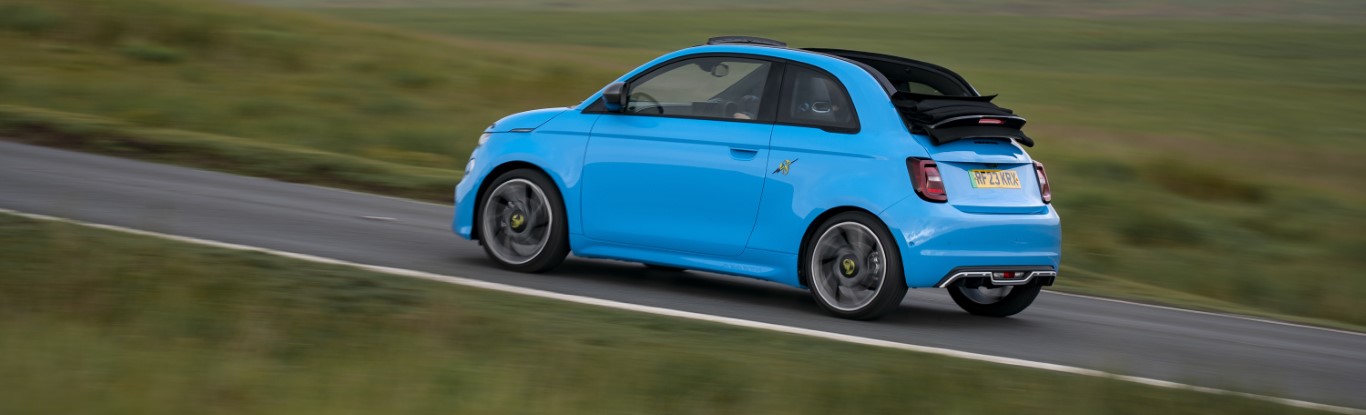
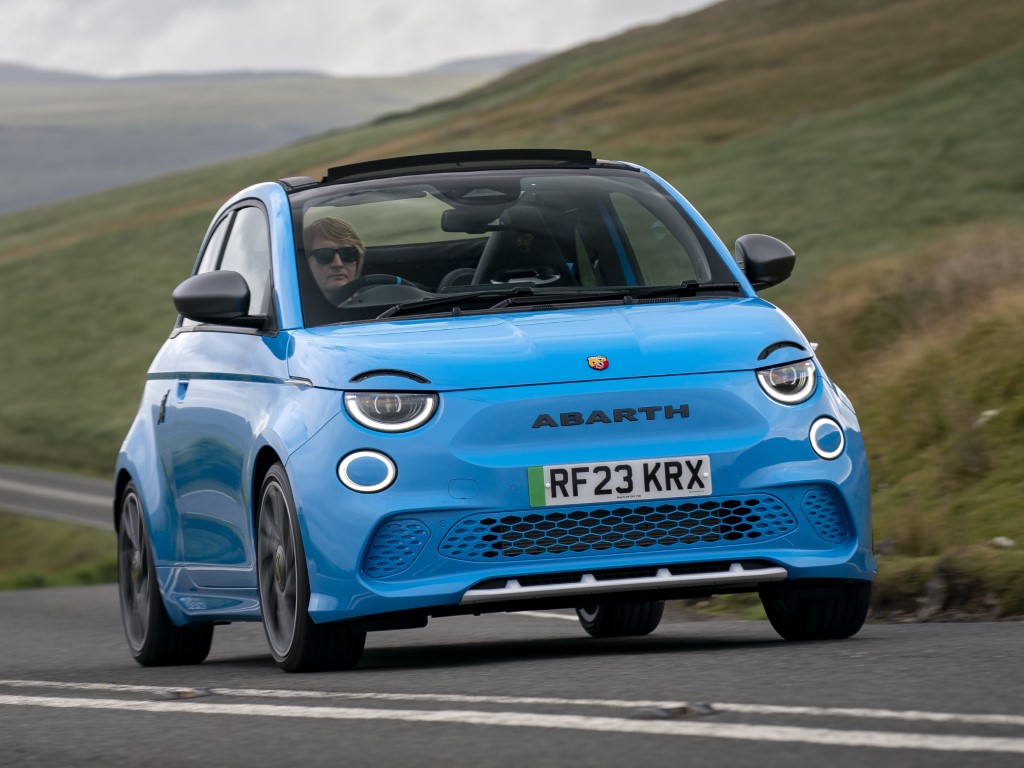
The front bumper was redesigned with straighter lines and a lower opening that optimizes airflow to the battery and motor cooling system. For the first time, the "ABARTH" lettering appears prominently on the front grille, replacing the round Fiat logo. The new scorpion logo, now stylized with a lightning bolt crossing its body to symbolize electrification, is present on the sides and the hood.
At the rear, a new diffuser aids in aerodynamic stability at high speeds, while the sporty side skirts help visually lower the car's center of gravity. The launch colors, Acid Green and Poison Blue, were specifically chosen to make the model stand out in urban traffic.
The interior is driver-focused and uses high-quality materials to create a cockpit atmosphere. In top-of-the-line versions, such as the Turismo, the dashboard and seats are covered in Alcantara, a material that offers excellent lateral grip during fast cornering.
The seats are bucket-style, with integrated headrests that bear the scorpion laser-engraved in Acid Green. The three-spoke sports steering wheel combines leather and Alcantara, featuring a blue marker at "12 o'clock" to assist the driver in quick maneuvers. Technology is centralized on a 10.25-inch touchscreen with the Uconnect system, which includes exclusive Abarth performance pages.
Since launch, Abarth has maintained the tradition of offering two body options, allowing customers to choose between the structural rigidity of a coupe or the freedom of a convertible.
The Hatchback version is the choice geared towards maximum performance. With a fixed roof (which can include a fixed panoramic glass on the Turismo version), it offers the highest torsional rigidity of the set, which translates into slightly more direct steering response. It is the ideal configuration for track use or aggressive technical driving. The trunk maintains a capacity of 185 liters, expandable to 550 liters with the rear seats folded down.
The Cabriolet uses a high-quality canvas soft top that slides over the car's fixed pillars. This architecture preserves much of the Hatchback's structural integrity, while offering a more intense auditory experience, especially when the Sound Generator is on. The soft top can be operated electrically at speeds up to 50 km/h. The additional weight of the soft top mechanism is about 25 kg, which does not alter the 0 to 100 km/h acceleration time, remaining at the same 7 seconds as the Hatchback version.
| Characteristic | Hatchback | Cabriolet |
|---|---|---|
| Structural Rigidity | High | Medium-High |
| Curb Weight | 1,410 kg | 1,435 kg |
| Acceleration 0-100 km/h | 7.0 s | 7.0 s |
| Top Speed | 155 km/h | 155 km/h |
| Cargo Capacity | 185 - 550 L | 185 L (Limited Access) |
Abarth's market strategy for the 500e is based on simplifying the range for the consumer, offering high-tech and styling-focused closed packages.
The first version available was the Scorpionissima special edition, limited to just 1,949 units produced worldwide. This number is a direct reference to the year the brand was born. The Scorpionissima was offered as both a Hatchback and a Cabriolet, equipped with all available options: 18-inch diamond-cut wheels, full Alcantara interior, JBL sound system, and the Sound Generator. Aesthetically, it stood out with exclusive side decals and vibrant colors.
The entry-level version offers the same 155 hp motor and the same battery, but with a greater focus on rationality. It uses 17-inch wheels, sporty fabric seats, and a standard sound system. However, it retains essential items like the Abarth driving modes and the 10.25-inch infotainment system.
The Turismo version is the regular top-of-the-line in the catalog. It inherits much of the Scorpionissima's equipment, including the 18-inch wheels, heated seats, wireless charger, and the full ADAS system. In the UK and other selected markets, the Sound Generator is standard on the Turismo version.
The Abarth 500e is produced at the historic Mirafiori plant in Turin, Italy. Despite being a technically advanced product praised by specialized critics for its driving dynamics, the model faces headwinds in the global economic landscape.
Sales of compact electric vehicles in Europe suffered a slowdown in 2024. The Fiat 500e, which serves as the basis for the Abarth, saw its sales drop from 65,000 units in 2023 to a forecast of less than 30,000 units in 2024. This decline is attributed to the end of government subsidies in countries like Germany and strong competition from larger, lower-cost electric models from other markets.
As a result, production at Mirafiori was halted several times throughout 2024. In the United States, the scenario is even more restricted: the Fiat 500e sold only 970 units in 2024, indicating that the Abarth model will have an extremely limited presence in that market, if it comes to be marketed on a large scale at all.
| Region | Estimated 500e Sales (2024) | Context |
|---|---|---|
| France | 17,306 units | Drop of ~27% vs 2023 |
| Germany | ~8,000 units | End of state subsidies |
| Italy | 2,345 units | Market prefers hybrids |
| USA | 970 units | Marginal volume |
Brazil received the Abarth 500e at the end of 2023, positioning the model as the top of the brand's sporty range in the country, above the Pulse Abarth and the Fastback Abarth.
At launch, the Abarth 500e was announced with a price of approximately R$ 298,990.00. This value places it in a luxury segment, competing with models like the Mini Cooper SE and the Volvo EX30. The car is sold as a "technological toy" for enthusiasts who desire exclusivity and the status of owning the first electric scorpion.
Unlike Europe, where the brand struggles to gain volume, in Brazil, Abarth enjoys strong brand equity. Fiat leads the Brazilian market with over 20% market share, which offers a robust network of dealerships prepared to support the new electrified models.
Stellantis does not intend to let the Abarth 500e stagnate. A robust update plan is already underway to correct the main points of consumer criticism, such as the high price and limited range.
For the year 2027, a profound technical update (technical facelift) is planned. The highlight will be the adoption of new LFP (Lithium Iron Phosphate) chemistry batteries, which are cheaper and more durable than the current NMC (Nickel Manganese Cobalt) batteries. This strategic move aims to reduce the final cost of the vehicle and make the 500e line more competitive against new Chinese rivals. New, more efficient motors are also expected to be introduced at this stage.
Stellantis has confirmed that an entirely new generation of the Fiat/Abarth 500e is planned for 2030. This new generation will abandon the current platform in favor of an even more modern architecture, focused on total connectivity and higher-level autonomous driving, while maintaining the line's iconic design DNA. Between 2025 and 2027, the brand will also introduce hybrid versions of the 500 based on the electric platform to serve as a market "buffer" while the global charging infrastructure stabilizes.
The Abarth 500e Hatchback and Cabriolet represent a remarkable engineering feat: the preservation of an emotional identity on an electron-powered platform. Technically, the car exceeds the expectations of an urban hot hatch, offering instant acceleration, a low center of gravity, and a sound experience that attempts to fill the gap left by combustion.
Although production volume suffers from the fluctuations of the EV market and the price is still a hurdle for the masses, the Abarth 500e fulfills its role as a "halo car" for Stellantis. It serves as the performance laboratory that will dictate the pace of future launches, such as the Abarth 600e, and consolidates the brand as one of the few that dares to inject passion and "fun" into a segment often criticized for its lack of soul. The evolution planned for 2027 and the new generation of 2030 ensure that the scorpion will continue to sting on the streets, regardless of the energy source that powers it.