
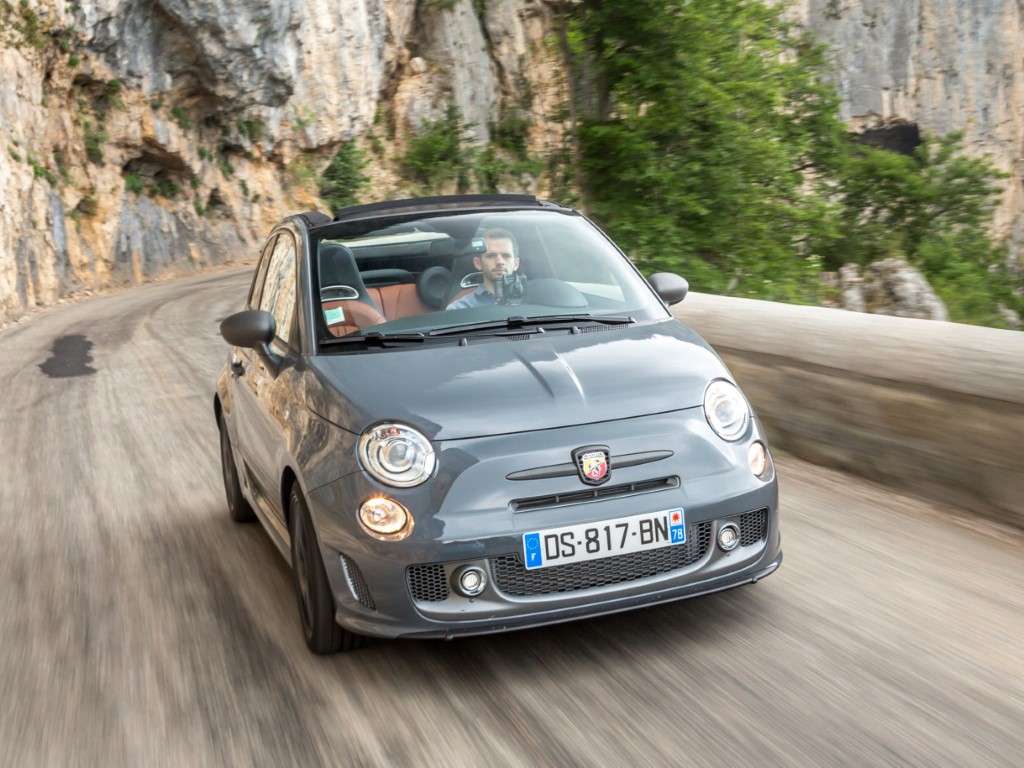
1st Generation
(2013 - 2015)
1.4 T-Jet
180 cv
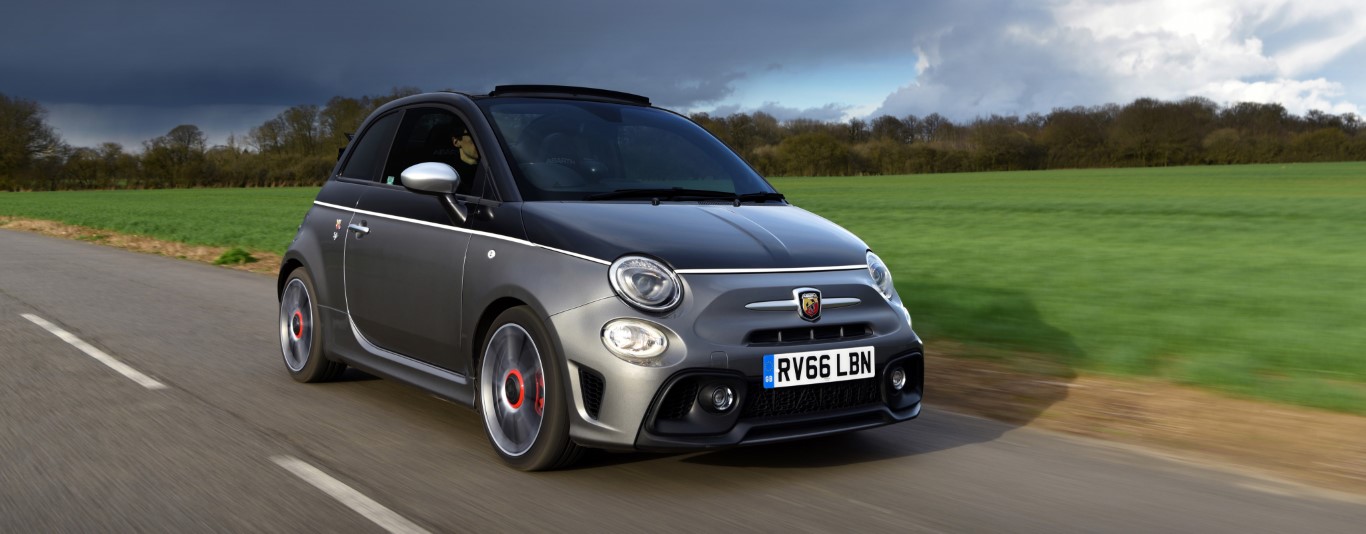
Technical specifications, versions, and history for the Abarth 595C Convertible.
Select a generation to see available versions
(2013 - 2015)
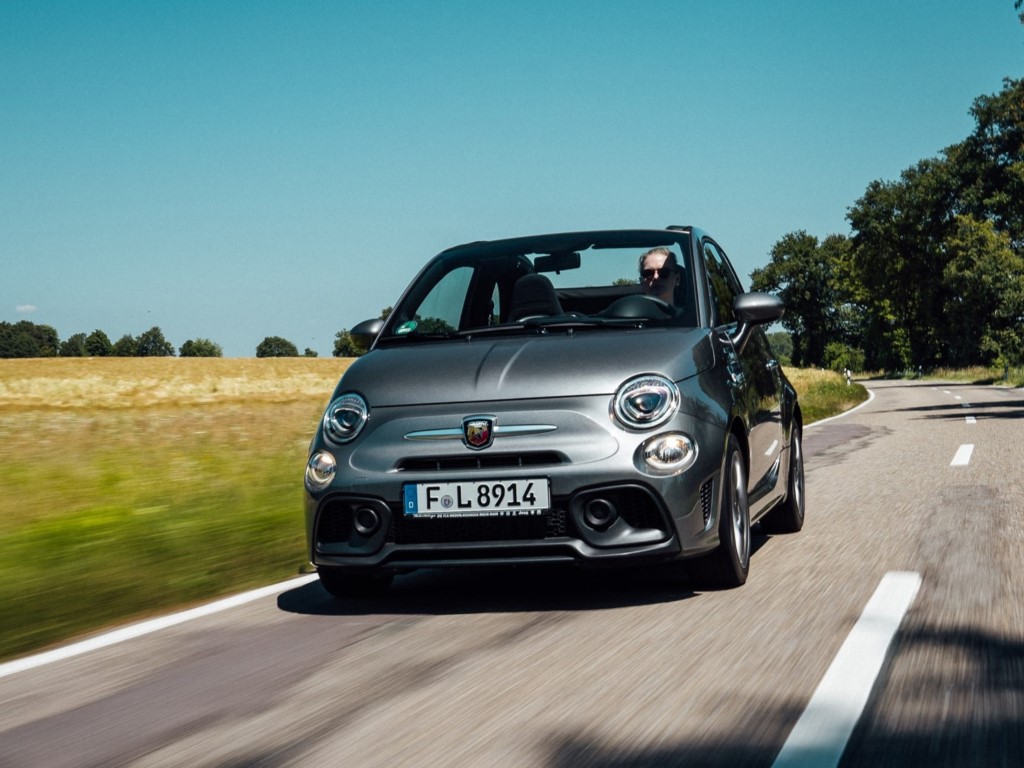
(2016 - 2024)
Select a powertrain to view full technical specifications
The history of the Abarth 595 is a testament to the persistence of an engineering philosophy that prioritizes agility and power density over absolute size. From its original presentation in 1963 to its modern form as an icon of Stellantis, the model has served as the ultimate expression of the "pocket rocket" concept. This report details the complete trajectory of the model, examining its mechanical roots, the technological transitions between generations, and the design subtleties that distinguish the Hatchback and Cabrio variants throughout decades of evolution.
The genesis of the Abarth 595 dates back to September 1963, when Carlo Abarth revealed the model at the Turin Motor Show. The vehicle was conceived on the basis of the Fiat 500 D, a model that had already enjoyed growing popularity since 1961. The transformation carried out by Abarth was profound, not only in aesthetics but at the core of the engine. The displacement was increased to 593.7 cc, an adjustment that gave rise to the name "595".
The engineering applied by Carlo Abarth focused on high-performance internal components. The engine received new single-piece cast iron cylinders, high-dome pistons to increase the compression ratio, and a more aggressive camshaft. Fueling was guaranteed by a vertical Solex carburetor, while lubrication was optimized by an oversized aluminum oil pan, which protruded from the rear of the car to aid in heat dissipation. The result was a 30% increase over the original power, reaching 27 hp at 5,000 rpm and a top speed of 120 km/h (75 mph), impressive figures for a vehicle of its size and era.
Visually, the classic 595 distinguished itself by the perforated front grille in the style of the 850TC and the metallic "Fiat Abarth 595" badging. An element that would become legendary was the dual-exit "Record Monza" exhaust, which gave the car an aggressive and unmistakable sound. Commercial success was driven by a bold marketing tactic: offering free test drives during the Turin Motor Show, which generated a massive flow of interested people and established Abarth as the performance brand for the masses.
Table 1: Technical Specifications of the Classic Abarth 595
| Component | Specification (1963) | Impact on Performance |
|---|---|---|
| Displacement | 593.7 cc | Basis for increased torque and power |
| Power | 27 hp @ 5,000 rpm | 30% increase over the Fiat 500 D |
| Top Speed | 120 km/h | Superiority in its displacement class |
| Exhaust System | Record Monza (Dual outlet) | Better gas flow and distinct sound |
| Cooling | Enlarged aluminum oil pan | Reduction of oil temperature at high revs |
After years of focusing on tuning kits and limited editions, the Abarth brand was refounded in 2007 as an independent unit within the Fiat Group. The official relaunch of the model based on the new Fiat 500 took place in 2008. Initially named simply Abarth 500, the car featured the 1.4 Turbo T-Jet engine, which would become the gold standard for the brand in the decades to follow.
The "595" nomenclature was reintroduced in 2012 to designate versions that received a superior performance treatment compared to the base model. In this phase, Abarth structured the range to cater to different customer profiles: the 595 Turismo, focused on elegance and comfort for fast journeys, and the 595 Competizione, aimed at a rawer experience closer to the track. Both versions initially used IHI RHF3-P turbines, calibrated to provide immediate torque at low revs, resulting in about 160 hp of power.
The architecture of the 1368 cc 1.4 T-Jet engine proved to be extremely robust. Equipped with 16 valves and sequential electronic injection, the powertrain offered a solid foundation for gradual evolutions. The differential of these first modern series was the balance between daily usability and acceleration capability, a characteristic that allowed Abarth to capture a market share of enthusiasts who desired a small car with the behavior of a legitimate sports car.
In 2016, the Abarth 595 line underwent its most profound renewal, known as Series 4. This update marked the official end of the "Abarth 500" designation, with all models permanently bearing the 595 emblem. The facelift brought aesthetic improvements inspired by the renewal of the Fiat 500, but with a much more aggressive technical focus.
The new front bumper was redesigned with a significantly larger air intake, which optimized heat management in the engine compartment and increased cooling capacity by 18%. The optical groups were updated to include poly-elliptical headlights and LED daytime running lights (DRL) as standard equipment across the range. Inside, the biggest change was the introduction of the Uconnect infotainment system with a 5- or 7-inch screen, bringing modern connectivity like Apple CarPlay and Android Auto.
Mechanically, Series 4 reorganized the powertrains. The entry-level model now offered 145 hp, while the Turismo version went up to 165 hp and the Competizione remained at the top with 180 hp. One of the most important evolutions was the widespread adoption of the Garrett GT 1446 turbine in the more powerful versions, replacing the IHI in favor of a greater capacity to sustain pressure at high revs. The table below details the structure of the range after the 2016 facelift.
Table 2: Abarth 595 Range Structure (Series 4)
| Version | Powertrain | Turbocharger | Power | Main Focus |
|---|---|---|---|---|
| 595 (Base) | 1.4 T-Jet | IHI RHF3-P | 145 hp | Accessibility and urban agility |
| 595 Pista | 1.4 T-Jet | IHI RHF3-P | 160 hp | Connectivity and telemetry for youths |
| 595 Turismo | 1.4 T-Jet | Garrett GT 1446 | 165 hp | GT style and internal sophistication |
| 595 Competizione | 1.4 T-Jet | Garrett GT 1446 | 180 hp | Maximum performance and track use |
| 595 Esseesse | 1.4 T-Jet | Garrett GT 1446 | 180 hp | Historical tradition and premium components |
The choice between the Hatchback and Cabriolet bodies involves technical nuances that go beyond aesthetics. The Abarth 595C (Cabrio) is not a full convertible in the traditional sense, but rather a model that uses an electrically retractable fabric roof that moves between the fixed roof arches. This configuration allows the car to maintain superior structural rigidity to that of pillarless convertibles, but it introduces important dynamic differences.
In terms of weight, the Cabriolet variant is approximately 40 to 55 kg heavier than the Hatchback, depending on the equipment configuration. This additional weight is located primarily in the upper rear section, due to the roof mechanism and the necessary structural reinforcements, which slightly alters the vehicle's center of gravity. Dynamically, although Abarth worked to keep the differences minimal, experts note that the Hatchback offers a superior feeling of "solidity" in high-speed corners and over uneven surfaces.
Practically, the Cabriolet presents limitations in the trunk. Although the nominal capacity of 185 liters is identical to the Hatchback, the opening of the compartment in the 595C is significantly smaller, consisting of a tilting lid that limits the entry of bulky objects. Furthermore, with the roof fully retracted, rear visibility is severely compromised, and accessing the trunk requires the electronic system to move the roof slightly upwards. However, the reward is acoustic: with the roof open, occupants have direct access to the "roar" of the exhaust system, a central feature of the Abarth experience.
Table 3: Technical Differences between Hatchback and Cabrio (180 hp)
| Parameter | 595 Hatchback | 595C (Cabriolet) | Observation |
|---|---|---|---|
| Weight (EU) | 1,110 kg | 1,165 kg | Curb weight with driver |
| Torsional Rigidity | High (Fixed roof) | Moderate/High (Fixed arches) | Hatchback is preferable for track |
| Aerodynamics (Cd) | 0.33 | 0.35 | Cabriolet generates more drag with open roof |
| Exhaust Sound | Muffled (Insulation) | Visceral (Open roof) | Superior auditory experience in the Cabrio |
| Trunk Access | Wide (Full hatch) | Restricted (Partial lid) | Volume is the same, but loading opening differs |
The evolution of the Abarth 595 was not limited to just an increase in power, but the integration of chassis technologies that transformed an urban car into an instrument of precision. Two pillars support this transformation: the suspension and the braking systems.
The introduction of Koni shock absorbers with FSD (Frequency Selective Damping) technology was a milestone for the brand. Unlike expensive electronic systems, FSD uses a mechanical hydraulic valve that opens or closes depending on the frequency of the oscillations. On uneven surfaces (high frequency), the valve allows a greater flow of oil, making the suspension more compliant and comfortable. In high-speed corners (low frequency), the valve restricts the flow, increasing firmness and body control. In the Competizione and Esseesse versions, this system is applied to both axles, while in the Turismo version it is common to find it only on the rear axle.
To stop the vehicle consistently, Abarth equipped the 180 hp versions with high-performance Brembo systems. These consist of four-piston fixed aluminum calipers and 305 mm ventilated and cross-drilled discs at the front. The cross-drilling of the discs is not just aesthetic; it helps dissipate heat and clear gases generated by brake pad friction, preventing "fading" during intense use on circuits. Furthermore, the mechanical limited-slip differential (Abarth D.A.M.), available in the more extreme versions, allows power to be distributed efficiently between the front wheels in tight corners, minimizing understeer and allowing earlier acceleration.
The 1.4 T-Jet engine went through several calibrations to meet emissions standards and performance demands. The transition from the IHI turbine to the Garrett GT 1446 is the most discussed technical point among enthusiasts. While the IHI delivers maximum torque around 2,000 rpm, the Garrett requires about 2,500 rpm to reach its maximum pressure, but it offers much superior breath up to the rev limit, allowing the Competizione to maintain its power curve more linearly.
Regarding the transmission, Abarth maintained a traditional and an automated approach. The five-speed manual gearbox is praised for its robustness and the elevated positioning of the lever, which facilitates quick shifts. As an alternative, the sequential robotized gearbox (MTA) offers the convenience of automatic or manual shifts via steering wheel paddles. Although the MTA is heavier and has more noticeable torque interruptions than a modern dual-clutch gearbox, it is valued for its mechanical simplicity and the reduction of 0 to 100 km/h acceleration time in certain conditions, despite officially being slightly slower than the manual (6.7s vs 6.9s in the 180 hp version).
Table 4: Transmission Comparison (Series 4)
| Characteristic | Manual (5MT) | Robotized (MTA/5AT) | Observation |
|---|---|---|---|
| Speeds | 5 Gears | 5 Gears | Both focused on short ratios |
| Actuation | Dash-mounted lever | Buttons and Paddles | Lever position is ergonomic |
| Weight | Lighter | ~15-20 kg Additional | Impacts front weight distribution |
| 0-100 km/h (180 hp) | 6.7 seconds | 6.9 seconds | Manual is superior in pure launches |
| Average Consumption | ~6.3 L/100 km | ~6.8 L/100 km | Manual is marginally more efficient |
The experience on board the Abarth 595 was transformed by digital technology. Up until 2014, the model used a concentric analog dashboard that many considered difficult to read. With the introduction of the 7-inch TFT dashboard, developed by Magneti Marelli, the driver gained access to a much wider range of information.
This digital panel integrates the speedometer, tachometer, fuel level, and water temperature in a colorful and configurable interface. In "Sport" mode, the screen shifts to a reddish hue, and the central graphic changes to display the G-meter, encouraging more dynamic driving. Furthermore, the turbo pressure gauge (boost gauge) is a separate physical piece mounted on top of the dashboard, maintaining the visual connection with the racing cars of the past.
The Uconnect system, introduced in the 2016 facelift, brought the necessary modernity for daily use. The 7-inch HD version includes DAB radio, TomTom navigation, and crucially, "Abarth Telemetry." This native application allows loading famous racetrack maps; the GPS recognizes the car's position on the track and automatically times laps, displaying driving tips to improve performance.
The Abarth 595 proved to be a financial and image success for FCA (now Stellantis). Although based on a design dating back to 2007, the model continued to break sales records until the end of the 2010s. The year 2018 was the peak, with 23,500 units sold in Europe, a 36.5% jump compared to the previous year.
This success is attributed to Abarth's "micro-segmentation" strategy. By constantly releasing limited editions and upgrade kits, the brand kept the model fresh and desirable to collectors. The UK market emerged as the largest for the brand, surpassing even Italy in certain periods, with British enthusiasts being particularly drawn to the combination of Italian performance and ease of parking in dense cities.
However, the transition to electrification brought a sharp decline in the numbers of combustion models. By 2025, data shows that only a small fraction of thermal models are still registered, consisting mainly of final stocks. Total production of the 500 family (including Fiat and Abarth) surpassed 2.5 million units in 2021, consolidating it as one of the most important models produced at the Tychy plant in Poland.
Table 5: Evolution of Annual Sales (Europe)
| Year | Approximate Sales (Abarth) | Observation |
|---|---|---|
| 2012 | 8,000 units | Consolidation of the 595 name |
| 2015 | 13,000 units | Pre-Series 4 facelift |
| 2018 | 27,000 units | Historical global sales record |
| 2022 | 12,800 units | Start of electric transition |
| 2025 (1st Half) | 154 units | End of the line for thermal models |
Abarth used milestone anniversaries to launch the most desired versions of the 595. The "70th Anniversary", launched in 2019, is a significant example. All cars produced that year received a special commemorative badge. The 70-year Competizione version came equipped with Sabelt seats embroidered with the anniversary logo and the telemetry system as standard.
The reintroduction of the "Esseesse" brand in 2019 also served as a tribute to the original tuning kit from the 60s. The new 595 Esseesse positioned itself at the top of the hierarchy, bringing as standard items that were previously optional or exclusive to limited editions, such as the Akrapovič exhaust system with carbon tips and the high-flow air filter from BMC.
Another notable variant was the 595 Pista, which focused on a cost-benefit balance for younger drivers. It featured the IHI turbine with 160 hp, but included as standard the Koni FSD rear suspension and the Record Monza exhaust, items that would normally require jumping to the more expensive versions. These editions allowed the brand to cover all price points within the compact hot hatch niche.
The Abarth 595, in its Hatch and Cabrio forms, represents the pinnacle of the development of compact performance cars based on internal combustion. The brand's ability to evolve a 2007 platform for nearly two decades, maintaining public interest and mechanical competitiveness, is a rare phenomenon in the modern industry.
From the resilient 1.4 T-Jet engine to the Koni suspension systems and Brembo brakes, the 595 was built with high-quality components that justified its premium price over the regular Fiat 500. The model will cease to be produced to make way for the new all-electric Abarth 500e, but its legacy as the "little devil" that democratized telemetry and track performance in a sub-four-meter package is assured in automotive history. The Abarth 595 was not just a car, but a celebration tool of Italian mechanical engineering, proving that driving emotion does not depend on the size of the vehicle, but on the soul put into its development.
Images of the Abarth 595C Convertible