1st Generation
(2024-)
Technical specifications, versions, and history for the Abarth 600e.
Select a generation to see available versions
(2024-)
Select a powertrain to view full technical specifications
The emergence of the Abarth 600e represents one of the most significant moments in the history of the scorpion brand, signaling not only the launch of its most powerful model to date but also the consolidation of a profound energy transition. To understand the technical and symbolic importance of this vehicle, it is necessary to analyze Abarth's trajectory from its racing roots in the mid-20th century to its current technological integration under the aegis of the Stellantis group. This report details the evolution of the 600e project, covering its historical lineage, engineering specifications, range variations, and commercial performance in the contemporary European scenario.
The identity of the new Abarth 600e is intrinsically linked to the original Fiat 600, launched in 1955 as a vehicle destined to motorize post-war Italy. Carlo Abarth, recognized for his ability to extract extraordinary performance from small-displacement engines, saw in the Fiat 600 the ideal platform for his technical modifications. The brand's philosophy, "small but wicked," was forged on the tracks through the conversions that transformed mild-mannered family cars into feared racing machines on European circuits.
By 1956, Abarth was already offering tuning kits that increased the displacement and compression ratio of Fiat engines. The development culminated in the iconic Fiat-Abarth 850 TC (Turismo Competizione) in 1961. This model used the block from the Fiat 600 D, but with the displacement raised to 847 cc, reaching 52 HP at 5,800 rpm, which allowed a top speed of 140 km/h. To ensure safety at speeds so much higher than the factory model, Abarth introduced disc brakes on the front axle, a rare innovation for cars of that size at the time.
The 850 TC evolved into the 1000 TC, which used a 982 cc engine and produced up to 85 HP in its racing versions. These vehicles dominated Division 1 of the European Touring Car Championship (ETCC) between 1965 and 1967. A striking visual feature of these models was the rear engine cover held open by props, a solution initially aimed at cooling, but which proved effective as an improvised spoiler, increasing rear stability at high speeds. This focus on functional aerodynamics and thermal management is a pillar that Abarth sought to recapture in the design of the modern 600e.
| Technical Attribute | Fiat-Abarth 850 TC (1961) | Fiat-Abarth 1000 TC (1966) |
|---|---|---|
| Engine Configuration | Inline 4-cylinder, rear-mounted | Inline 4-cylinder, rear-mounted |
| Actual Displacement | 847 cm³ | 982 cm³ |
| Maximum Power | 52 HP | 85 HP |
| Top Speed | 140 km/h | > 170 km/h |
| Curb Weight | 610 kg | ~ 583 kg |
| Notable Innovations | Disc brakes, front radiator | 5-speed gearbox, integrated radiator |
Sources:
The Abarth 600e project was conceived as a response to the brand's need for electrification, without abandoning the performance that defines the scorpion. Developed in direct partnership with Stellantis Motorsport, the vehicle is not merely a modified version of the Fiat 600e, but rather a restructured automobile under the Perfo-eCMP platform. This architecture is an evolution of the Common Modular Platform, optimized specifically to handle the instant torque and dynamic demands of a high-performance electric "hot hatch".
The collaboration with Stellantis's motorsport division allowed the 600e to utilize knowledge gained in Formula E. The electric motor was tested on dynos used for racing cars, ensuring that the 280 HP power delivery was constant and reliable even under conditions of intense circuit use. Furthermore, engineering focused on the chassis's structural rigidity and the suspension tuning, which was lowered and received resized stabilizer bars to mitigate body roll.
The Abarth 600e sets a new performance benchmark for the brand. The powertrain consists of a permanent magnet synchronous motor coupled to the front axle, offering two power variants that define the model's versions.
The entry-level powertrain delivers 240 HP (177 kW), while the high-performance variant reaches 280 HP (207 kW). Both versions share a maximum torque of 345 Nm, available instantaneously, which guarantees vigorous acceleration. In the 280 HP configuration, the vehicle accelerates from 0 to 100 km/h in just 5.85 seconds, reaching an electronically limited top speed of 200 km/h.
Traction is managed by a fundamental mechanical component: the JTEKT Torsen limited-slip differential (LSD). Unlike many competitors that use brake-based electronic torque vectoring, Abarth opted for a robust mechanical solution. This allows power to be distributed more effectively between the front wheels during cornering, reducing understeer and allowing the driver to apply the throttle earlier when exiting a corner without losing traction.
| Engine Version | Power (HP/kW) | Maximum Torque | 0-100 km/h | Top Speed |
|---|---|---|---|---|
| Turismo Variant (Standard) | 240 HP / 177 kW | 345 Nm | 6.24 s | 200 km/h |
| Competizione / Scorpionissima Variant | 280 HP / 207 kW | 345 Nm | 5.85 s | 200 km/h |
Sources:
The Abarth 600e's electronic system allows the driver to select between three driving modes, which drastically alter the vehicle's behavior:
The battery is the heaviest and most sensitive component of a performance electric vehicle. In the Abarth 600e, the battery pack has a nominal capacity of 54 kWh, with 51 kWh of usable capacity.
To prevent performance degradation due to the heat generated by rapid discharges (acceleration) and intense recharges (regenerative braking), Abarth implemented a reinforced cooling system. A high-flow coolant pump ensures that the lithium-ion cells remain within the ideal thermal window, which is crucial for maintaining consistent lap times on a circuit and ensuring the component's longevity.
The homologated range under the WLTP cycle varies according to the tire configuration. Equipped with economy-focused tires, the 600e can travel up to 334 km. However, with the high-grip Michelin Pilot Sport EV tires, the real combined range is around 317 km to 322 km.
Charging was designed to be practical both in domestic environments and at high-speed stations:
Although the Abarth 600e is a recent market release, its offering structure has already undergone notable evolution to adapt to consumer demands and the brand's global strategies.
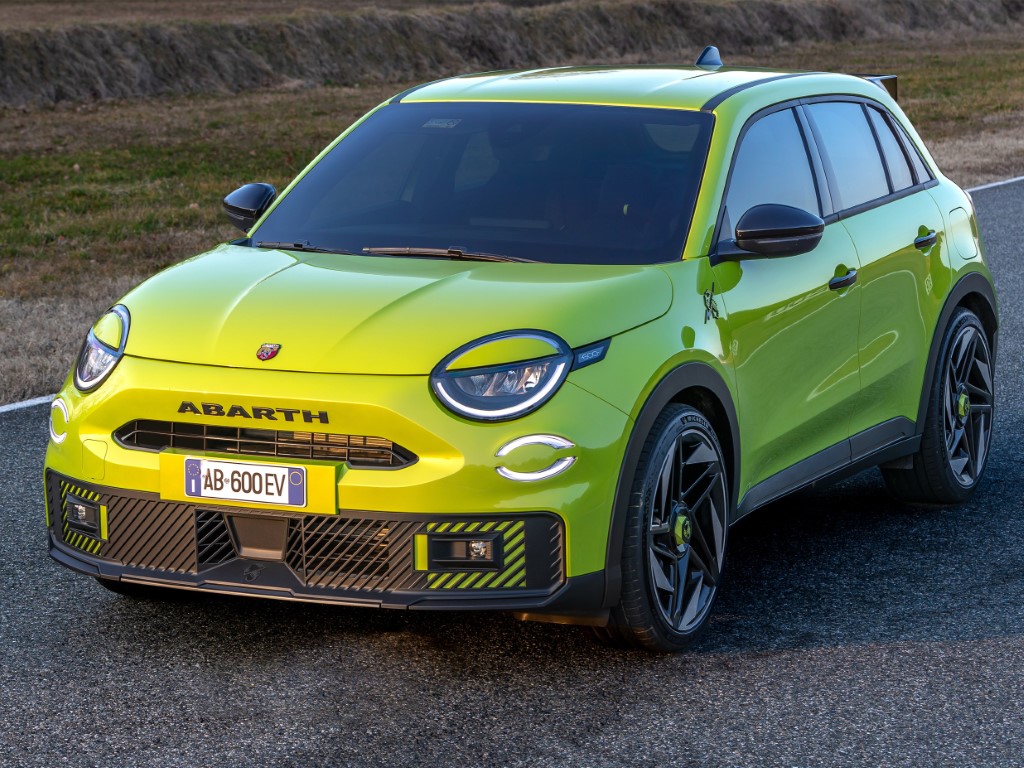
The model debuted with the limited launch edition named Scorpionissima, produced in exactly 1,949 units. This version was designed as a technological showcase, featuring the 280 HP engine and exclusive colors such as Hypnotic Purple and Acid Green. The Scorpionissima included all available options, such as the Abarth sound generator, integrated navigation, and Level 2 driving assistances.
In January 2026, Abarth announced a significant update to the 600e offering, replacing the initial models with two new catalog designations, aligning with the brand's historical nomenclature.
Abarth continued the tradition of creating ultra-exclusive models for specific moments. A notable example is the Milano Cortina 2026 edition, launched to celebrate the Winter Olympic Games.
The dynamic superiority of the Abarth 600e over the regular Fiat 600e is the result of high-performance components supplied by specialized racing partners.
To contain the impetus of the 280 HP and handle the additional weight of the batteries, Abarth equipped the 600e with brakes developed by Alcon. The front discs are ventilated and are 380 mm in diameter, actuated by four-piston monoblock calipers. This system was designed to offer superior resistance to overheating and a pedal modulation that allows the driver to precisely feel the limit of grip before ABS intervention.
Mechanical grip is enhanced by exclusive Michelin Pilot Sport EV tires, which utilize a dual-compound technology derived from Formula E. The tread has a high-rigidity outer zone for cornering stability and an inner zone optimized for longitudinal traction. Beyond performance, these tires were designed to reduce road noise, something fundamental in electric vehicles where the engine sound does not mask external noises.
The Perfo-eCMP chassis features a track widened by 30 mm at the front and 25 mm at the rear compared to the conventional Fiat 600e. This alteration increases lateral stability and allows for the installation of 20-inch wheels with wider rims. The suspension uses springs and shock absorbers with specific calibration to minimize front-end dive under heavy braking and rear-end squat during hard acceleration.
The design of the Abarth 600e follows the maxim that form must follow function. Every visual element was conceived to improve aerodynamics or cooling.
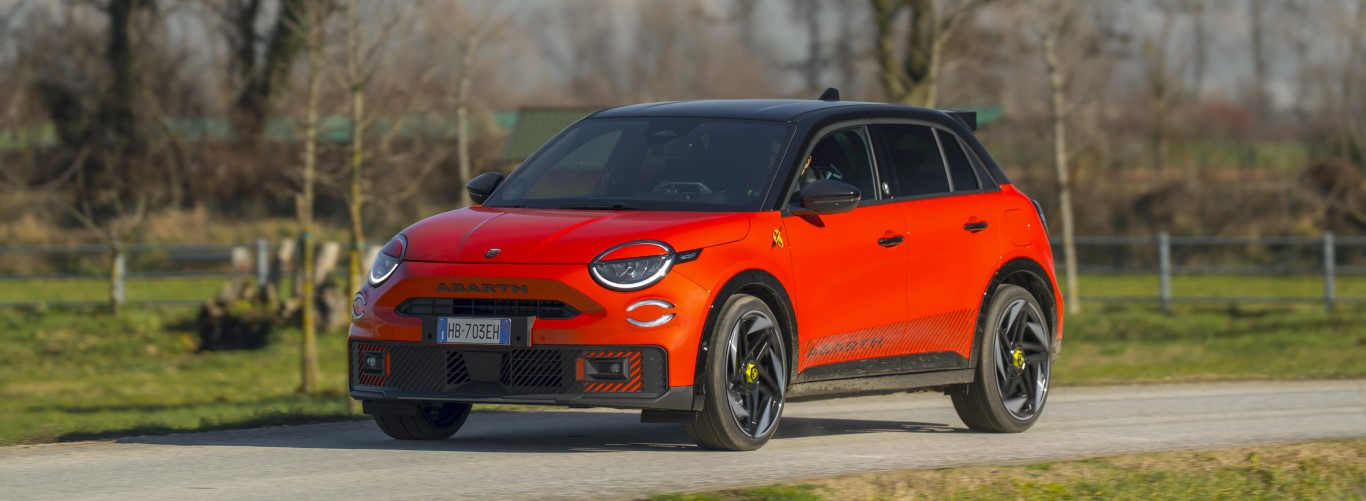
The front bumper, nicknamed the "Shark Nose", has a large lower air intake that harkens back to the classic Abarth 850 TC. The lines are angular and aggressive, helping to direct air to the wheel wells and radiators. At the rear, a generous roof spoiler and a lower diffuser work together to reduce aerodynamic drag and generate downforce, keeping the car stable at high cruising speeds.
The 20-inch wheels are noteworthy for their five-spoke design that resembles a scorpion's pincer, with a diamond-cut finish and center caps that hide the wheel bolts, giving it a "center lock" look typical of racing cars.
Inside the Abarth 600e, the focus is on driving ergonomics. The Sabelt seats are fundamental in this experience, constructed with four different types of foam to offer firm lumbar support and prominent side bolsters that hold the body in high-G corners. The steering wheel, finished in Alcantara and leather, has a flat-bottom design and a central marker in green or orange.
On-board technology is centered on a 10.25-inch screen offering the "Performance Pages" system. This system allows the driver to view technical data in real time:
The commercial trajectory of the Abarth 600e is a reflection of the challenges faced by niche brands in the transition to electric. Although the vehicle is technically advanced, its initial acceptance was moderated by economic and cultural factors.
Industry data indicates that the Abarth 600e registered about 318 units in Europe during the first half of 2025. This equates to an average of approximately 50 units per month, a volume considerably lower than Stellantis's initial internal projections. This downward trend followed the performance of the Abarth 500e, suggesting that the brand's traditional audience is still hesitant to abandon thermal engines.
| Reference Period | Abarth 600e Registrations | Brand Context (Total) |
|---|---|---|
| 1st Half 2025 | 318 units | 1,030 units (including 500e and thermals) |
| Share in the Range | ~ 31% of the Abarth total | 80% reduction vs 1st half of 2024 |
| Scorpionissima Production | 1,949 units | Global launch limited edition |
Sources:
The suggested price for the Abarth 600e Competizione is over €40,000 in markets such as Germany and the Netherlands. This value places it in direct competition with models like:
The strategy of reducing the price of the Turismo version to around £33,995 at the beginning of 2026 was a clear attempt by Stellantis to increase the model's competitiveness and attract buyers looking for a stylish electric crossover, but without the prohibitive cost of the collector's editions.
The Abarth 600e is the culmination of an engineering effort to prove that electrification does not mean the death of automotive passion. It succeeds Carlo Abarth's legacy of transforming a civilian Fiat vehicle into a performance machine, but now using electrons instead of high-octane gasoline. The inclusion of a mechanical Torsen differential, Alcon brakes, and Formula E technology tires demonstrates that the brand spared no effort to ensure that the 600e was dynamically superior to any other crossover in its category.
The evolution of the range, moving from the limited Scorpionissima to the structured Turismo and Competizione versions, shows a brand that is maturing its electric offering. Although initial production numbers and European sales reflect a difficult transition, the Abarth 600e remains a technical milestone: a vehicle that offers 280 HP and a visceral driving experience in a compact and practical package for everyday use. The scorpion may be quieter, but with the 600e, it has proven to be more powerful and technologically sophisticated than ever before.
Images of the Abarth 600e