
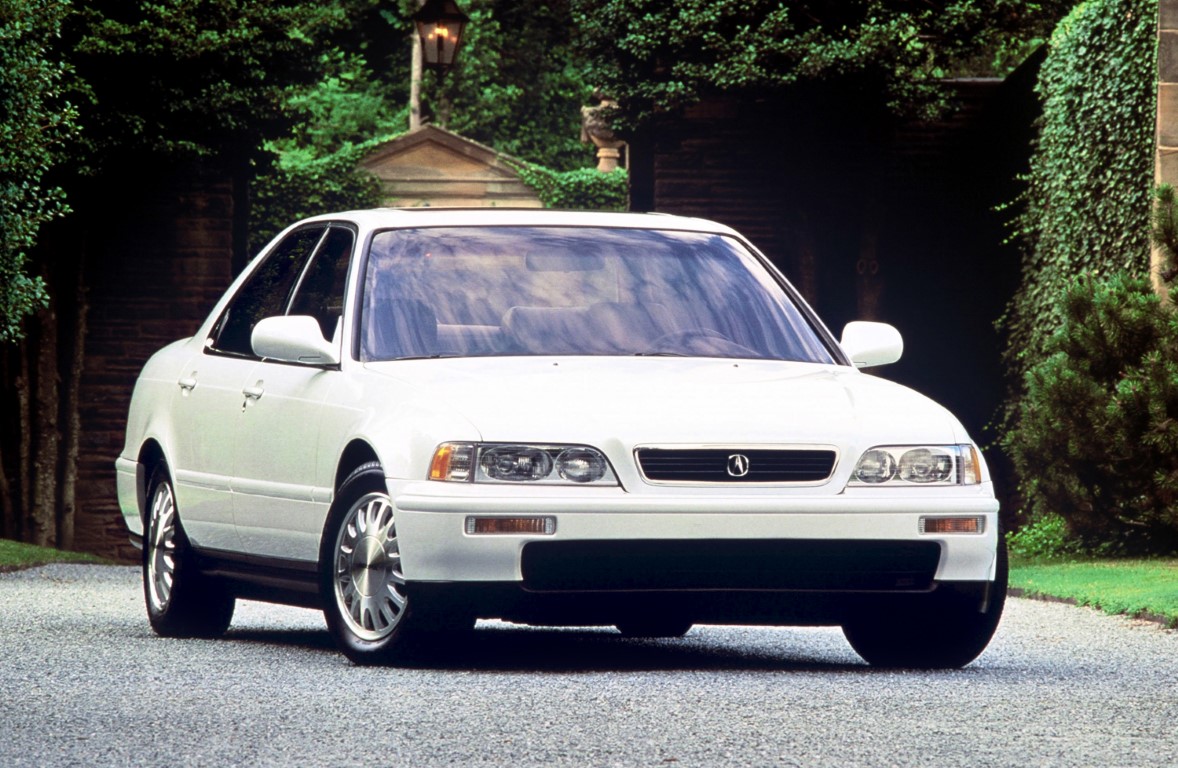
The Initial Trajectory
The trajectory of the Acura Legend represents one of the most fundamental chapters in modern automotive history, marking not only the birth of a new luxury brand but also a paradigm shift in how Japanese vehicles were perceived globally. Launched in 1986, the Legend was the inaugural vehicle of the Acura division, the first luxury brand created by a Japanese manufacturer, Honda, with the specific goal of challenging the dominance of European and American brands in the lucrative North American market. During a decade of production divided into two distinct generations (1985–1995), the Legend evolved from a technically advanced touring sedan to a high-performance competitor, introducing innovations in safety, powertrain, and comfort that redefined the expectations of the mid-size luxury segment.
The Historical Context and the Creation of the Acura Division
To understand the importance of the Legend, it is necessary to analyze the economic scenario of the 1980s. At that time, the United States government imposed Voluntary Export Restraints on Japanese manufacturers, limiting the number of cars that could be shipped to the country. To maintain and expand profit margins under these quantitative limitations, Honda realized it needed to sell higher value-added vehicles. The Acura Legend was born from this strategic imperative, designed to offer a driving experience and a level of refinement that traditional Japanese brands, like Honda itself or Toyota, had not yet explored on a global scale.
The Legend project, known internally by the codename "HX", was developed in parallel with the creation of the Acura dealership network, which opened its doors in March 1986. Honda sought to differentiate Acura through the concept of "Precision Crafted Performance", and the Legend was the standard-bearer of this philosophy. It was the first production Honda to be equipped exclusively with a V6 engine, signaling a break with the brand's tradition of focusing on high-efficiency four-cylinder engines.
The Strategic Alliance between Honda and Rover
A unique aspect of the Legend's development was the technical collaboration between Honda and British Leyland, which would later become the Rover Group. In August 1981, the two companies began discussions to co-develop a new luxury car that would replace the aging Rover SD1 and give Honda a quick entry into the executive sedan segment. This project resulted in the Honda Legend and the Rover 800 (sold in the US as the Sterling 825/827).
Honda took the lead in developing the V6 engine and the manual and automatic transmissions, while Rover contributed significantly to the structural design of the body and the refinement of the interior. Although they shared the basic structure, the floorpan, and the engine, the two cars diverged considerably in terms of outer panels, electrical systems, and suspension. Honda focused on a more "Germanic" approach, focusing on control and precision, while Rover aimed for a "warmer and more glamorous" environment, using traditional woods and leathers that Honda eventually incorporated into later versions of the Legend after learning from British knowledge in luxury interiors.
Production and Sales Data
| Year | Annual Volume (USA) | Main Observations |
|---|---|---|
| 1986 | 25,062 | Acura operations begin |
| 1987 | 54,713 | Launch of the Legend Coupe |
| 1988 | 70,770 | Historical sales peak for the model |
| 1989 | 64,638 | Introduction of the facelift and new rear suspension |
| 1990 | 53,666 | Transition to the second generation |
| 1991 | 65,689 | Immediate success of the new longitudinal design |
| 1992 | 49,926 | Maintenance of segment leadership |
| 1993 | 38,866 | Introduction of the Type II engine in the Coupe |
| 1994 | 35,709 | Launch of the high-performance GS Sedan |
| 1995 | 18,259 | Last year of production for the Legend designation |
First Generation (1986–1990): The Trailblazer (KA1–KA6)
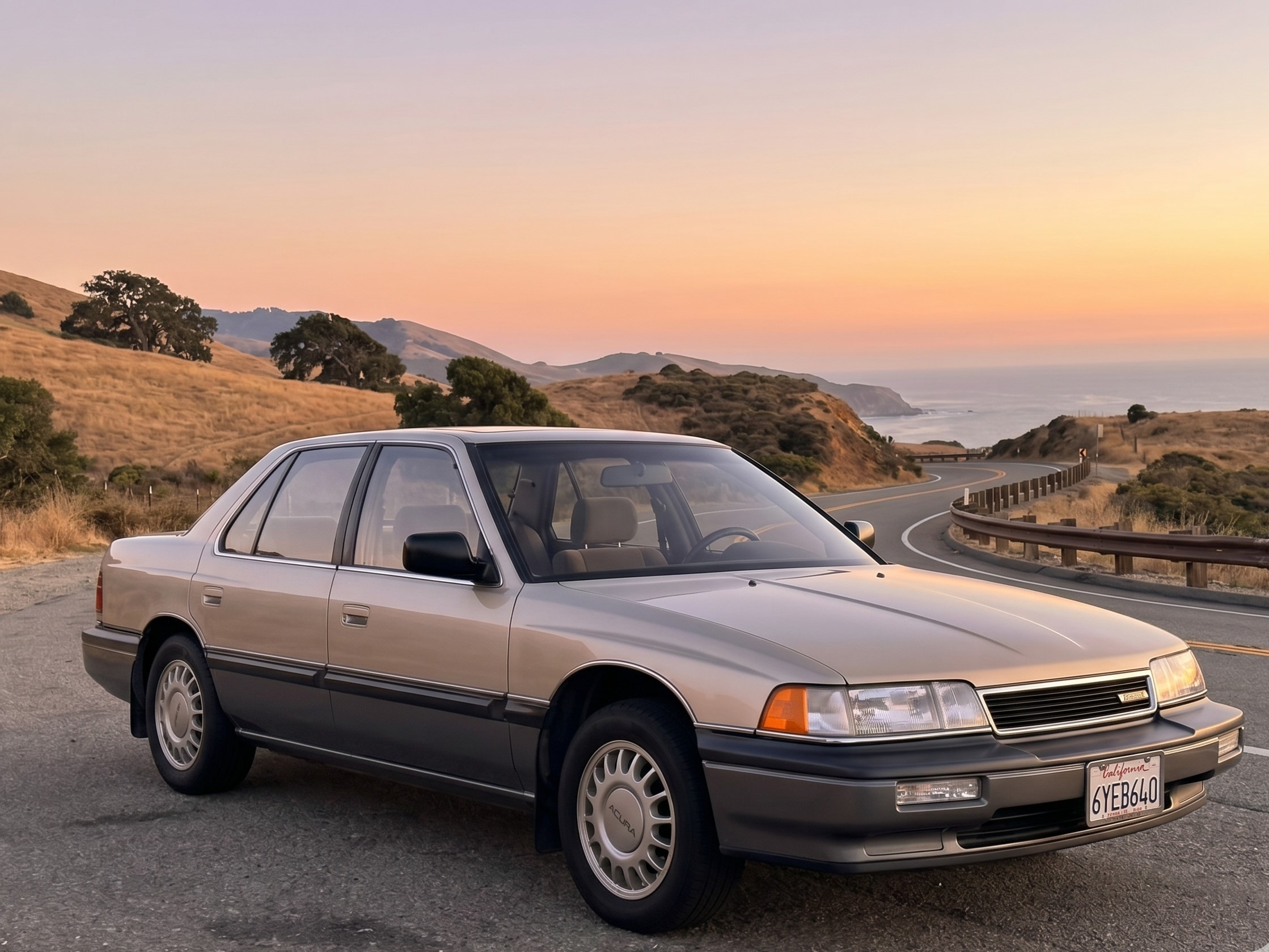
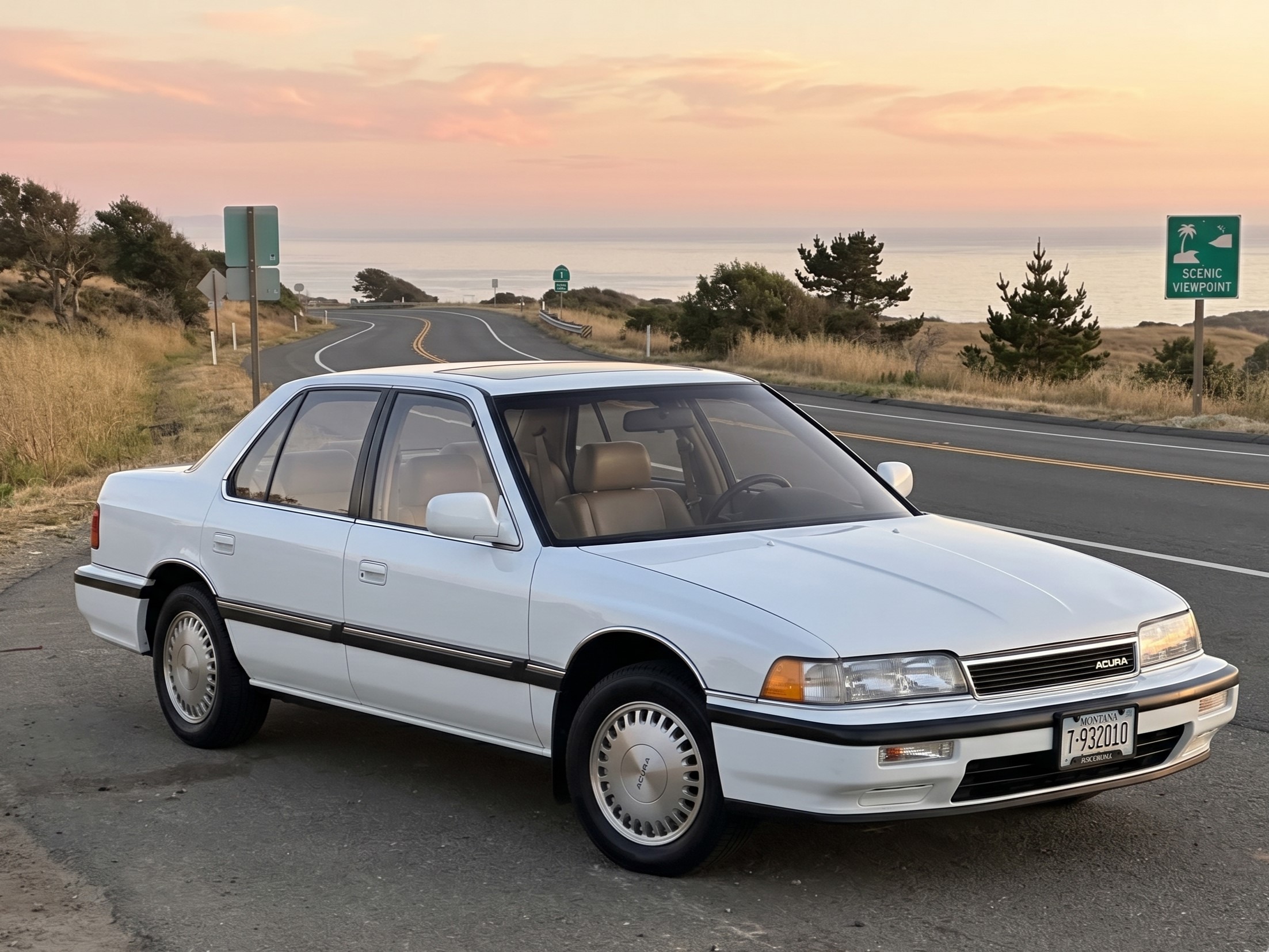
The first generation of the Legend debuted in Japan in October 1985 and arrived in North America for the 1986 model year. Initially available only as a four-door sedan, the model was designed to offer a balance between ride comfort and direct driver feedback, using a four-wheel independent suspension.
Initial Powertrains and Transmissions
The 1986 Legend was equipped with the C25A engine, a 2.5-liter 24-valve SOHC V6 that produced 151 horsepower. This engine was a technological showcase, using Honda's PGM-FI (Programmed Fuel Injection) system and a variable intake control system to smooth torque delivery. Buyers could choose between a 5-speed manual transmission or an electronically controlled 4-speed automatic.
In 1987, Acura introduced the Legend Coupe, which brought not only a more aerodynamic and sportier body but also a more powerful 2.7-liter V6 engine (C27A), with 161 horsepower. This 2.7-liter engine was extended to the sedan starting in 1988, becoming the standard for the lineup.
The 1989 Facelift: Technical Maturation
For the 1989 model year, the Legend Sedan underwent a significant renovation. Visually, the car received lower-profile one-piece headlights, new grilles, body-colored bumpers, and redesigned taillights. However, the most important changes were internal and mechanical.
The sedan's rear suspension was upgraded from a basic setup to the double-wishbone system already used on the Coupe, providing a much more stable and precise ride. Additionally, safety was prioritized with the inclusion of a driver's side airbag (SRS) as standard on all models, along with a four-channel ABS braking system.
Trim Details and Technology of the First Generation
The Legend versions were mainly divided into Base, L (Luxury), and LS (Luxury Sport). The LS model, introduced at the end of the first generation, represented the pinnacle of the brand's luxury at the time, including Bose audio systems specifically designed for the cabin's acoustics, walnut wood trim, and position-memory seats. In the Japanese market, there were even more exclusive variants, such as the "Wing Turbo" version, which used a 2.0-liter V6 engine with a variable-geometry turbocharger to bypass engine displacement taxes in Japan.
Engine Specifications - 1st Generation
| Feature | 2.5L V6 (C25A) | 2.7L V6 (C27A) | 2.0L V6 Turbo (C20AT) |
|---|---|---|---|
| Configuration | V6 90° SOHC 24V | V6 90° SOHC 24V | V6 90° SOHC 24V Turbo |
| Power (hp) | 151 hp @ 5,800 rpm | 161 hp @ 5,900 rpm | 187 hp @ 6,000 rpm |
| Torque (lb-ft) | 154 lb-ft @ 4,500 rpm | 162 lb-ft @ 4,500 rpm | 177 lb-ft @ 3,500 rpm |
| Markets | Global (1986-87) | Global (1987-90) | Japan (Only) |
Second Generation (1991–1995): The Longitudinal Revolution (KA7/KA8)
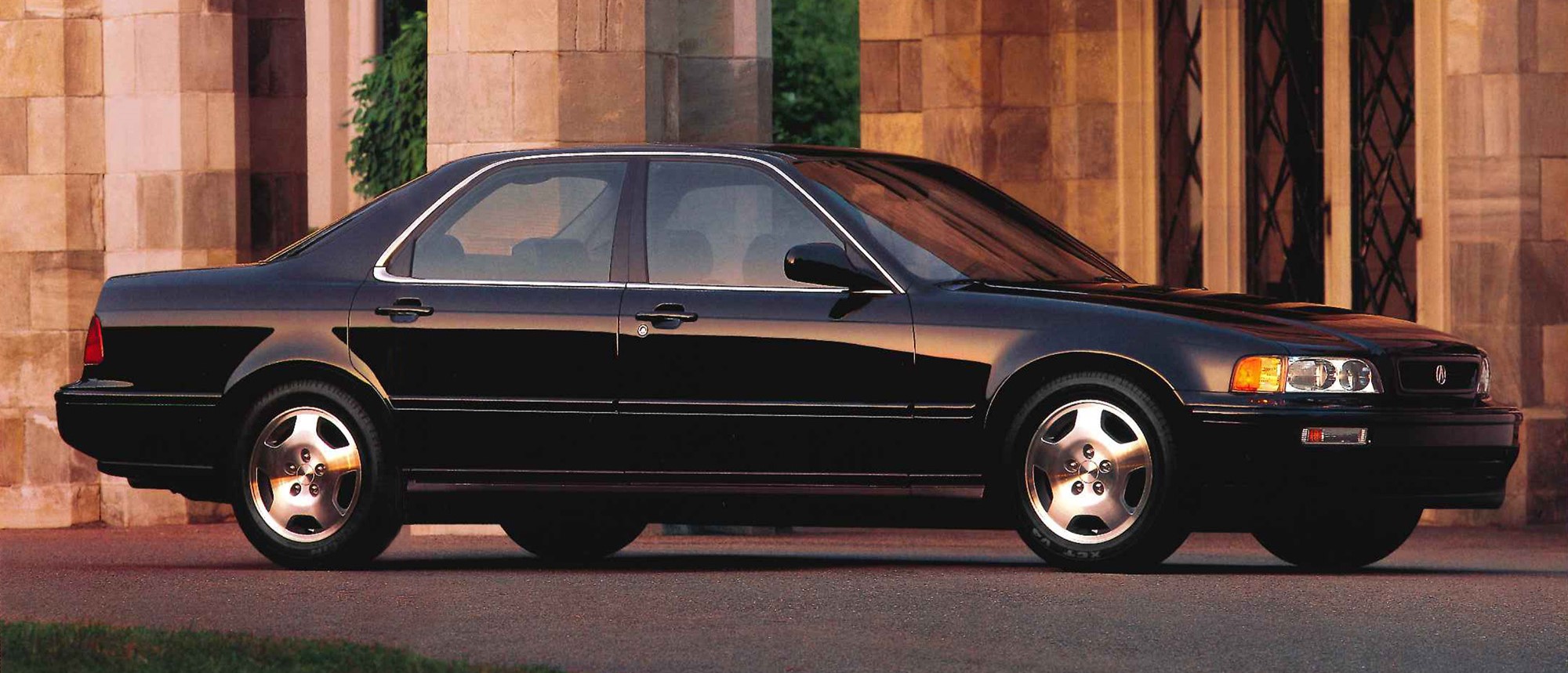
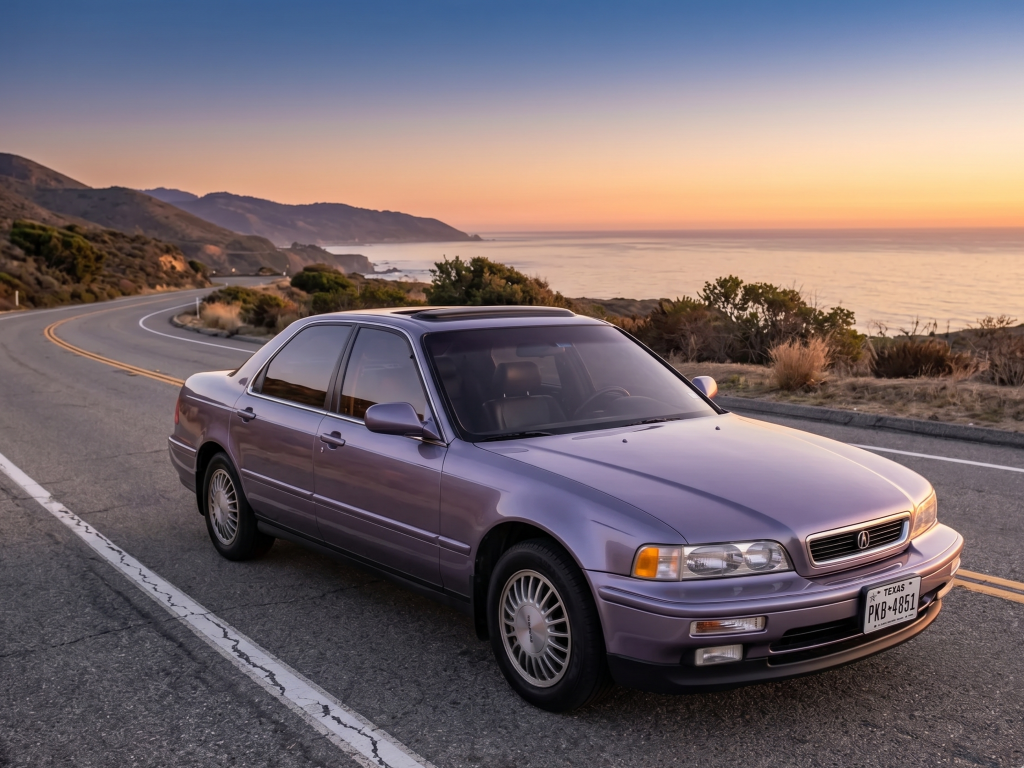
The second generation of the Acura Legend, launched in November 1990, was an entirely new design that elevated the vehicle to a higher level of luxury and engineering. The goal was to compete more aggressively with rear-wheel-drive sedans from German brands and the new competitor Lexus, keeping front-wheel drive but adopting an innovative mechanical layout.
Longitudinal Architecture and Weight Distribution
Unlike most front-wheel-drive cars that mount their engines transversely, the second-generation Legend adopted a longitudinal (north-south) mounting. This engineering decision allowed the engine to be positioned further back in the chassis, resulting in a 60/40 weight distribution, considered ideal for a front-wheel-drive luxury car to balance traction and handling. Furthermore, the longitudinal mounting allowed for a turning radius 2.3 feet smaller than that of the previous generation, making maneuvers in urban environments easier despite the increase in the car's size.
The 3.2L V6 Engine and the Type I and Type II Variants
The new 3.2-liter C32A engine was significantly more powerful than its 2.7-liter predecessor without increasing the overall weight of the powertrain. Initially, the engine delivered 200 horsepower and 210 lb-ft of torque. This engine used a direct ignition system, similar to the one used in Formula 1 cars and the NSX, eliminating the need for a traditional distributor and ignition cables for greater reliability.
In 1993, Acura introduced the "Type II" engine for the Legend Coupe. Through refinements to the intake system, larger valves, and a higher-flowing exhaust system, power was raised to 230 horsepower at 6,200 rpm. The Type II engine was designed to provide superior high-rpm performance without sacrificing the torque necessary for city driving.
Technical Details - 2nd Generation Engines
| Feature | Type I V6 (Sedan L/LS) | Type II V6 (GS and Coupe) |
|---|---|---|
| Maximum Power | 200 hp @ 5,500 rpm | 230 hp @ 6,200 rpm |
| Maximum Torque | 210 lb-ft @ 4,500 rpm | 206 lb-ft @ 5,000 rpm |
| Intake Valve Diameter | 33 mm | 34 mm |
| Valve Lift (Int/Exh) | 9.6 mm / 9.2 mm | 10.2 mm / 9.5 mm |
| Available Transmissions | 5MT / 4AT | 6MT / 4AT |
The 1994 Facelift and the GS Model
The year 1994 marked the mid-cycle update for the second generation. Visual changes included redesigned front grilles, new bumpers, and front air intakes. The Legend Coupe LS received a body-colored front spoiler and side skirts, while the sedan gained the new top-of-the-line "GS" model.
The Legend Sedan GS was a crucial addition, bringing the 230-hp Type II engine and the 6-speed manual transmission to the four-door body style for the first time. Aside from the stronger engine, the GS came equipped with 16-inch wheels, recalibrated sport suspension, and two-piston brake calipers in the front, making it the sportiest sedan in the model's history. Inside, the steering column gained an electrically adjustable tilt and telescopic feature with a position memory linked to the driver's seat.
Innovation in Safety and Comfort: The Legend's DNA
Throughout its existence, the Legend served as Honda's laboratory for new safety technologies that would later become common across the entire industry.
Active Safety and Assistance Systems
- Airbags: As mentioned, the Legend pioneered Acura's airbags in 1987. In the second generation, dual front airbags became standard on almost all trims, along with seatbelts with automatic pre-tensioners.
- Traction Control (TCS): Introduced in 1993, the TCS used the ABS wheel speed sensors to detect slip. If the wheels lost traction on slippery surfaces, the system reduced engine power to ensure the driver maintained directional control.
- Impact-Absorbing Structure: The unibody was designed with specific crumple zones and steel side-impact door beams to minimize injuries in side and frontal collisions.
Cabin Luxury and Ergonomics
The Legend's interior was designed to reduce driver stress, with controls positioned within easy reach and large, clear analog instruments. The Acura/Bose Premium audio system, especially in the second generation, featured eight speakers and digital signal processing to provide a sound experience comparable to high-fidelity home systems.
A notable luxury feature on the second-generation Legend Coupe was the soft-close door system. A pneumatic mechanism detected when the door was ajar and gently pulled it shut to ensure a perfect seal, eliminating the need to slam the door and reducing outside noise in the cabin. Additionally, the car featured a steering column system that automatically tilted up when the key was removed, making it easier for the driver to enter and exit.
Geographic Evolutions and the End of the Legend Designation
Although the Acura Legend was a resounding success in the United States — even outselling all European luxury competitors combined in 1987 — the brand faced an identity dilemma in the mid-1990s.
The Transition to Alphanumeric Nomenclature
In 1996, Acura decided that its model names were becoming stronger than the brand itself. Consumers would say they owned a "Legend" or an "Integra" without mentioning Acura. To strengthen Acura's corporate identity, the company shifted to alphanumeric designations, and the Legend was replaced by the Acura 3.5RL (Refined Luxury).
The 3.5RL continued the lineage of the third-generation Japanese Honda Legend (KA9), maintaining the longitudinal mounting of the V6 engine and the focus on an extremely quiet and smooth ride. However, the aura of "executive sportiness" from the original Legend was gradually replaced by a more conservative approach to traditional luxury.
The Legend on the Global Stage
Outside North America, the Legend name persisted. In Japan and Europe, the Honda Legend continued to be sold and evolved through three more generations. The fourth generation (2004–2012) introduced the SH-AWD all-wheel-drive system, which could distribute torque not only between the front and rear but also between the left and right rear wheels to improve cornering. The fifth and final generation (2014–2021) was equipped with an advanced hybrid system and Level 3 autonomous driving technologies, before production was finally ended in 2021 with the closure of the Sayama plant.
Dimensional Evolution
| Dimension | 1st Gen Sedan (1986) | 2nd Gen Sedan (1991) | 5th Gen (2018 Facelift) |
|---|---|---|---|
| Length | 4,811 mm | 4,950 mm | 5,032 mm |
| Wheelbase | 2,761 mm | 2,911 mm | 2,850 mm |
| Width | 1,735 mm | 1,811 mm | 1,890 mm |
| Average Weight | 1,396 kg | 1,567 kg | ~1,980 kg (Hybrid) |
Conclusions on the History of the Acura Legend
The Acura Legend was not just a luxury car; it was proof that Japanese engineering could compete at the highest level without compromising the reliability that made brands like Honda famous. From the innovation of the longitudinally mounted V6 engine to the pioneering introduction of safety systems like airbags and traction control, the Legend shaped the modern luxury market.
Its production, centered mainly at the Sayama plant in Japan, maintained quality standards that were the envy of the industry, as evidenced by the Rover partnership's failure to achieve the same levels of excellence at the British Cowley plant. The Legend left a legacy of "Smart Luxury", where technology served the driver to provide an effortless, safe, and exciting driving experience. For collectors and enthusiasts today, models like the Type II Coupe with a 6-speed manual transmission or the GS Sedan represent the peak of an Acura golden era, where mechanical innovation had no limits and the brand was determined to prove it was the best in the world.