




Introduction and Strategic Industry Context
The Pre-MDX Scenario and the Identity Crisis
In the late 1990s, the North American automotive market was undergoing a seismic transformation. The sport utility vehicle (SUV) segment, previously dominated by rustic vehicles derived from work trucks, began to invade affluent suburbs. Traditional luxury brands found themselves at a crossroads: ignore the trend and focus on traditional sedans or adapt quickly. Mercedes-Benz launched the ML320 and Lexus introduced the RX300, defining two distinct paths: robustness with a separate chassis (body-on-frame) versus the comfort of unibody construction.
Acura, Honda's luxury division, found itself in a vulnerable position. Its only representative in the segment was the Acura SLX, a vehicle that, in reality, was a rebadged Isuzu Trooper. The SLX suffered from image problems, a lack of refinement, and an agrarian driving dynamic that did not match the brand's slogan "Precision Crafted Performance". Honda, the parent company, recognized that to survive and thrive in the lucrative North American market, it needed an authentic, internally developed product that combined the utility of a minivan with the aspirational image of an SUV and the dynamics of a sports sedan.
The Genesis of "Multi-Dimensional Luxury"
The project that would give rise to the MDX (an acronym for Multi-Dimensional luXury) was handed over to Honda's R&D team in the United States. This was a crucial strategic decision: the MDX would be a vehicle designed by Americans, for Americans, and built in North America. The goal was to create the world's first three-row luxury SUV with unibody construction, challenging the notion that a seven-seater family vehicle needed to be clumsy or excessively large.
The chosen platform was Honda's Global Light Truck Platform, shared with the Odyssey minivan and the Pilot SUV. However, to justify the Acura badge and the premium price, the engineering was pushed to extremes of torsional rigidity and acoustic insulation. The launch of the MDX in 2000 (as a 2001 model) was not just the debut of a model; it was the moment Acura planted its flag as a standalone manufacturer of luxury light trucks, definitively separating itself from dependence on partnerships with Isuzu.
First Generation (YD1): 2001–2006
Engineering and Platform
The first generation of the MDX hit the market redefining expectations. By opting for unibody construction, Acura managed to offer a flat floor, which was impossible in truck-based SUVs due to the chassis rails and the elevated rear driveshaft. This allowed the incorporation of a third row of seats that, when not in use, folded perfectly into the floor, creating a completely flat cargo area — a packaging innovation that would become an industry standard years later.
The dimensions were generous for the time, with a width of 1,955 mm, ensuring lateral stability and ample shoulder room for passengers. The 2,700 mm wheelbase balanced urban maneuverability with comfort on interstate highways.
The Mechanical Heart: J35A3 Engine
Under the hood, the first-generation MDX exclusively used Honda's J-series V6 engine.
- Initial Specifications (2001-2002): The 3.5L SOHC (single overhead camshaft) VTEC engine produced 240 horsepower and 332 Nm (245 lb-ft) of torque. VTEC technology allowed the engine to have dual behavior: economical and smooth at low rpms, and aggressive at high rpms, altering the cam profile to allow greater intake of the air-fuel mixture.
- Transmission: A 5-speed automatic gearbox managed the power. Although innovative for offering an extra gear compared to the common 4-speed gearboxes at the time, this transmission faced initial criticisms and durability problems, specifically related to overheating and premature wear of the third gear, issues that Honda sought to mitigate in subsequent revisions through oil cooling kits.
Traction Revolution: The VTM-4 System
The great technical differentiator of this generation was the Variable Torque Management 4WD (VTM-4) all-wheel drive system. Unlike passive AWD systems that only reacted after the wheel lost traction, VTM-4 was proactive.
Operation: The system monitored throttle position, engine speed, and wheel speed. During hard acceleration, the system preemptively sent torque to the rear axle to prevent loss of front traction.
Lock Feature: The dashboard featured a "VTM-4 Lock" button. When activated at low speeds (first and second gears, below 30 km/h), the system magnetically locked the left and right rear clutches, simulating a locked differential. This gave the MDX surprising capability in deep snow and mud, something rare for an asphalt-focused vehicle.
Detailed Year-by-Year Evolution
Acura applied an aggressive continuous improvement (Kaizen) strategy during the life cycle of the first generation.
- 2001: The launch focused on value, with robust equipment and an optional navigation system.
- 2002: Acoustic refinement with new sound absorption materials.
- 2003: Power increase to 260 hp, reinforced chassis, and introduction of a rearview camera.
- 2004: Mid-cycle facelift with 265 hp, new grille, and curtain airbags for all rows.
- 2005: Introduction of Bluetooth HandsFreeLink.
- 2006: Final interior aesthetic refinements.
Second Generation (YD2): 2007–2013
Philosophy Shift: The Nürburgring Effect
Launched in October 2006, the second generation of the MDX represented a philosophical break. Acura decided that the MDX needed to be exciting, changing the development target from the Lexus RX to the BMW X5. The "Keen Edge" design brought sharper lines and a wider stance. To ensure dynamics, the prototypes were tuned at the Nürburgring Nordschleife, focusing on reducing body roll and improving steering response.
The Technical Innovation: Super Handling All-Wheel Drive (SH-AWD)
The greatest technological contribution of this generation was the replacement of the VTM-4 with the SH-AWD system.
- True Torque Vectoring: The SH-AWD featured an active rear differential that could send up to 70% of the total torque to the rear axle and, of that amount, 100% to a single rear wheel.
- Physics in Action: When cornering, the system accelerated the outside rear wheel, creating a "yaw moment" that pushed the car into the corner, combating understeer and providing impressive agility.
Advanced Mechanical Engineering
3.7L V6 Engine (J37A1): The displacement increased to 3.7 liters, producing 300 hp and 373 Nm of torque. The block used aluminum cylinder liners with a high silicon concentration for better heat dissipation and weight reduction.
Transmission and Active Suspension: Initially with 5 speeds, the model received a new 6-speed transmission in 2010. The Active Damper System (ADS), available on top packages, used magnetorheological dampers to adjust the suspension in milliseconds, alternating between "Comfort" and "Sport" modes.
Third Generation (YD3): 2014–2020
A New Platform for a New Era
Launched in 2013 as a 2014 model, the third generation focused on efficiency and space. Built on an entirely new platform with extensive use of high-strength steels, the MDX lost about 125 kg. The "Aero Sculpture" design improved aerodynamics by 17%, and the wheelbase increased to 2,820 mm, improving interior space and access to the third row.
Strategic Innovation: Front-Wheel Drive (FWD)
For the first time, the MDX was offered with front-wheel drive (FWD) only, aiming to lower the entry price and cater to warm-climate markets, in addition to improving fuel economy.
Powertrain Evolution
3.5L V6 Engine (J35Y5): With direct injection and Variable Cylinder Management (VCM), the engine produced 290 hp and 362 Nm of torque. The VCM allowed three cylinders to be deactivated while cruising to save fuel.
The Transmission Saga: It started with a 6-speed automatic, shifting to a 9-speed ZF in 2016, which faced early calibration criticisms that were later improved via software.
The Technological Apex: MDX Sport Hybrid SH-AWD (2017–2020)
The hybrid variant, derived from the NSX, combined a 3.0-liter V6 with three electric motors (one in the transmission and two on the rear axle), generating a combined 321 hp. The rear unit allowed for instant and electric torque vectoring, offering superior performance and better urban fuel consumption.
Fourth Generation (YD4): 2022–Present
Brand Repositioning
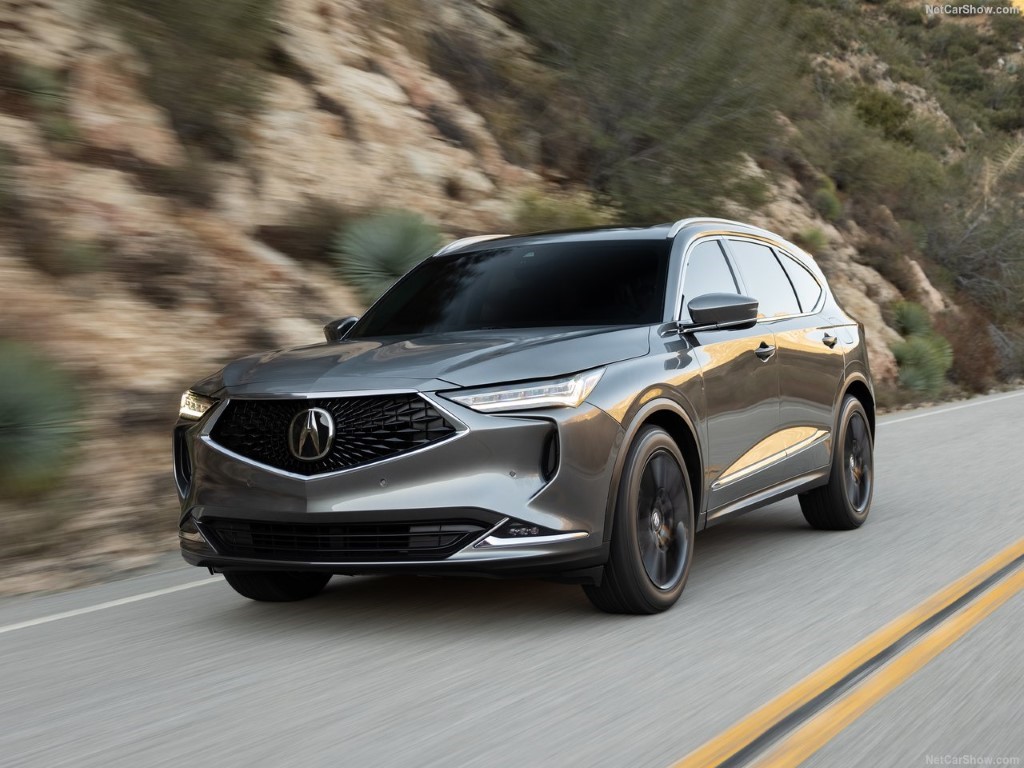
Launched as Acura's new flagship, the 2022 MDX adopted the mantra "Performance Crafted Precision". The vehicle grew in all dimensions and adopted a more athletic stance, with proportions that mimic rear-wheel-drive vehicles.
Chassis Engineering: The Return of the Double Wishbone
The most celebrated technical change was the adoption of the Double Wishbone front suspension, replacing the MacPherson strut. This allowed for superior control of tire camber in corners, drastically increasing mechanical grip and isolating vertical movements from the steering for purer feedback.
The Pinnacle of Performance: MDX Type S
The MDX Type S, launched in late 2021, is Acura's fastest SUV. Equipped with an exclusive 3.0L Turbo V6 (355 hp and 480 Nm), adjustable air suspension, and Brembo brakes, it competes directly with six-cylinder German rivals.
2025 Update
The mid-cycle update focused on technology, eliminating the touchpad in favor of a 12.3-inch touchscreen, integrating Google Built-in, and introducing Bang & Olufsen audio.
Comparative Analysis and Conclusion
Generations Summary Table
| Generation | Years | Main Powertrain | Transmission | Technological Highlight | Production Location |
|---|---|---|---|---|---|
| 1st Generation | 2001-2006 | 3.5L V6 (240-265 hp) | 5-Speed Auto | VTM-4 AWD, folding 3rd row | Alliston, Canada |
| 2nd Generation | 2007-2013 | 3.7L V6 (300 hp) | 5/6-Speed Auto | SH-AWD, ADS Suspension | Alliston, Canada |
| 3rd Generation | 2014-2020 | 3.5L V6 (290 hp) / 3.0L Hybrid | 6/9-Speed / 7-DCT | Sport Hybrid, AcuraWatch, optional FWD | Lincoln, AL / East Liberty, OH |
| 4th Generation | 2022-Pres. | 3.5L V6 / 3.0L Turbo (355 hp) | 10-Speed Auto | Type S, Air Suspension, Double Wishbone | East Liberty, Ohio |
Analytical Conclusion
The Acura MDX is a case study in adaptation and resilience. It started as a risky bet in a non-existent segment and set the standard for 7-seater luxury crossovers. Its trajectory reveals a strategic oscillation between comfort and performance, culminating in the fourth generation that attempts to synthesize the sporty soul of the Type S with modern technological luxury. With over 1 million units sold, the MDX remains the backbone of Acura, proving the longevity of an SUV that evolves with its audience.