



Summary and Strategic Context (2000–2003)
The Vacuum in Acura's Portfolio
In the early 2000s, Acura faced a dilemma regarding identity and product positioning in North America. The brand had built its reputation in the 90s with the legendary Acura Integra, a model that offered sedan and coupe variants, serving as the entry point to the brand. However, with the transition from the Integra to the RSX in 2002, Acura made the strategic decision to offer the RSX exclusively as a two-door coupe. This created a significant vacuum in the product lineup: there was no compact, sporty sedan to compete with the growing popularity of the BMW 3 Series (E46 generation) and the Audi A4 (B6 generation), which dominated the "Yuppie" (young urban professionals) market.
The Acura TL sedan, although popular, was growing in size and price, moving into a higher segment. Acura needed a vehicle that was smaller, more agile, and focused on pure driving dynamics, something that would revive the spirit of the Integra Sedan, but with a superior level of refinement (NVH - Noise, Vibration, and Harshness), suitable for maturing buyers.
The "Global Accord" Strategy
Honda's solution to this problem was a brilliant exercise in global platform leveraging. At the time, Honda produced two distinct lines of vehicles under the "Accord" name:
- North American Accord: A large sedan, focused on comfort, rear space, and soft suspension, designed for wide American highways and the tastes of the average US consumer.
- Japanese/European Accord (CL7/CL9 Series): A significantly narrower, shorter, and sportier vehicle. This car was designed for the winding roads of Europe and the narrow streets of Japan, competing directly with compact executive sedans.
Acura decided to import the Japanese/European version of the Accord to North America, rebranding it as the Acura TSX (Touring Sport eXperimental). The model would be positioned as a premium sports sedan, filling the gap left by the Integra Sedan and serving as the new entry point for the brand's sedan lineup.
This strategic decision was fundamental. Unlike the American Accord, which utilized simplified suspensions in some versions and prioritized isolation, the TSX inherited the sophisticated double wishbone front suspension and multi-link rear suspension from the Japanese Accord Euro R, ensuring a superior dynamic foundation from the start.
First Generation (CL9): 2004–2008
The Era of Pure Engineering
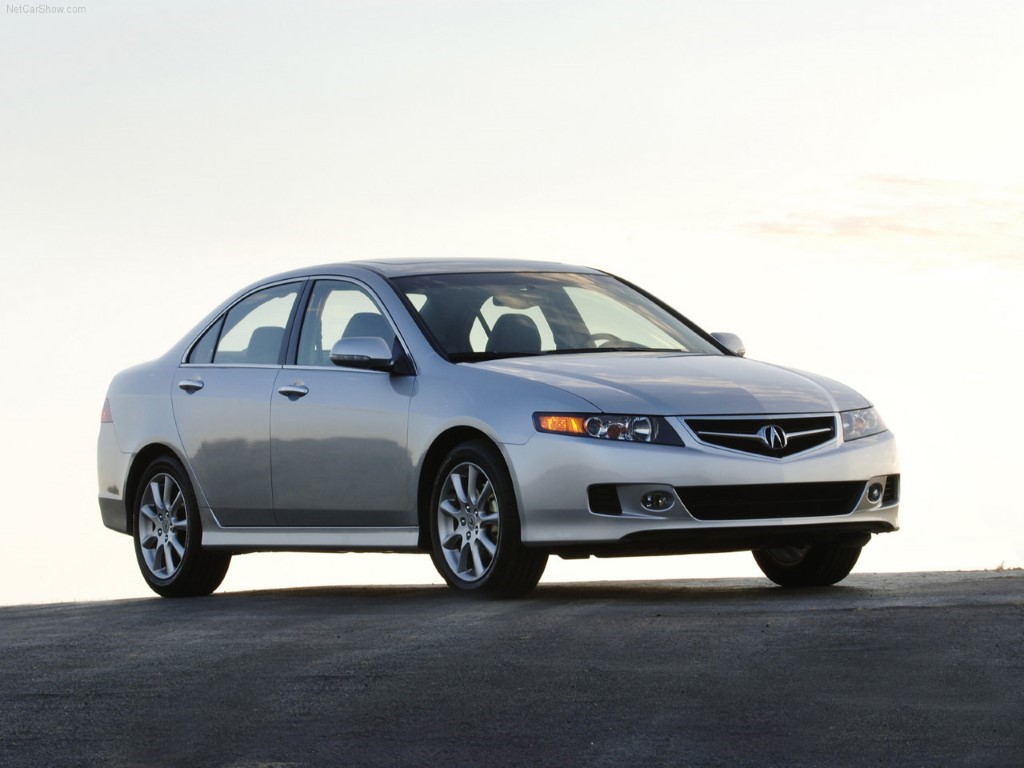
The first-generation TSX, internally designated by the chassis code CL9, is widely considered by automotive enthusiasts and engineers as one of Honda's high points in terms of mechanical balance. Produced exclusively at the Sayama plant in Japan, the model arrived at dealerships in April 2003 as a 2004 model.
Technical Analysis of the K24A2 Engine
The heart of the first-generation TSX is the 2.4-liter inline four-cylinder engine, code K24A2. This was not a "standard" Honda engine; it differed drastically from the versions of the K24 engine found in the CR-V or the American Accord of the time.
- Full i-VTEC Technology: Unlike the "economy" versions of i-VTEC that only acted on the intake for fuel economy, the TSX's K24A2 possessed the "true" performance VTEC system. The system altered the camshaft profile on both the intake and exhaust at high RPMs, allowing the engine to breathe freely up to its 7,100 rpm redline.
- Electronic Throttle (Drive-by-Wire): The TSX was one of the first to implement a refined electronic throttle system, designed to simulate the tactile and immediate response of a physical cable, eliminating the "lag" common in early electronic systems.
- Initial Specifications (2004-2005): The engine produced 200 HP (SAE Net) and 166 lb-ft of torque. Honda focused on linear power delivery, sacrificing the low-end torque typical of large engines in favor of an elastic and sporty response at high RPMs.
Transmissions and Chassis Dynamics
The TSX offered two transmission options, both of high technical quality:
- 6-Speed Manual: This gearbox is frequently cited as one of the best front-wheel-drive manual transmissions ever made. The casing was made of magnesium to reduce weight ahead of the front axle, improving weight distribution. The shifter throw was short and mechanical, evoking the feel of the Honda S2000.
- 5-Speed Automatic (SportShift): A robust unit that allowed for sequential manual shifts. The standout feature of this gearbox was the Grade Logic Control system, which detected inclines and declines, holding gears longer to prevent gear hunting and provide engine braking.
Suspension and Rigidity: The double wishbone front suspension architecture allowed for superior camber control during aggressive cornering, keeping the tire in optimal contact with the ground. This contrasted with the cheaper MacPherson strut suspension common in competitors, which tended to lose geometry under intense lateral load. The CL9 chassis was extremely rigid, utilizing high-strength steel in key points, which allowed Acura engineers to tune the suspension to be firm without being uncomfortable.
Evolution of the First Generation (2006 Facelift)
2004 and 2005 Models: The Launch
2004: Official launch. The car came very well equipped right out of the box, a strategy by Acura to differentiate itself from the Germans (BMW/Audi) who charged extra for almost everything. Items like a moonroof, heated leather seats, Xenon (HID) headlights, and a premium sound system were standard.
2005: Minor updates. The radio system gained XM Satellite Radio compatibility. There were tweaks to interior lighting, and heated side mirrors became standard on all trims.
The Great 2006 Facelift: Engineering vs. Marketing
The 2006 model year brought the most profound changes in the history of the first generation. Although visually the alterations were subtle, mechanically the car was re-engineered.
The SAE Horsepower Controversy: In 2006, the official listed power output rose to 205 HP (from 200 HP). However, this hides a much larger improvement. In 2005/2006, the SAE (Society of Automotive Engineers) revised its horsepower measurement standards to be much more stringent. If the 2004 engine (200 HP) had been measured by the new 2006 standards, it would have been rated around 189 HP. Therefore, the 2006 engine didn't just gain 5 horsepower; it gained about 15 to 16 true horsepower compared to the previous model, a significant performance jump that often goes unnoticed.
Breakdown of the 2006 Mechanical Improvements
To achieve this real gain, Honda performed surgery on the K24A2 engine:
- Intake: Airflow in the intake duct was increased from 95 liters/second to 110 liters/second. The intake valves were enlarged (+1 mm in diameter) and the camshaft profile was made more aggressive for greater duration and lift.
- Exhaust: The exhaust system was widened. The pipe diameter increased from 54mm to 57.2mm. The density of the catalytic converter cells was reduced (from 900 to 400 cells) to reduce backpressure, increasing exhaust flow from 115 to 125 liters/second.
- Engine Block: Additional ventilation channels were machined into the block to reduce internal crankcase pressure and pumping losses.
Aesthetic and Functional Alterations (2006)
- New, more angular front and rear bumpers.
- Redesigned side skirts and standard integrated fog lights.
- New 17-inch alloy wheels.
- Interior: New sporty steering wheel, addition of Bluetooth HandsFreeLink, and an auxiliary input for digital audio. The navigation system was updated with a faster processor and more points of interest.
2007 and 2008 Models: The Final Refinement
2007: Introduction of the Tire Pressure Monitoring System (TPMS) as standard. Few mechanical changes, consolidating the reliability of the 2006 package.
2008: The final year of the first generation. Acura launched new color options and kept the car unchanged, setting the stage for the next generation. This year is frequently the most sought-after in the used market as it is the most "mature" and bug-free version of the CL9 chassis.
Second Generation (CU2): 2009–2014
Maturity and Redefinition
Launched in March 2008 as a 2009 model, the second-generation TSX (CU2 chassis) arrived during a turbulent economic time (the global financial crisis). Acura's goal was to maintain sportiness but add more comfort, space, and technology, responding to criticisms that the first generation was "too small" by American luxury standards.
Design Evolution and Chassis Engineering
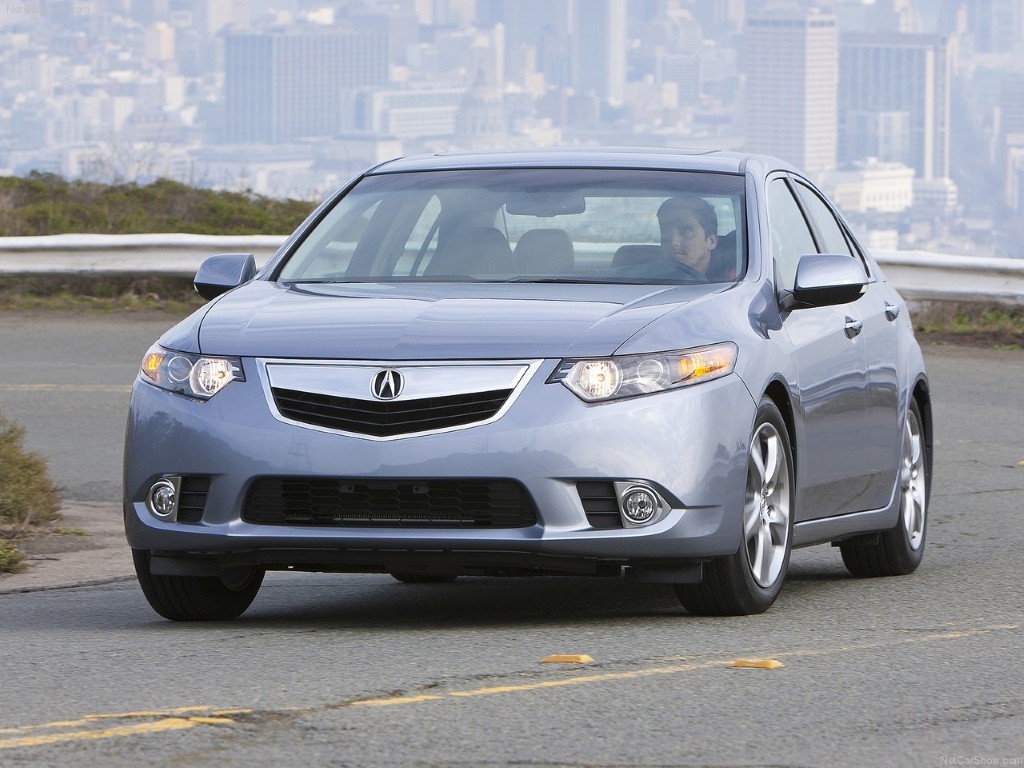
The new TSX grew. The width increased significantly (72.4 inches), and the wheelbase was extended to 106.5 inches. The design adopted Acura's controversial "Keen Edge" visual language, characterized by the prominent metallic front grille (dubbed the "beak" or "power plenum"), which proved divisive among purists.
- Steering Change (EPS): One of the most debated technical changes was the replacement of traditional hydraulic steering with Electric Power Steering (EPS). The EPS system was programmed with algorithms to compensate for crosswinds and road camber, reducing driver fatigue. While more fuel-efficient, many critics felt that the tactile road feedback — a hallmark of the first generation — was muted.
- Structural Rigidity: The body structure was radically improved with the introduction of the Advanced Compatibility Engineering (ACE) body structure. The use of new chassis frame rails and a closed-channel roof structure increased torsional rigidity, allowing for better protection in rollovers and frontal collisions.
Powertrain: K24Z3
The base 4-cylinder engine evolved into the K24Z3.
- Specifications: 201 HP at 7,000 rpm and 172 lb-ft of torque (manual transmission).
- Technical Differences: The compression ratio increased to 11.0:1. However, the exhaust manifold was now cast directly into the cylinder head (a single piece). This allowed for faster catalytic converter warm-up (improving emissions), but restricted maximum exhaust flow compared to the separate header design of the previous generation, making performance modifications (tuning) more difficult.
Lineup Expansion: V6 and Sport Wagon
The second generation saw Acura attempt to expand the TSX's appeal into two new sub-segments, resulting in some of the rarest and most interesting versions in the model's history.
The TSX V6 (2010–2014): American Power
In 2010, responding to demands that the TSX needed "more engine" to compete with the BMW 328i and Lexus IS350, Acura introduced the 3.5-liter J35Z6 V6 engine to the sedan.
- Numbers: 280 HP at 6,200 rpm and 254 lb-ft of torque.
- Dynamics: The V6 model came only with a 5-speed automatic transmission. To handle the extra weight of the large engine up front, Acura recalibrated the front suspension springs and retuned the dampers. While very fast in a straight line, the V6 suffered from greater understeer in corners due to the nose-heavy weight distribution.
- Market: The TSX V6 was a niche product. Its price placed it perilously close to the base Acura TL, which was a larger car. As a result, sales were limited, making it a rarity today.
The TSX Sport Wagon (2011–2014): The Unicorn
Launched as a 2011 model, the TSX Sport Wagon is perhaps the most cult-followed version of the model. It was, essentially, the Honda Accord Tourer sold in Europe, brought to the US to compete with the Audi A4 Avant and the BMW 3 Series Touring.
- Unique Configuration: The Wagon was offered only with the 4-cylinder engine (2.4L) and automatic transmission. There was no V6 or manual version in the US, a decision that frustrated many enthusiasts but was based on Acura's market analysis that manual wagons didn't sell in enough volume to justify homologation.
- Utility: It offered 66.2 cubic feet of cargo space with the rear seats folded, more than many compact SUVs of the time. The rear design was distinct, with a sloping roofline that prioritized style without completely sacrificing utility.
- Extreme Rarity: Production was minuscule. In 2011, only 3,210 units were sold. In 2014, its final year, only 640 units left the dealerships. It's estimated that only around 10,000 units exist in North America, making it a guaranteed future classic.
Chronological Evolution Gen 2 (2009–2014)
2009–2010: The Early Years
2009: Launch. Introduction of the "Technology Package," which included the acclaimed 10-speaker ELS Surround sound system designed by Grammy-winning audio engineer Elliot Scheiner. This system is frequently cited as one of the best factory audio systems in any car under $50,000 at the time.
2010: Launch of the V6 model. Updates to the navigation system to include real-time traffic and weather.
2011: The Mid-Cycle Facelift
The 2011 model brought crucial refinements to address complaints about noise and aesthetics.
- NVH (Noise, Vibration, and Harshness): Acura installed thicker side glass, an acoustic windshield, and additional insulation in the floorpan and A/B/C pillars. This made the cabin significantly quieter at highway speeds.
- Aesthetics: The front grille was subtly redesigned to be less "aggressive," with thinner slots. The taillights received revised lenses.
- Efficiency: Internal engine improvements (friction reduction) slightly increased fuel economy.
2012: Special Edition and Final Refinements
Special Edition (SE): Launched in 2012 to celebrate the sportiness of the 4-cylinder engine. The SE included a more aggressive aerodynamic kit (front, side, and rear underbody spoilers), exclusive 17-inch dark-finish polished wheels, and an interior with perforated suede seats (Lux Suede) featuring red stitching. There were no power changes, but the aesthetics evoked the old Euro R.
2013-2014: Final years of production. The TSX remained largely unchanged as Acura prepared its successor, the TLX (which would replace both the TSX and the TL).
Competitive Dynamics, Legacy, and Market
Competitive Dynamics and Global Comparison
It is crucial to position the TSX correctly on Honda's global map to understand its unique characteristics.
TSX vs. Honda Accord (Brazil/USA)
Many consumers confuse the TSX with the Honda Accord sold in Brazil or the US.
- The Platform Difference: The Accord sold in Brazil up to the 7th/8th generation was the "Global/American" model, a wide car focused on comfort. The TSX (Accord Euro) shares very few parts with this model. The TSX is narrower, has a shorter wheelbase, and a completely different chassis calibration. While the Brazilian Accord "floats" down the road, the TSX "reads" the road.
- Interchangeability: Suspension parts, body panels, and headlights are not interchangeable between the Brazilian/American Accord and the Acura TSX.
TSX vs. German Competitors
The TSX was designed to attack the BMW 325i/328i and the Audi A4 1.8T/2.0T.
- TSX Advantage: Superior electronic and mechanical reliability, lower cost of ownership, and a list of standard equipment that would be optional on the Germans.
- Disadvantage: Lack of Rear-Wheel Drive (RWD) or All-Wheel Drive (AWD) – except in markets outside the US where the Accord Euro had an AWD option, the American TSX was always FWD (front-wheel drive), which limited its appeal to drift purists or extreme performance seekers.
Legacy on the Track (RealTime Racing)
The TSX's credibility as a sports car was cemented on the track by the Wisconsin-based RealTime Racing team.
- Dominance in the SCCA World Challenge: Under the leadership of driver and owner Peter Cunningham, RealTime Racing adopted the TSX (1st Generation) to replace the victorious Integra Type R and RSX in the Touring Car category of the SCCA World Challenge. The race cars retained the original steel unibody and used K24 engines with reinforced internals, but based on the production architecture. The TSX dominated the category, winning the Manufacturers' Championship for Acura in 2005, 2008, and 2009.
- The V6 and GTS Era: With the arrival of the second generation, RealTime Racing moved up a category to the GTS class. They equipped the CU2 chassis with the J35 V6 engine, competing against the Ford Mustang Boss 302 and Chevrolet Camaro. Against all odds, the front-wheel-drive sedan (now extensively modified) won races against rear-wheel-drive muscle cars, proving the excellence of Honda/Acura's chassis engineering.
Market and Production Report
The TSX's sales trajectory directly reflects the economic health of the US and the shift in consumer preference toward SUVs.
| Calendar Year | Total Sales | Wagon (Only) | Contextual Analysis |
|---|---|---|---|
| 2003 | 18,932 | N/A | Partial launch (April-Dec) |
| 2004 | 30,365 | N/A | First full year. Immediate success. |
| 2005 | 34,856 | N/A | Continuous growth. |
| 2006 | 38,035 | N/A | Historical peak. The facelift boosted demand. |
| 2007 | 33,037 | N/A | Stabilization. |
| 2008 | 31,998 | N/A | Resilience despite the financial crisis. |
| 2009 | 28,650 | N/A | Decline (Global recession/Gen 2 launch). |
| 2010 | 32,076 | 126* | Recovery with V6. (*Pre-production units). |
| 2011 | 30,935 | 3,210 | Official Wagon launch. |
| 2012 | 28,865 | 4,234 | Wagon sales peak. Gen 2 Facelift. |
| 2013 | 17,484 | 1,976 | Abrupt drop (Cannibalization by ILX/RDX). |
| 2014 | 5,647 | 640 | End of production. Remaining stock. |
| 2015 | 352 | - | Final inventory sales. |
| Total | ~292,000 | ~10,188 |
Data Interpretation: The Sport Wagon represents less than 4% of total production throughout the TSX's history, confirming its status as a "unicorn." The peak in 2006 demonstrates how well-received the mid-cycle refresh was. The drop in 2013/2014 was accelerated by Acura's decision to introduce the ILX as the new entry-level car.
Ownership and Technical Maintenance Guide
For current and future owners, the TSX is an extremely reliable car, but it has specific weak points that require attention.
First Generation Problems (2004-2008)
- A/C "Black Death": The Keihin brand A/C compressor tends to fail internally, sending metal shrapnel throughout the system. The repair requires replacing not just the compressor, but the condenser, evaporator, and lines, costing thousands of dollars.
- Power Steering Leaks: The steering rack develops leaks at the side seals. Fluid can leak into the boots, remaining invisible until it's too late. The heat from the K24 engine degrades the power steering pump hoses and O-rings.
- Center Console Lights: The backlights for the radio and climate control buttons fail due to cold solder joints on the printed circuit board (PCB).
Second Generation Problems (2009-2014)
- Excessive Oil Consumption (Pistons): Especially in 2009 and 2010 models. Honda identified that the piston oil rings could become clogged with carbon deposits, allowing oil to burn. Acura extended the warranty to 8 years/125,000 miles for some affected chassis.
- VTC Actuator (Cold Start Rattle): A ubiquitous problem in K-series engines. Upon starting the car cold, a loud metallic "rattle" noise is heard for 1-2 seconds. This occurs because the locking pin inside the VTC actuator gear wears out, allowing the gear to knock before oil pressure builds. While annoying, it rarely causes catastrophic engine failure, but replacement is the only cure.
- Rear Brake Calipers: The rear calipers tend to seize (lock up) due to corrosion on the slide pins, causing premature and uneven wear of the rear brake pads.
Conclusion
The Acura TSX occupies a unique place in automotive history. It represented the pinnacle of Honda's philosophy of "accessible luxury through superior engineering." While its successors (ILX and TLX) focused more on digital technology and visual design, the TSX – especially the first-generation CL9 – remained true to mechanical purity: double wishbone suspension, high-revving naturally aspirated engines, and tactile transmissions. With just under 300,000 units sold over a decade in the US, the TSX wasn't a mass-market volume car like the Toyota Camry, but it built a loyal fanbase. The V6 and Sport Wagon versions stand as testaments to Acura's willingness to experiment, and today they are coveted pieces in the used market. For the enthusiast seeking Japanese reliability with the soul of a European sports sedan, the TSX undeniably remains one of the best options ever produced.