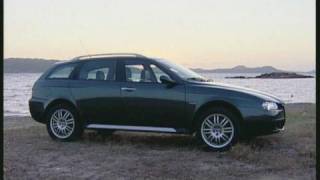
932 Series 1
(2000 - 2002)
2.5 L V6 Busso
192 cv

Technical specifications, versions, and history for the Alfa Romeo 156 SW.
Select a generation to see available versions
(2000 - 2002)

(2002 - 2003)

(2003 - 2006)

(2002 - 2005)
In the mid-1990s, Alfa Romeo found itself at a crossroads. Under the management of the Fiat Group since 1986, the Milanese brand was fighting an identity crisis. The years of industrial "synergies," focused on cost rationalization and the sharing of components between different brands, had diluted the essence that defined an Alfa Romeo: the passion, the bold design, and the engineering focused on driving pleasure, the famous Cuore Sportivo. The model that best represented this dilemma was the Alfa Romeo 155, the direct predecessor to the 156. Although it was a competent car with notable success on the touring car racing tracks, the 155 was frequently criticized for its "boxy" design and its shared origins with Fiat models, which distanced it from the emotional heritage of the brand. Alfa Romeo urgently needed a product that was not just a replacement, but an authentic declaration of rebirth.
That declaration arrived resoundingly in September 1997, at the Frankfurt Motor Show. The Alfa Romeo 156, known internally as Project 932, was revealed to the world, with a formal presentation to the international press in Lisbon, Portugal, shortly after. The reaction was almost universal acclaim. The design of the 156 was so innovative and harmonious that, overnight, it made all its rivals look dated. The impact on the public was equally overwhelming. In the first "open doors" weekend at dealerships, almost a million people went to see the new model up close, resulting in more than 100,000 orders in the following months, an unprecedented success for the brand.
The climax of this enthusiastic reception came in 1998, when the Alfa Romeo 156 was crowned with the prestigious "European Car of the Year" award. It was the first time that Alfa Romeo had won this title, an achievement that served as crucial validation of the company's new direction. The award was not just a trophy; it was the legitimization of the 156 as a true "savior," a car that, single-handedly, managed to put Alfa Romeo back on the global automotive map with credibility and admiration. Throughout its career, the 156 would accumulate more than 35 international awards, confirming its status as an icon. The success of the 156 was no accident, but the result of a deliberate repositioning strategy. Fiat and Alfa Romeo invested heavily in a unique design and cutting-edge technologies to clearly differentiate themselves from their corporate relatives and, more importantly, to challenge German dominance in the segment. The 156 was not just a new car; it was the materialization of a promise to return to its origins, a movement that not only saved the brand from a possible decline but also provided the financial and image capital for the development of future successes, such as the Alfa 147 and, many years later, the acclaimed Giulia.
The visual impact of the Alfa Romeo 156 cannot be understated. It was an automotive work of art that redefined expectations for the design of a family sedan. The mind behind this aesthetic revolution was Walter de Silva, who at the time headed the Centro Stile Alfa Romeo. His time at Alfa Romeo, between 1986 and 1999, was marked by the renewal of the brand's design language, and the 156 was his masterpiece, a project that he himself considers one of the most important of his illustrious career, which would later lead him to oversee the design of the entire Volkswagen Group.
De Silva's approach to the 156 was one of modernity that respected memory. He consciously abandoned the wedge profile and straight lines that characterized the 155 and many cars of the era, opting for a harmonious, sophisticated, and almost feminine shape, with high flanks and curved surfaces that seemed sculpted by the wind. Inspiration came from timeless classics of the brand, such as the Alfa Romeo 1900, the Giulietta, and the Giulia, but the final result was not retro at all. The goal, according to the design team, was to dive deep into the brand's history to find the "essence of beauty" and translate it into a contemporary language. The result was a car that looked simultaneously classic and futuristic, capturing Alfa Romeo's sporting spirit through elegance and refinement, rather than pure aggression.
Several design elements of the 156 instantly became iconic, defining not only the car but the very identity of the brand for years to come.
The front of the 156 was dominated by the traditional scudetto, Alfa Romeo's shield-shaped grille. However, instead of being an element integrated into the bumper, the 156's scudetto was deep, prominent, and "invaded" the bumper's structure, extending downwards. This design decision, taken to preserve the integrity and historical importance of the grille, created a practical consequence that became a styling signature: the front license plate had to be shifted to the left side. What started as a technical necessity turned into one of Alfa Romeo's most recognizable and copied visual characteristics, conveying a sporty asymmetry and a disregard for conventions that perfectly fit the brand's personality.
The most celebrated and influential design innovation of the 156 was undoubtedly the rear door handle. Instead of being positioned on the door panel, it was cleverly "hidden" in the black window frame, next to the C-pillar. This genius visual trick disguised the car's four-door nature, creating the illusion of a sporty and elegant coupé. By emphasizing the front handles and hiding the rear ones, De Silva managed to combine the practicality of a family sedan with the exciting aesthetics of a two-door car. This solution was not just an aesthetic detail; it was a functional response to a fundamental design challenge and proved to be so effective that it was widely imitated by countless manufacturers in the following decades, in models as diverse as the SEAT León, the Honda Civic, and the Holden Barina Spark, solidifying the 156 as a true trendsetter.
The rest of the bodywork was a study in simplicity and fluidity. The surfaces were clean and uncluttered, with only two subtle creases over the wheel axles to define the waistline and add a touch of visual muscle. The rear was short and abrupt, with horizontal taillights that accentuated the width of the car. All this sculpting work was not just aesthetic; the 156 achieved an aerodynamic drag coefficient (Cd) of 0.31, a respectable value for the time that contributed to its efficiency and stability at high speeds.
The design philosophy centered on passion and performance continued inside. The cabin was conceived as a cockpit, with the instrument panel and center console clearly oriented towards the driver, reinforcing the idea that this was a car to be driven, not just to be transported in. The two main dials, the speedometer and the tachometer, were housed in deep, separate "binoculars," a clear homage to the dashboards of classic Alfas from the 60s, like the GTV and the Spider. At the top of the center console, three smaller dials for fuel, temperature, and the clock were equally angled towards the driver. The quality of the materials and attention to detail were evident, especially in the higher trim packages. The Lusso package offered a luxurious Momo mahogany wood steering wheel and gear knob, while the Sport package included Recaro sports seats and leather trim, creating an environment that was simultaneously elegant and sporty. The design of the 156 was so successful that it established a new visual dictionary for Alfa Romeo. Elements like the offset license plate, the prominent grille, and the flowing silhouette became an integral part of the brand's DNA, and its influence is undeniable in the design of the modern Alfa Romeo Giulia, a fact confirmed by Alfa's own head of design, Alessandro Maccolini. The 156 was not just a beautiful car; it was the architect of Alfa Romeo's visual identity for the 21st century.
The Alfa Romeo 156 was produced between 1996 and 2007, a period during which it underwent significant evolutions that kept it competitive and desirable. Its history can be divided into three distinct phases, each marked by mechanical, technological, and aesthetic updates that refined the original formula.
The first generation of the 156 laid the foundations for its success, offering a diverse range of engines and technological innovations that placed it ahead of its competitors.
The petrol range was the heart of the 156's driving experience.
The 156 marked a turning point not only for Alfa Romeo but for the entire automotive industry by being the first mass-produced car in the world to introduce common-rail direct injection technology in diesel engines. Developed by the Fiat Group, the JTD (Jet Turbo Diesel) system revolutionized the perception of diesel engines. For the first time, a diesel engine could offer levels of performance, silence, and refinement that rivaled their petrol equivalents, eliminating much of the noise and vibration characteristic of older diesels. The initial versions were the four-cylinder 1.9 JTD with 105 hp and the powerful five-cylinder 2.4 JTD with 136 hp.
Initially launched as a four-door sedan, the 156 family grew in 2000 with the introduction of the Sportwagon. True to its name, it was marketed as a "lifestyle wagon," with an advertising campaign starring actress Catherine Zeta-Jones. Its design took priority over cargo capacity, which, at 360 liters, was modest for the segment.
In terms of transmissions, in addition to the five-speed manual gearbox, two innovative options were introduced. The 2.5 V6 could be equipped with the Q-System, a four-speed automatic transmission that included an 'H' pattern selector, allowing manual shifts that simulated a traditional gearbox. For the 2.0 Twin Spark engine, starting in 1999, the Selespeed was available, a five-speed automated manual gearbox with steering wheel controls (initially buttons, then paddles), offering a driving experience inspired by Formula 1.
The first versions of the 156 could be personalized with different trim packages to reflect the owner's preferences:
In 2002, the 156 received its first major update, focused mainly on the interior and the introduction of a new petrol engine.
The second major update, in 2003, brought a new exterior appearance, signed by another automotive design legend, Giorgetto Giugiaro.
| Engine | Displacement | Power (hp @ rpm) | Torque (Nm @ rpm) | 0-100 km/h (s) | Max. Speed (km/h) |
|---|---|---|---|---|---|
| 1.6 Twin Spark | 1598 cc | 120 @ 6300 | 144 @ 4500 | 10.5 | 200 |
| 1.8 Twin Spark | 1747 cc | 144 @ 6500 | 169 @ 3500 | 9.3 | 210 |
| 2.0 Twin Spark | 1970 cc | 155 @ 6400 | 187 @ 3500 | 8.6 | 216 |
| 2.5 V6 24v | 2492 cc | 190 @ 6300 | 222 @ 5000 | 7.3 | 230 |
| 1.9 JTD | 1910 cc | 105 @ 4000 | 255 @ 2000 | 10.4 | 188 |
| 2.4 JTD | 2387 cc | 136 @ 4200 | 310 @ 2000 | 9.5 | 203 |
| Engine | Displacement | Power (hp @ rpm) | Torque (Nm @ rpm) | 0-100 km/h (s) | Max. Speed (km/h) |
|---|---|---|---|---|---|
| 1.6 Twin Spark | 1598 cc | 120 @ 6200 | 146 @ 4200 | 10.5 | 200 |
| 1.8 Twin Spark | 1747 cc | 140 @ 6500 | 163 @ 3900 | 9.4 | 208 |
| 2.0 JTS | 1970 cc | 165 @ 6400 | 206 @ 3250 | 8.2 | 220 |
| 2.5 V6 24v | 2492 cc | 192 @ 6300 | 218 @ 5000 | 7.3 | 230 |
| 1.9 JTD 8v | 1910 cc | 115 @ 4000 | 275 @ 2000 | 10.3 | 191 |
| 1.9 JTDm 16v | 1910 cc | 140 @ 4000 | 305 @ 2000 | 9.3 | 209 |
| 1.9 JTDm 16v | 1910 cc | 150 @ 4000 | 305 @ 2000 | 9.1 | 212 |
| 2.4 JTDm 20v | 2387 cc | 175 @ 4000 | 385 @ 2000 | 8.3 | 225 |
In addition to the regular range, the 156 gave rise to special versions that became legendary among enthusiasts, each with a very defined purpose and personality.
Launched at the Frankfurt Motor Show in 2001, the GTA version resurrected one of the most sacred acronyms in Alfa Romeo's history, which stands for Gran Turismo Alleggerita (Lightened Grand Touring), a direct tribute to the victorious Giulia Sprint GTAs of the 60s. The goal was clear: to create a high-performance sedan to directly challenge the German icons of the segment, like the BMW M3 and the Mercedes-Benz C-Class AMG.
The central element of the GTA was, unsurprisingly, its engine. Alfa Romeo took the already exceptional V6 Busso and increased its displacement from 2.5 to 3.2 liters. The result was a masterpiece of engineering, capable of delivering 250 hp at 6,200 rpm and 300 Nm of torque at 4,800 rpm. This engine, known for its melodious sound and its linear and thrilling power delivery, was coupled with a six-speed manual gearbox or a reinforced version of the Selespeed robotic transmission, also with six speeds. Performance was top-tier: acceleration from 0 to 100 km/h in just 6.3 seconds and a maximum speed of 250 km/h.
The GTA was much more than just a powerful engine. Each car was assembled on a dedicated production line, receiving a series of modifications to transform the 156 into a pure performance machine. The bodywork was widened and equipped with exclusive bumpers, side skirts, and a rear extractor, giving it a more aggressive stance and improving aerodynamics. The suspension was completely revised, with a reduced ride height, firmer springs and shock absorbers, thicker anti-roll bars, and aluminum components to reduce unsprung weight. The steering, already fast on the normal 156, became even more direct on the GTA, with only 1.75 turns lock-to-lock, which Alfa Romeo claimed to be the most direct steering of any mass-produced car at the time. To stop all this performance, the braking system was handed over to Brembo, with large 305 mm ventilated discs at the front (later increased to 330 mm in November 2003) and four-piston calipers.
The 156 GTA was produced in very limited numbers, which increases its status as a future classic. In total, 4,651 units were manufactured, including the sedan and Sportwagon versions. Production ended in October 2005, when the V6 Busso engine no longer met new emissions standards and the 156 was being replaced by the 159. The distribution was as follows:
At the end of its life cycle, in 2004, the 156 ventured into new territory with the launch of the Crosswagon Q4, Alfa Romeo's response to the emerging crossover market. This model was not just a styling exercise; it represented an attempt to expand the 156's appeal to an audience looking for more versatility and capability in all weather conditions.
The heart of the system was the Q4 permanent all-wheel drive. This system used three differentials, with a Torsen C center differential that dynamically distributed torque between the axles. In normal grip conditions, the distribution slightly favored the rear axle (58% to the rear, 42% to the front), giving the car a behavior closer to rear-wheel drive and improving agility.
Aesthetically, the Crosswagon clearly distinguished itself from the other versions. The ride height was raised by 6.5 cm, and the bodywork received grey plastic cladding on the bumpers and wheel arches, as well as aluminum-look inserts, giving it a more robust and adventurous visual. It was available exclusively with the 1.9 JTDm 16-valve engine with 150 hp. For those who wanted the safety of all-wheel drive without the crossover look, Alfa Romeo also offered the Sportwagon Q4, which combined the same drivetrain and engine with the bodywork and ride height of the standard Sportwagon.
The Crosswagon Q4 was the last variant of the 156 to be discontinued, remaining in production until the end of 2007, two years after the end of production of the standard sedan and Sportwagon. These versions represent two distinct strategies: the GTA was a "halo car," designed not to sell in volume, but to lend its prestige and aura of performance to the entire 156 range. On the other hand, the Crosswagon was a market experiment, a test for Alfa Romeo's entry into the crossover segment, a move whose importance would only become fully clear years later with the launch of the successful Stelvio SUV.
The Alfa Romeo 156 didn't just shine on the roads; it also became a dominant force in motorsport, continuing the brand's rich tradition in touring car racing, where its predecessor, the 155, had already achieved great success.
Prepared by N.Technology, the racing division of the Fiat Group, the racing 156 completely dominated the European Touring Car Championship (ETCC) in the early 2000s. The official Alfa Romeo team won the drivers' title for three consecutive years, with Fabrizio Giovanardi winning in 2001 and 2002, and Gabriele Tarquini taking the title in 2003. This period of dominance cemented the 156's reputation as a true race car, capable of overcoming strong competition from brands like BMW.
One of the most interesting and often misunderstood aspects of the 156's success in the ETCC is related to its engine. Many believed that the race car was based on the GTA road version and, therefore, used the V6 Busso engine. However, due to Super 2000 category regulations, this was not allowed. In reality, the heart of the racing machine was an extensively modified, high-revving version of the four-cylinder 2.0 Twin Spark engine. This engine, featuring a dry sump and almost completely redesigned, was capable of producing around 310 hp of power at over 8,200 rpm, a remarkable feat for a naturally aspirated 2.0-liter engine.
Alfa Romeo knew how to capitalize on this track success brilliantly. The visual association between the victorious race car and the GTA road model, which shared the same aggressive silhouette, was an extremely powerful marketing tool. Although the engines were completely different, the "win on Sunday, sell on Monday" strategy worked perfectly. The ETCC victories created an aura of invincibility and performance that transferred to the entire 156 range, making the road model, and particularly the GTA with its V6, even more desirable in the eyes of the public. It was a classic example of how sporting success can be used to build and strengthen the image of a brand and a specific model.
The trajectory of the Alfa Romeo 156 in the Brazilian market was marked by exclusivity and a range configuration adapted to local tastes, different from the vast offering available in Europe. The model was officially imported by Fiat and arrived in Brazil in 1998, already as a 1999 model line, to compete in the prestigious luxury sedan segment against established German rivals, such as the Audi A4 and the BMW 3 Series.
Upon its launch in Brazil, the 156 was available in two main versions, both equipped with the highly praised 2.0 Twin Spark 16-valve engine, which produced 155 hp, and coupled with a five-speed manual gearbox.
Despite the acclaimed design, sales in Brazil did not reach the expected volumes. To revitalize interest in the model, in 2002 (already as a 2003 model), Fiat changed the strategy. The 2.0 Twin Spark engine was discontinued, and the 156 began to be imported in a single version, equipped with the 190 hp 2.5 V6 "Busso" engine. However, to suit the Brazilian luxury car market's preference, this engine came exclusively coupled with the four-speed Q-System automatic transmission.
The station wagon version, the beautiful Sportwagon, was also officially imported, but in extremely limited numbers. Only 146 units arrived in Brazil, making it a very rare item today and highly coveted by collectors and brand enthusiasts.
One of the most fascinating stories of the 156 in Brazil involves a very special batch of cars. In 2001, Fiat imported eight units of the 156, model year 1999, equipped with the combination most desired by purists: the 2.5 V6 "Busso" engine coupled with the six-speed manual gearbox. These cars were not intended for public sale, but rather for the exclusive use of Fiat of Brazil's board of directors. Years later, these examples were sold on the used market and, due to their rarity and unique configuration in the country, they became true collector's items, known among "Alfistas" as the "Alfas da Diretoria" (Alfas of the Board).
The importation strategy for the 156 in Brazil demonstrates a clear adaptation to the dynamics of the local market. The transition from the manual 2.0 to the automatic 2.5 V6 reflects the perception that the Brazilian luxury car consumer values the power of a larger engine and the comfort of an automatic transmission more than the purity of a manual gearbox. The limited offering of versions, excluding diesel engines and entry-level models, and the extreme rarity of the Sportwagon and the manual V6 versions, positioned the 156 in Brazil as a niche product, focused on image and style, in contrast to its position as a volume model in Europe.
The Alfa Romeo 156 left an indelible mark on Alfa Romeo's history and the automotive world. Its legacy is measured not only by its commercial success but also by its lasting influence on design and engineering, and by the special place it occupies in the hearts of enthusiasts.
The 156 was undoubtedly one of the greatest commercial successes in Alfa Romeo's history. During its production cycle, between 1996 and 2007, a total of 673,435 units were manufactured. Some official brand sources round this number up to about 680,000 units. This sales volume was crucial to the company's financial health in the late 90s and early 2000s. The model's success was so significant that it tripled Alfa Romeo's market share in the competitive European D segment, going from 0.7% in 1996 to 3.2% in 2001. In the same period, the brand's total sales recorded an impressive growth of 72%.
| Version | Units Produced / Imported |
|---|---|
| Total Production (Global, 1996-2007) | 673,435 |
| Total GTA Production (Global) | 4,651 |
| - GTA Sedan (Manual) | 2,625 |
| - GTA Sedan (Selespeed) | 348 |
| - GTA Sportwagon (Manual) | 1,174 |
| - GTA Sportwagon (Selespeed) | 504 |
| Official Importation to Brazil (Sedan) | 1,492 |
| Official Importation to Brazil (Sportwagon) | 146 |
Today, the Alfa Romeo 156 is an accessible modern classic and an excellent gateway into the world of the "Alfisti". However, like any Italian car with character, it requires attention to certain points before purchasing.
Despite its qualities, the 156 has known weak points that require careful inspection.
The Alfa Romeo 156 transcends its condition as a mere automobile to establish itself as a true turning point in the history of the Milanese brand. Launched at a critical moment, it not only replaced a functional but unloved predecessor, but it also redefined Alfa Romeo's identity for the 21st century. It was tangible proof that the brand, even under the umbrella of a large industrial group, could rediscover its soul and create a product that was, unequivocally, an Alfa Romeo in its purest state.
Its success was multifaceted. Walter de Silva's design was a masterpiece of balance, combining sensuality and sportiness in a way that influenced the entire industry. Technologically, it was a pioneer, democratizing the revolutionary common-rail technology that forever transformed diesel engines. And, more importantly, on the road, it delivered the promise of the Cuore Sportivo with agile driving dynamics and charismatic engines that enveloped the driver in a complete sensory experience.
Its legacy is enduring. The 156 not only ensured the survival and relevance of Alfa Romeo, but also laid the aesthetic and philosophical foundations for future models, including the acclaimed Giulia. Today, more than two decades after its launch, the 156 continues to be celebrated by enthusiasts worldwide as one of the most beautiful and exciting sedans ever produced. It was, in short, the car that saved Alfa Romeo, giving it back the brilliance, passion, and respect that its history deserved.