


Origins and Development Context
The post-World War II period required the Italian manufacturer Alfa Romeo to undergo a profound operational and strategic transformation. Until the end of the 1940s, the company was recognized for the almost artisanal production of highly sophisticated and expensive luxury cars, such as the six-cylinder 6C 2500 line. However, the new post-war economic reality significantly reduced the demand for these niche vehicles. To survive, the company's board realized it needed a modern passenger vehicle, smaller and designed for mass production, that could achieve high sales volumes without giving up the sporty performance inherent to the brand's identity.
The development of the new model was led by chief engineer Orazio Satta Puliga. The first prototype of the vehicle was unofficially presented at the Turin Motor Show in May 1950. However, due to aesthetic similarities with a competing FIAT project, the original design was considered unsatisfactory and returned to the drawing board. With the collaboration of Gaetano Ponzoni, from the renowned coachbuilder Touring Superleggera, the design team refined the car's lines. The definitive model was officially presented to the press and the public in October 1950, during the Paris Motor Show.
Named the Alfa Romeo 1900, the model represented three historical revolutions for the Milanese manufacturer:
- It was the brand's first automobile built entirely on an automated assembly line at the Portello plant in Milan.
- It was the brand's first mass-produced car to dispense with the separate chassis in favor of an integrated unibody structure.
- It became the first Alfa Romeo model to come factory-equipped with left-hand drive as standard, catering to the international market.
With the commercial slogan "The family car that wins races", Alfa Romeo managed to position the 1900 Berlina as a practical and spacious everyday sedan, but with mechanical attributes capable of making it win important touring competitions of the time, such as the Targa Florio and the Stella Alpina.
Technical Design and Construction Characteristics
The architecture of the Alfa Romeo 1900 Berlina combined innovative engineering solutions to ensure superior dynamic behavior. The unibody structure was designed to offer excellent torsional rigidity. The car featured a wheelbase of 2,630 mm, an overall length of 4,400 mm, a width of 1,600 mm, and a height of 1,490 mm. The vehicle's dry weight was approximately 1,100 kg for the first version, and its aerodynamic drag coefficient (Cd) was 0.46, a competitive mark by the standards of a 1950s family sedan. The luggage capacity was 380 liters and the fuel tank held 53 liters.
Mechanically, the inline four-cylinder engine was installed in a front longitudinal position, transmitting power to the rear axle. The front suspension was independent, composed of overlapping arms (double wishbones), coil springs, and telescopic hydraulic shock absorbers. The rear used a solid axle very well anchored by longitudinal radius arms and a central triangular arm, supported by coil springs. This setup prevented the excessive oscillations common in other cars of the time. The braking system featured four-wheel drum brakes.
The engine featured advanced characteristics inherited from the race tracks. The block was made of cast iron, but it received a light alloy cylinder head with hemispherical combustion chambers and chain-driven dual overhead camshafts (DOHC). Due to the shortage of industrial materials and components in post-war Italy, Alfa Romeo outsourced the manufacturing of some internal engine parts, importing Hepolite brand pistons from the United Kingdom with an 82.55 mm bore. To withstand high temperatures and sporty rpm regimes, the engine valves were sodium-filled, and the valve seats were machined from hardened stellite alloys.
The first models left the factory with 6.00-16 Pirelli Stella Bianca bias-ply tires. Starting in 1952, the manufacturer adopted the new 165HR400 Pirelli Cinturato radial tires, an innovation that significantly improved the sedan's steering precision and cornering stability.
Timeline and Evolution of the Powertrains
Throughout its life cycle from 1950 to 1959, the Alfa Romeo 1900 Berlina's engine underwent gradual modifications to offer more power and better drivability. The factory-prepared sports versions, known by the acronyms TI (Turismo Internazionale) and TI Super, paved the way for the brand's dynamic success on the tracks and streets.
At launch in 1950, the basic version (Normale) utilized the Type 1306 engine with 1,884 cc of displacement. Equipped with a single Weber or Solex carburetor, the engine produced between 80 hp and 90 hp at 4,800 rpm, allowing for a top speed of 150 km/h to 163 km/h.
In 1951, the manufacturer introduced the 1900 TI. This sporty version used the same 1,884 cc block, but received significant improvements: the compression ratio increased from 7.5:1 to 7.75:1, the intake valves were enlarged from 38 mm to 41 mm (and the exhaust valves from 34 mm to 36.5 mm), and the engine was now fed by a Weber 40 DCA 3 twin-choke carburetor or two Solex 40 PII twin-choke carburetors. These changes raised the power to 100 hp at 5,500 rpm, increasing the top speed to 170 km/h.
In 1954, a restructuring of the range took place under the direction of Francesco Quaroni and Giuseppe Luraghi. The engine bore was expanded from 82.55 mm to 84.5 mm (maintaining the 88 mm stroke), which generated a new 1,975 cc displacement block known as the Type 1308.
This new 2.0-liter engine equipped two new four-door versions:
- 1900 Super: Replaced the basic Normale model. Focused on smooth operation and higher torque, it produced 90 hp at 5,200 rpm using a single Solex 40 PAJ carburetor, with a top speed of 160 km/h.
- 1900 TI Super: Strictly aimed at high performance. Equipped with an 8.0:1 compression ratio, reworked camshafts, and two twin-choke Weber carburetors, it generated 115 hp at 5,500 rpm. This version reached a top speed of 180 km/h and was mated to a four-speed manual gearbox (although special racing versions and derivative coupes used five-speed transmissions).
| Model Version | Production Period | Engine (Code) | Displacement | Power | Maximum Torque | Top Speed |
|---|---|---|---|---|---|---|
| Berlina Normale | 1950–1954 | Type 1306 | 1,884 cc | 80–90 hp @ 4,800 rpm | 140 Nm @ 3,500 rpm | 150–163 km/h |
| Berlina TI | 1951–1953 | Type 1306 | 1,884 cc | 100 hp @ 5,500 rpm | 130 Nm @ 3,000 rpm | 170 km/h |
| Berlina Super | 1954–1959 | Type 1308 | 1,975 cc | 90 hp @ 5,200 rpm | 140 Nm @ 3,500 rpm | 160 km/h |
| Berlina TI Super | 1954–1957 | Type 1308 | 1,975 cc | 115 hp @ 5,500 rpm | 157 Nm @ 3,700 rpm | 180 km/h |
Design Updates and the 1954 Facelift
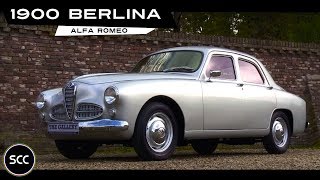
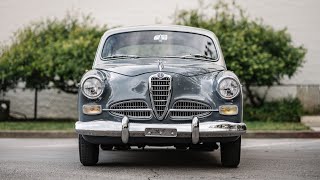
The original design of the four-door Berlina bodywork featured a clean aerodynamic proposal. Its fenders were integrated into the rest of the body without protrusions, adopting the modern visual concept of the early 1950s. In the front section, Alfa Romeo's traditional heart-shaped shield was accompanied by two horizontal air intakes positioned just below, conferring a sober and sporty appearance at the same time.
With the introduction of the "Super" series in 1954, Alfa Romeo promoted styling and comfort updates to keep the model competitive against more modern European luxury sedans.
The facelift's exterior styling modifications included:
- Adoption of new chrome details and trims on the bodywork.
- Front headlights and taillights with softened contours.
- Introduction of two-tone paint schemes (roof with a different shade than the base of the body) inspired by aesthetic trends coming from the United States.
The cabin also underwent an important functional evolution. In the first series (1950-1953), the Berlina was configured to accommodate up to six passengers thanks to two bench seats (front and rear) and the positioning of the gear lever mounted on the steering column, which eliminated the center console and increased interior space. The dashboard had a simpler finish with a single semi-circular dial for basic instrumentation.
After the 1954 facelift, the curved dashboard began offering refined leather or piano black finish options. The instrument panel was updated with new trims and, to improve control and ergonomics during more agile driving, Alfa Romeo began offering individual bucket-style sports seats in place of the front bench seat. The steering column-mounted gear lever was replaced, in the second series, by a floor-mounted lever.
Production Statistical Data
The Alfa Romeo 1900 assembly line ceased its activities in 1959. Over almost a decade of production, the Portello plant in Milan recorded the production of 21,304 vehicles belonging to the 1900 range. Of this total, the factory four-door Berlinas amounted to 17,390 units, consolidating itself as the brand's highest commercial volume model up to that point. The rest of the production consisted of the short-chassis coupe (Sprint) and cabriolet versions made for external coachbuilders (1900C), special competition variants, bare chassis (1,083 units of the 1900C and 91 units of the long L chassis), and the Matta AR51/AR52 4x4 military utility vehicle.
Most of the sedans were assembled in Italy, but there was also a small batch assembled under license at the S.A. Impéria plant in Nessonvaux, Belgium, between 1953 and 1954.
| Category / Berlina Version | Units Produced | Chronological Breakdown / Annual Production |
|---|---|---|
| Berlina Normale (1,884 cc) | 7,611 | 1950: 6 units 1951: 1,220 units 1952: 3,107 units 1953: 3,115 units |
| Berlina TI (1,884 cc) | 572 | Production concentrated from 1951 to 1953 |
| Berlina Super (1,975 cc) | 8,282 | Main production from 1954 to 1959 |
| Berlina TI Super (1,975 cc) | 478 | Main production from 1954 to 1957 |
| Berlina Primavera (Boano) | 300 | 1955: 4 units 1956: 286 units 1957: 10 units |
| Overall Berlina Total | 17,390 | Corresponds to approximately 81.6% of the entire 1900 range |
Special Derivations and Historical Legacy
The success and technical flexibility of the Alfa Romeo 1900 platform extended beyond conventional street cars. The solidity of its unibody structure and good suspension qualities gave rise to special projects, international partnerships, and epoch-making applications.
The Emergence of the "Pantera" in Italian Public Safety
In the early 1950s, the Italian State Police (Polizia di Stato) sought to renew its mobile patrol fleet with fast, robust vehicles capable of effectively combating crime. The corporation selected the Alfa Romeo 1900 TI and the powerful TI Super to become the first modern patrol cars specifically equipped for this service.
Painted in a glossy and aggressive black, the Berlina earned the popular nickname "Pantera" (Panther) due to its dynamic agility and powerful 115 hp engine. About 400 units of the sedan were adapted and supplied to the police with exclusive technical modifications:
- Metal grilles installed at the front of the vehicle to protect the tires against punctures or intentional collisions.
- Two-piece armored safety windshield.
- High-frequency radio transmitter integrated into the dashboard.
- A manual directional searchlight mounted on the driver's side.
- A folding flexible canvas roof that allowed officers to stand up inside the cabin to return enemy fire.
These cars became icons of police culture and Italian public safety during the 1950s.
Carrozzeria Boano and the Primavera
Seeking to explore new luxury markets, the manufacturer supplied rolling chassis to renowned coachbuilders to create exclusive coupes and convertibles. Carrozzeria Boano used the 1,975 cc structural and mechanical base of the Berlina Super to develop a highly stylized two-door coupe body called the "Primavera". Produced in an extremely restricted run of 300 units between 1955 and 1957, the Primavera drew attention for its elaborate two-tone paint and a curved, slanted "B" pillar that subsequently influenced other European automotive designs.
IKA Bergantín: An Alternative in Argentina
In the late 1950s, Industrias Kaiser Argentina (IKA) operated successfully in the local licensed production of the large Kaiser Carabela sedan and Jeep utilities at the Córdoba plant. To complement its production line and offer a smaller, more economical mid-size option, IKA negotiated with Alfa Romeo in 1959 the purchase of all the industrial machinery and stamping dies for the 1900 Berlina, which was being phased out in Italy.
The car was named the IKA Bergantín and its manufacturing began in March 1960. The vehicle consisted of a peculiar mix of Italian engineering with North American utility mechanics:
- The unibody structure and suspension system were identical to those of the 1900 Berlina.
- The basic powertrain consisted of the Argentine-made 2.5-liter Willys four-cylinder engine, which yielded 77 hp.
- In 1961, the option of the 115 hp 3.7-liter Continental inline-six engine was added.
- The rear driveshafts, drum brakes, and other peripherals were shared with the local Jeep and Estanciera line to reduce costs.
Aesthetically, IKA stylists altered Alfa Romeo's classic European look to give the car a more robust appearance to the taste of Argentine buyers. The traditional vertical shield-shaped grille was removed, making way for a wide horizontal grille placed between the headlights. The car also received full chrome hubcaps, whitewall tires, and two-tone paint to add sophistication.
The Bergantín's trajectory ended in February 1962, with just under 5,000 units sold. The main obstacle to the project was the severe wear of the original stamping dies acquired from Alfa Romeo. Already heavily worn by years of use in Milan, the tooling began to produce body panels with frequent defects and misalignments, making it difficult to maintain the minimum quality standards required by IKA on the Argentine assembly line and forcing the early discontinuation of the model.
Conclusions
The Alfa Romeo 1900 Berlina played a vital restructuring role for the brand in the post-war scenario. By ushering in the era of unibody construction and automated assembly lines in Milan, the model proved that Alfa Romeo could produce automobiles in an industrialized manner, without compromising its recognized sporty character and engineering refinement.
With more than 17,000 sedans manufactured, the 1900 established itself as Alfa Romeo's biggest commercial success up to the mid-1950s. The technological knowledge gained from developing the dual overhead camshaft engine and the serial production of the 1900 Berlina served as a direct basis for the creation of the Giulietta and Giulia lines. These subsequent models firmly consolidated the Italian manufacturer's global presence as a benchmark in high-volume sports sedans in the following decades.