



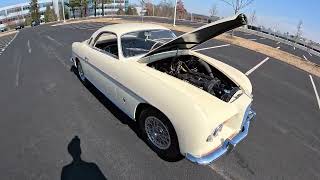

Introduction and Development Context
In the post-World War II period, Alfa Romeo had to completely restructure its production philosophy and commercial strategy to ensure survival in the European automotive market. Previous models, such as the legendary 6C and 8C series, were refined but demanded artisanal and expensive manufacturing methods, unviable for the new post-war economic scenario. Under the technical leadership of engineer Orazio Satta Puliga, the Italian manufacturer developed the Alfa Romeo 1900, launched in late 1950. The model represented a historical milestone in industrial restructuring by becoming the brand's first vehicle built entirely on an automated assembly line and the first to adopt an integrated unibody structure.
To promote the new four-door sedan (Berlina), the brand's commercial department used the famous advertising slogan "the family car that wins races". The four-cylinder engine with dual overhead camshafts offered excellent sporty performance, which quickly attracted the interest of private drivers and teams. To meet this competitive demand and support the renowned industry of independent Italian coachbuilders, Alfa Romeo made available a special version of the unibody called the 1900C. The letter "C" refers to corto (short in Italian), indicating a reduction in the wheelbase from 2,630 mm to 2,500 mm. This shortened base, extremely rigid and lightweight, served as a starting point for prestigious studios to create some of the most striking coupe and cabriolet bodies in history.
Mechanical Architecture, Suspension, and Braking Systems
The 1900C's technical project featured compact and efficient external dimensions, with a length of 440.5 cm, a width of 163 cm, and a height of 135 cm. The dry weight of the bodies varied between 1,000 kg and 1,100 kg, depending on the type of structure and the amount of aluminum used by the different specialized workshops.
The front suspension utilized double wishbones with coil springs and hydraulic telescopic shock absorbers supplied by Girling. At the rear, the suspension system underwent a major evolution during the model's early years. Initially, the rear solid axle was located by light alloy trailing arms and a transverse Panhard rod, which caused vibrations and instability in sharp and high-speed corners. To solve this lateral stability deficiency, Alfa Romeo engineers introduced a new arrangement consisting of two tubular steel trailing arms and two short diagonal arms connected to a central pivot positioned above the differential housing. This parallelogram arrangement eliminated unwanted oscillations and significantly improved the vehicle's grip and dynamic behavior.
The model's braking system featured finned aluminum hydraulic drums called "Alfin". These brakes had self-adjusting properties and integrated cooling ducts at the front to efficiently dissipate heat under severe use on racetracks. Regarding tires, the first 1900C units left the factory equipped with conventional 6.00-16 Pirelli Stella Bianca tires. However, from 1952 onwards, the manufacturer adopted the 165HR400 specification Pirelli Cinturato radial tires, often mounted on Borrani wire wheels with knock-off hubs to optimize steering responses.
Evolution of Engines and Transmissions
The 1900C engine was developed from high-strength racing block concepts, utilizing an inline four-cylinder cast iron block with a light alloy cylinder head and dual overhead camshafts (DOHC). A notable mechanical feature of the 1900's engine was the practical valve clearance adjustment system. The valve stems, with a diameter of 10 mm, had an internal thread into which a dog-leg shaped tappet was screwed, eliminating the need to remove the camshafts to change adjustment shims, which greatly facilitated the work of mechanics and tuners.
Between 1951 and 1959, the 1900C's engines were divided into two main powertrains associated with the model's generations and updates:
| Performance Specification | Sprint Version (1.9 Liters - 1951 to 1953) | Super Sprint Version (2.0 Liters - 1953 to 1959) |
|---|---|---|
| Block Code | Type 1306 | Type 1308 |
| Total Displacement | 1,884 cc | 1,975 cc |
| Bore x Stroke | 82.55 mm x 88 mm | 84.5 mm x 88 mm |
| Compression Ratio | 7.75:1 | 8.0:1 |
| Carburetion | Single downdraft Solex | Two Solex 40 PII twin-choke carburetors |
| Maximum Power | 100 hp @ 5,500 rpm | 115 hp @ 5,500 rpm |
| Top Speed | ~180 km/h | ~190 km/h |
| Transmission and Actuation | 4-speed manual (steering column) | 5-speed manual (column or center console) |
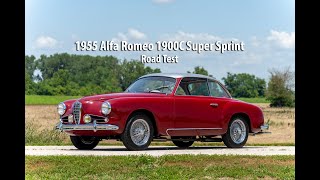
The initial Sprint version (1.9 liters) used the same mechanical configuration as the 1900 TI sports sedan, generating 100 hp to ensure agility in road competitions. In 1953, to honor the dynamic performance and extract more torque, Alfa Romeo increased the cylinder bore by 2 mm (from 82.55 mm to 84.5 mm), creating the "Super" engine line of 1,975 cc. In the strongest configuration used in the Super Sprint coupes (CSS), power was raised to 115 hp with the help of two Solex twin-choke carburetors and larger intake valves, which went from 38 mm to 41 mm.
From mid-1955, a profound mechanical revision replaced the single chain that drove the camshafts with two silent chains. This modification reversed the rotation of the camshafts and changed the cylinder firing order from 1-3-4-2 to 1-2-4-3, improving engine balance. The gearbox also evolved into a 5-speed transmission synchronized from second to fourth gear, with gear ratios optimized for the power curves of the Type 1308 powerplant.
The Four Series of the Touring Superleggera Coupe
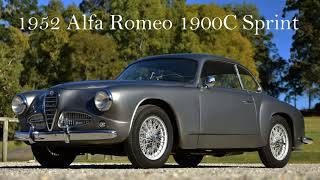
Due to the close relationship between the executives of Alfa Romeo and Carrozzeria Touring of Milan, the company received the task of producing the official sporty coupe version that would be sold directly in the brand's dealership network. Touring built the aluminum body using its patented Superleggera method, characterized by the lightness and structural rigidity obtained by attaching hand-formed aluminum alloy panels over a thin framework of steel tubes.
Although the historical documentation of the time shows discrepancies among the archives of the manufacturer, the historical registry of Touring, and the model's official club, the evolution of the Touring coupe is unofficially divided into four distinct series:
| Generation / Touring Series | Design Characteristics | Finish Differentiators | Units Produced |
|---|---|---|---|
| Series 1 (1951 - 1953) | 5-window coupe format with front end inherited from the sedan | Type 1 with long doors under the sills and flush door handles; Type 2 with shortened doors | 650 units |
| Series 2 (1954) | 5-window format with short doors over the sills | 1,975 cc Super engine and 5-speed column-mounted gearbox | 299 units |
| Series 3 (1954 - 1955) | 5-window format with larger glass areas and rear windshield | New front air vents, larger brakes, and center console-mounted gearbox | Part of the 854 Super Sprint units |
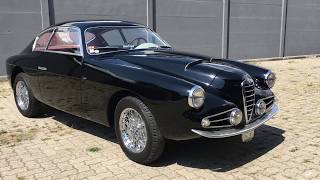
| Series 4 (1956 - 1958) | Rakish and sporty bodywork with only 3 windows | Clean look inspired by the Giulietta Sprint design | Part of the 854 Super Sprint units |
During the production of Series 1, Touring refined the model seeking manufacturing efficiency. The transition from Type 1 to Type 2 mainly consisted of shortening the doors so that they did not extend below the side sill line, simplifying the artisanal adjustments. The 1954 Series 2 was a temporary transitional model that adopted the updated 2.0-liter engine and the new 5-speed gearbox, but kept the previous short-door body and the column-mounted gear lever. Series 3 brought the aesthetic and ergonomic improvements the model needed, with enlarged windows and the highly requested sporty gear lever on the center console. Finally, Series 4 abandoned the classic five-window design in favor of a modern three-window fastback body, moving visually closer to the identity of the brand's new compact coupes.
The Pinin Farina Models: Coupe and Cabriolet
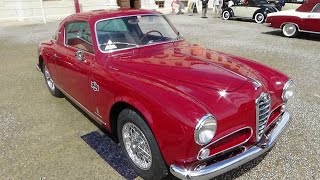
While Touring focused on purely sporty coupes, Alfa Romeo commissioned Carrozzeria Pinin Farina to manufacture a four-seater convertible version (Cabriolet) and a corresponding coupe. The goal of the studio led by Battista Farina was to create elegant models for everyday use, offering a refined option compared to the convertibles produced by other coachbuilders such as Stabilimenti Farina and Worblaufen.
Pinin Farina produced exactly 88 units of the Cabriolet and about 100 units of the Coupe on the short 1900C platform between the years 1952 and 1953, with the billing and delivery of some batches occurring in 1954. To ensure a competitive weight, the studio made extensive use of aluminum in molding functional panels, such as the inner fenders, doors, and structural trim linings, resulting in a weight increase of only 50 kg compared to Touring's aluminum coupe. Inside, leather was discarded in the first batches because Battista Farina considered it too common, opting to line the entire dashboard, doors, and roof with extremely high-quality mohair fabric.
The evolution of these versions followed a clear distinction between two production series:
- First Series (1952): Characterized by prominent dual air intakes on the hood (dual cowls) and bumpers with classic overriders.
- Second Series (1953/1954 Facelift): Introduced significant visual improvements to make the car's lines cleaner and more elegant. The hood lost the dual openings, the coupe's rear window was enlarged, and the bumpers lost the overriders. The instrument panel was completely redesigned, and additional modifications were made to the exterior door handles, side decorative trims, and the profile of the front fenders.
It is estimated that only about 30 units of these rare convertibles have stood the test of time, with only 21 documented examples remaining today, kept in prestigious private collections.
Special Editions and Independent Coachbuilders
The availability of the 1900C's shortened and rigid chassis allowed other renowned design firms to execute extremely low-volume projects or one-offs that marked the era of European automotive design:
- Zagato (1900 SSZ): Designed by the studio's heir, Elio Zagato, to cater to amateur and professional drivers competing in touring and GT categories, the model had only 39 units produced (plus two Spyder versions in 1957). The extremely light aluminum body eliminated superfluous weight, and the roof featured the famous "double bubble" contour to ensure the necessary headroom for helmet use. The hood featured prominent air scoops to accommodate the large Solex carburetors. Five of these cars participated in the legendary 1955 Mille Miglia race.
- Ghia and Ghia-Aigle: The Ghia studio produced 21 coupes based on the 1,884 cc and 1,975 cc chassis between 1954 and 1955, including the sporty Supergioiello variants. Additionally, Ghia built about 10 units of the extravagant "Ghia Special" designed by Giovanni Savonuzzi, with protruding fenders and aerodynamic rear fins. The Swiss subsidiary Ghia-Aigle assembled 8 cars based on the 1900 mechanics, notably a one-off elegant gold and silver cabriolet, which featured a two-tone red and gray leather interior and was exhibited at the 1955 Geneva Motor Show.
- Boano: Mario Boano designed and assembled coupe versions (Series 1 and Series 2) in 1956 on the 1900C Super Sprint chassis, adopting lines that strikingly echoed the traits of the Ferrari 250 GT of the time. The studio also developed a three-door version based on the original production sedan, dubbed the Primavera.
- Vignale: Built the iconic one-off "La Flèche" (The Arrow) on chassis AR1900C 01942, a futuristic conceptual convertible designed by Giovanni Michelotti and prominently displayed at the 1955 Turin Motor Show.
- Boneschi, Colli, and Stabilimenti Farina: The Stabilimenti Farina studio assembled 48 units of its refined Victoria Cabriolet in 1952. Boneschi produced two units of its exotic Astral Spider convertible in 1953, while Colli built exclusive sports coupes based on the same chassis.
Synthesis and Technical Conclusions
A detailed analysis of the Alfa Romeo 1900C's history reveals that the model was not only a success on the tracks and streets of post-war Europe, but also represented the closing of a fundamental chapter in the history of the Italian automobile. It was Alfa Romeo's last mass-produced model whose unibody chassis were supplied on a large scale to independent coachbuilders to apply custom designs. With technological advancement and the consolidation of more rigid and integrated production methods adopted in the following decades, this artisanal manufacturing practice became financially unviable. The 1900C series coupes and cabriolets remain as historical testimonies to performance-focused engineering and custom-made coachwork design.


