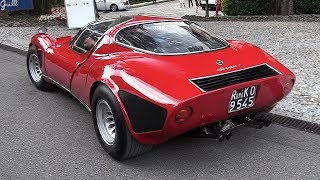
The contemporary resurrection of the model was officially revealed on August 30, 2023, under the
leadership of Alfa Romeo CEO Jean-Philippe Imparato. The project began to be outlined in June 2022,
inheriting part of the structural development of an Alfa Romeo supercar project that had previously been
shelved and repurposed to give life to the Maserati MC20. Designed by César Barreau under the direction of
Alejandro Mesonero-Romanos at Alfa Romeo's Centro Stile, the model serves as a modern tribute to the forms
created by Franco Scaglione.
Production was strictly limited to 33 custom-made units, all sold to selected collectors even before
the car's official unveiling through the "Bottega" customization program. The artisanal manufacturing was
delegated to the prestigious Carrozzeria Touring Superleggera, with production deliveries beginning in
December 2024 and recently concluded.
Although the new 33 Stradale shares the lower section of the carbon fiber monocoque chassis and the
front and rear aluminum subframes with the Maserati MC20, its upper structure is entirely new and exclusive.
Additionally, the air intakes, active double-wishbone suspension calibration, and semi-virtual steering
system were independently refined by Alfa Romeo.
A crucial technical difference lies in its internal combustion powertrain: the 3.0-liter twin-turbo
V6 engine, positioned longitudinally at the rear, is a direct development of the 2.9-liter V6 powerplant
used in the Quadrifoglio models of the Giulia and Stelvio. Unlike Maserati's Nettuno engine, Alfa Romeo's V6
does not use the pre-chamber combustion system, delivering an exclusive calibration of over 620 hp paired
with an 8-speed ZF dual-clutch automatic transmission that sends torque to the rear wheels via an electronic
limited-slip differential.
As an eco-friendly propulsion alternative, the manufacturer offered a 100% electric (BEV)
configuration composed of three permanent-magnet synchronous motors that produce a combined power of over
750 hp. This electric powertrain operates on an 800-volt high-voltage architecture with a battery of 102
gross kWh (90 usable kWh), ensuring zero to one hundred kilometers per hour acceleration in under three
seconds and an estimated range of about 450 km under the WLTP test cycle.
Despite the strong engineering appeal and the pioneering role the electric version would represent
for the Arese manufacturer, none of the 33 final buyers of the supercar opted for electric propulsion. Two
clients had initially ordered the electric version (BEV), but decided to alter the specifications of their
orders to the twin-turbo gasoline V6 powerplant during the car's technical detailing process.
This unanimous choice highlights a clear behavior in the artisanal collector supercar market: buyers
prioritize the auditory experience of the combustion engine, dynamic lightness (the combustion V6 model
weighs less than 1,500 kg, while the electric one exceeds 2,100 kg due to the heavy batteries), and purist
mechanical involvement over the silent instantaneous performance offered by electric systems.
The estimated value of each handcrafted example exceeded the $2 million range. The model currently
exhibits significant appreciation in the collector market, with remaining units being traded on the
secondary market for values ranging between 3 and 3.9 million euros.