1st Generation
(1968 - 1969)
2.0 L V8
266 cv

Technical specifications, versions, and history for the Alfa Romeo 33 Stradale.
Select a generation to see available versions
(1968 - 1969)

(2024-)
Select a powertrain to view full technical specifications
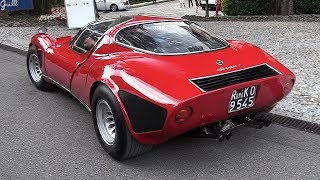
The Alfa Romeo 33 Stradale is widely recognized as one of the most beautiful and influential cars in the history of the global automotive industry. Originally conceived in the 1960s as a direct adaptation of a racing prototype for the streets, the model set new standards for performance, aerodynamics, and design. More than five decades later, the Italian brand has revived this lineage with a modern reinterpretation that unites the purist spirit of classic mechanics with contemporary propulsion technologies.
The story of the classic 33 Stradale began with the creation of Delta Automobili in March 1963, a company founded by engineer Carlo Chiti (former Ferrari designer) and Ludovico Chizzola. This operation functioned as an unofficial racing division of Alfa Romeo, being renamed Autodelta in 1963, becoming the manufacturer's official competition department.
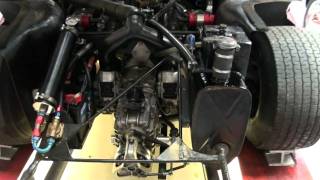
In 1965, the first Tipo 33 chassis, inspired by aeronautical engineering, arrived at Autodelta's facilities in Settimo Milanese, a strategic location near the Balocco test track. This initial chassis featured an asymmetrical "H" shaped structure made of riveted magnesium alloy tubes. A notable technical characteristic of this project was the location of the fuel tanks inside these enormous structural tubes, which ensured that the car's center of gravity and weight distribution remained perfectly balanced as fuel was consumed.
The first dynamic tests were carried out using a 1,570 cc four-cylinder engine inherited from the Alfa Romeo TZ2 competition model. However, the engineering team quickly developed an entirely new powertrain: a 2.0-liter V8 block with 260 horsepower. The first racing prototype built was nicknamed "Periscopica" because of the prominent air intake positioned above the cabin's roll bar. The competitive debut took place at the Fléron hill climb race near Liège, Belgium, driven by Autodelta's chief tester, Teodoro Zeccoli.
Driven by the car's success on the tracks, Alfa Romeo decided, in September 1967, to produce a limited run for civilian customers. The initial goal was to manufacture 50 units to homologate the car in the Group 4 racing category. The creation of the aesthetic design for the street version ("Stradale" in Italian) was entrusted to renowned stylist Franco Scaglione, who developed the project through Carrozzeria Sargiotto. The construction of the hand-molded aluminum bodies was given to Carrozzeria Marazzi in Milan.
To convert a track prototype into a viable street model, Autodelta's engineering made profound modifications to the chassis. While the track structure used magnesium tubes manufactured by the aviation company Aeronautica Sicula in Palermo, the Stradale model adopted steel center tubes for greater impact protection. The magnesium front and rear subframes (produced by Campagnolo in Vicenza) were reinforced with steel elements. Additionally, the wheelbase was lengthened by 10 centimeters (totaling 2,350 mm) to offer a minimally viable interior space for the occupants.
The model made its official world debut at the sports car show in Monza in September 1967, followed by presentations at the Paris and Turin motor shows in the same year. Production lasted until March 1969, totaling only 18 completed chassis due to the extreme complexity of assembly and the prohibitive selling price for the time.
The powertrain positioned at the rear of the 33 Stradale was a 90-degree V8 unit entirely constructed from lightweight aluminum alloy, with a displacement of 1,995 cc (78 mm bore and 52.2 mm stroke) and dry-sump lubrication. With a maximum operating speed set at an impressive 10,000 rpm, the engine was an almost exact replica of the racing block.
To make it viable for use on public roads, the engine received specific adjustments. The original compression ratio was reduced from 11.0:1 to 10.0:1, the valve opening times were softened, and the Lucas competition direct fuel injection system was replaced by an indirect mechanical SPICA unit.
An important technical difference compared to the track car was the adoption of chain-driven camshafts, unlike the direct gears of the racing version. Even so, the Stradale engine retained the flat-plane racing crankshaft. The unit featured dual overhead camshafts (DOHC), two valves per cylinder, and Alfa Romeo's Twin Spark ignition system, which used two spark plugs per cylinder operated by four ignition coils.
The declared maximum power was 230 PS (227 hp) at 8,800 rpm, with maximum torque of 206 N·m at 7,000 rpm. The transmission system consisted of a five-speed manual rear transaxle supplied by ZF with a limited-slip differential, although the prototypes and some production units left the factory equipped with the original track-spec six-speed Colotti manual transmission.
Thanks to the extremely low weight of just 700 kg provided by the lightweight aluminum body (Peraluman alloy), the acceleration was overwhelming. The model completed the zero to one hundred kilometers per hour test in under 5.5 seconds and reached a declared top speed of 260 km/h. In tests conducted in 1968 by the German magazine Auto, Motor und Sport, the car completed the standing kilometer in 24.0 seconds, setting the record for the fastest production vehicle in the world for that distance at the time.
| Technical Specification | Details of the Classic Model (1967–1969) |
|---|---|
| Engine | 90° V8 in lightweight aluminum alloy, magnesium and aluminum block and cylinder head |
| Fuel System | SPICA mechanical indirect injection, dry sump, 16 spark plugs (Twin Spark) |
| Displacement | 1,995 cc (2.0 Liters) |
| Power | 230 PS (227 hp / 169 kW) at 8,800 rpm |
| Torque | 206 N·m (152 lb·ft) at 7,000 rpm |
| Transmission | ZF 5-speed manual (or Colotti 6-speed in prototypes) |
| Brakes | Girling 4-wheel ventilated discs (rear inboard mounted on the transaxle) |
| Wheels and Tires | 13-inch magnesium Campagnolo (8" front and 9" rear width) |
| Total Weight | 700 kg |
The entirely manual manufacturing executed by Carrozzeria Marazzi meant that each of the few produced units of the 33 Stradale featured exclusive finishing details. There were no generations or official restylings (facelifts) planned by Alfa Romeo, but rather a constant evolution of technical refinement and adaptation to traffic laws throughout the short production cycle:
| Chassis Group | Quantity | Destination and Known Status |
|---|---|---|
| Dual Headlight Prototypes | 2 units | Chassis 105.33.01 sold to the Gallery Abarth collection (Japan); Chassis 105.33.12 kept in the Alfa Romeo Historical Museum in Arese. |
| Street Production Versions | 11 units | Conventional road models delivered to customers (chassis 101 to 106, 111, 113/133, etc.). Chassis 111 was the only factory blue one; chassis 113 was numbered 133 to avoid the unlucky number. |
| Chassis Granted to Studios | 5 units | Delivered without bodywork to the Bertone, Pininfarina, and Italdesign houses for the development of motor show concept cars. |
The five chassis that were delivered without bodywork by Alfa Romeo to external design studios gave rise to six innovative concept cars that redefined the aesthetic trends of the 1970s and 1980s:
The contemporary resurrection of the model was officially revealed on August 30, 2023, under the leadership of Alfa Romeo CEO Jean-Philippe Imparato. The project began to be outlined in June 2022, inheriting part of the structural development of an Alfa Romeo supercar project that had previously been shelved and repurposed to give life to the Maserati MC20. Designed by César Barreau under the direction of Alejandro Mesonero-Romanos at Alfa Romeo's Centro Stile, the model serves as a modern tribute to the forms created by Franco Scaglione.
Production was strictly limited to 33 custom-made units, all sold to selected collectors even before the car's official unveiling through the "Bottega" customization program. The artisanal manufacturing was delegated to the prestigious Carrozzeria Touring Superleggera, with production deliveries beginning in December 2024 and recently concluded.
Although the new 33 Stradale shares the lower section of the carbon fiber monocoque chassis and the front and rear aluminum subframes with the Maserati MC20, its upper structure is entirely new and exclusive. Additionally, the air intakes, active double-wishbone suspension calibration, and semi-virtual steering system were independently refined by Alfa Romeo.
A crucial technical difference lies in its internal combustion powertrain: the 3.0-liter twin-turbo V6 engine, positioned longitudinally at the rear, is a direct development of the 2.9-liter V6 powerplant used in the Quadrifoglio models of the Giulia and Stelvio. Unlike Maserati's Nettuno engine, Alfa Romeo's V6 does not use the pre-chamber combustion system, delivering an exclusive calibration of over 620 hp paired with an 8-speed ZF dual-clutch automatic transmission that sends torque to the rear wheels via an electronic limited-slip differential.
As an eco-friendly propulsion alternative, the manufacturer offered a 100% electric (BEV) configuration composed of three permanent-magnet synchronous motors that produce a combined power of over 750 hp. This electric powertrain operates on an 800-volt high-voltage architecture with a battery of 102 gross kWh (90 usable kWh), ensuring zero to one hundred kilometers per hour acceleration in under three seconds and an estimated range of about 450 km under the WLTP test cycle.
Despite the strong engineering appeal and the pioneering role the electric version would represent for the Arese manufacturer, none of the 33 final buyers of the supercar opted for electric propulsion. Two clients had initially ordered the electric version (BEV), but decided to alter the specifications of their orders to the twin-turbo gasoline V6 powerplant during the car's technical detailing process.
This unanimous choice highlights a clear behavior in the artisanal collector supercar market: buyers prioritize the auditory experience of the combustion engine, dynamic lightness (the combustion V6 model weighs less than 1,500 kg, while the electric one exceeds 2,100 kg due to the heavy batteries), and purist mechanical involvement over the silent instantaneous performance offered by electric systems.
The estimated value of each handcrafted example exceeded the $2 million range. The model currently exhibits significant appreciation in the collector market, with remaining units being traded on the secondary market for values ranging between 3 and 3.9 million euros.
The evolution of the Alfa Romeo 33 Stradale between 1967 and the contemporary model illustrates the technological, safety, and market transformations the automotive industry has undergone over more than five decades. While the classic was an analog, raw machine adapted directly from a race car with very little acoustic insulation, the modern model unites classic aesthetic elements with modern standards of structural rigidity, electronic driving modes (Strada and Pista), and daily usability.
The following table presents the comparative technical performance and dimension data between the original model and the two engineering specifications developed for the modern 2023 reinterpretation:
| Technical Specification | Classic First Generation (1967) | New Generation Combustion V6 (2023) | New Generation Electric BEV (2023) |
|---|---|---|---|
| Engine Architecture | 2.0L Naturally Aspirated 90° V8 | 3.0L Twin-Turbo 90° V6 | Three synchronous electric motors |
| Power Source | Gasoline (SPICA Injection) | Gasoline (Direct Injection) | Lithium-Ion Battery (102/90 kWh) |
| Maximum Power | 230 PS (227 hp) | > 620 CV (611 hp) | > 750 CV (740 hp) |
| Transmission | ZF 5-speed manual | ZF 8-speed dual-clutch | 1-speed direct drive with torque vectoring |
| Drivetrain | Rear-Wheel Drive (RWD) | Rear-Wheel Drive (RWD) | All-Wheel Drive (AWD) |
| Chassis Type | Steel and magnesium tubular | Carbon monocoque and subframes | Carbon monocoque and subframes |
| Total Weight | 700 kg | < 1,500 kg | < 2,100 kg |
| 0-100 km/h Acceleration | < 5.5 seconds | < 3.0 seconds | < 3.0 seconds |
| Top Speed | 260 km/h | 333 km/h | > 310 km/h |
| Units Manufactured | 18 classic chassis | 33 units | Zero units ordered |
This structural transition consecrates the 33 Stradale not only as a historical speed milestone for Alfa Romeo, but also as a notable example of automotive design that kept its original essence untouched even after undergoing the electrification and structural modernization required in the 21st century.
Images of the Alfa Romeo 33 Stradale