




Origin and Industrial Development: Projects K1 and K2
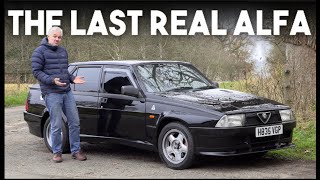
The Alfa Romeo 75 was officially presented on May 17, 1985, under project codes Tipo 161 and 162B, marking the 75th anniversary of the Milanese manufacturer. The three-box mid-size sedan arrived on the European market to replace the Giulietta (Series 116), inheriting much of the mechanical structure and overall silhouette of its predecessor. For fans of the brand, the model represents a dividing milestone: it was the last rear-wheel-drive automobile developed entirely independently by Alfa Romeo before its acquisition by the Fiat Group, which occurred in November 1986. After the corporate merger, Alfa Romeo migrated to shared front-wheel-drive platforms in the successor Alfa Romeo 155, which gave the 75 the title of "the last authentic Alfa Romeo".
The birth of the model took place amidst a severe financial crisis at Alfa Romeo in the early 1980s. Under tight budget constraints, the board initiated two parallel portfolio renewal projects in 1982: Project K2, which would replace the Alfetta to originate the Alfa 90 luxury sedan, and Project K1, intended to replace the Giulietta. While the design of the Alfa 90 was outsourced to the Bertone studio, under the leadership of Marcello Gandini, the development of Project K1 remained in-house at Alfa Romeo's Centro Stile, headed by Ermanno Cressoni. The engineering directorate, led by Domenico Chirico, focused the Alfa 75 on a purely sporty public profile, while the Alfa 90 assumed the role of a refined executive sedan.
Because resources for stamping were minimal, Cressoni and his team were forbidden to create new doors and pillars, being forced to keep the central frame and roof arch of the original Giulietta. To bypass this limitation and create an updated identity with reduced costs, Cressoni applied a dark gray plastic trim that ran along the entire beltline and angled upward upon reaching the rear pillar. Dubbed "la linea", this visual trick disguised the proportions of the old bodywork and gave the car a dynamic wedge shape, aligning the sedan with the aesthetic identity of the Alfa 33 hatchback.
Alfa Romeo also used the 75 project to correct chronic quality control problems that were damaging its institutional image. Previously, models like the Alfasud suffered from premature and severe corrosion due to the use of low-quality recycled steel and the fact that they were assembled at the Pomigliano d'Arco plant, where coastal saline moisture accelerated wear. Even worse, the old solution of injecting synthetic foam into structural cavities for sound insulation retained water and aggravated rust. For the Alfa 75, the manufacturer implemented the electrophoresis (e-coat) painting process, applying a uniform protective layer over the entire steel body through electric ion attraction, shielding the internal cavities against moisture accumulation and oxidation.
The Transaxle Mechanical Architecture and Dynamic Behavior
The main technical differentiator of the Alfa Romeo 75 was its ideal weight distribution, achieving a ratio of almost 50% over the front axle and 50% over the rear. This balance was achieved through the transaxle mechanical configuration, inherited from the brand's experience on Formula 1 tracks during the 1940s. In this layout, the combustion engine is positioned longitudinally in the front, while the clutch, the five-speed gearbox, and the differential are integrated into a single compact unit mounted directly on the rear axle.
To connect the two ends of the powertrain, engineers designed a two-piece driveshaft that spun at the same angular speed as the engine. Due to this constant and high rotation, the system was prone to generating intense mechanical vibrations at high revs. To mitigate noise and harshness, Alfa Romeo divided the driveshaft into two sections coupled by high-strength flexible rubber joints, creating an elastic behavior characteristic of the model's torque delivery.
The sedan's suspension was designed to optimize tire contact with the ground without compromising engine bay space or the unibody's torsional rigidity:
- Front Suspension: Utilized independent overlapping arms articulated by longitudinal torsion bars instead of conventional coil springs, assisted by telescopic hydraulic shock absorbers and an anti-roll bar.
- Rear Suspension: Consisted of a De Dion-type solid axle connected to a Watt's linkage and coil springs. This structure kept the rear wheels parallel to each other and perpendicular to the asphalt, reducing camber under strong lateral acceleration in corners.
- Inboard Rear Brakes: The rear brake discs were not installed on the wheels, but rather positioned at the output of the rear differential block, very close to the center of the vehicle. This engineering reduced the unsprung mass of the rear assembly, allowing the suspension to respond much faster to ground imperfections.
Internal Ergonomics, Technology, and Cabin
The interior of the Alfa Romeo 75 reproduced the straight and angular line language of the bodywork, integrating the center console and the instrument panel into a single visual block. To position the vehicle in a higher category, the cabin shared velour upholstery and checkered fabrics with the Alfa 90, offering height and reach adjustment for the steering wheel as standard. However, the pursuit of visual innovation resulted in eccentric ergonomic solutions.
The handbrake was designed in a "U" shape, resembling an aircraft throttle lever, which required an adjustment period for the driver. The front power window switches were relocated to the overhead console, near the map reading light buttons, while the radio was placed in a low and inaccessible position behind the gear stick.
In terms of embedded technology, the sedan featured the "Alfa Romeo Control", an electronic diagnostic panel mounted on the dashboard that continuously monitored fluid levels, component wear, and the integrity of the electrical system. The trunk had a nominal capacity of 500 liters in standard four-cylinder engine versions. However, luggage accessibility was hampered by the excessively high rear loading lip and the narrow opening of the tailgate. In the six-cylinder variants and export models, trunk capacity was reduced to 390 liters, as the fuel tank was repositioned from the rear floorpan to behind the rear seat backrest to meet crash test requirements.
The Alfa Romeo Milano and Export Specifications
In 1986, Alfa Romeo renamed the 75 for the North American market (United States and Canada) under the designation "Alfa Romeo Milano", paying homage to the city of Milan. The vehicle underwent profound modifications to meet the strict passive safety and emissions control criteria of US federal legislation.
Externally, the slim European bumpers were replaced by telescopic "America" bumpers, equipped with rubber bellows at the ends and internal impact shock absorbers, which required reinforcements to the body mounting plates. Side marker lights integrated into the bumpers were added, along with side impact protection bars in the doors, safety hooks on the hood to prevent the part from invading the windshield in collisions, and an exhaust pipe shifted to the right (instead of the traditional central outlet).
The Milano's instrumentation displayed scales in miles per hour (mph), oil pressure in pounds per square inch (psi), and coolant temperature in degrees Fahrenheit (°F). The Alfa Romeo Control system received an additional indicator light for seat belt use. Mechanically, the Milano utilized exclusively the V6 engine, being marketed in four main trim levels:
| Milano Version | Powertrain | Limited Slip Differential (LSD) | Available Transmission | Trim and Comfort Features |
|---|---|---|---|---|
| Silver | 2.5 V6 | No (Open Differential) | 5-speed manual | Basic trim, simple cloth upholstery, no sunroof. |
| Gold | 2.5 V6 | No (Open Differential) | 5-speed manual or 3-speed automatic | Optional or standard sunroof, upgraded velour upholstery. |
| Platinum | 2.5 V6 | No (Open Differential) | 5-speed manual or 3-speed automatic | Luxury trim, premium velour seats, standard power sunroof. |
| Verde | 3.0 V6 | Yes (25% Lock) | 5-speed manual | Recaro sports seats, Brembo brake calipers, Teves ABS, spoiler kit and integrated moldings. |
Chronological Evolution, Generations, and Facelifts
The Alfa Romeo 75 did not have multiple chassis generations, but rather a continuous evolution process divided into two distinct phases, known as Series 1 and Series 2.
First Series (1985–1988)
Launched in May 1985 with carbureted four-cylinder engines (1.6, 1.8, and 2.0 liters), an injected 2.5 V6, and a 2.0-liter turbodiesel supplied by VM Motori. Early versions featured orange lenses on the taillights and side turn signal repeaters.
In 1986, the 1.8 Turbo was added, which used a Garrett T3 turbocharger with an intercooler and oil cooler to extract 155 hp from the Bialbero four-cylinder block. This version served as the basis for the homologation of FIA Group A touring cars, requiring an initial minimum production of 5,000 street units.
The year 1987 marked a major mechanical revolution with the launch of the 2.0 Twin Spark (TS). Alfa Romeo's engineering redesigned the cylinder head of the two-liter engine to adopt two spark plugs per cylinder (promoting a more homogeneous combustion), shallow hemispherical combustion chambers, Bosch Motronic digital electronic injection, and the pioneering variable valve timing system on the intake camshaft. The engine generated 148 hp and drastically improved the dynamic balance of the 75, as the aluminum engine was much lighter than the V6 blocks, eliminating the understeer tendency when entering tight corners. In the same year, the 3.0 V6 America emerged, increasing the Busso engine's displacement to 2,959 cc to yield 188 hp.
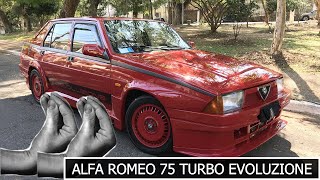
Also in 1987, Alfa Romeo produced the rare 75 Turbo Evoluzione, limited to exactly 500 examples assembled between March and April. This version was necessary to homologate additional aerodynamic and mechanical modifications for the 1987 WTCC championship. Under FIA rules, turbo engines suffered a capacity multiplier of 1.7 for competition class purposes. The original 1,779 cc engine would equal 3,024 cc, placing the 75 in Class 1, which would put it at a disadvantage against larger cars.
To put it in Class 2 (up to 3,000 cc), Alfa Romeo reduced the cylinder bore from 80 mm to 79.6 mm, decreasing the physical displacement to 1,752 cc. This resulted in a corrected displacement of 2,978 cc (1752 x 1.7). The Evoluzione's block (Tipo 061.58) featured thicker cylinder walls to withstand extreme turbo pressures on the tracks, a revised cylinder head, and a Garrett T03 turbo tuned to 0.9 bar in the street version. Although officially declared with the same 155 hp as the conventional turbo, the engine generated about 175 real hp in civilian use.
Second Series (1988 to 1992 Facelift)
Introduced in the fall of 1988 for the 1989 model year, Series 2 brought styling and mechanical engineering changes. On the exterior, the vehicle received a new front grille with integrated grey horizontal fins and all-red taillight lenses. The instrument panel was updated with revised graphics and a grey background.
The most significant alteration of Series 2 was the installation of the "isostatic" gear selection system. The chronic locking and imprecision of gear shifts in previous models — caused by the long path between the console lever and the rear gearbox — were solved by a new set of balanced rods and pivots, accompanied by a new single-disc clutch and redesigned gear synchronizers.
To meet Europe's pollution limits, multi-point electronic injection (i.e.) was extended to the smaller engines, eliminating the old twin-choke carburetors. The 1.8 engine gained the 1.8 i.e. version (122 hp) and, at the end of 1989, the 1.6 received the 1.6 i.e. version (107 hp). A new 2.4-liter turbodiesel engine from VM Motori, generating 112 hp and equipped with an intercooler, was added to the catalog to meet the European long-distance market.
In 1990, Alfa Romeo updated the top-of-the-line variants. The 1.8 Turbo engine received the Quadrifoglio Verde (QV) tuning, reaching 165 hp. The top of the line became the 3.0 V6 QV "Potenziata", which abandoned the analog Bosch L-Jetronic injection in favor of the integrated digital Bosch Motronic system (shared with the Alfa 164), raising the power to 192 hp. This large-displacement version received new anti-roll torsion bars, stiffer shock absorbers, and 15-inch alloy wheels.
Between 1991 and 1992, in the final months of manufacturing, numbered editions emerged such as the ASN (Allestimento Sportivo Numerato), which featured grey velour Recaro seats, exclusive 14-inch Speedline alloy wheels, and a numbered identification plaque on the dashboard. The special editions Indy, Imola, and Trofeo concluded the production cycle at the end of 1992, making way for the definitive introduction of the Alfa Romeo 155.
Production Quantifications and Market Success
The Alfa Romeo 75 was a notable commercial success by the standards of the Milanese manufacturer, achieving high sales volumes during its manufacturing period. In the first three years of sales (1985–1987), the Arese plant produced 236,907 units. At the end of its life cycle in 1992, the total cumulative volume reached about 386,767 assembled examples.
The model had wide institutional acceptance in Italy, serving as the standard patrol vehicle for police forces (Carabinieri), fire departments, and ambulances due to its reliability at high speeds and ample interior cabin space. Below, production volumes are detailed by specific factory powertrain:
Consolidated Production Volume by Version (1985–1992)
| Model / Powertrain | Fuel System / Aspiration System | Production Volume (Units) |
|---|---|---|
| 1.6 | Carburetor / Naturally Aspirated | 99,522 |
| 1.6 i.e. | Electronic Injection / Naturally Aspirated | 27,989 |
| 1.8 | Carburetor / Naturally Aspirated | 45,138 |
| 1.8 i.e. | Electronic Injection / Naturally Aspirated | 48,270 |
| 1.8 Turbo / America / Q.V. | Electronic Injection / Turbocharger | 6,536 |
| 1.8 Turbo Evoluzione | Electronic Injection / Turbocharger (Homologation) | 500 |
| 2.0 | Carburetor / Naturally Aspirated | 18,971 |
| 2.0 Twin Spark | Electronic Injection (Twin Spark) / Naturally Aspirated | 57,084 |
| 2.5 V6 Q.V. / Milano | Electronic Injection / Naturally Aspirated | 12,611 |
| 3.0 V6 / America / Q.V. | Electronic Injection / Naturally Aspirated | 6,753 |
| 2.0 Turbodiesel (TD) | Mechanical Diesel Injection / Turbocharger | 46,273 |
| 2.4 Turbodiesel (TD) | Mechanical Diesel Injection / Turbocharger | 6,110 |
| Audited Total Production | — | 375,257 |
Note: The total of 375,257 units represents vehicles cataloged in detail by engine type on the primary assembly lines. The difference to the consolidated historical figure of 386,767 units refers to development prototypes, Autodelta competition vehicles, and special chassis supplied to partner design studios.
Final Considerations
The Alfa Romeo 75 closed a period of automotive engineering that prioritized static mass distribution and refined chassis tuning over the simplification of manufacturing costs. The adoption of the rear transaxle with the De Dion tube provided neutral and precise driving dynamics, although it brought challenges such as the chronic vibration of the driveshaft and the complexity of the gear linkage — efficiently solved only in the 1988 facelift with the isostatic linkage.
At the same time, Europe's tax barriers of the 1980s encouraged the technical development of the agile 1.8 Turbo engine as a more economical tax alternative to the large 2.5 and 3.0-liter V6 blocks, generating rare and highly valued variations in today's collector market, such as the track-focused Turbo Evoluzione. As the last rear-wheel-drive project developed entirely independently by the Arese plant before Fiat's corporate dominance, the 75 remains the ultimate expression of Alfa Romeo's traditional engineering.


