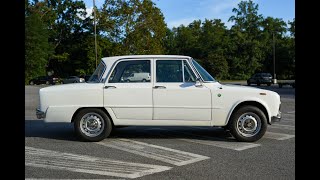
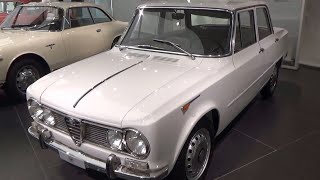
Series 1
(1962 - 1967)
1.6 L I4 8V
112 cv

Technical specifications, versions, and history for the Alfa Romeo Giulia Berlina.
Select a generation to see available versions
(1962 - 1967)

(1967 - 1971)

(1972 - 1974)

(1974 - 1979)
The launch of the Alfa Romeo Giulia Sedan (Tipo 105) represented one of the most profound transformations in the development of family cars in the post-war period. Revealed to the public on June 27, 1962, at the Monza Circuit, the model broke with the convention that practical four-door cars had to be slow and heavy. Under the direction of designer Giuseppe Scarnati, the Milan manufacturer conceived a high-performance compact sedan that combined sophisticated aluminum mechanics, a lightweight chassis weighing close to a ton, and a body that pushed the limits of aerodynamics for the time. Production extended until 1977, with remaining units being sold and registered until 1978 and 1979, consolidating a remarkable trajectory in the European and international markets.
Manufacturing of the Giulia initially took place at the classic Portello plant in Milan, being gradually transferred to the modern Arese plant from 1965 onwards. To bypass tariff barriers and import taxes in specific markets, the sedan was also assembled in completely knocked down (CKD) kit format in Setúbal, Portugal, by the Movauto company, in addition to having local assembly lines in Rosslyn, South Africa, and Salisbury, Rhodesia. This global distribution helped popularize the brand's image of practical sportiness across different continents.
Despite its rectangular visual shape and well-defined three boxes, the Giulia Sedan was one of the first mass-produced vehicles developed with the systematic aid of wind tunnel testing. This technical refinement allowed it to achieve a drag coefficient of just Cd = 0.34, an exceptionally low value for the 1960s, surpassing even contemporary sports models with a more fluid shape. The truncated-style rear section, known in Italian as coda tronca, played a fundamental role in directing the airflow, reducing turbulence and the low-pressure zone behind the vehicle, which guaranteed directional stability at high speeds and less engine effort on highways.
The construction of the unibody prioritized weight reduction without compromising torsional rigidity, resulting in a curb weight that varied between 978 kg and 1,130 kg, depending on the equipment and powertrain chosen. The attention to detail extended to the hood area, front grille, and roof, creating a harmonious transition of lines from bumper to bumper. Upon leaving the assembly lines, all variations of the sedan were originally fitted with high-performance Pirelli Cinturato radial tires, using the sizes 165HR14 (CA67 model) or 155HR15 (CA67 model), suited to withstand the high cruising speeds the vehicle reached.
The suspension architecture of the Giulia Sedan was designed to offer superior dynamic behavior compared to contemporary conventional sedans. At the front, an independent double-wishbone (double A-arm) arrangement with coil springs and telescopic shock absorbers was used, which allowed the tires to remain perpendicular to the ground even under heavy lateral loads. At the rear, the choice of a solid axle was refined with the adoption of longitudinal control arms and an upper T-shaped reaction bar made of light alloy, which precisely limited the transverse and longitudinal movements of the axle, keeping the rear coil springs always aligned.
The braking system underwent constant updates to keep up with the power increase of the engines. The first units produced between 1962 and the first half of 1963 used drum brakes on all four wheels, with the front ones equipped with a high-pressure three-shoe system to contain heat buildup on mountain descents. Starting in August 1963, after manufacturing about 22,000 vehicles, Alfa Romeo introduced Dunlop-brand disc brakes on all four wheels, accompanied by a vacuum brake booster. In late 1966 and early 1967, the disc brake supplier was changed to the ATE brand, which featured more robust calipers and simplified maintenance pads.
In 1968, the manufacturer updated the rear suspension, modifying geometric anchor points and adding a rear anti-roll bar to mitigate body roll. This alteration coincided with the change in wheel dimensions, which went from 15 inches to 14 inches, aiming for wider tires. Later, in 1970, the Giulia received an independent dual-circuit braking system for greater safety in case of leaks, the replacement of the under-dash (umbrella-type) handbrake lever with a conventional lever positioned on the floor between the front seats, and the introduction of suspended pedals for left-hand-drive units, while right-hand-drive models kept the floor-hinged pedals until production ended.
The life cycle of the Giulia Sedan extended over fifteen years of continuous production, a period in which it received aesthetic improvements, cost simplifications, and new engine options. The model portfolio developed gradually through four main phases.
The initial phase established the model's reputation for sportiness with the launch of the Giulia TI (Tipo 105.14) in 1962. Equipped with the 1,570 cc Twin Cam engine fed by a single Solex 33 PAIA 7 twin-choke carburetor, the sedan delivered 92 hp. The interior featured a split-bench front seat configuration and a steering column-mounted gear lever, allowing it to officially carry up to six occupants. The instrument panel had a metallic finish with a horizontal scale (ribbon-type) speedometer and a two-spoke steering wheel with a chrome horn ring. In May 1964, Alfa Romeo made available the floor-shift version (Tipo 105.08) in exclusive association with new individual front sports seats. The CKD kits destined for export received the chassis designation Tipo 105.09.
To consolidate participation in touring car competitions, the brand developed the Giulia TI Super (Tipo 105.16), a lightened version that saw only 501 units manufactured between 1963 and 1964. The engine received identical modifications to those of the Sprint Speciale coupe, adopting two horizontal twin-choke Weber 45 DCOE 14 carburetors, which raised the power to 112 hp. The weight reduction to 910 kg was achieved by removing the overriders, replacing the two inner headlights on the front grille with steel mesh screens for air intake, adopting acrylic rear windows, and Campagnolo magnesium alloy wheels. Inside, the model came with simplified bucket seats, a three-spoke aluminum steering wheel, and an instrument panel with circular dials. To save weight in the doors, the metal inner door handles were swapped for braided leather straps, a solution that would later be replicated in the GTA race car.
In February 1966, Alfa Romeo applied the first comprehensive set of styling and functional updates to the Giulia TI. The floor-mounted gear lever became standard equipment on all units. The cabin now boasted redesigned door panels, more anatomical seats, and a renewed instrument panel with three circular dials instead of the old horizontal speedometer. On the exterior, the taillights gained L-shaped chrome trims replacing the older C-shaped ones. Production of this original TI specification was discontinued in 1967, being succeeded by the 1600 S model.
Aiming to broaden the customer base and dodge the high Italian tax burden on large displacement engines, Alfa Romeo introduced the Giulia 1300 (Tipo 105.06) in 1964. The model featured a 1,290 cc engine fed by a single carburetor that yielded 78 hp, mated to a simplified floor-mounted four-speed transmission. Externally, it was recognized by the front end featuring only two circular headlights and, inside, by the trim devoid of carpets, replaced by rubber mats. In 1965, this was complemented by the Giulia 1300 TI (Tipo 105.39), which brought an evolution of the 1,290 cc block to yield 82 hp, now associated with a five-speed transmission. With a slightly improved interior and competitive price, the 1300 TI became the greatest sales success in the entire history of the Giulia, recording over 140,000 units produced.
The definitive sedan of the series emerged in 1965 under the name Giulia Super (Tipo 105.26). The project consisted of applying the 1,570 cc engine fed by two horizontal twin-choke Weber 40 DCOE carburetors, but with a milder and more elastic tuning than that used in the track-focused TI Super, resulting in 98 hp and abundant mid-range torque. The bodywork featured four headlights at the front, a grille with a metallic finish in two cast pieces, and enveloping front seats described as armchairs. The instrument panel received faux wood appliques and an instrument binnacle with two large circular dials.
In the year 1969, Alfa Romeo launched the premium version Giulia Super "Biscione", characterized by the application of two enameled emblems featuring the Sforza family serpent on the rear pillars, chrome trims on the side sills of the bodywork, a rear window with integrated heating filaments, and maximum power raised to 104 hp.
In parallel, in 1968, the automaker created the Giulia 1600 S (Tipo 105.85) as a direct commercial response to the success of the 100 hp Fiat 125 Special. It was an intermediate model that utilized the simplified two-headlight bodywork of the 1300, but equipped with the 1,570 cc engine fitted with a twin-choke single carburetor to deliver 95 hp. This highway-focused model was produced for only two years, being withdrawn from the market in 1970. Also during this period, small series of station wagon conversions of the sedan were sold under the designation Giulia Super Promiscua, manufactured externally by Carrozzeria Colli and intended mainly for police and commercial use. In 1970, the Giulia 1300 Super (Tipo 115.09) was introduced, combining the 1.3 dual twin-choke carburetor engine (89 hp) with the luxury four-headlight trim and wooden dashboard typical of the 1.6 versions, marking the first time the chassis prefix 115 was used on the sedan.
In 1972, Alfa Romeo adopted a profound production restructuring known as "Unificato" to contain rising industrial costs. Visual differentiation between versions of different displacements was eliminated. The Giulia Super 1.3 (Tipo 115.09) and the Giulia Super 1.6 (Tipo 105.26) began sharing exactly the same four-headlight bodywork, metal hubcaps without chrome trim rings and with exposed wheel bolts, center console in the cabin, and molded nylon carpets. The only technical distinction lay in the engine displacement, the final adjustment of the rear differential gear ratio, and the power of the 1.6 engine, which was subtly recalibrated to 106 hp under the engine code 00526/A*S aimed at reducing harmful gas emissions and fuel consumption.
The last major styling transformation of the Giulia occurred in 1974 with the launch of the Nuova Super (Tipo 115.09S for the 1.3 engine and Tipo 105.26S for the 1.6 engine). Aiming to align the classic lines of the 1960s with the rectilinear aesthetics of the 1970s, Alfa Romeo eliminated the decorative ribs and creases from the front hood and trunk lid, making the sheet metal surfaces completely smooth. The front end received a new matte black plastic grille that integrated four round headlights of the same diameter, while the chrome metal bumpers were replaced by linear pieces with thick protective rubber strips. The interior was updated with center consoles integrated into the dashboard, matte wood trim, and front seats equipped as standard with adjustable headrests.
The global energy crisis of 1973 led the manufacturer to launch, in June 1976, the Giulia Nuova Super Diesel (Tipo 115.40). It was the first passenger car with diesel cycle propulsion in Alfa Romeo's history. The adopted engine was an indirect injection four-cylinder powerplant manufactured by the British company Perkins (model 4.108), with 1,760 cc (commonly called 1.8 liters). The naturally aspirated engine produced 55 hp of maximum power, allowing it to reach a top speed of only 138 km/h. The model faced criticism for the high level of vibrations in the cabin and the sluggish dynamic behavior when compared to the traditional gasoline Twin Cams, but it found steady sales in commercial fleets and taxi drivers in Italy until the definitive end of the line in 1977.
A notable geographic sporty variation was developed locally in South Africa in December 1972, under the name Giulia 1600 Rallye. Aimed at local competitions, the South African subsidiary combined the simplified, lighter two-headlight bodywork of the 1300 Super with a high-performance 1.6 engine tuned to yield 125 hp (SAE), equipping the vehicle with integrated auxiliary driving lights, sporty rearview mirrors, adjustable competition seats, and a factory limited-slip differential.
The convenience and interior trim elements of the Giulia Sedan reflected the transition from the analog and ornate cabins of the 1960s to the functional and plastic ergonomics of the 1970s. This evolution is visible in the main contact points between the driver, passengers, and the vehicle.
The early Giulia TI models used a classic two-spoke black steering wheel with a synthetic ivory trim in the center and a chrome half-ring for the horn. With the introduction of the TI Super in 1963, Alfa Romeo adopted a sporty-profile steering wheel with three perforated aluminum spokes and a central horn button, a design that was extended to the 1965 Giulia Super. The more economical 1.3-liter versions received a simplified black plastic steering wheel with three thin spokes and horn buttons arranged along the spokes. In the final phase of the 1.6-liter Nuova Super, the manufacturer adopted the classic sporty steering wheel with three concave spokes and a wooden rim from the Hellebore brand, providing a more sophisticated and classic grip.
The material used on the floor of the Giulia Sedan varied according to the version's market positioning. The top-of-the-line versions, such as the original Giulia TI, the homologation TI Super, and the classic Giulia Super, were assembled with thick wool carpets divided into several sections. Conversely, the economical smaller-displacement versions, such as the Giulia 1300 Berlina and the 1300 TI, left the factory with a full covering of grey or black rubber mats, aiming for ease of cleaning and lower production cost. In the final generations starting in 1970 and in the Nuova Super series, Alfa Romeo adopted single-piece molded nylon carpets, which improved acoustic insulation against transmission noise and exhaust fumes.
The evolution of the seats reflects the improvement in lateral support for the driver. Early sedans came equipped with flat, loosely structured seats, with the front being a bench seat type on versions with column shifters. The Giulia TI Super broke this pattern by adopting lightweight bucket seats upholstered in fabric, similar to those of the Giulietta SZ sports car, designed to hold the driver in fast corners. The 1965 Giulia Super introduced anatomical armchair-type front seats, characterized by pronounced side bolsters and a rounded finish on the back, inspired by seats used by German luxury brands. The rear seat featured a retractable center armrest as standard on most versions. While cabins up until the early 1970s were fully upholstered in Skai-type vinyl, the final phase under the Nuova Super line introduced the option of velour and ventilated fabric upholstery.
The table below presents comparative mechanical data of all official variations of the Giulia sedan body developed between 1962 and 1977.
| Technical Specification | Giulia TI (1962) | Giulia TI Super (1963) | Giulia 1300 (1964) | Giulia Super 1.6 (1965) | Giulia 1300 TI (1965) | Giulia 1600 S (1968) | Giulia 1300 Super (1970) | Giulia Super 1.6 Unificato (1972) | Giulia Nuova Super Diesel (1976) |
|---|---|---|---|---|---|---|---|---|---|
| Chassis Code | Tipo 105.14 | Tipo 105.16 | Tipo 105.06 | Tipo 105.26 | Tipo 105.39 | Tipo 105.85 | Tipo 115.09 | Tipo 105.26 | Tipo 115.40 |
| Displacement | 1,570 cc | 1,570 cc | 1,290 cc | 1,570 cc | 1,290 cc | 1,570 cc | 1,290 cc | 1,570 cc | 1,760 cc |
| Engine Architecture | L4 DOHC Aluminum | L4 DOHC Aluminum | L4 DOHC Aluminum | L4 DOHC Aluminum | L4 DOHC Aluminum | L4 DOHC Aluminum | L4 DOHC Aluminum | L4 DOHC Aluminum | L4 SOHC Perkins Diesel |
| Fuel System | 1x Solex 33 PAIA 7 | 2x Weber 45 DCOE 14 | 1x Single-barrel Carburetor | 2x Weber 40 DCOE | 1x Single-barrel Carburetor | 1x Twin-choke Carburetor | 2x Twin-choke Carburetors | 2x Twin-choke Carburetors | Mechanical Indirect Injection |
| Maximum Power | 92 hp (DIN) @ 6,200 rpm | 112 hp (DIN) @ 6,500 rpm | 78 hp (DIN) @ 6,000 rpm | 98 hp (DIN) @ 5,500 rpm | 82 hp (DIN) @ 6,000 rpm | 95 hp (DIN) @ 5,500 rpm | 89 hp (DIN) @ 6,000 rpm | 106 hp (DIN) @ 5,500 rpm | 55 hp (SAE) @ 4,000 rpm |
| Maximum Torque | 119 Nm @ 4,000 rpm | 142 Nm @ 4,400 rpm | 103 Nm @ 4,500 rpm | 130 Nm @ 2,900 rpm | 104 Nm @ 4,900 rpm | 138 Nm @ 4,400 rpm | 115 Nm @ 3,200 rpm | 142 Nm @ 4,400 rpm | N/A |
| Transmission | 5-speed Manual | 5-speed Manual | 4-speed Manual | 5-speed Manual | 5-speed Manual | 5-speed Manual | 5-speed Manual | 5-speed Manual | 5-speed Manual |
| Differential Ratio | 5.12:1 | 5.12:1 | 4.56:1 | 4.56:1 | 4.56:1 | 4.78:1 | 4.56:1 | 4.56:1 | 4.10:1 |
| Top Speed | 170 km/h | 185 km/h | 158 km/h | 170 km/h | 164 km/h | 170 km/h | 165 km/h | 178 km/h | 138 km/h |
The Giulia Sedan was the model responsible for transforming Alfa Romeo from a low-volume semi-artisanal manufacturer into a large-scale producer capable of competing globally. Production data details the sales distribution of each variant over the years.
| Model Variant | Sales Period | Base Chassis Code | Production Volume Recorded |
|---|---|---|---|
| Giulia TI (Column and floor shift) | 1962 – 1967 | Tipo 105.14 / 105.08 | 66,833 units (43,227 column / 23,606 floor) |
| Giulia TI Super | 1963 – 1964 | Tipo 105.16 | 501 units |
| Giulia 1300 Berlina | 1964 – 1971 | Tipo 105.06 | 28,358 units |
| Giulia 1300 TI | 1965 – 1972 | Tipo 105.39 | 140,684 units |
| Giulia Super 1.6 (Classic, Biscione, and Unificato) | 1965 – 1974 | Tipo 105.26 | 125,000 units |
| Giulia 1600 S | 1968 – 1970 | Tipo 105.85 | 2,215 units |
| Giulia 1300 Super (Classic and Unificato) | 1970 – 1974 | Tipo 115.09 | 85,200 units |
| Giulia Nuova Super 1300 | 1974 – 1977 | Tipo 115.09S | 68,000 units |
| Giulia Nuova Super 1600 | 1974 – 1977 | Tipo 105.26S | 29,800 units |
| Giulia Nuova Super Diesel | 1976 – 1977 | Tipo 115.40 | 6,573 units |
| Cumulative Sedan Total | 1962 – 1977 | Tipo 105 / 115 | 553,164 units |
Note: The statistics presented strictly refer to the four-door sedan body style, excluding the Sprint GT, GTV, and GTA coupe versions, as well as the Spider convertible, which featured the short Tipo 105 chassis with independent production volumes.
The commercial trajectory and development of the Giulia Sedan between 1962 and 1979 offer an overview of the industrial, economic, and legislative transformations that shaped European automobiles in the second half of the 20th century.
The expressive market success of the 1.3-liter variants, especially the Giulia 1300 TI with over 140,000 units sold, highlights the direct influence of tax policies on engineering development. In Italy and other southern European countries, the tax on the ownership and circulation of motor vehicles was calculated based on engine displacement, applying punitive rates to any powerplant that exceeded the 1,300 cc limit.
Instead of accepting a loss of dynamic performance when downsizing its sedan's engine, Alfa Romeo chose to keep the refined light-alloy architecture, double overhead camshafts, and hemispherical combustion chambers in the 1,290 cc block. By extracting up to 89 dynamic horsepower in the twin-carbureted specifications, the brand surpassed the performance of competing cars equipped with 1.6 and even 1.8-liter engines, proving that mechanical sophistication and thermal efficiency were more effective ways to achieve performance than simply increasing displacement.
Italian Engine Tax Legislation (1960s/1970s)
  ├── Displacement < 1,300 cc (Standard/Accessible Taxation)
  │     └── Response: Development of the 1,290 cc Twin Cam engine (78 to 89 hp)
  └── Displacement > 1,300 cc (Punitive/Luxury Tax Rate)
        └── Response: Restriction of 1.6 versions to export markets or luxury niche
The Giulia Sedan challenged the design consensus of its era by proving that a car with a geometric visual shape and internal habitability for five passengers could be as aerodynamic as a low-profile sports coupe. Tests conducted in the wind tunnel of the Polytechnic Institute of Turin allowed engineers to subtly round the windshield corners, create air drainage channels on the sides of the roof, and adopt the truncated rear to detach the airflow in a controlled manner. This approach ensured the car could reach 170 km/h with a modest 98 hp engine, enabling high cruising speeds on newly opened European highways, while maintaining a spacious, square 480-liter trunk.
The transition of the assembly lines from the old Portello complex to the modern Arese plant, completed in the mid-1960s, reflected Alfa Romeo's need to restructure itself to face competition from large global conglomerates. The fragmentation of the Giulia range into numerous variations with distinct aesthetic and mechanical details caused bottlenecks on the assembly line and increased the unit cost.
The trim unifications promoted starting in 1972 with the "Unificato" series and the subsequent standardization of the "Nuova Super" in 1974 were strategic manufacturing rationalization decisions. By sharing the same body stampings, the same internal console, and identical suspension systems between the 1.3 and 1.6-liter models, Alfa Romeo simplified its supply chain and increased production speed, ensuring the financial sustainability of the line until the end of its life cycle.
Industrial Evolution Flow of the Giulia Sedan (Tipo 105)
  [1962–1967: Portello Phase]
     - Low-volume artisanal production
     - High variation of aesthetic components and instrumentation
  [1968–1971: Range Expansion]
     - Definitive transition to the modern Arese plant
     - Coexistence of multiple bodies and trims (1300 vs 1600)

     - Complete aesthetic unification of interiors and exterior components
     - Maximization of economies of scale to face volume competitors
The introduction of the Perkins Diesel cycle engine in the Giulia in 1976 represents a practical case of urgent adaptation to the geopolitical realities of the period. The 1973 oil crisis and the consequent Sunday driving bans imposed by the Italian government created an immediate demand for economical and durable automobiles, especially in the commercial fleet market.
Although the 55 hp diesel engine sacrificed the high-performance image associated with the Giulia name, the decision allowed Alfa Romeo to offer a viable alternative for customers driving high daily mileages amidst rising fuel costs. This variant, despite being noisy and slow, guaranteed the survival of the Tipo 105 chassis in the working market until the modern Alfa Romeo Giulietta (Tipo 116) was ready to assume the production volume of the Italian factory.