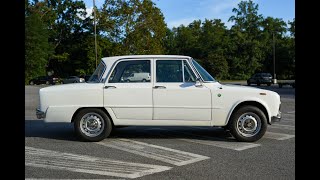
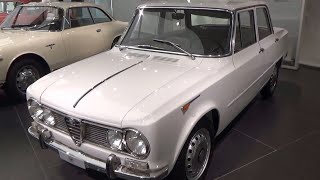
The life cycle of the Giulia Sedan extended over fifteen years of continuous production, a period in which it
received aesthetic improvements, cost simplifications, and new engine options. The model portfolio developed
gradually through four main phases.
The Launch Era and the Homologated Sports Car (1962–1967)
The initial phase established the model's reputation for sportiness with the launch of the Giulia TI (Tipo
105.14) in 1962. Equipped with the 1,570 cc Twin Cam engine fed by a single Solex 33 PAIA 7 twin-choke
carburetor, the sedan delivered 92 hp. The interior featured a split-bench front seat configuration and a
steering column-mounted gear lever, allowing it to officially carry up to six occupants. The instrument
panel had a metallic finish with a horizontal scale (ribbon-type) speedometer and a two-spoke steering wheel
with a chrome horn ring. In May 1964, Alfa Romeo made available the floor-shift version (Tipo 105.08) in
exclusive association with new individual front sports seats. The CKD kits destined for export received the
chassis designation Tipo 105.09.
To consolidate participation in touring car competitions, the brand developed the Giulia TI Super (Tipo
105.16), a lightened version that saw only 501 units manufactured between 1963 and 1964. The engine received
identical modifications to those of the Sprint Speciale coupe, adopting two horizontal twin-choke Weber 45
DCOE 14 carburetors, which raised the power to 112 hp. The weight reduction to 910 kg was achieved by
removing the overriders, replacing the two inner headlights on the front grille with steel mesh screens for
air intake, adopting acrylic rear windows, and Campagnolo magnesium alloy wheels. Inside, the model came
with simplified bucket seats, a three-spoke aluminum steering wheel, and an instrument panel with circular
dials. To save weight in the doors, the metal inner door handles were swapped for braided leather straps, a
solution that would later be replicated in the GTA race car.
In February 1966, Alfa Romeo applied the first comprehensive set of styling and functional updates to the
Giulia TI. The floor-mounted gear lever became standard equipment on all units. The cabin now boasted
redesigned door panels, more anatomical seats, and a renewed instrument panel with three circular dials
instead of the old horizontal speedometer. On the exterior, the taillights gained L-shaped chrome trims
replacing the older C-shaped ones. Production of this original TI specification was discontinued in 1967,
being succeeded by the 1600 S model.
Line Expansion and the Consecration of the Giulia Super (1964–1972)
Aiming to broaden the customer base and dodge the high Italian tax burden on large displacement engines, Alfa
Romeo introduced the Giulia 1300 (Tipo 105.06) in 1964. The model featured a 1,290 cc engine fed by a single
carburetor that yielded 78 hp, mated to a simplified floor-mounted four-speed transmission. Externally, it
was recognized by the front end featuring only two circular headlights and, inside, by the trim devoid of
carpets, replaced by rubber mats. In 1965, this was complemented by the Giulia 1300 TI (Tipo 105.39), which
brought an evolution of the 1,290 cc block to yield 82 hp, now associated with a five-speed transmission.
With a slightly improved interior and competitive price, the 1300 TI became the greatest sales success in
the entire history of the Giulia, recording over 140,000 units produced.
The definitive sedan of the series emerged in 1965 under the name Giulia Super (Tipo 105.26). The project
consisted of applying the 1,570 cc engine fed by two horizontal twin-choke Weber 40 DCOE carburetors, but
with a milder and more elastic tuning than that used in the track-focused TI Super, resulting in 98 hp and
abundant mid-range torque. The bodywork featured four headlights at the front, a grille with a metallic
finish in two cast pieces, and enveloping front seats described as armchairs. The instrument panel received
faux wood appliques and an instrument binnacle with two large circular dials.
In the year 1969, Alfa Romeo launched the premium version Giulia Super "Biscione", characterized by the
application of two enameled emblems featuring the Sforza family serpent on the rear pillars, chrome trims on
the side sills of the bodywork, a rear window with integrated heating filaments, and maximum power raised to
104 hp.
In parallel, in 1968, the automaker created the Giulia 1600 S (Tipo 105.85) as a direct commercial response
to the success of the 100 hp Fiat 125 Special. It was an intermediate model that utilized the simplified
two-headlight bodywork of the 1300, but equipped with the 1,570 cc engine fitted with a twin-choke single
carburetor to deliver 95 hp. This highway-focused model was produced for only two years, being withdrawn
from the market in 1970. Also during this period, small series of station wagon conversions of the sedan
were sold under the designation Giulia Super Promiscua, manufactured externally by Carrozzeria Colli and
intended mainly for police and commercial use. In 1970, the Giulia 1300 Super (Tipo 115.09) was introduced,
combining the 1.3 dual twin-choke carburetor engine (89 hp) with the luxury four-headlight trim and wooden
dashboard typical of the 1.6 versions, marking the first time the chassis prefix 115 was used on the sedan.
The Unified Phase (1972–1974)
In 1972, Alfa Romeo adopted a profound production restructuring known as "Unificato" to contain rising
industrial costs. Visual differentiation between versions of different displacements was eliminated. The
Giulia Super 1.3 (Tipo 115.09) and the Giulia Super 1.6 (Tipo 105.26) began sharing exactly the same
four-headlight bodywork, metal hubcaps without chrome trim rings and with exposed wheel bolts, center
console in the cabin, and molded nylon carpets. The only technical distinction lay in the engine
displacement, the final adjustment of the rear differential gear ratio, and the power of the 1.6 engine,
which was subtly recalibrated to 106 hp under the engine code 00526/A*S aimed at reducing harmful gas
emissions and fuel consumption.
The Nuova Super Redesign and the Diesel Variant (1974–1979)
The last major styling transformation of the Giulia occurred in 1974 with the launch of the Nuova Super (Tipo
115.09S for the 1.3 engine and Tipo 105.26S for the 1.6 engine). Aiming to align the classic lines of the
1960s with the rectilinear aesthetics of the 1970s, Alfa Romeo eliminated the decorative ribs and creases
from the front hood and trunk lid, making the sheet metal surfaces completely smooth. The front end received
a new matte black plastic grille that integrated four round headlights of the same diameter, while the
chrome metal bumpers were replaced by linear pieces with thick protective rubber strips. The interior was
updated with center consoles integrated into the dashboard, matte wood trim, and front seats equipped as
standard with adjustable headrests.
The global energy crisis of 1973 led the manufacturer to launch, in June 1976, the Giulia Nuova Super Diesel
(Tipo 115.40). It was the first passenger car with diesel cycle propulsion in Alfa Romeo's history. The
adopted engine was an indirect injection four-cylinder powerplant manufactured by the British company
Perkins (model 4.108), with 1,760 cc (commonly called 1.8 liters). The naturally aspirated engine produced
55 hp of maximum power, allowing it to reach a top speed of only 138 km/h. The model faced criticism for the
high level of vibrations in the cabin and the sluggish dynamic behavior when compared to the traditional
gasoline Twin Cams, but it found steady sales in commercial fleets and taxi drivers in Italy until the
definitive end of the line in 1977.
A notable geographic sporty variation was developed locally in South Africa in December 1972, under the name
Giulia 1600 Rallye. Aimed at local competitions, the South African subsidiary combined the simplified,
lighter two-headlight bodywork of the 1300 Super with a high-performance 1.6 engine tuned to yield 125 hp
(SAE), equipping the vehicle with integrated auxiliary driving lights, sporty rearview mirrors, adjustable
competition seats, and a factory limited-slip differential.