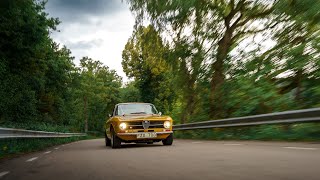
Sprint GT
(1963 - 1966)
1.6 L I4 8V
106 cv

Technical specifications, versions, and history for the Alfa Romeo Giulia GT.
Select a generation to see available versions
(1963 - 1966)

(1965 - 1968)

(1967 - 1971)

(1971 - 1976)
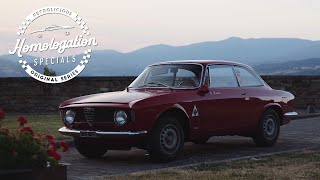
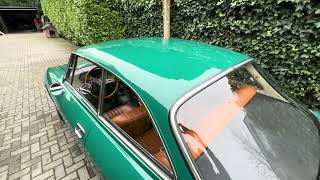
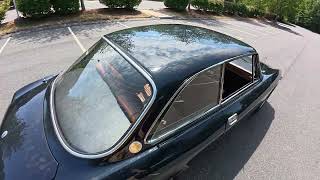
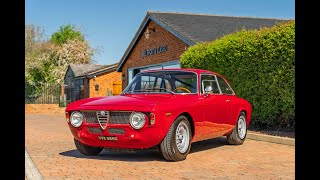
The Alfa Romeo Giulia Sprint GT (Tipo 105) was presented to the public in September 1963, initially at the Arese plant and, shortly thereafter, at the Frankfurt Motor Show. Designed as the natural successor to the acclaimed Giulietta Sprint of the 101 series, this new sports coupe was penned by the young Giorgetto Giugiaro, who at the time worked for the Bertone studio. The Giulia line featured larger displacement engines and much more modern engineering for the time, positioning itself as the Italian manufacturer's sportiest and most desired option.
The development of the Tipo 105 was based on a shortened version of the Giulia sedan chassis, reducing the wheelbase from 2,510 mm to 2,350 mm. This structural alteration was fundamental in giving the coupe exceptional agility in corners and a balanced weight distribution, characteristics that became trademarks of the model.
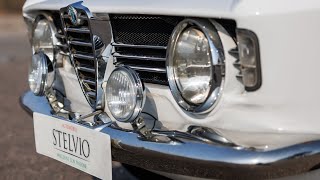
The most striking and debated visual element of the early versions of the Giulia GT was the "scalino" (an Italian term meaning "step"). This gap of approximately one centimeter, located between the front part of the hood and the radiator grille, arose from a design clearance that ended up not being corrected before the start of mass production. What could have been seen as an assembly defect became a symbol of visual identity highly valued by collectors.
During this first phase, the models also featured other design peculiarities that changed over time:
The hood with the "scalino" step began to be phased out with the arrival of the 1750 GT Veloce model in 1967, which introduced the "smooth front", where the hood integrated directly into the fenders without any gap. The entry-level models, known as GT Junior, retained the stepped front until they received this same aesthetic update in 1970.
In 1964, Alfa Romeo decided to offer a four-seater convertible option based on the Sprint GT coupe. As Bertone's production capacity was fully exhausted, the design and assembly of the convertible were transferred to Carrozzeria Touring in Milan, receiving the official designation "Giulia GTC" (GT Convertible).
The removal of the hardtop and the steel side pillars drastically compromised the car's resistance against torsion. To solve this problem, Touring added several metal reinforcements in strategic sections of the bodywork. These reinforcements were modified and improved throughout the car's short production period. The great merit of the project was keeping the vehicle's final weight extremely low, fluctuating between 905 kg and 950 kg, which preserved the sporty performance and agile dynamics of the hardtop car.
The Giulia GTC featured a folding canvas soft top that was completely hidden when retracted, retractable rear side windows, and an exclusive matte black dashboard finish (replacing the textured gray of the coupe). On the trunk lid, it displayed the written logo "GiuliaGTC".
Carrozzeria Touring was facing severe financial difficulties during this period and closed its activities shortly after completing the manufacturing of this model. Because of this, the Giulia GTC went down in history as the last official project carried out by the legendary Milanese coachbuilder. Only 1,003 units were produced (including about 99 to 100 right-hand drive examples for the UK and South African markets).
The Tipo 105 coupe line evolved through two main branches: the high-performance line (GT and GTV) and the lower-cost entry-level line (GT Junior).
The debut model used the bodywork with the "scalino" hood and flat dashboard. It was powered by the 1.6-liter Twin Cam engine fed by two Weber 40 DCOE twin-choke carburetors, generating 106 horsepower.
Launched to bring more refinement to the lineup, the 1.6-liter GT Veloce (GTV) received an updated engine with larger exhaust valves. This raised the power to 109 horsepower and significantly increased torque at low revs, making the driving more vigorous. The model retained the "scalino" body style.
This version marked the first major aesthetic restyling and profound mechanical evolution of the line. The "scalino" hood was abandoned and replaced by the smooth front equipped with four circular headlights (two larger ones at the ends and two smaller ones in the inner grille).
To optimize dynamic behavior and high-speed control, the suspension was geometrically recalibrated and received a rear anti-roll bar. The 15-inch wheels were replaced by 14-inch diameter wheels, but wider (5.5 inches), allowing for the fitting of better-performing tires.
The 1750 GTV was divided into two distinct phases:
Equipped with the 2.0-liter (1,962 cc) engine producing 130 to 132 horsepower, the 2000 GTV replaced the 1750 model. The top speed rose to 195 km/h, and the 0 to 100 km/h acceleration time fell to about 9 seconds.
Visual modifications included a new front grille with horizontal chrome slats that formed the outline of Alfa Romeo's traditional central shield, significantly larger integrated taillights, and wheels with small center caps exposing the lug nuts, with the option of "Turbina" style sports alloy wheels. The interior lost some of the wood trim on the dashboard, and all instrument dials were concentrated directly behind the steering wheel, improving driver visibility. Mechanically, the car received larger brakes and a limited-slip differential (LSD) as standard equipment.
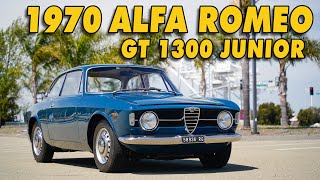
In 1965, Alfa Romeo created the "Junior" sub-brand with the launch of the GT 1300 Junior. The main goal was to offer a sports coupe with lower acquisition and maintenance costs, bypassing the strict Italian tax legislation that levied very heavy taxes on vehicles equipped with engines over 1.3 liters.
The 1,290 cc engine produced 89 horsepower, providing a top speed of 170 km/h, an excellent mark for a car of that displacement at the time. The model retained the same dynamic qualities as its older siblings, although it used a simpler interior finish, a flat dashboard, and a front grille with only a single horizontal chrome strip.
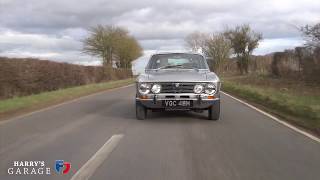
Introduced in 1972, this model used the classic 1.6-liter (1,570 cc) engine with 108 to 110 horsepower to fill the market gap between the GT 1300 Junior and the top-of-the-line 2000 GTV. Initially, the exterior look maintained the two-headlight configuration and simplified trim.
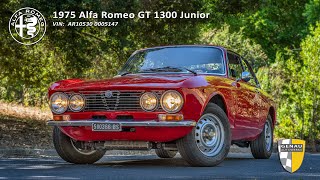
To simplify production at the Arese plant, Alfa Romeo decided to standardize the bodies starting in 1974. With this unification, both the GT 1300 Junior and the GT 1600 Junior received the same bodywork and interior trim as the 2000 GTV, including the four-headlight front end.
The only external differences of the Unified Junior models compared to the GTV were:
Mechanically, the Juniors retained smaller front disc brakes and specific gear and differential ratios to suit their smaller displacement engines.
Additionally, Alfa Romeo offered variants with an extremely aerodynamic and futuristic two-seater coupe bodywork, designed by Ercole Spada for Carrozzeria Zagato in Milan. The GT 1300 Junior Zagato (1,108 units between 1969 and 1972) and the later GT 1600 Junior Zagato (402 units between 1972 and 1975) were produced.
All engines used in the Tipo 105 were part of the renowned Alfa Romeo Twin Cam family. They featured cast aluminum blocks and cylinder heads, a five-bearing crankshaft, and hemispherical combustion chambers with two valves per cylinder actuated directly by two overhead camshafts.
The fuel delivery system featured two twin-choke side-draft carburetors (Weber, Solex, or Dell'Orto) on most versions, or SPICA mechanical fuel injection for American market models. The transmission was always a five-speed synchronized manual, transmitting power to the rear wheels.
The following table presents the structured and consolidated technical details of all versions of the Tipo 105 series:
| Model | Type Code | Production Period | Displacement (cc) | Bore x Stroke (mm) | Fuel System | Comp. Ratio | Net Power | Max Torque | Curb Weight (kg) | Units Produced |
|---|---|---|---|---|---|---|---|---|---|---|
| Giulia Sprint GT | 105.02 | 1963–1966 | 1,570 cc | 78.0 x 82.0 | 2x Weber 40 DCOE Carb. | 9.0:1 | 106 hp @ 6,000 rpm | 139 Nm @ 3,000 rpm | 950 kg | 21,542 |
| Giulia Sprint GTC | 105.25 | 1964–1966 | 1,570 cc | 78.0 x 82.0 | 2x Weber 40 DCOE Carb. | 9.0:1 | 106 hp @ 6,000 rpm | 139 Nm @ 3,000 rpm | 905 kg | 1,003 |
| Sprint GT Veloce | 105.36 | 1965–1968 | 1,570 cc | 78.0 x 82.0 | 2x Weber 45 DCOE Carb. | 9.7:1 | 109 hp @ 6,000 rpm | 142 Nm @ 3,000 rpm | 850 kg | 14,240 |
| 1750 GT Veloce (S1) | 105.44 | 1967–1969 | 1,779 cc | 80.0 x 88.5 | 2x Weber / SPICA Carb. | 9.0:1 | 118-122 hp @ 5,500 rpm | 186 Nm @ 3,000 rpm | 1,030 kg | 44,269 (Total S1/S2) |
| 1750 GT Veloce (S2) | 105.44 | 1969–1972 | 1,779 cc | 80.0 x 88.5 | 2x Weber / SPICA Carb. | 9.0:1 | 118-122 hp @ 5,500 rpm | 186 Nm @ 3,000 rpm | 1,040 kg | Included in total above |
| 2000 GT Veloce | 105.21 | 1971–1977 | 1,962 cc | 84.1 x 88.4 | 2x Weber / SPICA Carb. | 9.0:1 | 130-132 hp @ 5,500 rpm | 182 Nm @ 3,000 rpm | 1,025 kg | 37,459 |
| GT 1300 Junior | 105.30 | 1965–1977 | 1,290 cc | 67.5 x 75.0 | 2x Solex/Weber Carb. | 9.0:1 | 89 hp @ 6,000 rpm | 137 Nm @ 3,200 rpm | 930 kg | 91,195 |
| GT 1600 Junior | 115.03 | 1972–1976 | 1,570 cc | 78.0 x 82.0 | 2x Solex/Weber Carb. | 9.0:1 | 108-110 hp @ 6,000 rpm | 139 Nm @ 3,000 rpm | 930 kg | 14,299 |
| Junior Zagato 1300 | 105 | 1969–1972 | 1,290 cc | 67.5 x 75.0 | 2x Solex/Weber Carb. | 9.0:1 | 89 hp @ 6,000 rpm | 137 Nm @ 3,200 rpm | 875 kg | 1,108 |
| Junior Zagato 1600 | 105 | 1972–1975 | 1,570 cc | 78.0 x 82.0 | 2x Solex/Weber Carb. | 9.0:1 | 108-110 hp @ 6,000 rpm | 139 Nm @ 3,000 rpm | 950 kg | 402 |
The Alfa Romeo Giulia coupe and convertible line based on the Tipo 105 chassis represents an indelible milestone in post-war automotive engineering. By combining structural lightness, refined light-alloy double overhead camshaft engines, and the elegant design conceived by Bertone and refined by Touring, the Milanese manufacturer created a lasting benchmark of sportiness and practical design.
The market success of these different generations and facelifts highlights the success of Alfa Romeo's strategy in diversifying its portfolio between the fast GTV models and the smart Junior models, ensuring enthusiasm on the tracks and high sales volume on the streets. Today, these vehicles are coveted worldwide as icons of style and dynamic performance of their era.