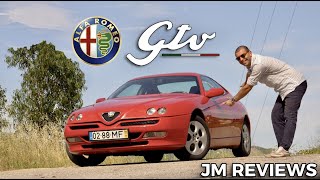
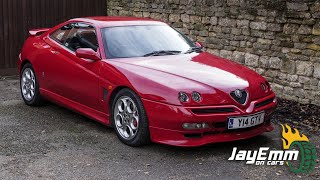
Throughout its ten years of active commercialization, the Alfa Romeo GTV went through three distinct phases
of stylistic and technical updating to remain modern and in compliance with European emission legislation.
Phase 1 (1994–1998) and the Phase 1b Transition (1996–1997)
The first Phase 1 models were characterized by a clean and purist look, sporting the front shield
("Scudetto") integrated into the hood in black plastic without a chrome frame, and side skirts that circled
the car's base painted in matte black. The instrument panel adopted classic analog gauges deeply recessed in
individual cylinders aimed directly at the driver's view.
In mid-1996, a technical transition known as Phase 1b began. The GTV model began to offer the 3.0 V6 24-valve
engine. To handle the power increase and the resized Brembo brakes with 305 mm discs and four-piston red
calipers, the car began to be equipped with 16-inch "Teledial" style alloy wheels (five circular holes).
Internally, the finish was improved with pleated leather seats from the MOMO brand in red, white, or tan,
with coordinated door linings and carpets. The center console replaced the round ventilation knobs with
rectangular selectors and introduced a three-spoke sports steering wheel.
Phase 2 (1998–2003)
Presented in May 1998, Phase 2 focused on modernizing the cabin and aesthetic refinements. The car's exterior
adopted the front shield with a polished chrome frame, and the side skirts began to be painted the same
color as the bodywork.
The cabin received an entirely redesigned center console with a silver finish imitating satin aluminum, plus
new gauges and climate controls. Alfa Romeo made available the internal styling packages "Red Style"
(red-centered dashboard with red or black seats) and "Blue Style" (seats, dashboard, and carpets entirely in
coordinated blue or white). Mechanically, the powerplants were adapted to meet Euro 2 environmental
standards (CF2 electronic management series). The 3.0 V6 24V engine gained a new six-speed manual
transmission. In the year 2000, to optimize operating costs, the Fiat Group transferred final assembly of
the GTV from its old Arese plant in Milan to Pininfarina's specialized facilities in San Giorgio Canavese.
Phase 3 (2003–2004/2006)
Phase 3 was the most radical update applied to the model, also designed directly by the Pininfarina studio.
The vehicle's front end was restyled to incorporate the new Alfa Romeo visual standard, adopting a much
larger and deeper central chrome shield that extended to the lower part of the bumper, which forced the
license plate to be offset to the left side.
Internally, seats with a slightly lowered base were installed, and the center console received a slight
button repositioning. The aging Twin Spark four-cylinder engine was replaced by the modern JTS engine with
direct fuel injection. At the top of the range, the 3.0 V6 24V engine was discontinued to make way for the
240 PS 3.2 V6 powerplant. Series production of the model ended in late 2004, although remaining stock units
continued to be sold until mid-2006.