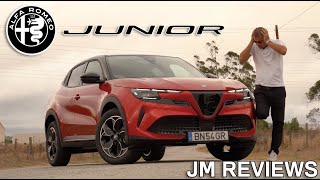
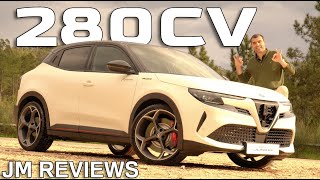
1st Generation
(2024-)
Electric motor
280 cv

Technical specifications, versions, and history for the Alfa Romeo Junior.
Select a generation to see available versions
(2024-)
Select a powertrain to view full technical specifications
The trajectory of the Alfa Romeo Junior, the first subcompact luxury crossover SUV (B-SUV) from the traditional Milanese brand, began with one of the most unusual episodes in global automotive industry history. Officially presented to the press on April 10, 2024, under the name "Milano", the model had its nomenclature challenged by the Italian government just five days after its public reveal. Italy's Minister of Industry, Adolfo Urso, declared that the use of the name "Milano" was illegal under a 2003 law that prohibits the marketing of products with Italian-sounding names if they are not manufactured within national territory.
Since the new sport utility vehicle is assembled at the Tychy plant in Poland, the government argued that christening it with the name of the famous Italian city would mislead consumers. Although Alfa Romeo maintained that the name met all legal requirements and represented a tribute to the city where the brand was born in 1910, the board opted to change the nomenclature to "Junior" on April 15, 2024. The decision aimed to defuse political debates and protect the product's commercial image.
The name "Junior" revives a highly prestigious historical designation within the brand, originally used in the 1960s to identify the entry-level versions of the Giulia coupes from the 105 and 115 series, which were created to attract younger buyers and enthusiasts. Within the manufacturer's modern portfolio, the Junior assumes a highly strategic role, acting as the spiritual successor to two former volume compact models: the MiTo hatchback and the Giulietta small family hatchback. Assembling the vehicle in Poland, made possible by synergies within the Stellantis group, was vital to make the project viable. According to the group's leadership, if the Junior were produced in Italy, the final cost passed on to the consumer would increase by about 10,000 euros, which would ruin its competitiveness in the fiercely contested entry-level urban crossover segment.
The Alfa Romeo Junior is built on the Stellantis e-CMP (Common Modular Platform) modular platform, a highly flexible architecture shared with other compact crossovers in the group, such as the Jeep Avenger, the Fiat 600, and the Peugeot 2008. Despite sharing this base, Alfa Romeo's dynamic development team — which includes engineers responsible for extreme projects like the Giulia GTA — carried out profound modifications to the steering and suspension systems to ensure the model delivered the brand's typical agile handling.
The model exhibits a compact size ideal for urban traffic, but with muscular proportions marked by short overhangs and pronounced wheel arches. Its dimensional specifications vary subtly according to the powertrain and chosen version, as detailed in the table below:
Table 1: Alfa Romeo Junior Dimensions, Weights, and Capacities
| Dimensional Attribute | Ibrida Variant (FWD) | Ibrida Q4 Variant (AWD) | Elettrica Variant (Base) | Elettrica Veloce Variant |
|---|---|---|---|---|
| Length | 4,173 mm | 4,173 mm | 4,173 mm | 4,173 mm |
| Width (without mirrors) | 1,781 mm | 1,781 mm | 1,781 mm | 1,781 mm |
| Width (with mirrors) | 1,981 mm | 1,981 mm | 1,981 mm | 1,981 mm |
| Height | 1,539 mm | 1,539 mm | 1,533 mm | 1,505 mm |
| Wheelbase | 2,557 mm | 2,558 mm | 2,562 mm | 2,563 mm |
| Curb Weight | 1,305 kg | 1,500 kg | 1,545 kg | 1,485 kg |
| Trunk Capacity | 415 liters | 340 liters | 400 / 415 liters | 399 / 400 liters |
| Turning Diameter | 10.5 m | 10.5 m | 10.5 m | 10.5 m |
The trunk of the fully electric front-wheel-drive configurations includes a small storage compartment under the front hood (frunk), smartly designed to practically house the fast-charging cables. The rear luggage space also features a three-level adjustable floor system in the conventional versions, facilitating cargo modularity in daily use.
Since the Alfa Romeo Junior was launched on the market in the second half of 2024, it is currently in its first generation and has not yet undergone a traditional mid-cycle restyling (facelift). However, its brief trajectory already boasts highly relevant engineering evolutions and range expansions, such as the introduction of the Q4 all-wheel drive in early 2025 and the debut of the Sport Speciale special series for the 2026 lineup.
The Junior range is composed of four main powertrain options, divided between mild hybrid systems (MHEV) and fully battery-electric powerplants (BEV).
Table 2: Alfa Romeo Junior Propulsion Technical Specifications
| Mechanical Characteristic | Ibrida 1.2 MHEV FWD | Ibrida Q4 1.2 MHEV AWD | Elettrica (Base) | Elettrica Veloce |
|---|---|---|---|---|
| Engine Type | Gasoline turbo, 3 cylinders, 1.2 L (PSA EB2 Gen3) | Gasoline turbo, 3 cylinders, 1.2 L (PSA EB2 Gen3) | Front synchronous electric | Front synchronous electric |
| Electric Component | 21 kW (28 hp) P2 electric motor | Two 21 kW electric motors (front + rear) | 54 kWh Lithium-Ion Battery (51 kWh usable)54 kWh Lithium-Ion Battery (51 kWh usable) | |
| Combined Power | 136 hp @ 5,750 rpm / Adjusted to 145 hp in some markets | 145 hp (107 kW) | 156 hp (115 kW) | 280 hp (207 kW) |
| Maximum Torque | 230 Nm @ 1,500 rpm | 230 Nm (combustion) + electric motors | 260 Nm | 345 Nm |
| Transmission | 6-speed dual-clutch automated | 6-speed dual-clutch automated | 1-speed Automatic | 1-speed Automatic |
| Acceleration (0-100 km/h) | 8.9 seconds | 9.1 seconds | 9.0 seconds | 5.9 seconds |
| Top Speed | 206 km/h | 200 km/h | 150 km/h | 200 km/h |
| Consumption / Efficiency | 5.3 L/100 km (WLTP) | 5.2 L/100 km (WLTP) | 15.2 kWh/100 km | 17.2 kWh/100 km (WLTP) |
| Maximum Range | N/A | N/A | Up to 410 km (WLTP) | Up to 334 km (WLTP) |
In the front-wheel-drive hybrid version (Ibrida FWD), the internal combustion engine delivers 136 hp, but in several European and British sales catalogs, the total combined output of the hybrid system is labeled as 145 hp due to direct assistance from the 21 kW electric motor integrated into the transmission. The Q4 all-wheel-drive technology, introduced in 2025, brings a remarkable advance to the segment by dispensing with physical driveshaft connections between the axles.
Rear-wheel drive is provided purely electronically by a 21 kW motor coupled to the rear axle, which manages torque instantaneously according to the grip and inclination conditions of the track. Thanks to the Power Looping functionality, the AWD system remains active even when the 48V battery is at its minimum charge level. This optimized calibration reduces understeer in corners by about 30% compared to the front-wheel-drive configuration. To support this superior dynamics, the Q4 version debuts a MultiLink independent rear suspension on the platform, accompanied by custom-developed anti-roll bars and shock absorbers.
The development of the top-of-the-line electric Veloce reflects Alfa Romeo's constant search for dynamic credibility in the high-performance electric segment. Initially projected to deliver 240 hp, the version had its numbers updated by the automaker in June 2024. Final dynamic track tests revealed that the front synchronous motor actually achieved 280 hp (207 kW). This change elevated the Junior Veloce to the same power level as the top-of-the-line versions of the Giulia and Stelvio, positioning it as a true high-performance sport utility vehicle in the compact segment.
The Veloce's dynamic package features deep technical engineering refinements. It brings the renowned Torsen mechanical limited-slip differential to the front axle to maximize traction under severe acceleration out of corners. The chassis height relative to the ground was reduced by 25 mm, the steering received a direct sporty calibration with 2.6 turns lock-to-lock, and the front brakes were oversized with 380 mm discs assisted by four-piston monobloc calipers. 20-inch "Venti" alloy wheels equipped with Michelin Pilot Sport EV tires complete the dynamic assembly.
Designed at the prestigious Alfa Romeo Centro Stile in Turin, the Junior exhibits striking visual elements inspired by the manufacturer's rich past. The silhouette features the "Coda Tronca" (truncated tail), a rear element that optimizes aerodynamic drag while paying homage to the classic Giulia TZ race car. The front end adopts a sporty grille that can come in two stylistic variants according to the chosen version:
The interior finish of the subcompact crossover intensely focuses on the driver's ergonomics. The dashboard features the "Cannocchiale" (binocular) design that surrounds a 10.25-inch configurable digital screen. In the center, a second 10.25-inch touchscreen, angled 11 degrees toward the driver, manages entertainment and navigation maps.
The seats can be configured in the Icona pattern, composed of basic fabric and manual adjustments; the Spiga, which adopts black and red fabric with decorative stitching, electric adjustments, and a massage function for the driver; or the Corsa pattern, sports bucket seats developed by Sabelt in Alcantara and artificial leather that offer high lateral support. As part of the model's aesthetic evolution for 2026, Alfa Romeo decided to remove the traditional front offset-mounted license plates from all European models due to new safety rules for pedestrian impacts, maintaining a centralized plate look instead.
Official production of the Alfa Romeo Junior began on September 30, 2024, at the Tychy manufacturing facility in Poland. This high-tech plant is also responsible for the assembly lines of the Jeep Avenger and the Fiat 600.
The vehicle's commercial performance played a central role in Alfa Romeo's financial recovery between 2024 and 2026. In the consolidated year of 2025, the brand recorded a significant growth of 20.1% in global sales, surpassing 73,000 delivered units, a level directly sustained by the success of Junior orders. The compact utility accumulated more than 60,000 purchase orders across 41 global markets during the launch period. The model quickly positioned itself at the top of premium B-SUV sales in highly representative countries like Italy, France, Austria, Greece, and Slovakia.
Table 3: Market Performance and Sales Distribution (Consolidated 2025)
| Business and Sales Indicator | Commercial Performance Data |
|---|---|
| Total Alfa Romeo Sales Volume | Over 73,000 global units |
| Junior Order Book | Over 60,000 bookings in 41 countries |
| Share of the Ibrida Version (MHEV) | ~70% of the total order mix |
| Share of the Elettrica Version (Base) | ~25% of the total order mix |
| Share of the Elettrica Veloce Version | ~5% of the total order mix |
| Pure Battery Electric Model Penetration Rate | 17% of total Junior sales volume |
| Registration Growth in Europe | +31.1% driven by entry-level range |
| Fastest-Growing Markets (YoY) | United Kingdom (+80.1%), France (+41.9%), Italy (+20.7%) |
Despite strong commercial indicators in Europe and Asia, Alfa Romeo did not introduce the Junior into the North American market, focusing its efforts instead on volume markets like Mexico, where the model debuted in early 2026 exclusively in the 145 hp Ibrida variant. This absence from the US market occurred in parallel with a severe 36.2% drop in the brand's US sales during 2025, where combined deliveries of the Tonale, Stelvio, and Giulia totaled just 5,652 units.
Industrial dynamics in Poland also went through periods of instability. In late 2025, facing a weakened European market and a general slowdown in battery-electric purchases, Stellantis decreed scheduled technical shutdowns in Tychy. Production of the Alfa Romeo Junior and its sister models was halted for nine days as a measure to adjust and control dealership inventories, demonstrating the operational challenges stemming from European economic volatility.
As an entirely new project, the Alfa Romeo Junior underwent two main recall campaigns and had specific faults documented by its owners and dealership networks between 2024 and 2026.
In late 2024, the manufacturer opened a free campaign for an electronic update to the control module of the LED matrix headlights, which exhibited high-beam aiming faults in foggy conditions or oncoming traffic. The same recall corrected an inconsistency in the electric power steering-linked ADAS systems, where the lane-keeping assist made sudden corrections or deactivated without prior warning.
During 2025, a second safety recall was issued focusing exclusively on the 1.2 Ibrida powertrain. The intervention included the replacement of fuel lines in the engine bay that presented a risk of friction and subsequent fuel leakage under high working pressures.
Owners of the model reported occasional issues with the 6-speed e-DCT automated transmission. In certain situations of constant acceleration, the gearbox enters an electronic protection mode, locking in fourth gear and requiring a complete shutdown of the vehicle to restart the system. In terms of comfort, users pointed out faint metallic noises coming from the engine compartment in the first minutes after a cold start, behavior considered characteristic of the three-cylinder engine until the lubricant reaches its ideal working temperature.
To keep the factory warranty active, Alfa Romeo establishes a strict schedule of corrective and preventive maintenance every 15,000 km or one year, with the mandatory use of synthetic lubricant approved under the PSA B71 2290 technical specification to avoid premature wear of the 1.2-liter engine's wet timing belt.
The Alfa Romeo Junior precisely fulfills its corporate mission of re-establishing the Italian brand's production volume within the European premium vehicle scene. Sharing off-the-shelf components within the Stellantis portfolio allowed the brand to offer a financially viable entry-level model.
Although the manufacturer's corporate guidelines target a full transition to electrification, the reality of the Junior's sales data — where 70% of buyer preferences are concentrated on the MHEV hybrid system — reinforces that a flexible offering of combustion and electrified powertrains remains the main commercial pillar supporting traditional premium brands in markets where electric charging infrastructure is still consolidating.
Images of the Alfa Romeo Junior