1st Generation
(2020-2024)
4.0 Twin-Turbo
707 cv
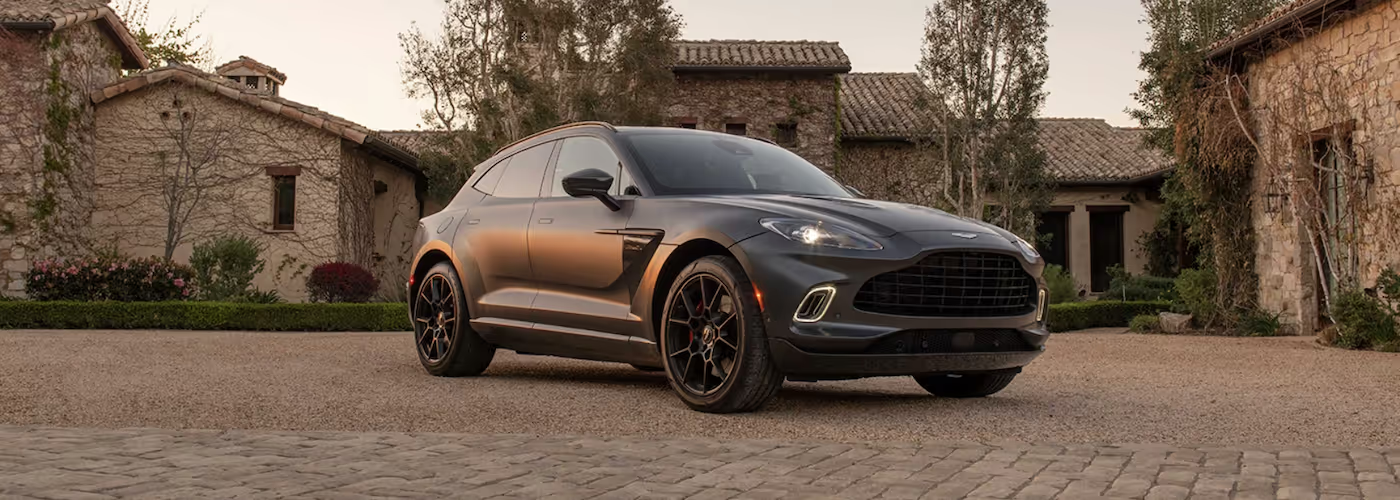
The SUV that translated Aston Martin’s sporting soul into a new dimension of luxury and versatility.
Select a generation to see available versions
(2020-2024)
The history of the Aston Martin DBX cannot be separated from the narrative of survival and reinvention that permeates the trajectory of Aston Martin Lagonda. For over a century, the British brand was revered for producing elegant Grand Tourers (GTs) and high-performance sports cars, cementing its image in popular culture through an indelible association with the James Bond franchise. However, the economic reality of the ultra-luxury automotive industry in the 21st century imposed challenges that tradition alone could not overcome. The company's historical financial volatility demanded stabilization, and the global market's response pointed unequivocally in one direction: Sport Utility Vehicles (SUVs).
In the mid-2010s, direct and indirect competitors were already reaping the rewards of diversifying their portfolios. Porsche, with the Cayenne, had proven that purists might protest, but the market would buy in droves. Bentley was preparing the Bentayga and Lamborghini the Urus. Under the leadership of then-CEO Dr. Andy Palmer, Aston Martin conceived the "Second Century Plan", an aggressive strategy to ensure the company's sustainability in its second hundred years of life. This plan envisioned the launch of seven core models in seven years, with the DBX being the fourth and, strategically, the most crucial to generate cash volume and finance the niche sports cars.
The first tangible sign of this ambition was revealed at the Geneva Motor Show in 2015, with the presentation of the DBX concept. That initial prototype differed significantly from the final production car; it was a two-door coupe with raised suspension, suggesting a fusion between a traditional GT and a crossover. The message, however, was clear: Aston Martin was redefining what an SUV could be, prioritizing aesthetic beauty and proportion in a segment known for utilitarian and boxy vehicles.
One of the biggest concerns during the development phase, which spanned from 2015 to 2019, was ensuring that the DBX wasn't just a "tall Aston Martin", but that it met the practical needs of a broader audience. The brand's traditional demographic was predominantly male. For the DBX, Aston Martin actively sought to attract affluent women and families.
To this end, the company established a "Female Advisory Board", a group of customers and experts who provided crucial feedback on ergonomics, visibility, and daily usability. This feedback influenced design decisions, such as the layout of the center console (with space for handbags), ease of access to the rear seats, and outward visibility, ensuring the vehicle was welcoming to drivers of all statures, from the 5th percentile female to the 99th percentile male.
Unlike many rivals that use shared platforms within large conglomerates (such as the Volkswagen Group, where Audi, Porsche, Bentley, and Lamborghini share the MLB Evo architecture), Aston Martin chose a more arduous and exclusive path: developing a dedicated bonded aluminum platform. The brand's historic infrastructure in Gaydon, England, lacked the capacity to absorb the mass production of an SUV with these characteristics.
The solution was a massive investment in creating a second factory in St Athan, Wales. The chosen site carried significant historical weight: it was a former Royal Air Force base (RAF St Athan). The conversion project, initiated in 2015, transformed military hangars into a state-of-the-art assembly line. This decision was not only logistical but also political and social, bringing skilled jobs to the region and marking the DBX as the first Aston Martin to be "Made in Wales". The factory was officially opened for DBX production in 2019, ready to build up to 4,000 units per year, operating with the philosophy of blending precision automation with the artisanal hand-finishing typical of the brand.
The commercial launch of the DBX took place in 2020, introducing a technical architecture that sought to resolve the paradox of the luxury SUV: how to offer limousine comfort and sports car dynamics in a 2.2-ton package.
The decision not to share a platform allowed Aston Martin's engineers, led by Chief Creative Officer Marek Reichman, to dictate the vehicle's exact proportions without the compromises inherent in adapting an existing chassis. The DBX structure uses bonded aluminum technology, a technique refined by the brand in its sports cars. The use of thermally cured aerospace adhesives, rather than traditional welds, results in an incredibly rigid and lightweight structure.
This architecture allowed for a long wheelbase of 3,060 mm. The immediate technical advantage was the ability to push the wheels to the extreme corners of the bodywork, reducing front and rear overhangs. This not only improved interior space, allowing for a wide and flat floor, but also reduced the polar moment of inertia, making it easier for the vehicle to change direction in corners. The curb weight was kept to 2,245 kg, a competitive figure for an SUV of this size with a V8 engine and all-wheel drive.
For the powertrain, Aston Martin maintained its strategic technical partnership with Mercedes-AMG. The launch model was equipped with the 4.0-liter twin-turbo V8 engine (code M177), a power unit widely praised for its durability and linear power delivery.
The engine was mounted in a "front-mid" position, pushed back behind the front axle as much as possible. This contributed to an almost perfect weight distribution of 54% at the front and 46% at the rear, essential for neutral handling. The chosen transmission was a 9-speed automatic gearbox with a torque converter (9G-Tronic), supplied by Mercedes, but with exclusive Aston Martin software mapping to ensure shifts that suited the car's GT character.
The dynamic "secret" of the DBX lies in its complex triple volume air suspension. Unlike conventional steel springs or simple air bags, this system allows for an extreme variation in spring stiffness and ride height. The car can be raised by up to 45 mm to clear off-road obstacles or lowered by 50 mm to ease access and improve high-speed aerodynamics.
Complementing the air springs, the DBX introduced a 48-volt electronic anti-roll control (eARC) system. Instead of rigid physical anti-roll bars connecting the left and right wheels (which would hurt comfort over one-sided potholes), the eARC uses powerful electric motors to twist the bars only when necessary. In corners, the system applies torque contrary to body lean, keeping the car flat. Aston Martin claimed that the DBX, thanks to this system, generates less body roll in extreme corners than its DB11 sports coupe, a remarkable engineering feat for a tall SUV.
The all-wheel drive (AWD) system is equally sophisticated, utilizing an active central transfer case that can send up to 100% of torque to the rear axle if necessary, and an electronic limited-slip rear differential (eDiff) that distributes power between the rear wheels for torque vectoring, helping to "push" the car's nose into the corner.
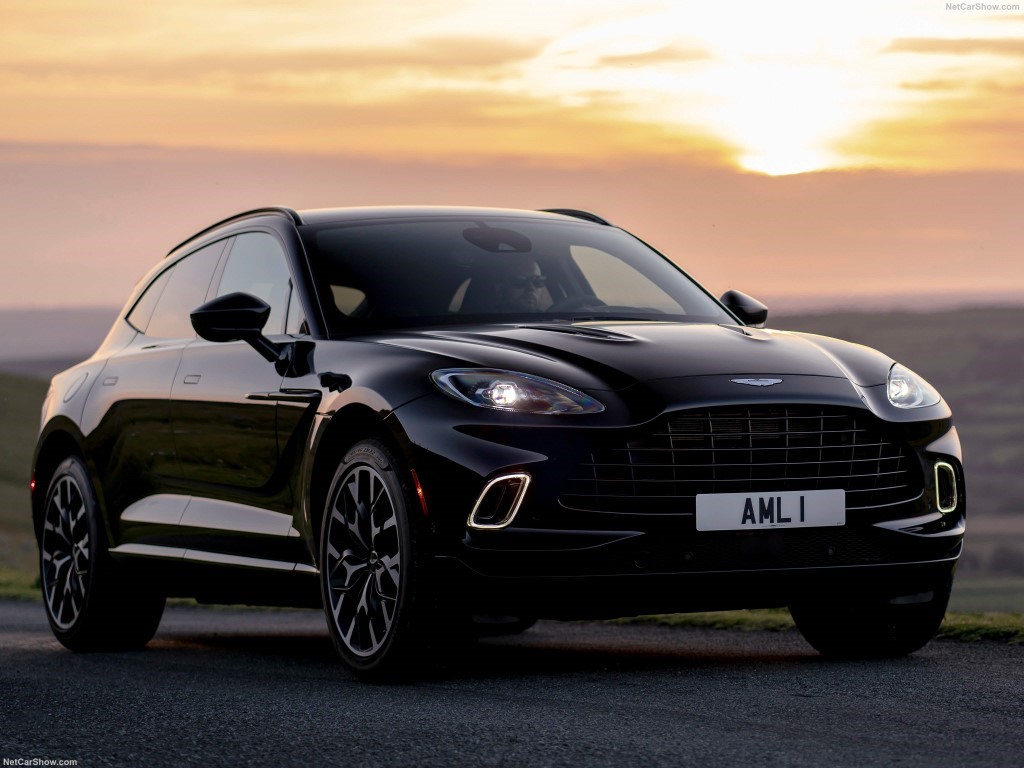
The DBX's design, penned by Marek Reichman, was guided by the "Golden Ratio", aiming for an aesthetic that was undeniably Aston Martin without resorting to caricatures.
The front of the vehicle is dominated by the largest "DB" grille ever fitted to an Aston Martin up to that point, necessary to feed the cooling requirements of the twin-turbo V8. The bi-LED oval headlights maintain the family's visual signature. A distinct feature are the integrated daytime running light (DRL) ducts that are not merely aesthetic; they channel air through the front wheel arches to reduce turbulence and aerodynamic drag along the sides of the vehicle, creating an "air curtain".
The doors are "Swan-hinged", opening slightly upwards and outwards. This is not just a dramatic flourish; it prevents the doors from scraping on high curbs, a common problem with low sports cars, now adapted for the SUV to ease entry and exit without dirtying clothes on the sills.
The rear of the DBX features a controversial, yet highly functional design, inspired by the Vantage model. The tailgate has a pronounced "ducktail". This element generates significant downforce on the rear axle, stabilizing the vehicle at high speeds.
More interesting is the management of airflow over the rear window. The air passing over the roof is directed by a top-mounted spoiler, flowing down over the rear glass and cleaning it naturally. This aerodynamic efficiency allowed designers to dispense with a rear windshield wiper, keeping the design lines clean and elegant, a rarity in the SUV segment where vertical rear windows generally accumulate dirt.
Recognizing the critical importance of the Chinese market and its tax peculiarities, Aston Martin diversified the DBX range in November 2021 with an exclusive version for that region: the DBX Straight-Six (Mild Hybrid). Equipped with a Mercedes-AMG M256 engine (3.0L inline-6), it produced 435 PS and 520 Nm. Despite the tax logic, the model had a short life and was discontinued in 2024, as the Chinese ultra-luxury market preferred to migrate to the DBX707.
If the original DBX proved that Aston Martin could make an SUV, the DBX707, launched in 2022, proved that it could dominate the segment in terms of pure performance. The explicit goal was to surpass the Lamborghini Urus and claim the title of "world's most powerful luxury SUV".
Despite its mechanical success, the DBX faced severe criticism for its outdated interior and infotainment system. The response came with the 2025 model year update (unveiled in 2024).
With the arrival of the 2025 model, Aston Martin discontinued the "base" 550 PS V8 model, making the DBX707 the standard entry-level model of the global lineup.
Aston Martin announced the DBX S, designed to be the new flagship. It benefits from Valhalla technology, with power increased to 727 PS. The primary focus is "lightweighting", with options such as a carbon fiber roof and magnesium wheels, which can reduce total weight by up to 47 kg compared to the DBX707.
The impact of the DBX on Aston Martin's finances was transformative.
| Fiscal Year | Units Sold | % of Brand Total | Context |
|---|---|---|---|
| 2020 | 1,516 | ~45% (2nd half) | Mid-year launch. |
| 2021 | 3,001 | ~48% | First full year. Best-seller. |
| 2022 | 3,219 | >50% | Historical peak with the DBX707. |
| 2023 | 2,939 | ~44% | Slight retraction, but remained dominant. |
| 2024 (Est.) | ~1,900 | ~32% (Drop in H1) | Transition year and cut of the base model. |
The DBX was instrumental in increasing the brand's Average Selling Price (ASP), which reached a record £245,000 in 2024.
| Specification | DBX V8 (2020-2024) | DBX Straight-Six (China) | DBX707 (2022-Present) | DBX S (2025+) |
|---|---|---|---|---|
| Engine | M177 (4.0L V8 Biturbo) | M256 (3.0L I6 Turbo + 48V) | M177 (Revised) | M177 (Valhalla Spec) |
| Transmission | 9-Speed Auto (Torque Conv.) | 9-Speed Auto | 9-Speed MCT (Wet Clutch) | 9-Speed MCT (Optimized) |
| Maximum Power | 550 PS (542 hp) | 435 PS (429 hp) | 707 PS (697 hp) | 727 PS (717 hp) |
| Maximum Torque | 700 Nm | 520 Nm | 900 Nm | 900 Nm (extended range) |
| Acceleration 0-100 km/h | 4.5 seconds | 5.4 seconds | 3.3 seconds | 3.3 seconds (estimated) |
| Maximum Speed | 291 km/h | 259 km/h | 310 km/h | 310 km/h |
| Weight (DIN) | 2,245 kg | N/A | 2,245 kg | ~2,198 kg (with options) |
This report consolidates the trajectory of the Aston Martin DBX from a controversial concept in 2015 to the brand's financial pillar in 2024. The model exemplifies the luxury industry's ability to adapt to new consumer demands without entirely sacrificing its performance heritage.