Series II
(1972-1973)
5.3
320 cv

The "Brute" from Newport Pagnell: two decades of V8 power and handcrafted luxury that defined the British supercar.
Select a generation to see available versions
(1972-1973)

(1974-1978)
(1978-1986)
(1986-1989)
The history of the Aston Martin V8 is not merely the chronicle of a luxury automobile; it is the tangible record of the resilience of one of Britain's most iconic brands through two decades of industrial turbulence, oil crises, and corporate uncertainty. This model, handcrafted in Newport Pagnell between 1969 and 1989, served as the financial and engineering backbone of Aston Martin Lagonda Ltd., allowing the company to survive the departure of its patron, Sir David Brown, and enter the modern era.
The V8 represented a fundamental transition in the brand's philosophy: the shift from the agile, yet smaller, six-cylinder engines that powered the legendary DB4, DB5, and DB6, to a new era of raw power and high-speed Grand Touring (GT) capability, driven by a lightweight alloy V8 engine designed by the visionary Polish engineer Tadek Marek. During its twenty-year life cycle, the model evolved from a fast GT into Britain's first true "supercar" in the form of the V8 Vantage, challenging the Italian hegemony of Ferrari and Lamborghini with a unique combination of brute force and aristocratic refinement.
To understand the "Aston Martin V8", it is imperative to analyze its direct predecessor and chassis donor, the Aston Martin DBS. In the mid-1960s, Aston Martin recognized the need to replace the aging DB6 with a more modern, spacious, and aerodynamic car, capable of accommodating the new V8 engine that was under development.
The design of the new car was entrusted to William Towns, who conceived a modern, angular, and aggressive bodywork. The DBS was launched in 1967, but initially with the old inline six-cylinder engine due to delays with the V8. It was only in 1969 that the V8 engine was deemed ready for production, giving rise to the DBS V8.
| Characteristic | Detail |
|---|---|
| Production Period | 1969 – 1972 |
| Units Produced | 402 (approx.) |
| Engine | 5.3L V8, Bosch Mechanical Injection |
| Estimated Power | ~315 - 320 bhp |
| Top Speed | 160 mph (257 km/h) |
| Designer | William Towns |
Following the sale of Aston Martin by Sir David Brown in 1972, the "DBS" name was dropped and the car became known simply as the Aston Martin V8. The Aston Martin Owners Club (AMOC) classifies the evolution of this model into distinct "Series".
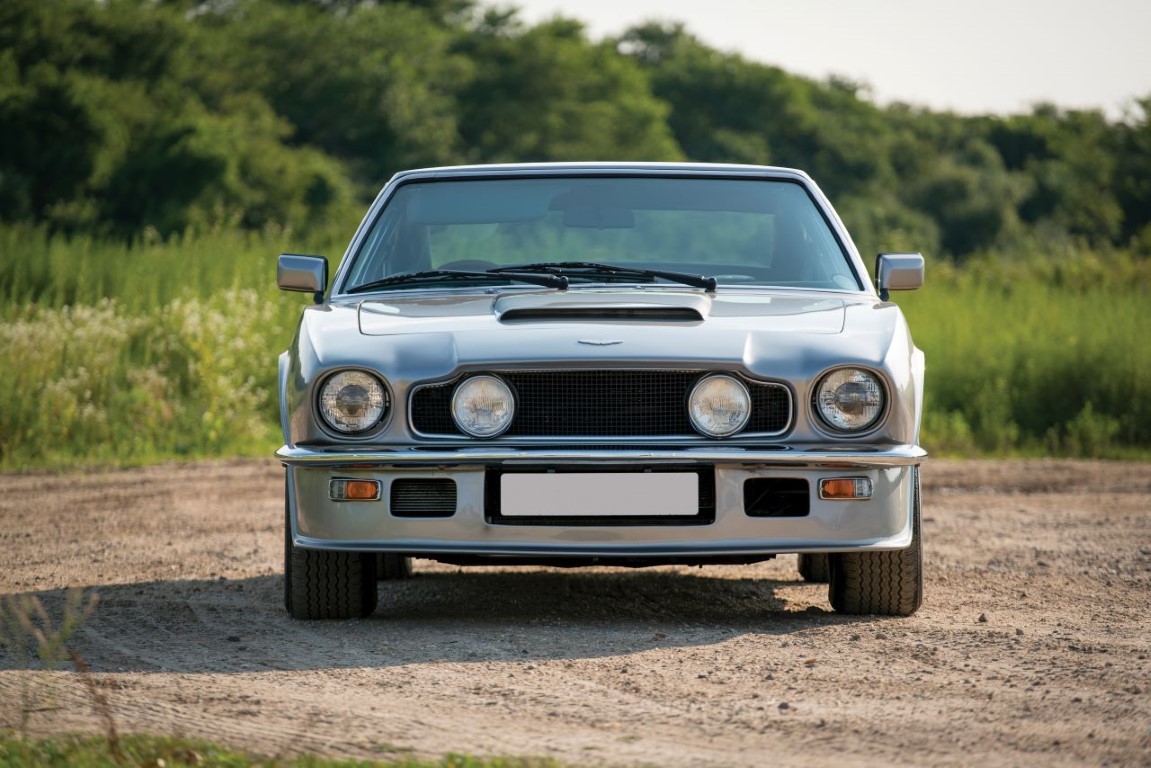
The first iteration under the new ownership. The most striking visual change was at the front: the four-headlight arrangement of the DBS was replaced by two single quartz-iodine headlights in a new black mesh grille. Mechanically, it retained the Bosch injection system from the DBS V8, which proved problematic and difficult to maintain.
Seeking greater reliability and compliance with emissions laws, Aston Martin replaced the Bosch injection with four Weber 42 DCNF carburetors. This change required a prominent air intake on the hood ("scoop"), which became the visual identifier of the Series 3. Estimated performance was around 310 bhp on European versions, but fell drastically on US "Emissions Control" models.
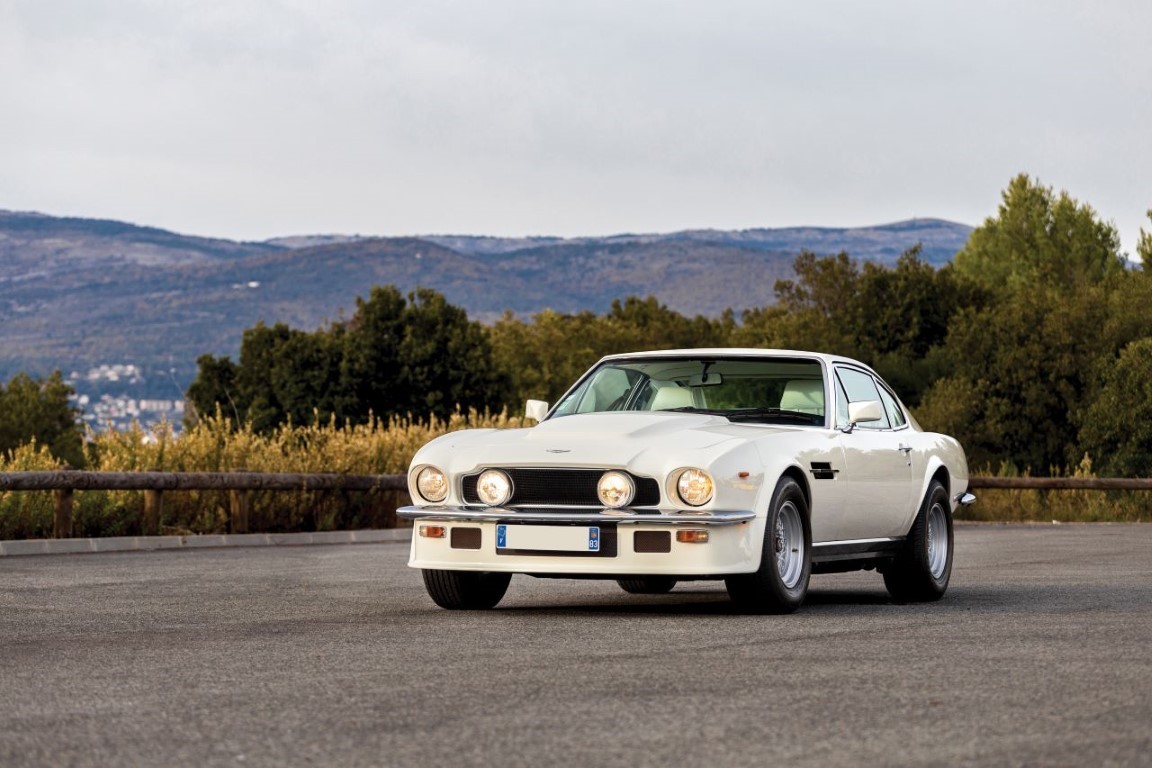
Considered the definitive maturation of the V8 as a luxury GT. The internal code "Oscar India" (October Introduction) christened this generation. The hood lost the open air intake and gained a closed "power bulge". At the rear, an integrated spoiler ("tea tray") improved aerodynamics. The interior became entirely upholstered in Connolly leather and gained walnut wood trim as standard.
Launched in 1977, the V8 Vantage was a deep mechanical rebuild designed to beat the Ferrari 512BB and the Lamborghini Countach. Engineers equipped the V8 with high-performance camshafts, larger valves, and gigantic Weber 48 IDF carburetors.
Power jumped to an estimated 380 bhp, even surpassing 400 bhp in the final versions. The car accelerated from 0 to 60 mph in 5.2 seconds, with a top speed of 274 km/h, securing the title of "fastest four-seater car in the world".
For high-speed stability, the front grille was blanked off and equipped with driving lights. A huge front spoiler and a rear spoiler (initially bolted on, later integrated) were added. Widened wheel arches accommodated wide tires.
The Definitive Version: The "X-Pack" (1986–1989): Equipped with high-compression Cosworth pistons and reworked cylinder heads, the V580X engine delivered between 410 and 432 bhp. Only about 131 to 137 cars were built to this specification.
| Model | 0-60 mph | Top Speed | Power (Est.) | Carburetors |
|---|---|---|---|---|
| V8 Saloon (Standard) | 6.6 sec | 240 km/h | 305 bhp | Weber 42 DCNF |
| V8 Vantage (Early) | 5.3 sec | 274 km/h | 380 bhp | Weber 48 IDF |
| V8 Vantage (X-Pack) | 5.2 sec | 275+ km/h | 432 bhp | Weber 48 IDF |
In June 1978, Aston Martin launched the V8 Volante (Series 1) to meet the demand of the North American market. Removing the roof required substantial reinforcements to the chassis, increasing the weight by up to 100 kg. The power soft top was fully lined for acoustic and thermal insulation.
In 1987, Prince Charles commissioned a V8 Vantage Volante, but requested a discreet bodywork, without the aggressive spoilers and side skirts of the standard Vantage. Aston Martin created the "wolf in sheep's clothing": full Vantage mechanics in an elegant Volante body. Only 22 units were built to the full PoW specification, making them extremely valuable.
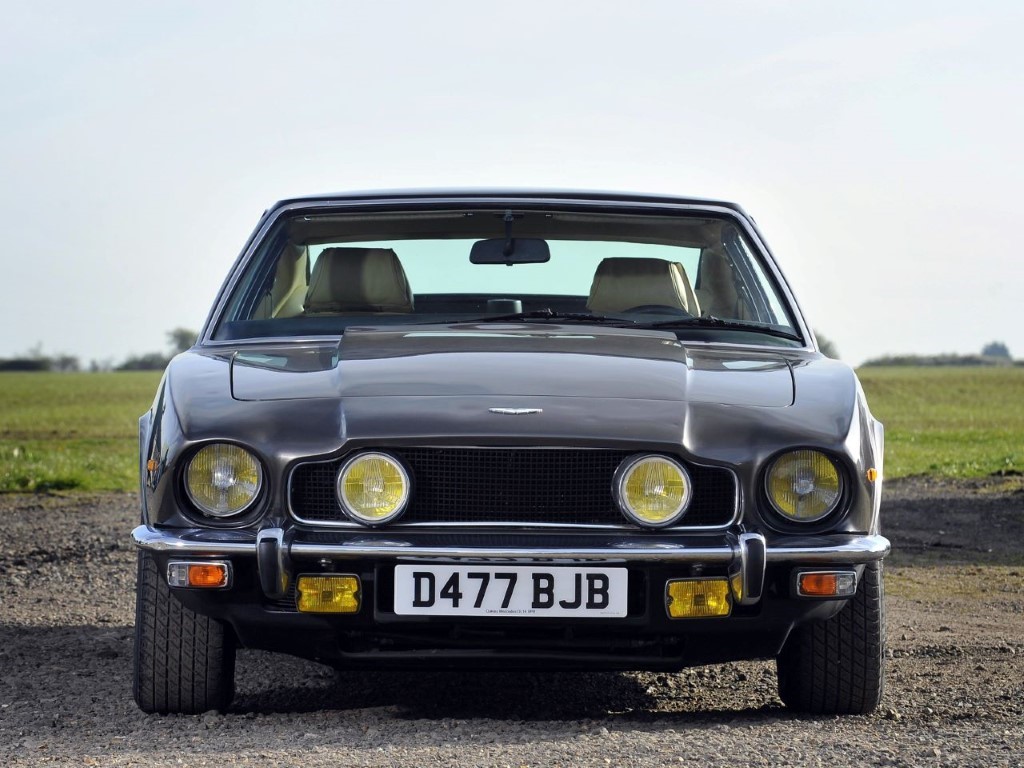
The final phase of the V8 Saloon adopted a Weber-Marelli sequential electronic fuel injection system, abandoning the carburetors (except on the Vantage). This allowed precise control of the mixture and eliminated the need for the "bulge" on the hood, returning to a flat, clean profile. Only about 60 coupes of this series were built.
A partnership with the Italian carrozzeria Zagato resulted in a lighter, shorter, and more aerodynamic car capable of reaching 300 km/h. The angular design was polarizing. Production was strictly limited: 52 coupes and 37 volantes.
| Model / Generation | Period | Units (Approx.) | Key Details |
|---|---|---|---|
| DBS V8 | 1969–1972 | 402 | Bosch injection, alloy wheels, 4 headlights. |
| V8 Saloon (Series 2) | 1972–1973 | 288 | New front (2 headlights), Bosch injection. |
| V8 Saloon (Series 3) | 1973–1978 | 967 | Weber carburetors, tall hood scoop. |
| V8 Saloon (Series 4) | 1978–1985 | 352 | "Oscar India", wood interior, integrated spoiler. |
| V8 Saloon (Series 5 EFI) | 1986–1989 | ~60 (Coupes) | Weber-Marelli injection, flat hood. |
| V8 Volante (Series 1) | 1978–1985 | 656 | Standard convertible, carbureted. |
| V8 Volante (Series 2 EFI) | 1986–1989 | 245 | Convertible with electronic injection. |
| V8 Vantage (Series 1) | 1977–1978 | 38 (+13 US) | Bolt-on spoiler, blanked grille. |
| V8 Vantage (Series 2) | 1978–1989 | 304 (+14 US) | Includes Oscar India and X-Pack. |
| V8 Vantage Volante | 1986–1989 | 192 (+56 US) | High-performance convertible. |
| V8 Vantage Volante PoW | 1987–1989 | 22 (+5 Cosm.) | Prince of Wales, discreet look. |
| V8 Zagato (Coupé) | 1986–1988 | 52 | Special Italian bodywork. |
| V8 Zagato (Volante) | 1987–1990 | 37 | Zagato convertible. |
| Estimated Total | 1969–1989 | ~4,021 | Total for all V8 variants. |
In 1987, James Bond once again drove an Aston Martin in the film "The Living Daylights", using a V8 Vantage Volante (modified to look like a coupe in some scenes). The car, equipped with retractable skis and missiles, revitalized global interest in the model.
Today, the Aston Martin V8 is seen as a "Blue Chip". At the top of the pyramid are the Vantage Volante Prince of Wales, which can exceed £500,000. The Series 3 and Series 5 EFI models represent more accessible entry points, although they require specialized maintenance.
The Aston Martin V8 was the right car at the right time — and at the wrong time. It was born amidst crisis, survived bankruptcy, and flourished in the era of excess of the 80s. Its engineering, led by Tadek Marek's immortal engine, proved robust enough to evolve from 300 to 430 horsepower over two decades. More than any other model, the V8 kept the lights on at Newport Pagnell, preserving British handcrafted tradition. It remains, to this day, as the muscular, loud, and luxurious definition of classic British motoring.