
Strategic Origin and European Regulatory Pressure
The Aston Martin Cygnet represents one of the most peculiar and controversial episodes in the contemporary automotive industry. Officially launched in 2011, the model did not stem from a natural consumer demand for a luxury compact vehicle, but rather from a legal and environmental requirement imposed by the European Union. In the late 2000s, European authorities established strict reduction targets for average fleet carbon dioxide ($CO_2$) emissions for every manufacturer. Companies exceeding the defined 2012 limits would face multi-billion-euro financial penalties.
Unlike sports car competitors operating within large automotive conglomerates that could offset emissions with mainstream and electrified cars from sister brands, Aston Martin operated entirely independently. The brand's lineup at the time consisted exclusively of high-displacement models equipped with V8 and V12 engines, such as the Vantage, DB9, and Rapide, which had high emission ratings. Lacking the time or budget to design a low-emissions car from scratch, the British manufacturer sought a swift external solution. Under the leadership of then-CEO Ulrich Bez, the company secured a supply agreement with Toyota to utilize the platform of the Japanese Toyota iQ microcar as the foundation for its own regulatory compliance vehicle.
The commercial concept of the Cygnet was structured as a "luxury tender." The brand's intent was to sell the minicar directly to existing supercar owners, offering an agile, refined, and easily parkable mode of transport for congested city centers, while maintaining the prestige associated with Aston Martin's winged badge.
Engineering Foundation and the Gaydon Customization Process
The mechanical base selected for the project was the Toyota iQ, marketed in other regions as the Scion iQ. Although the iQ was an economy car, it featured highly sophisticated space-saving engineering, including a compact steering gear, a flat underfloor fuel tank, a slim air-conditioning unit, and a remarkably tight turning circle of just four meters, making it an ideal platform for urban traffic.
The manufacturing process of the Cygnet began in Japan, from where assembled Toyota iQ units were shipped by sea to Aston Martin's facility in Gaydon, England. Upon arrival at the British headquarters, the cars were meticulously disassembled so the brand's craftspeople could begin a hand-built transformation that consumed approximately 175 hours of labor per vehicle.
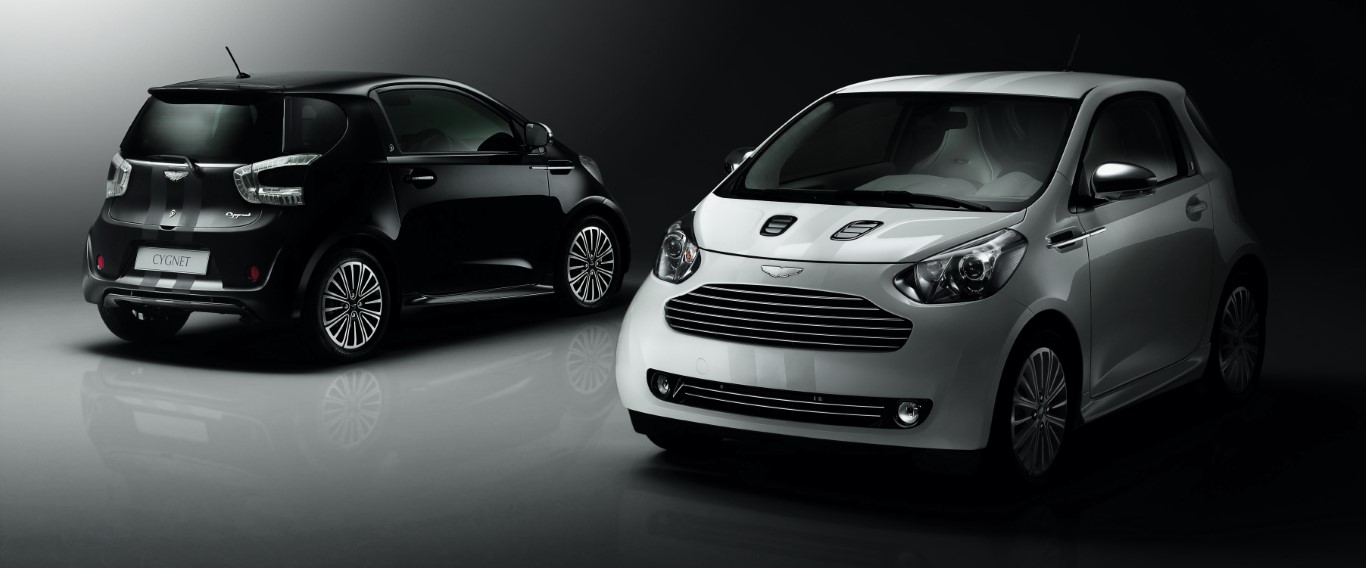
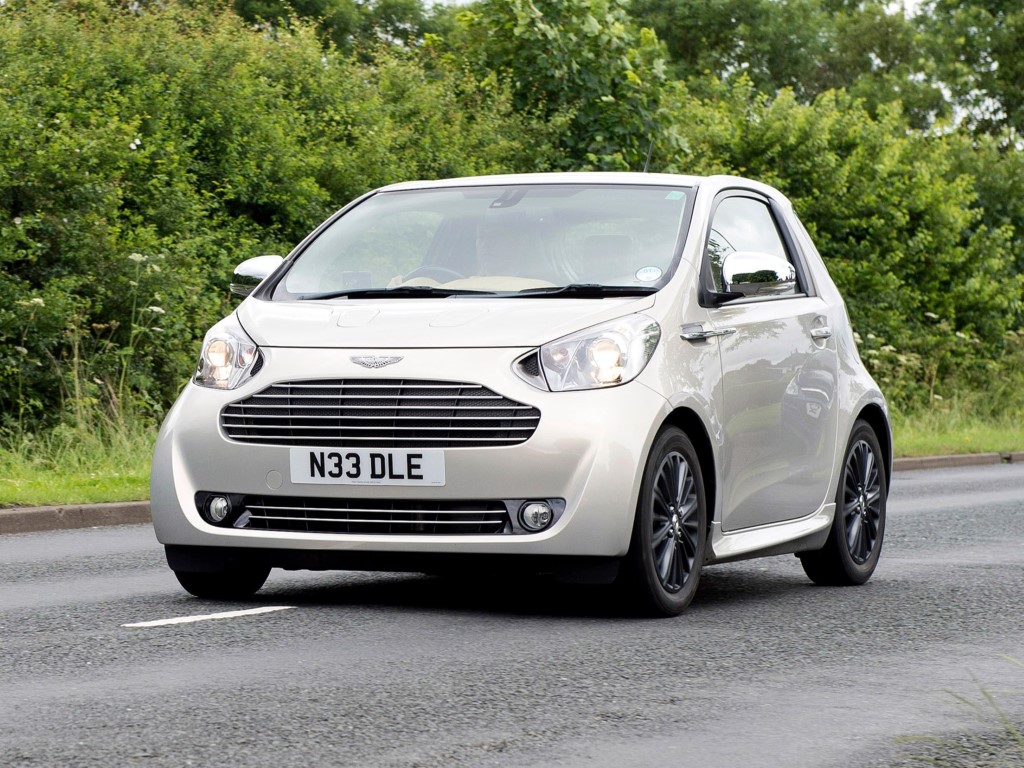
On the exterior, the visual makeover was extensive to ensure alignment with the English brand's design identity. Almost all outer body panels, with the exception of the roof, were replaced. The front end received an aluminum trapezoidal grille identical to that of the DB9 and DBS, along with a reshaped hood featuring functional air vents and redesigned headlights with bespoke internal bezels. The sides gained sculpted side strakes with chrome strakes, and the door handles featured raised detailing. At the rear, the Toyota's small original taillights were swapped for clear C-shaped lenses reminiscent of the brand's supercars, integrated into a unique bumper with a decorative rear diffuser. To conceal the project's origins, even the Toyota logos on the side glass were covered with metallic Aston Martin badges, and the original key received a sophisticated plastic casing carrying the British marque's emblem.
The Cygnet's interior was completely overhauled to match the sophistication expected by the brand's clientele. The hard plastic cabin of the Toyota iQ was stripped away and re-trimmed in hand-stitched premium leather and Alcantara. The center console was redesigned in a waterfall layout, and acoustic insulation was significantly enhanced through additional sound-deadening mats under thick wool carpeting. To optimize interior room, the dashboard retained its original asymmetrical layout, allowing the front passenger seat to sit slightly forward of the driver. This arrangement ensured enough space to seat up to three adults and one child, or to expand luggage capacity from 32 liters to 242 liters with the rear seats folded flat.
Evolution Over the Years: Absence of Generations and Facelifts
The Aston Martin Cygnet had a very brief production run, spanning from January 2011 to September 2013. Due to this short lifespan, the regular production model did not undergo platform generation changes and never received official restylings or mid-cycle facelifts. The vehicle sold in 2013 remained mechanically and aesthetically identical to the model presented at its 2011 launch.
The model's evolution occurred through the release of special editions and the introduction of bespoke customization programs throughout its manufacturing years, alongside one-off engineering projects developed later by commission.
Launch Editions (2011)
To mark the start of sales in 2011, Aston Martin offered two exclusive special editions for a limited time, with order books closing in April of that year:
- Launch Edition White: Distinguished by Snow White metallic paintwork with twin satin longitudinal stripes running over the hood, roof, and rear deck. It featured matte silver accents on the side strakes, chrome mirror caps, and 16-inch diamond-turned wheels with gloss white inner accents. The interior featured Pearl White leather upholstery combined with perforated Alcantara inserts backed in silver, set off by satin chrome trim.
- Launch Edition Black: Finished in Magic Black metallic paint with a deep dark-green undertone effect. The hood louvers and side strake surrounds were finished in matte black, while the alloy wheels featured a gloss black finish with diamond-turned faces. The interior was upholstered in Pure Black leather with diamond perforations, accompanied by dark chrome accents and black enamelled wing badges.
Limited Edition Cygnet & colette (2011)
Also in 2011, the carmaker joined forces with renowned Parisian fashion brand colette to create a limited collector's edition. The model featured exclusive Lightning Silver exterior paint with contrasting blue details on the mirror caps, front grille, and eight-spoke diamond-turned wheels. The interior was tailored in Bitter Chocolate brown leather with blue stitching and included blue leather cushions for the rear seats. Although 14 commissioned units were originally planned, records indicate that only two examples were actually built by the company's bespoke trim division.
Q by Aston Martin Customization (2012–2013)
Beginning at the 2012 Geneva Motor Show, the Cygnet served as a showcase for the launch of the brand's extreme personalization service, named Q by Aston Martin. The manufacturer used the compact to display exotic paint options—such as Cherry Tree Raspberry pink paired with a Tan leather interior—and innovative finishes, proving that the smallest model in the lineup could receive the same artistic treatment dedicated to the automaker's supercars.
The Cancelled Electric Evolution: e-Cygnet
During its development phase, Aston Martin engineering planned a major powertrain evolution for late 2013: a fully electric version dubbed the e-Cygnet. This project was to be based on the Toyota iQ EV, featuring lithium-ion batteries and an electric motor offering an estimated range of 100 kilometers (60 miles), tailored strictly for urban use. However, due to the overall cancellation of the Cygnet program in 2013, the electric model never progressed beyond preliminary technical development and prototype stages, being permanently shelved.
The Extreme V8 Cygnet (2018)
Five years after sales ended, the Q by Aston Martin special projects division accepted a commission from a loyal customer to create a unique one-off model. The concept involved installing the complete powertrain of the V8 Vantage S supercar into the Cygnet's compact body shell.
This modification required a ground-up re-engineering of the microcar's structure, including the fabrication of a new firewall, a custom sheet-metal central transmission tunnel, and the welding of a full roll cage integrated into the chassis to handle the heightened torsional loads. The front-wheel-drive system was converted to rear-wheel drive utilizing a shortened driveshaft and torque tube. The 4.7-liter V8 engine was mounted in a front-mid position, and the front and rear subframes from the Vantage S were incorporated to accommodate double-wishbone suspension and a high-performance braking system with 380 mm front discs. The one-off featured extended carbon-fiber wheel arches to cover the significantly wider track widths and 19-inch forged wheels with sports tires.
Powertrain, Transmission, and Technical Specifications
The regular series-production Aston Martin Cygnet relied exclusively on a single gasoline engine supplied by Toyota. Unlike the Toyota iQ, which also offered a smaller 1.0-liter three-cylinder unit and a 1.4-liter diesel version, Aston Martin equipped the Cygnet solely with the 1.33-liter inline four-cylinder engine featuring Dual VVT-i variable valve timing technology.
The following table provides a comparative breakdown of technical data for the standard manual model, the continuously variable automatic (CVT) variant, and the extreme specifications of the 2018 V8 special project:
| Technical Specification | Cygnet 1.33 Manual (Regular Production) | Cygnet 1.33 CVT (Regular Production) | e-Cygnet EV (Cancelled Project) | V8 Cygnet One-Off (2018 Special Project) |
|---|---|---|---|---|
| Engine Type | Inline 4-cylinder, 16V, DOHC (Toyota 1NR-FE) | Inline 4-cylinder, 16V, DOHC (Toyota 1NR-FE) | Battery Electric (Toyota EV) | V8, 32V (Aston Martin AM14) |
| Fuel Type | Gasoline | Gasoline | Electricity | Gasoline (Dry sump lubrication) |
| Engine Displacement | 1,329 cc | 1,329 cc | Not applicable | 4,735 cc |
| Peak Power | 97 hp (98 PS) @ 6,000 rpm | 97 hp (98 PS) @ 6,000 rpm | Not officially disclosed | 430 bhp (436 hp) @ 7,300 rpm |
| Peak Torque | 125 Nm @ 4,400 rpm | 125 Nm @ 4,400 rpm | Not officially disclosed | 490 Nm @ 5,000 rpm |
| Transmission | 6-speed manual with Stop/Start system | Continuously Variable Transmission (CVT) | Single-speed direct drive | 7-speed Sportshift II automated manual |
| Drivetrain Layout | Front-wheel drive (FWD) | Front-wheel drive (FWD) | Front-wheel drive (FWD) | Rear-wheel drive (RWD) with limited-slip diff |
| 0–100 km/h Acceleration | 11.8 seconds | 11.6 seconds | Not applicable | 4.2 seconds (0 to 60 mph) |
| Top Speed | 170 km/h | 170 km/h | Not applicable | 274 km/h |
| Curb Weight | 988 kg | 988 kg | Estimated at 1,100 kg | 1,375 kg |
| Fuel Consumption (Combined) | 5.0 L/100 km (20.0 km/L) | 5.2 L/100 km (19.2 km/L) | ~100 km range | Estimated at 13.7 L/100 km |
| $CO_2$ Emissions | 116 g/km | 120 g/km | 0 g/km | 321 g/km |
Production Volume and Sales Distribution
Production and sales figures for the Aston Martin Cygnet reveal a substantial gap between the automaker's original strategic projections and actual market performance. The manufacturer initially estimated an annual production run of up to 4,000 units. In practice, total global sales across its three production years fell below 800 units.
Consolidated production and regional distribution data, according to historical records and vehicle licensing databases, are outlined in the table below:
| Production and Sales Metric | Recorded Volume | Market Notes |
|---|---|---|
| Total Cumulative Production | 786 to 789 units | Exact global number of vehicles converted in Gaydon from 2011 to 2013. |
| End-Customer Deliveries | Fewer than 600 units | Volume actually delivered to private buyers globally. |
| Total Sales in the United Kingdom | 143 to 150 units | Consolidated registration figures for the domestic UK market. |
| Sales in Rest of Europe | Approximately 150 units | Units distributed across other European countries. |
| Exports to Other Markets | Around 480 units | Models shipped to Asia-Pacific and Middle Eastern countries. |
| "Cygnet & colette" Edition Production | 2 units | Customized commissioned builds themed after Parisian fashion. |
| "V8 Cygnet" Edition Production | 1 unit | One-off project completed by Q division for a specific client in 2018. |
Market Analysis and Discontinuation Factors
The commercial failure of the Aston Martin Cygnet can be attributed to a series of strategic and operational misalignments between the product offered and premium market expectations.
The primary obstacle was the vehicle's asking price. Launched in the United Kingdom at a base price of £30,995 (equivalent to roughly $50,000 USD at the time), the Cygnet cost nearly three times as much as the standard Toyota iQ on which it was based. Although the interior craftsmanship received praise for its high-grade materials, automotive media and buyers criticized the vehicle for retaining the exact driving dynamics and modest performance of a mainstream city car. With a 0–100 km/h acceleration time exceeding 11 seconds, the Cygnet failed to deliver the core values of power, acceleration, and dynamic driving characteristics that defined Aston Martin's high-performance sports cars.
The second factor was brand image pushback. Many enthusiasts and traditional customers viewed the Cygnet as a dilution of the company's heritage, dismissing the car as a mere exercise in "badge engineering" designed solely to skirt environmental fines. This negative perception deterred prospective buyers who wished to avoid appearing financially naive by paying such a premium for Toyota mechanicals.
Finally, in September 2013, Aston Martin officially announced the end of Cygnet production. Then-CEO Ulrich Bez stated that the decision became unavoidable after Toyota announced it would stop selling the iQ in 2014, cutting off the supply of donor chassis to Gaydon. However, industry analysts note that the shutdown was also accelerated by low market demand and shifts in European emissions regulations, which introduced more flexible criteria for low-volume independent manufacturers, making the Cygnet redundant for the brand's overall fleet compliance.
Conclusion and Current Collector Status
Although the Aston Martin Cygnet was considered a notable market misstep and a sales failure during its active lifespan, time has reshaped the historical perception of the model.
More than a decade after production ended, the vehicle experienced an unusual rehabilitation and value appreciation in the niche classic car market. Driven by its extremely low production volume—with fewer than 800 units built worldwide—its high mechanical reliability inherited from Japanese engineering, and its eccentric status within a supercar maker's history, the Cygnet has become a sought-after collector item. Well-maintained, low-mileage examples now trade in European markets at prices approaching or exceeding their original new sticker price, proving that rarity has turned this controversial compliance car into one of the most exclusive and intriguing models in Aston Martin's recent history.