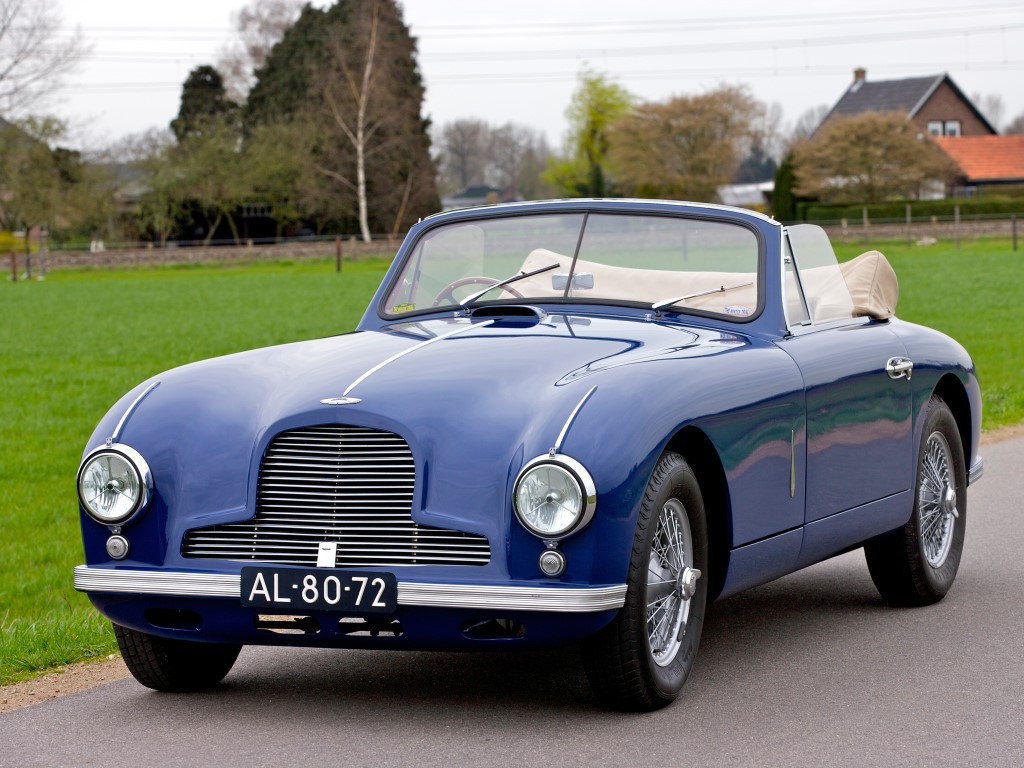
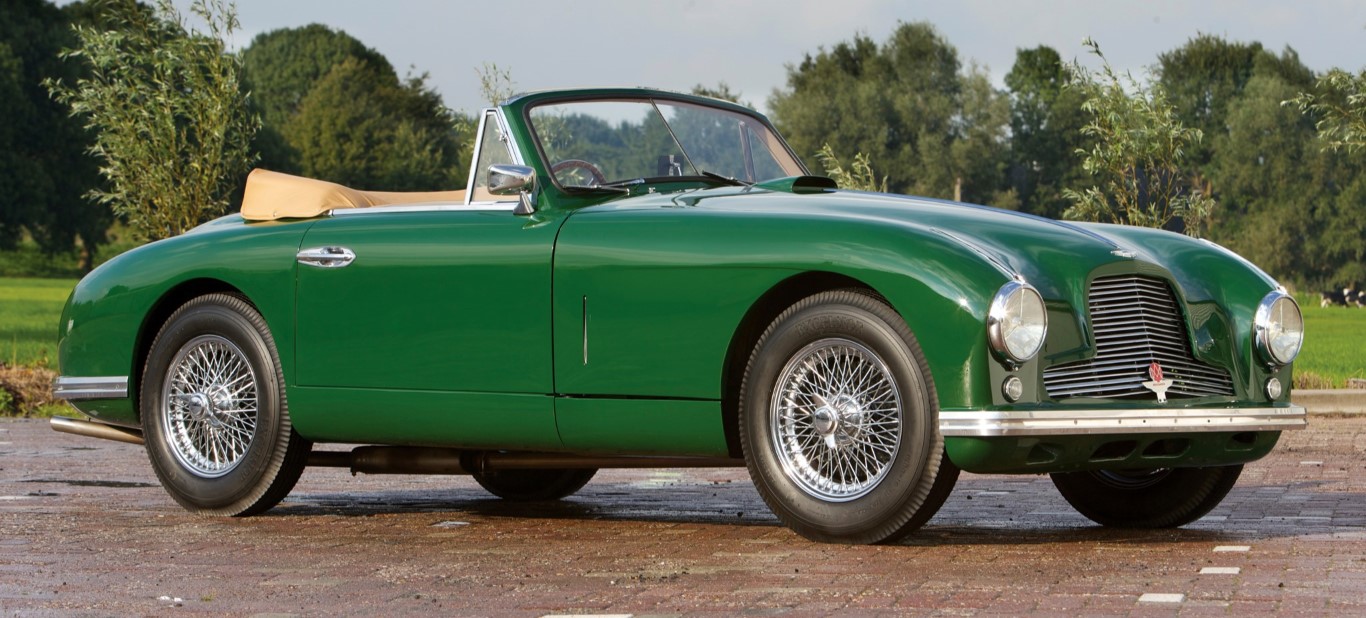
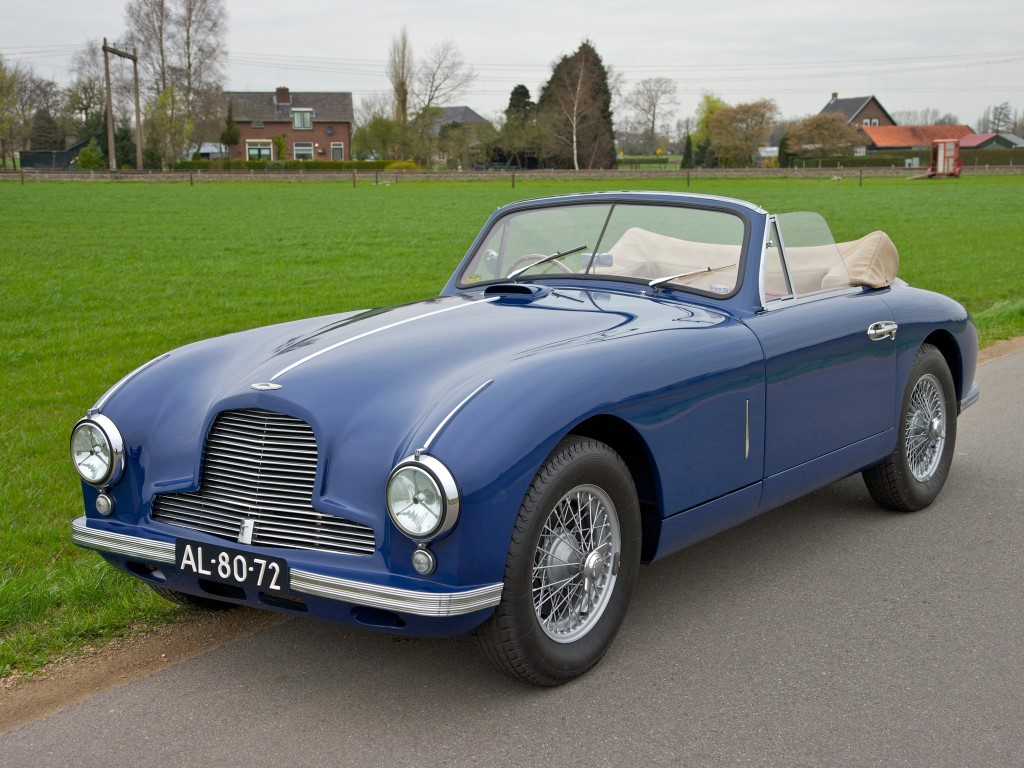
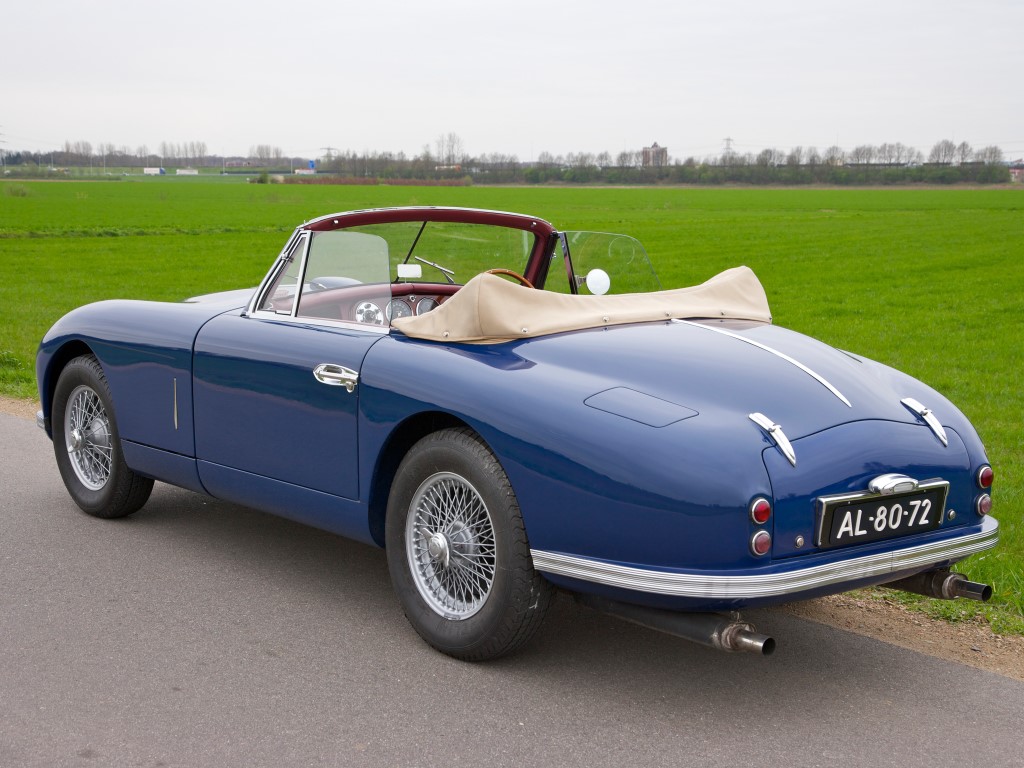
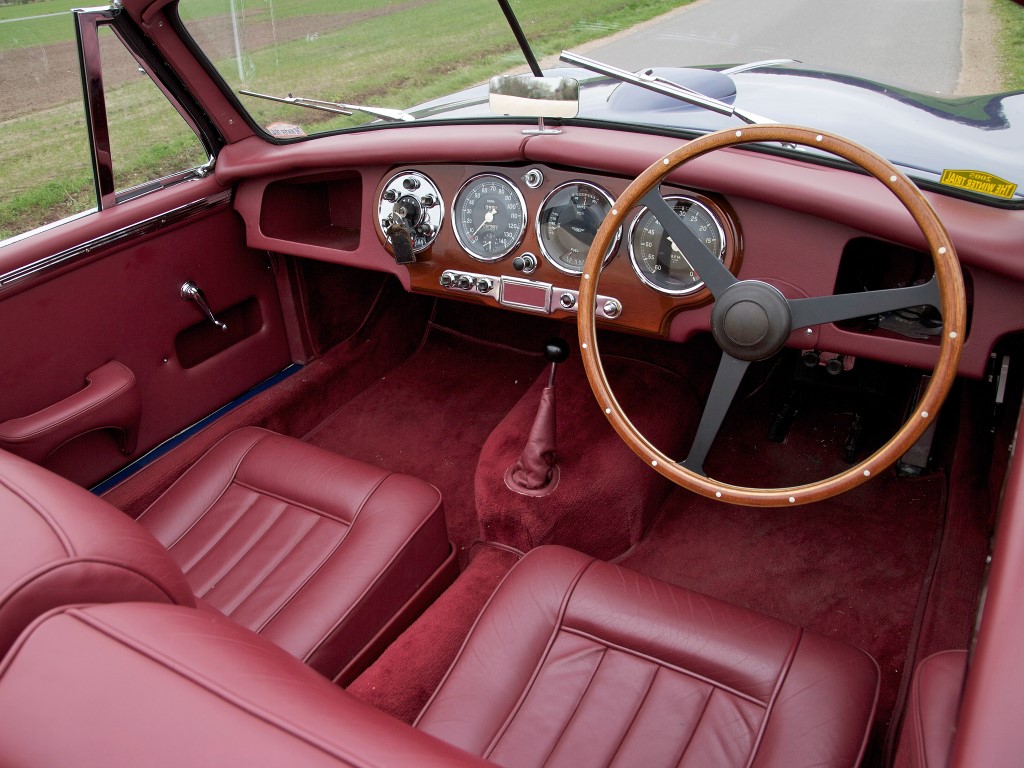
The DB2 was originally launched as a two-seater closed coupe (referred to by the factory as a Sports Saloon),
and was complemented in late 1950 by a convertible variant, the Drophead Coupé (DHC). The chassis consisted
of a shortened version of the tubular steel structure designed by Claude Hill for the DB1, clothed in a
lightweight, hand-shaped aluminum body. The suspension utilized an independent trailing-arm system at the
front with coil springs and an anti-roll bar, combined with a rigid axle at the rear with coil springs and
Girling-brand hydraulic drum brakes on all four wheels.
The Initial "Washboard" Series and Styling Evolutions
The first 49 units of the DB2, produced between 1950 and 1951, are known worldwide as the "Washboard" series
due to their specific design solutions. These initial units featured a chrome front grille split into three
distinct parts and large rectangular louvered vents located behind the front fenders to assist in cooling
the engine bay. Additionally, these early units featured decorative chrome trim along the side sills.
Starting from the 50th produced chassis, Aston Martin simplified the assembly line and the car's appearance.
Journalist Laurence Pomeroy from *The Motor* magazine convinced David Brown that the side vents cluttered
the car's visual lines, leading to the definitive elimination of these elements and the replacement of the
three-piece grille with a single piece featuring horizontal slats. The front hood was front-hinged and
tilted forward. At the rear of the vehicle, there was no conventional trunk lid; there was only a small
upper access hatch to reach the spare tire. Luggage had to be stowed in a generous space behind the front
seats, accessible only from inside the cabin.
In the mechanical aspect, Aston Martin offered two configurations of the 2.6-liter engine. The standard
version used the block code LB6, while the high-performance version, named Vantage, utilized structural
modifications to extract more power. Due to post-war austerity measures in Great Britain, which limited
local fuel to standard gasoline of just 72 octane, the first DB2 Vantage models were primarily allocated to
the North American market, where higher-quality fuel permitted the use of higher compression ratios. The
first Vantage unit produced (chassis LML 50/21) was delivered to and raced by the famous driver and builder
Briggs Cunningham.
| Technical Specifications |
Standard DB2 (LB6 Engine) |
DB2 Vantage (LB6V/LB6E Engine) |
| Displacement |
2,580 cc (Inline 6-cylinder) |
2,580 cc (Inline 6-cylinder) |
| Fuel System |
2x 1.5-inch SU H4 Carburetors |
2x 1.75-inch SU HV6 Carburetors |
| Compression Ratio |
6.5:1 |
8.16:1 |
| Maximum Power |
105 bhp @ 5,000 rpm |
125 bhp @ 5,000 rpm |
| Maximum Torque |
Approx. 170 Nm @ 3,000 rpm |
Approx. 190 Nm @ 2,750 rpm |
| Transmission |
4-speed Manual (column or floor shift) |
4-speed Manual (column or floor shift) |
| 0-96 km/h Acceleration |
~11.2 seconds |
~10.5 seconds |
| Top Speed |
187 km/h |
193 km/h |
| Total Production |
307 Units (Coupes) |
98 or 102 Units (DHC / Convertibles) |
The first examples of the DB2 left the factory equipped with a steering column-mounted gear lever (DBR code
transmission) to allow three people to sit on the single bench front seat, a common requirement of the North
American market at the time. However, the preference for sporty driving led Aston Martin to adopt the
floor-mounted shifter (DBC code) starting from chassis LML/50/17, a standard that was later retrofitted to
most of the older units. In total, DB2 production reached between 410 and 411 units before being concluded
in April 1953.