

1st Generation
(2004 - 2008)
5.9
456 cv
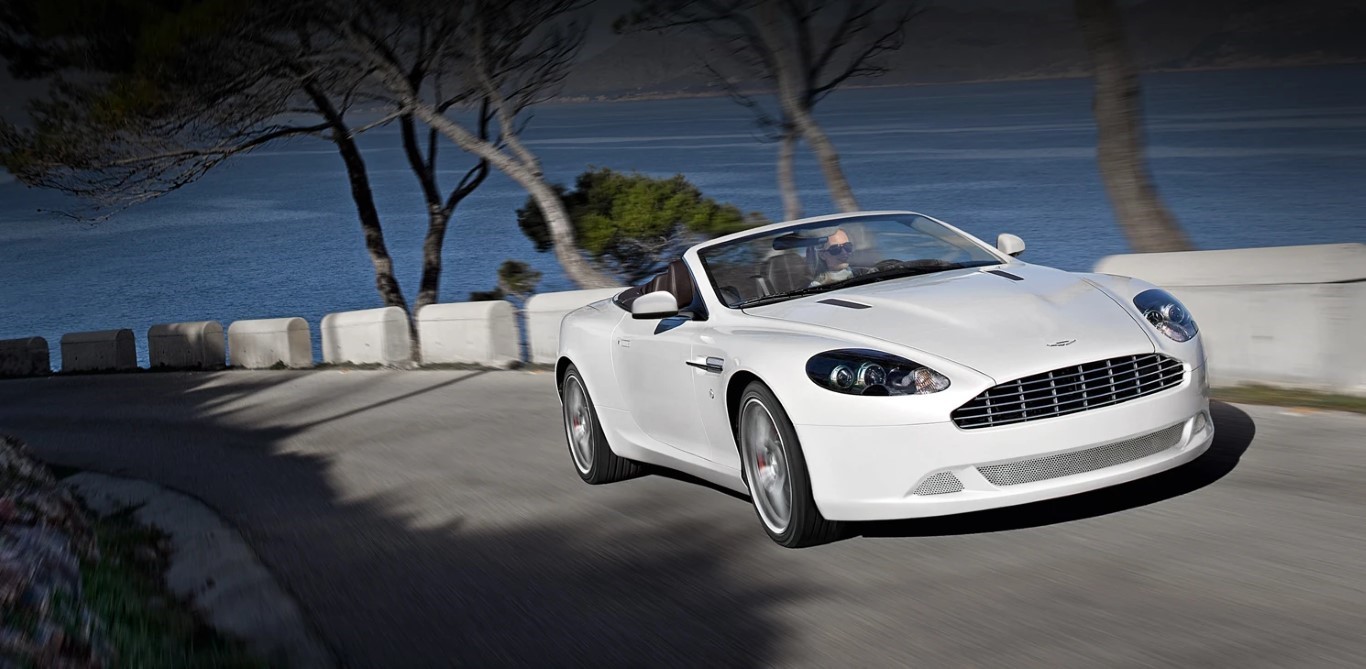
Technical specifications, versions, and history for the Aston Martin DB9 Volante.
Select a generation to see available versions
(2004 - 2008)

(2009 - 2010)

(2011 - 2012)

(2013 - 2016)
Select a powertrain to view full technical specifications
The Aston Martin DB9 Volante does not just represent another model in the illustrious lineage of luxury convertibles from the British manufacturer; it symbolizes the most critical turning point in the company's modern history. In the early 2000s, Aston Martin found itself at a crossroads. After surviving financially in the 1990s thanks to the success of the DB7 — a beautiful car, but built on an adapted and aging Jaguar XJS platform —, the brand needed a product that would not only compete, but set the standard in the luxury Grand Tourer (GT) sector. Under the management of the Ford Group and the leadership of CEO Dr. Ulrich Bez, the answer was a massive investment in a new headquarters and a new manufacturing philosophy.
The DB9, initially launched as a coupe at the 2003 Frankfurt Motor Show and followed by the Volante convertible at the 2004 Detroit Auto Show, was the first fruit of the new dedicated factory in Gaydon, Warwickshire. Unlike its predecessors manually assembled in Newport Pagnell or Bloxham, the DB9 ushered in an era of high-tech manufacturing, while maintaining the handcrafted finish that defines the brand.
This report exhaustively analyzes the trajectory of the DB9 Volante, from its conception on the revolutionary VH platform to its final editions in 2016. We will explore the engineering that allowed a convertible to maintain the structural rigidity of a coupe, the meticulous evolution of the 6.0-liter V12 engine, the nuances of each model update (facelifts), and the market analysis based on rare and specific production numbers. The goal is to provide a definitive document for enthusiasts, collectors, and automotive historians, detailing every aspect that makes the DB9 Volante a guaranteed future classic.
The backbone of the DB9 Volante's success lies in its architecture. The model was the pioneer vehicle to use Aston Martin's VH (Vertical / Horizontal) platform. The name "Vertical / Horizontal" does not merely refer to physical geometry, but to the platform's flexibility to be expanded vertically (in height and size) and horizontally (across different models and vehicle types) within the brand's range.
Unlike traditional stamped and welded steel constructions, the VH platform utilized extruded and bonded aluminum, a technology derived directly from the aerospace industry. The chassis parts were not joined by conventional welds, but rather by industrial-strength epoxy adhesives, heat-cured, and reinforced by mechanical rivets.
| Feature | Technical Benefit | Impact for the Driver |
|---|---|---|
| Structural Rigidity | Bonding creates a continuous union along the entire joint, unlike welding which only joins specific points. | The car vibrates less over bumps and responds more precisely to steering commands. |
| Reduced Weight | Aluminum is significantly lighter than steel. The DB9 chassis weighed 25% less than its predecessor, the DB7. | Better acceleration, shorter braking distances, and lower fuel consumption. |
| Energy Absorption | The structure was designed to efficiently dissipate impact forces. | Greater passive safety in the event of accidents, a priority in modern Aston Martin design. |
The great engineering challenge of any convertible is the loss of the roof. In a conventional car, the roof acts as a fundamental structural element, closing the chassis "box". By removing it, the car tends to twist, a phenomenon known as "scuttle shake" (chassis vibration), where the structure visibly flexes when passing over road imperfections.
The DB9 Volante was designed in parallel with the coupe, not as a later adaptation. Thanks to the inherent rigidity of the VH platform, Aston Martin managed to create a convertible with twice the torsional rigidity of the old DB7, without adding excessive weight in reinforcements. Although the Volante's suspension was tuned to be slightly softer than the coupe's — recognizing its character geared more towards leisure touring than track driving — the structural integrity allowed the car to maintain precise and sporty driving dynamics.
Safety was a central point in the Volante's development. The model features reinforced windshield pillars to support the car's weight in case of an inversion. Additionally, behind the rear seat headrests, there are two deployable "roll-hoops". Sensors monitor the vehicle's tilt and acceleration; if a rollover is imminent, these hoops are pyrotechnically deployed in milliseconds, shattering the rear window (if the top is up) to create a survival zone for the occupants.
The design of the DB9 is widely credited to Ian Callum, who initiated the project, and Henrik Fisker, who finalized it and brought it to production. The car's aesthetics were based on the "Golden Ratio," a mathematical rule of beauty and harmony found in nature and classical art. The goal was to create a car that looked "right" from any angle, without the need for visual excesses like large spoilers or aggressive air intakes.
For the Volante, the purity of lines was critical. Fisker designed the car so that the waistline (the line running just below the windows) was uninterrupted and flat, flowing from the hood to the rear. This gives the car an elegant and "planted" stance on the road.
Unlike the trend of the time, which favored retractable hard-tops — seen in competitors like the Mercedes-Benz SL or the Ferrari California —, Aston Martin opted for a traditional fabric roof. The reason was purely aesthetic and practical: hard-tops take up a lot of trunk space and require a bulky, high rear end to accommodate the folded panels, which would ruin the slender lines of the DB9.
Aston Martin's solution was a fabric roof with a "K-fold" mechanism.
Throughout its entire production run (2004–2016), the DB9 Volante was exclusively powered by a naturally aspirated 5.9-liter V12 engine (commercially dubbed 6.0 liters). This engine is the soul of the car, providing not just performance, but a characteristic soundtrack that defines the experience of owning an Aston Martin.
| Period | Code/Generation | Maximum Power | Maximum Torque | Technical Notes |
|---|---|---|---|---|
| 2004 – 2008 | V12 Gen 2 | 450 bhp (456 hp) at 6,000 rpm | 570 Nm at 5,000 rpm | Initial version launched with the car. Focused on linear torque delivery. |
| 2009 – 2012 | V12 Gen 3 | 470 bhp (477 hp) at 6,000 rpm | 600 Nm at 5,000 rpm | Revised cylinder head for greater efficiency and response. |
| 2013 – 2015 | V12 AM11 (Gen 4) | 510 bhp (517 hp) at 6,500 rpm | 620 Nm at 5,500 rpm | Reinforced block, new dual variable valve timing, machined combustion chamber. |
| 2016 | V12 GT Spec | 540 bhp (547 hp) at 6,750 rpm | 620 Nm at 5,500 rpm | Exclusive to the final "DB9 GT" version. The most powerful version installed in the DB9 chassis. |
Although the DB9 Volante appears visually similar throughout its 12-year lifespan, it underwent profound changes beneath the skin. We can segment its history into four distinct phases.
The DB9 Volante hit the market in 2005, about a year after the coupe. Initial reviews were extremely positive regarding its design and engine sound, but pointed out that the navigation system (supplied by Volvo) was antiquated and that the automatic transmission, while smooth, was not the fastest on the market.
In late 2008, for the 2009 model year, Aston Martin implemented the first major technical update.
This period is marked by a curious product strategy. In 2011, Aston Martin launched the Virage model, which sat between the DB9 and the flagship DBS. The Virage used the same platform and engine but had 497 hp and a more modern look, with sharper headlights.
During this time, the DB9 Volante received a subtle facelift to stay relevant, but it didn't get the full Virage visual treatment.
In 2012, Aston Martin discontinued the Virage model after just 18 months of production, realizing it cannibalized DB9 sales. The solution was to apply all the Virage's improvements and design to the DB9 itself, creating what is known as the "DB9 Gen 4" or "2013 Facelift". This is considered the "mature" and definitive version of the standard model.
To celebrate the end of production before the arrival of the DB11 successor, Aston Martin launched the DB9 GT Volante.
Aston Martin is a master at maintaining interest in long-life models through highly personalized and limited special editions. These versions of the DB9 Volante are the most sought after by investors and collectors.
This edition was created to highlight the luxurious side of "Grand Touring," in contrast to the sporty editions. It was a showcase for the "Q by Aston Martin" personalization division.
Launched to commemorate the 100th anniversary of Aston Martin's founding. Only 100 units of the Centenary Edition were produced in total. It is estimated that the number of DB9 Volante Centenary Editions is extremely low, possibly around 10 units worldwide, with the majority going to the American market.
In contrast to the classic luxury of the Morning Frost, the Carbon editions focused on a modern and aggressive aesthetic. Only 66 units of the DB9 Carbon Edition Volante were built.
Launched in conjunction with the Spectre movie from the 007 franchise, celebrating the long partnership between the brand and the fictional spy. Strictly limited to 150 global units (mostly Coupes, making the Volante Bond Edition even rarer).
A final farewell series, consisting of the last nine DB9 units to roll off the production line. All nine units were built to identical specifications, painted in the heritage "Cumberland Grey" color with a "Bitter Chocolate" interior. These cars feature interior plaques indicating their position in the final sequence and represent the definitive end of the DB9 era.
The total production volume of the DB9 model (combining all Coupe and Volante variants) over its 12-year lifespan is approximately 16,500 units. This makes the DB9 the most successful model in the brand's history up to that point, surpassing the DB7. It is estimated that there are between 6,000 and 7,000 DB9 Volante units produced in total.
The most important statistic for investors and driving purists is regarding the manual transmission. Originally, the DB9 was launched only with an automatic transmission. The manual option (6-speed Graziano) was quietly introduced later, but demand was extremely low. The option was discontinued prior to the 2013 facelift.
Implication: Finding a manual DB9 Volante is extremely difficult. These cars command a significant price premium (often costing double or more) compared to equivalent automatic models, being considered true unicorns in the collectible market.
The Aston Martin DB9 Volante ended its production in July 2016, being replaced by the DB11 Volante. Its legacy, however, is lasting. It proved that Aston Martin could transition from an artisanal niche manufacturer to a modern, technologically advanced company without losing the soul of its products.
The DB9 Volante remains one of the most beautiful and timeless automotive designs of the 21st century. The combination of perfect proportions designed by Callum and Fisker, the intoxicating sound of the naturally aspirated V12 (an endangered species in today's automotive world dominated by turbos and hybrids), and the practical usability guaranteed by the engineering of the VH platform, ensure its place in the pantheon of great cars.
For today's buyer, the DB9 Volante offers a unique opportunity to own a handcrafted V12 for a fraction of the price of an equivalent new car. While standard automatic models offer incredible value for money in the used market, the rare manual versions and special editions have already begun to appreciate in value, consolidating themselves as tangible investment assets. Whether as a Grand Tourer for weekend getaways or as the centerpiece of a collection, the DB9 Volante is, and will continue to be, an icon of British luxury.
Images of the Aston Martin DB9 Volante