The Context of the Birth of the DBS
In the mid-1960s, Aston Martin enjoyed the global success of the DB5 and DB6,
driven by James Bond's cinematic fame. However, the design of the
DB4/5/6 series, created by Carrozzeria Touring Superleggera of Milan, was beginning to age
against the more angular and modern trends emerging in Italy and the United
States. Aston Martin needed a replacement that offered more interior space,
comfortably accommodating four adults, something the DB6 only partially achieved.
Touring was initially contracted to design the successor and produced two prototypes
known as "DBS C". These cars were two-seater convertibles, with fluid
and elegant lines. However, Touring went bankrupt in 1966, before the project could be
industrialized. Aston Martin, needing a quick solution, turned to its
in-house designer, William Towns. Towns created something radically different: a wide,
aggressive, and angular fastback coupe that broke with the smooth curves of the previous decade.
Launched in 1967, the DBS Coupe was a shock of modernity.
Why Was There No Classic DBS Volante?
During the production period of the DBS (1967–1972), Aston Martin made a curious
strategic and financial decision. Although they had a new chassis and a new design with the
DBS, the demand for convertibles continued to be met by the previous model, the Aston
Martin DB6 Volante.
Production of the DB6 Volante extended until 1970, coexisting with the DBS Coupe. For the
board at the time, the DBS was positioned as a modern, closed GT for the businessman or
family, while the DB6 Volante catered to the traditional client who wanted to
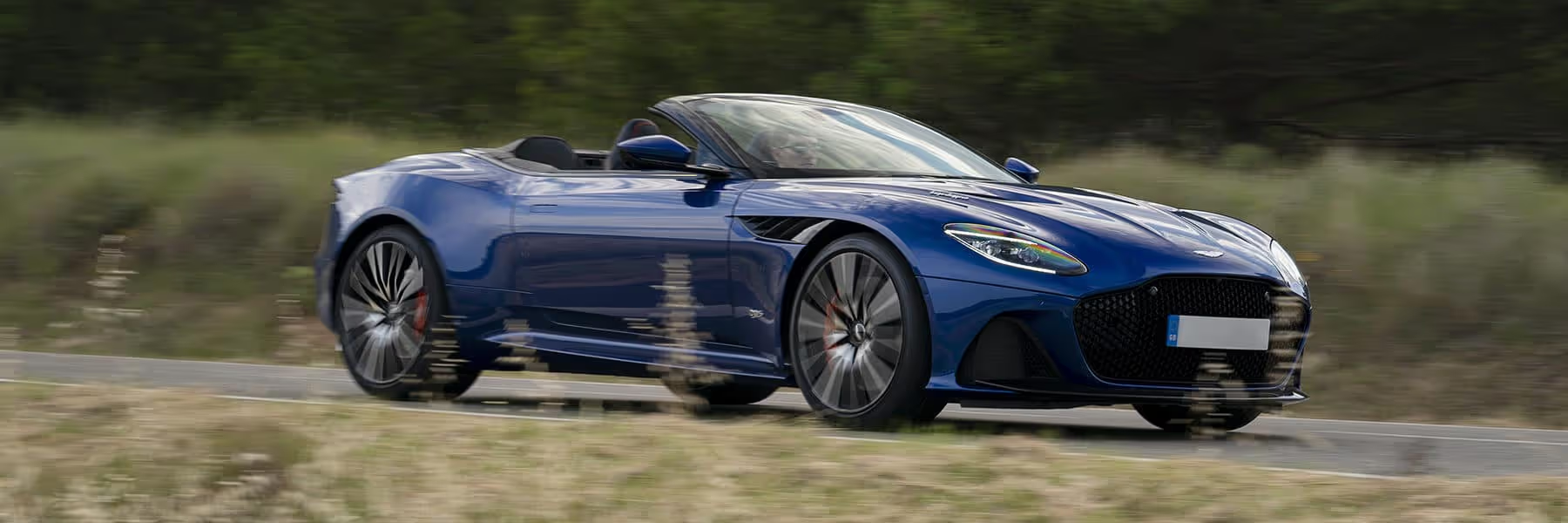
ride in the open air. Therefore, the "DBS Volante" never entered the official catalog of the
time
as a regular production model.
Technical Evolution and the V8 Legacy
The original DBS was designed to receive a new V8 engine, developed by the legendary
engineer Tadek Marek. However, the engine suffered development delays. As a
result, the early DBS (1967–1969) were equipped with the 4.0-liter inline-six
engine from the DB6, producing around 282 hp (or 325 hp in the Vantage
specification).
It was only in 1969 that the DBS V8 was launched, finally equipped with the 5.3-liter
V8 engine. This car became, at the time, the fastest four-seater car in the world,
capable of reaching 257 km/h (160 mph).
When the company was sold and the David Brown era ended in 1972, the DBS underwent a
"facelift" (receiving two single headlights instead of four) and was renamed simply
to Aston Martin V8. It was only years later, in 1978, on this revised base (which
technically was still the DBS chassis), that Aston Martin launched the "V8 Volante".
Thus, although the DBS DNA was present, the name "DBS Volante" remained
dormant.
Summary of Classic Era Production
- DBS (6 cylinders): 787 units.
- DBS V8: Approximately 402 units.
- DBS Volante (Factory): 0 mass-produced units (only
special conversions or prototypes not mass-marketed).