1st Generation
(2011 - 2012)
Technical specifications, versions, and history for the Aston Martin One-77.
Select a generation to see available versions
(2011 - 2012)
Select a powertrain to view full technical specifications
The Aston Martin One-77 was born as the most ambitious project of the British automaker during the so-called "Gaydon era". In 2007, after Aston Martin broke away from the direct control of the Ford group, the new management led by the David Richards consortium and CEO Dr. Ulrich Bez sought to create a technological showcase model that would consolidate the brand's independence and artisanal capability. The first public glimpse of the hypercar occurred at the 2008 Paris Motor Show, where the vehicle was kept partially under a striped grey cover, revealing only a detail of its front and right side.
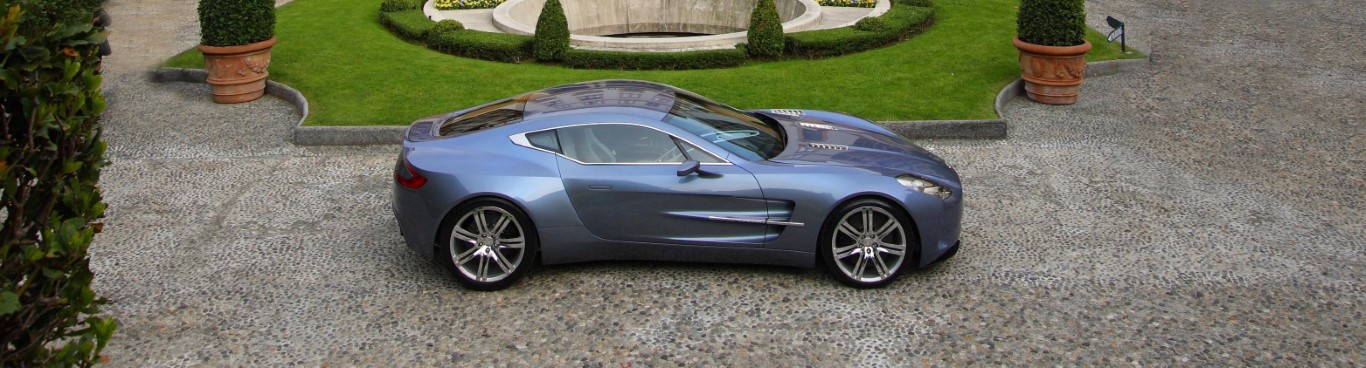
The complete and undisguised presentation took place in March 2009 at the Geneva Motor Show, where the manufacturer displayed a model in metallic blue and a complete functional chassis with the entire powertrain exposed. The following month, in April 2009, the functional prototype received the prestigious design award for concept cars and prototypes at the Concorso d'Eleganza Villa d'Este in Italy. The final production model began to be delivered to buyers in early 2011, with the last cars being finalized at the close of 2012.
To guarantee superior dynamic behavior and extreme lightness, the internal structure of the One-77 was conceived on a rigid carbon fiber monocoque chassis with honeycomb aluminum panels developed in close collaboration with the Canadian company Multimatic, one of the leading global specialists in composite materials. In contrast to the carbon fiber structure, the external body panels were artisanally hand-shaped from aluminum sheets, creating a fluid surface with strong visual appeal.
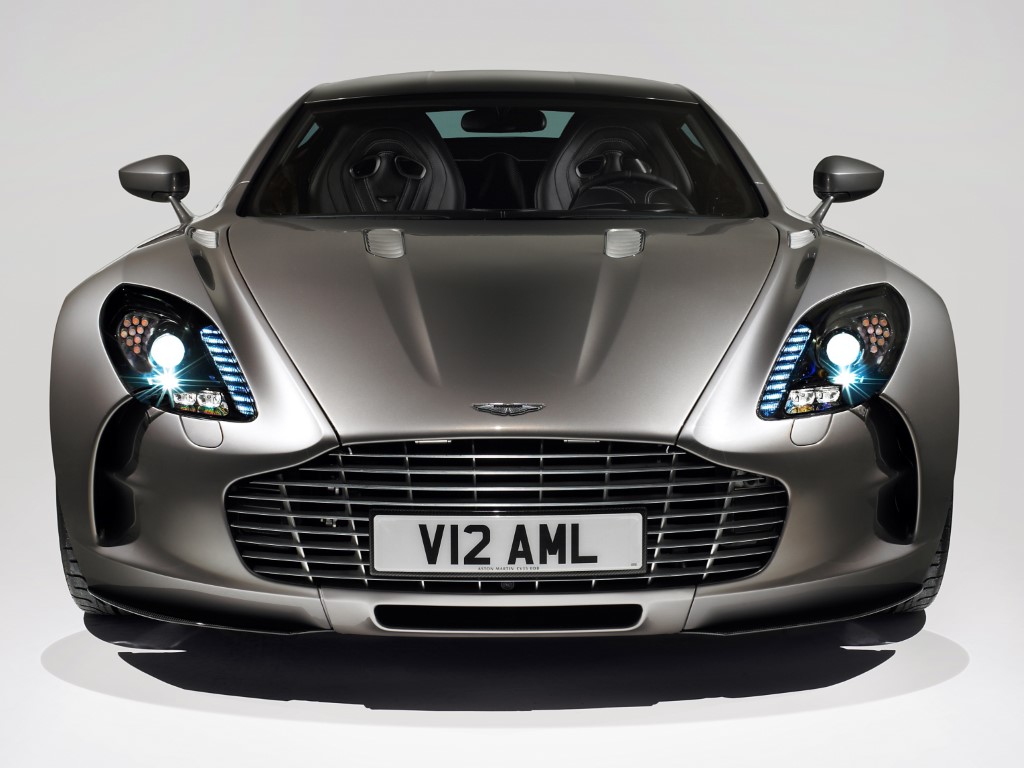
The dimensions of the model were engineered to emphasize its visual presence and ensure stability at high speeds. With an impressive width and reduced height, the model is visibly lower and shorter than other contemporary models of the brand, such as the DB9. Its doors, known as swan doors, open slightly upward and outward at a gentle angle, facilitating access to the cabin without hitting curbs or sidewalks.
The detailed dimensional specifications of the production model are presented in the table below:
| Physical Dimension or Parameter | Official Value of the Production Model |
|---|---|
| Overall Length | 4,601 mm |
| Width (without mirrors) | 1,999.5 mm |
| Width (with mirrors) | 2,204 mm |
| Height | 1,222 mm |
| Wheelbase | 2,791 mm |
| Front Track | 1,706 mm |
| Rear Track | 1,627 mm |
| Curb Weight | 1,630 kg |
| Projected Development Weight | 1,500 kg |
| Fuel Tank Capacity | 98 liters |
The heart of the Aston Martin One-77 is its naturally aspirated 7.3-liter V12 engine, designated internally as AM77 and developed in partnership with Cosworth. The technical team at Cosworth based it on the traditional 6.0-liter V12 block that powered the DBS and DB9, but performed an almost total re-engineering. The cubic capacity was expanded to 7,312 cc through an increase in cylinder bore and stroke. With the exception of the timing chain, nearly all moving and structural parts of the engine were uniquely redesigned, including new cylinder heads, high-strength pistons, connecting rods, crankshaft, and camshafts.
These alterations resulted in a 15% weight reduction (about 60 kg) in the engine block compared to the standard 6.0-liter engine. The engine utilizes a dry-sump lubrication system, allowing the powerplant to be installed 100 mm lower in the chassis compared to any previous Aston Martin V12. The engine was also moved 257 mm backward relative to the front axle, configuring an extremely efficient front-mid weight distribution for cornering.
| V12 Engine Technical Parameter | Official Specification |
|---|---|
| Engine Type | Aluminum V12, 48 valves, DOHC with variable timing |
| Exact Displacement | 7,312 cc (7.3 liters) |
| Compression Ratio | 10.9:1 |
| Maximum Power | 750 hp (760 PS / 559 kW) @ 7,500 rpm |
| Maximum Torque | 750 N·m (553 lb·ft) @ 5,000 rpm |
| Transmission | 6-speed automated manual Graziano with paddle shifts |
| Top Speed | 354 km/h (220 mph) |
| 0 to 100 km/h Acceleration | Less than 3.7 seconds |
| CO2 Emissions | 572 g/km |
The six-speed automated manual rear transaxle transmission, supplied by Graziano Trasmissioni, operates via an electro-hydraulic system controlled by selectors behind the steering wheel. All power is sent to the rear wheels through a carbon fiber driveshaft spinning inside a lightweight magnesium alloy torque tube. Although the system offers extremely fast shifts in sporty driving, the race-type clutch displays a somewhat harsh behavior that is difficult to modulate at slow urban speeds.
The driving dynamics of the One-77 are directly inspired by DTM category racing concepts. The model adopts independent double-wishbone suspension at all four corners with inboard pushrods, which transfer the vertical movements of the wheels to spring and damper assemblies mounted horizontally inside the chassis structure. The One-77 was a pioneer among road cars in using Dynamic Spool Valve (DSSV) technology dampers, which allow precise electric adjustment of ride height and stiffness directly via the dashboard controls. The rear suspension is composed of four spring coils, two of which are integrated into an active hydraulic mechanical torsion anti-roll bar.
To restrain the high speed, the hypercar relies on ventilated and drilled carbon-ceramic matrix brake discs. The system uses 398 mm diameter front discs operated by six-piston aluminum calipers, and 360 mm diameter rear discs coupled to four-piston calipers. The brakes were engineered with modified internal deflectors and thermal channels to prevent braking heat from being transmitted directly to the hydraulic fluid. Contact with the asphalt is made by Pirelli P Zero Corsa sports tires (measuring 255/35 ZR20 on the front axle and 335/30 ZR20 on the rear), which were dedicatedly developed for this model.
The interior of the One-77 reconciles racetrack minimalism with traditional Aston Martin luxury. The cabin accommodates only two people in lightweight sports seats upholstered in high-quality Obsidian Black leather or Alcantara, featuring electric adjustment controls and integrated memory. The instrument panel brings a clean layout with five analog dials dominated by the speedometer and tachometer. The center console is wide and clearly divides the two occupants, housing the satellite navigation system screen and the transmission selector buttons, dispensing with any type of physical gear lever.
The car's interior finish utilizes exposed carbon fiber combined with anodized black aluminum details and rotary buttons made of high-strength crystal. The electronic ignition key system, known as the ECU (emotion control unit), is also made of frosted crystal. Optional items offered to the original owners included a rearview camera, rose gold button finishes, and brake calipers with a gold finish.
The production volume of the hypercar was strictly limited to 77 units intended for public sale. The acquisition process required an initial reservation deposit of 200,000 pounds on the final price of 1,150,000 pounds. All 77 customer units had already been completely sold and reserved before the start of the first physical deliveries in 2011. For homologation and certification purposes, the brand produced additional test mules; the one with chassis number 10711, after extensive testing, was rebuilt, certified, and sold to the US market under a "Show or Display" license from the United States National Highway Traffic Safety Administration (NHTSA), totaling 78 cars in active circulation worldwide.
The Aston Martin One-77 had only a single production generation and did not receive aesthetic styling updates (known as facelifts) or mid-cycle modifications during its manufacturing run.
Near the conclusion of assembly in 2012, the brand launched a customization sub-brand and presented a limited special edition within the original production run. Named the One-77 Q-Series, this version had only 7 units produced in an extremely personalized manner under the new "Q by Aston Martin" special trim program. Although they maintained exactly the same mechanicals of the 7.3-liter V12 and the same automated manual gearbox, the Q-Series models featured striking visual decorations. The series was composed of strict visual schemes:
The table below details the main specifications and direct technical evolution of the One-77 platform and its derivatives created by the brand over the years:
| Model | Production Period | Production Volume | Powertrain (Fuel Type) | Maximum Power | Maximum Torque | Transmission Used | Application |
|---|---|---|---|---|---|---|---|
| One-77 (Standard) | 2011 – 2012 | 70 units | 7.3L naturally aspirated V12 (Gasoline) | 750 hp (760 PS) | 750 N·m | 6-speed Automated Manual | Public road / Highway |
| One-77 Q-Series | 2012 | 7 units | 7.3L naturally aspirated V12 (Gasoline) | 750 hp (760 PS) | 750 N·m | 6-speed Automated Manual | Public road / Bespoke |
| Vulcan | 2015 – 2016 | 24 units | 7.0L naturally aspirated V12 (Gasoline) | 820 hp | 780 N·m | 6-speed Racing Sequential | Track exclusive / Circuits |
| Victor | 2020 | 1 unit (One-Off Series) | 7.3L naturally aspirated V12 (Gasoline) | 836 hp | 821 N·m | 6-speed Manual (Graziano) | Public road / Highway |
The One-77 platform, engineered with a focus on carbon fiber rigidity, served as a direct structural foundation for two ultra-exclusive Aston Martin production cars in the subsequent years, expanding the dynamic life cycle of the original platform:
Launched in 2015 with a strict track focus, the Vulcan utilized the entire central structure of the carbon monocoque chassis and the basic suspension layout of the One-77 as its structural base. However, Aston Martin removed the hand-crafted aluminum body panels of the One-77, replacing them with aggressive new aerodynamic components built entirely from carbon fiber to lower total track weight to 1,350 kg.
The 7.3L engine was replaced by a unit based on the 6.0L racing V12, with displacement expanded to 7.0 liters to deliver 820 hp at 7,750 rpm through an Xtrac racing sequential gearbox. The aerodynamic arrangement generates about 1,350 kg of downforce at 190 mph, matching the total mass of the car itself. Production was limited to just 24 track-exclusive units.
Developed in 2020 by the Q special projects division, the Victor is a unique road-legal one-off vehicle that pays tribute to Victor Gauntlett, the chairman who revived the company in the 1980s. The Victor uses a remaining carbon fiber monocoque chassis from the One-77, paired with the six-way adjustable racing suspension inherited from the Vulcan. Its original 7.3-liter V12 engine from the One-77 was completely overhauled and modified by Cosworth to produce 836 hp and 821 N·m of torque.
The mechanical assembly of the Victor abandoned the automated manual transmission of the original One-77, adopting a traditional six-speed manual gearbox supplied by Graziano with a motorsport-spec clutch, making it the most powerful naturally aspirated manual vehicle in the brand's history. The Victor's bodywork is constructed of carbon fiber finished in Pentland Green, combining styling lines inspired by the classic 1970s V8 Vantage with taillights featuring technology derived from the Valkyrie hypercar.
Images of the Aston Martin One-77