Aston Martin Valiant

Aston Martin Valiant

Technical specifications, versions, and history for the Aston Martin Valiant.

Aston Martin Valiant Generations

Select a generation to see available versions

Aston Martin Valiant G1

1st Generation

(2024 - 2025)

5.2 L V12 48V Twin-Turbo 745 cv

Technical Data and History: Aston Martin Valiant

Origin and Historical Context

The Aston Martin Valiant was born from a personal commission made by two-time Formula 1 World Champion Fernando Alonso to the British manufacturer's special projects and customization division, Q by Aston Martin. Alonso requested a lighter, more powerful, and track-focused vehicle compared to the 2023 Aston Martin Valour, while maintaining road-legal homologation for public roads. Officially revealed worldwide in June 2024, the super sports car made its first public dynamic presentation at the Goodwood Festival of Speed in July 2024, driven by the Spanish driver himself.

The model's concept combines the visual aggressiveness of 1970s competition cars with exotic materials and aerodynamic engineering derived from modern motorsport. The main historical design reference is the emblematic 1980 Aston Martin RHAM/1, nicknamed "Muncher", a heavily modified model developed to compete in the 24 Hours of Le Mans.

Evolutionary Lineage, Generations, and Variants

The Aston Martin Valiant is not a mass-production vehicle and, therefore, has no generations or mid-cycle updates (facelifts). It is a strictly limited, single-production special edition. However, the Valiant represents the pinnacle of an evolutionary lineage of front-engine V12 super sports cars with manual transmissions developed by the brand.

This trajectory began in 2020 with the Aston Martin Victor, a one-off example equipped with a 7.3-liter naturally aspirated V12 engine and a six-speed manual gearbox. In 2023, the brand presented the Valour to celebrate its 110th anniversary, producing 110 units with a 5.2-liter twin-turbo V12 engine tuned to 715 hp. The Valiant emerges in 2024 as the most radical and track-focused version of this same architecture, incorporating higher power, weight-reduction components, adjustable competition suspension, and increased aerodynamic downforce.

Model Launch Year Units Produced Powertrain Power Torque Main Engineering Focus
Aston Martin Victor 2020 1 unit (One-off) 7.3L Naturally Aspirated V12 ~848 hp 821 Nm Exclusive design study and validation of the manual V12 concept.
Aston Martin Valour 2023 110 units 5.2L Twin-Turbo V12 715 hp (715 PS) 753 Nm 110th-anniversary commemorative edition with a balance between road and track.
Aston Martin Valiant 2024 38 units 5.2L Twin-Turbo V12 745 hp (745 PS) 753 Nm Track performance, extreme weight reduction, and advanced aerodynamics.
Powertrain, Performance, and Transmission

The engine of the Aston Martin Valiant is the 5.2-liter twin-turbo V12, constructed entirely in lightweight aluminum alloy and featuring double overhead camshafts. The block uses computer numerical control (CNC) machined combustion chambers and a revised electronic management system. This calibration generates 745 PS (745 hp) and 753 Nm of torque, maintaining a vigorous delivery of power at low and medium revs.

Power is transmitted to the rear wheels by a six-speed manual gearbox mounted at the rear axle (transaxle), connected to a mechanical limited-slip differential that optimizes traction out of corners. The exhaust system, developed in titanium, features four central outlets and contributes to mass reduction at the rear end while enhancing the engine's roar. The vehicle's projected top speed is 330 km/h.

Chassis Engineering, Suspension, and Weight Reduction

The transformation of the Valour platform to the track-focused configuration of the Valiant required structural interventions and the use of advanced lightweight materials. The main change in ride dynamics was the adoption of Multimatic Adaptive Spool Valve (ASV) dampers. This technology is capable of individually adjusting the damping response to one of 32 pre-programmed curves in less than six milliseconds, providing motorsport-level suspension control. The Sport, Sport Plus, and Track driving modes were specifically recalibrated for this setup.

Weight reduction was achieved through several solutions focused on strategic areas of the vehicle. The adoption of a 3D-printed rear subframe reduced the structural mass by 3 kg while maintaining torsional rigidity. The magnesium torque tube, connecting the engine to the rear gearbox, saved 8.6 kg at the center of the vehicle. The 21-inch forged magnesium wheels reduced unsprung mass by 14 kg, improving steering precision and control over road imperfections. The use of a motorsport-specification lithium-ion battery ensured an additional reduction of 11.5 kg. The carbon-ceramic braking system features 410 mm x 38 mm discs on the front axle and 360 mm x 32 mm on the rear, offering high resistance to fade under severe use.

Aerodynamics and Exterior Design

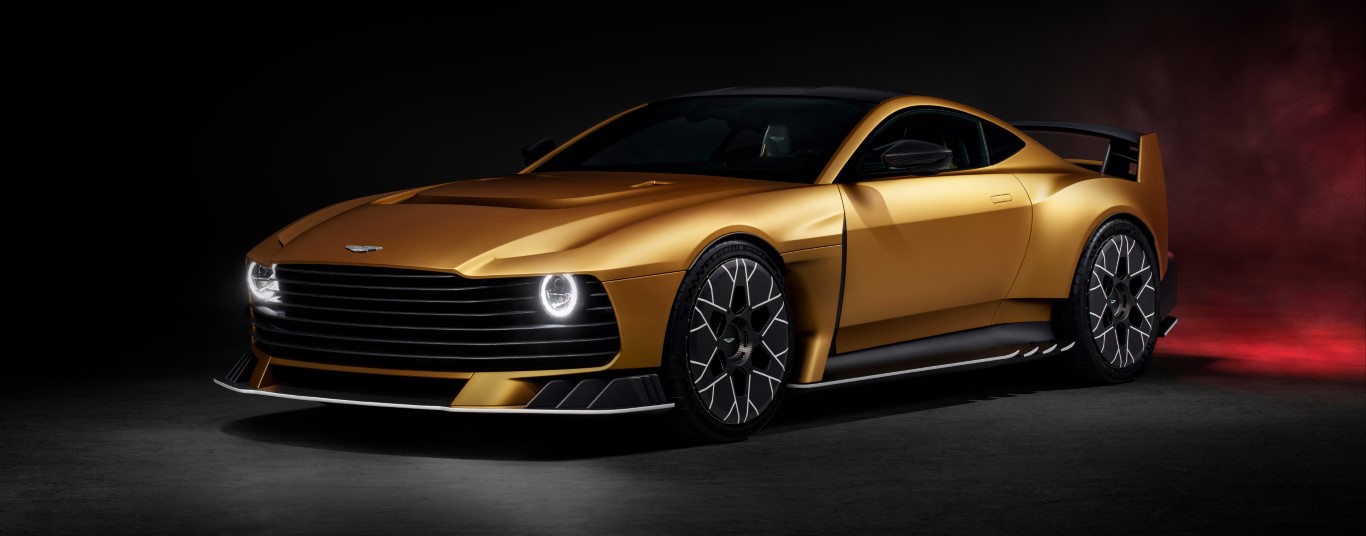
The Valiant's bodywork is constructed entirely from carbon fiber and was engineered to generate up to 383 kg of downforce. The front end displays a deep splitter and a full-width carbon fiber front grille, optimizing cooling airflow and reducing weight ahead of the front axle. The front fenders feature pronounced cutouts and top louvers to reduce accumulated pressure in the wheel arches and extract hot air from the brakes.

On the sides, the 21-inch magnesium wheels are equipped with carbon fiber aerodynamic discs (aero discs). Directly inspired by the Aston Martin RHAM/1 "Muncher", these discs minimize drag and air turbulence around the wheels. The component features six directed openings to cool the ceramic discs, alongside peripheral slots for hot air expulsion.

The rear section features a Kamm tail profile and a prominent fixed wing responsible for balancing the front aerodynamic load. The single-piece rear clamshell incorporates a transparent hinged panel that provides access to a dedicated storage space for helmets and race gear. The carbon fiber rear diffuser, developed using computational fluid dynamics (CFD) simulation, reduces aerodynamic lift and frames the four-outlet titanium exhaust system.

Cockpit Ergonomics and Driving Focus

The Valiant's cabin adopts a purely driver-focused two-seater layout. The interior is built with exposed satin carbon fiber on the dashboard and console, combined with minimal upholstery lined in Alcantara and Semi-Aniline Leather.

The steering wheel was developed exclusively for the model, featuring a circular shape, reduced rim diameter, and a complete absence of buttons or electronic selectors to avoid distractions while driving. A metallic mark positioned at 12 o'clock allows the driver to identify the alignment of the front wheels.

On the center console, an open cutout in the transmission tunnel leaves the manual gear linkage mechanism exposed. The lever uses a spherical knob and an H-pattern engagement developed to provide mechanical weight and precision. The Recaro Podium carbon fiber bucket seats feature strategically placed padding to optimize ventilation. Behind the seats, a tubular steel half-cage is installed, providing anchor points for four-point racing harnesses.

Production, Price, and Data Sheet

Production of the Aston Martin Valiant is limited to just 38 units globally. All examples were reserved prior to the vehicle's public presentation. The estimated price is around $2.56 million, varying according to the specifications requested by buyers with the Q by Aston Martin division. Customer deliveries began in the fourth quarter of 2024, with Fernando Alonso being the first buyer to receive the model.

Component / Parameter Technical Specification
Powertrain 5.2L Twin-Turbo V12, DOHC, aluminum block and cylinder head
Maximum Power 745 PS / 745 hp
Maximum Torque 753 Nm
Transmission 6-speed manual, transaxle layout with exposed linkage
Drivetrain Rear-Wheel Drive (RWD) with mechanical limited-slip differential
Suspension Multimatic ASV adaptive dampers with 32 adjustment curves
Brakes Carbon-Ceramic Discs (410x38 mm front / 360x32 mm rear)
Wheels and Tires 21" Forged Magnesium (275/35 R21 front / 325/30 R21 rear)
Aerodynamic Downforce 383 kg at track speed
Exhaust System High-flow titanium with four central outlets
Production Volume 38 units worldwide
Estimated Price US$ 2.56 million
Final Considerations

The Aston Martin Valiant represents the synthesis of an analog super sports car fine-tuned by modern competition technologies. By fulfilling Fernando Alonso's individual request for a circuit-focused automobile equipped with a high-displacement V12 engine and a manual transmission, the manufacturer created a model that closes an important chapter in the history of high-performance front internal combustion engines. The integration of magnesium alloys, 3D-printed parts, and ultra-fast-responding adaptive suspension reaffirms the technical capability of the Q by Aston Martin division in developing extremely complex bespoke projects.

Technical data based on: • Official manufacturer catalogs • EPA / WLTP documentation when available • Official press releases

Editorial content produced by Gabriel Carvalho. | Última revisão: Dezembro/2025.