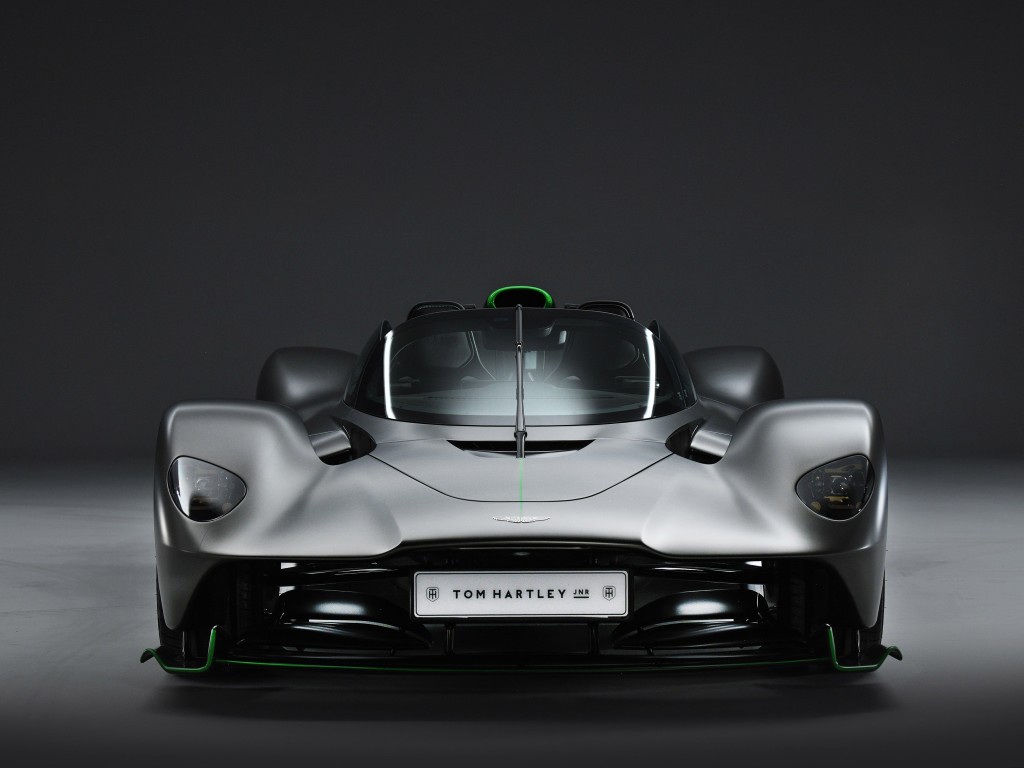
Aston Martin Valkyrie Spider

Aston Martin Valkyrie Spider

Technical specifications, versions, and history for the Aston Martin Valkyrie Spider.

Aston Martin Valkyrie Spider Generations

Select a generation to see available versions

Aston Martin Valkyrie Spider G1

1st Generation

(2023 - 2024)

6.5 L V12 48V Hybrid 1155 cv

Technical Data and History: Aston Martin Valkyrie Spider

The Aston Martin Valkyrie

The Aston Martin Valkyrie represents one of the most ambitious achievements of modern automotive engineering. Designed with the goal of transferring Formula 1 aerodynamic and structural concepts directly to the streets, the model is the result of technical cooperation between Aston Martin Lagonda and Red Bull Racing Advanced Technologies, under the leadership of designer Adrian Newey. The hypercar's trajectory spans from its conceptual inception to the development of exclusive track editions and homologated variants for international motorsport.

Origin and Development History

The primary idea for the project emerged in 2012, when Adrian Newey, then technical director at Red Bull Racing, began sketching a road car without the limitations imposed by Formula 1 sporting regulations. The project was formalized in 2015 under the codename "Nebula", an acronym referencing the names Newey, Red Bull, and Lagonda. Shortly thereafter, the partnership gave birth to the official code AM-RB 001, signaling the union between Aston Martin and Red Bull.

The first full-scale static concept model was presented on July 15, 2016, at Aston Martin's headquarters in Gaydon. On March 6, 2017, the manufacturer confirmed the definitive name "Valkyrie", maintaining the brand's tradition of naming high-performance models starting with the letter "V" and drawing inspiration from Norse mythology. To turn the project into reality, a consortium of renowned technical partners was formed. Multimatic took on the development of the carbon fiber monocoque, Cosworth was tasked with creating the naturally aspirated V12 engine, Rimac Automobili and Integral Powertrain supplied the hybrid electric system and batteries based on Formula 1's KERS, Ricardo designed the sequential transmission, Bosch provided the control electronics, and Michelin developed the high-performance tires.

The dynamic testing process utilized the VP-1 and VP-2 development prototypes. The public track debut took place in July 2019 during the British Grand Prix at Silverstone, also featuring the collaboration of driver Max Verstappen in fine-tuning driving dynamics. After complex technological integration challenges and emissions calibration to comply with Euro 6 standards, assembly of production units in Gaydon commenced in November 2021 under executive Tobias Moers, extending through December 2024.

Technical Architecture, Aerodynamics, and Powertrain

The Aston Martin Valkyrie's structure stands out for its 100% carbon fiber construction, completely eliminating any metallic structural steel components. This choice made it possible to achieve an extremely low dry weight of 1,030 kg for the Coupé version. The exterior design adopts the ground effect concept, utilizing large underfloor Venturi tunnels that direct air to the rear diffuser. This aerodynamic architecture generates up to 1,800 kgf of downforce at high speeds in the road version without needing large conventional rear wings.

To manage the immense aerodynamic load and prevent tire blowouts under extreme pressure, Aston Martin developed an active hydraulic system consisting of 17 actuators. This system adjusts ride height in real time and deploys aerodynamic flaps to bleed off excess pressure, keeping grip levels within the operational limits of the Michelin tires. The cockpit features a teardrop shape to optimize airflow around the cabin, positioning the driver and passenger with feet elevated in a posture similar to Formula 1 cars. The dashboard eliminates conventional dials, centralizing operational functions and instrumentation on the digital screen of the removable steering wheel.

The hybrid powertrain of the road-going versions combines a mid-rear naturally aspirated 6.5-liter Cosworth RA V12 engine. This engine generates 1,000 hp (1,014 PS) at 10,500 rpm on its own, reaching a maximum engine speed of 11,100 rpm. Integrated into the transmission, an electric motor supplied by Integral Powertrain adds 160 hp (162 PS), powered by a 1.3 kWh battery pack developed by Rimac. Combined output reaches 1,160 hp (1,176 PS) at 10,500 rpm and maximum torque of 900 Nm at 6,000 rpm. All power is sent to the rear wheels via a 7-speed automated sequential gearbox produced by Ricardo.

Model Variants and Engineering Evolutions

The Aston Martin Valkyrie did not undergo traditional aesthetic restylings (facelifts) throughout its life cycle. Instead, its evolution occurred through the creation of four distinct structural variants, engineered to meet specific usage and competition goals.

The Valkyrie Coupé represents the original road-legal configuration. With production strictly limited to 150 units, it features gull-wing doors and top-exit exhaust pipes located above the engine compartment. This version accelerates from 0 to 100 km/h in 2.6 seconds and reaches a top speed in excess of 350 km/h.

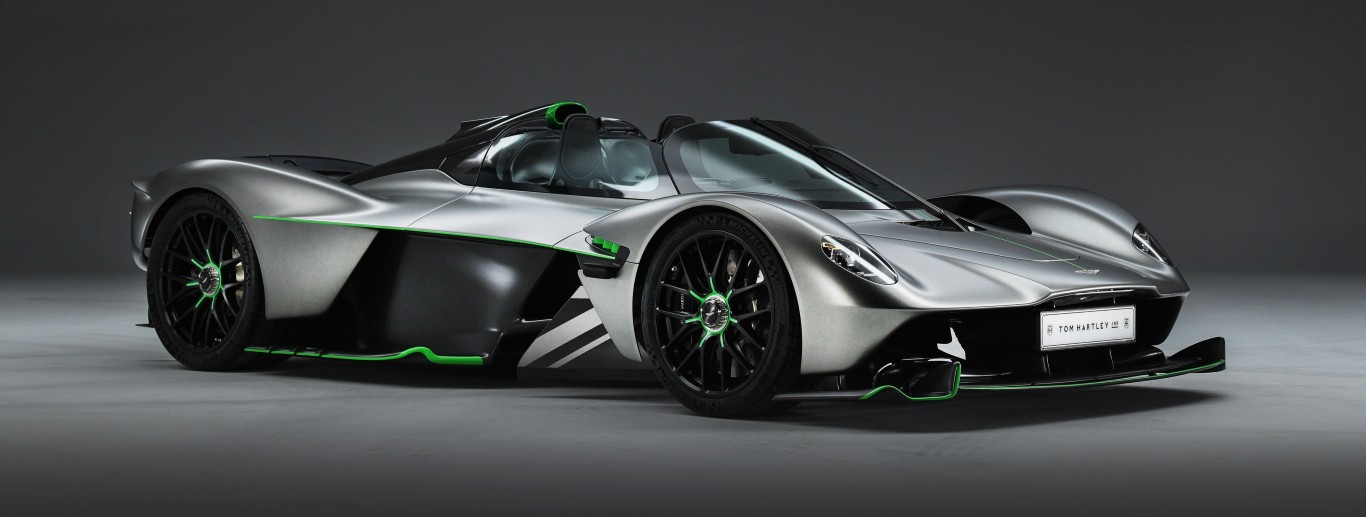
The Valkyrie Spider is the open-top targa variation without a fixed roof, designed to deliver open-air driving with production limited to 85 units. Eliminating the rigid roof structure required a redesign of the doors, which adopted butterfly-style operation. Retaining the same 1,160 hp hybrid powertrain, engineering recalibrated air deflectors and active underbody aerodynamics to ensure generation of the same 1,800 kg of downforce. Top speed exceeds 330 km/h with the roof removed, reaching 350 km/h when the removable carbon fiber roof panel is installed.

The Valkyrie AMR Pro was developed exclusively for track-only use, free from road homologation constraints. The original 2018 concept project was overhauled to incorporate learnings from the endurance racing program. A total of 40 units were produced. The chassis was significantly modified: the wheelbase increased by 380 mm, front track was widened by 96 mm, rear track by 115 mm, and overall body length grew by 266 mm. The hybrid system was completely removed for weight reduction, letting the 6.5-liter V12 engine operate purely atmospherically with 1,000 bhp (1,015 PS) at 11,000 rpm. To protect the clutch during pit launches, the vehicle uses a small 48V electric motor to assist acceleration up to 15 km/h, at which point the V12 engine is bump-started. With weight reduced to approximately 1,000 kg, this version generates over 2,000 kg of downforce and lateral acceleration exceeding 3.5G, using 18-inch wheels with Michelin slick tires and carbon-carbon brakes.

The Valkyrie AMR-LMH is the racing prototype developed by Aston Martin Performance Technologies (AMPT) to compete in the premier classes of the FIA WEC (including the 24 Hours of Le Mans) and the North American IMSA championship starting in 2025. It is the only car in the Hypercar class directly based on a production model. To comply with Balance of Performance (BoP) technical regulations, the 6.5-liter Cosworth V12 engine operates without hybrid assistance and is calibrated for lean burn, producing around 500 kW (~670 bhp). The prototype adopts the minimum regulatory weight limit of 1,030 kg, pushrod-operated torsion bar suspension, and quick-release body panels for fast pit stop replacements.

Comparative Technical Specifications

Structural and performance data for the four Aston Martin Valkyrie variants are detailed in the following table.

Parameter / Variant Valkyrie Coupé Valkyrie Spider Valkyrie AMR Pro Valkyrie AMR-LMH
Application Road Homologated Road Homologated Track Exclusive WEC / IMSA Competition
Total Production 150 units 85 units 40 units Racing Prototypes
Production Period 2021 – 2024 2022 – 2024 2021 – 2024 2024 – Present (2025 Debut)
Internal Combustion Engine 6.5L Cosworth Naturally Aspirated V12 6.5L Cosworth Naturally Aspirated V12 6.5L Cosworth Naturally Aspirated V12 6.5L Cosworth Naturally Aspirated V12
Engine Output 1,000 hp @ 10,500 rpm 1,000 hp @ 10,500 rpm 1,000 bhp / 1,015 cv @ 11,000 rpm ~670 bhp (500 kW - BoP Limit)
Hybrid Electric System Rimac / Integral (160 hp) Rimac / Integral (160 hp) None (48V Starter Assist) None
Combined Power 1,160 hp (1,176 PS) 1,160 hp (1,176 PS) 1,000 bhp / 1,015 PS ~670 bhp
Maximum Torque 900 Nm @ 6,000 rpm 900 Nm @ 6,000 rpm 780 Nm Calibrated via BoP Curve
Transmission 7-speed Sequential Ricardo 7-speed Sequential Ricardo 7-speed Sequential Ricardo 7-speed Racing Sequential
Dry / Minimum Weight ~1,030 kg ~1,300 kg ~1,000 kg 1,030 kg (FIA Minimum)
Downforce ~1,800 kgf ~1,800 kgf > 2,000 kgf Calibrated by LMH Regulations
Door Mechanism Gull-wing Butterfly Gull-wing / Track Setup Quick-Access Racing Doors
Project Milestones and Chronology

The chronological evolution of the project, from initial conceptual ideas to the end of production and entry into competition, is presented in the table below.

Year Development and Production Milestone
2012 First conceptual sketches drawn by Adrian Newey under the premise of a F1-aerodynamic road car.
2015 Formal start of cooperation under codename "Project Nebula" between Newey, Red Bull, and Aston Martin.
2016 Public unveiling of the full-scale static concept model AM-RB 001 at Gaydon headquarters.
2017 Announcement of the definitive "Valkyrie" name and start of production for VP-1 and VP-2 functional prototypes.
2018 Presentation of the first Valkyrie AMR Pro concept study at the Geneva Motor Show.
2019 First public dynamic demonstration at Silverstone and showcase of the pre-production version in Geneva.
2021 Start of final series assembly in Gaydon and deliveries of the first Coupé and AMR Pro units.
2022 Beginning of customer deliveries for the Valkyrie Spider convertible variant.
2023 Relaunch of the endurance racing program focused on homologation for the Le Mans Hypercar category.
2024 Official completion of production for all 275 units destined for private customers by December.
2025 Official debut of the Valkyrie AMR-LMH prototype in the FIA WEC and IMSA world championships.
Industry Impact and Conclusion

Production of the Aston Martin Valkyrie officially concluded in December 2024, totaling exactly 275 units built for the hypercar market. The total volume consists of 150 Coupé units, 85 Spiders, and 40 AMR Pro versions.

The Valkyrie's significance lies in the practical application of solutions previously restricted to top-tier racing prototypes. The project proved the technical feasibility of using ground effect as the primary aerodynamic element in road cars, while introducing active suspension control and downforce bleed systems. At the same time, developing a naturally aspirated V12 engine capable of revving to 11,100 rpm while meeting legal emissions standards set a landmark milestone in internal combustion engine engineering. The platform's cycle concludes with the direct transfer of road-developed technologies back to the track in the Le Mans Hypercar program, consolidating the model as a game-changer in Aston Martin's history.

Technical data based on: • Official manufacturer catalogs • EPA / WLTP documentation when available • Official press releases

Editorial content produced by Gabriel Carvalho. | Última revisão: Dezembro/2025.