

1st Generation
(2024-)
5.2 V12
715 cv
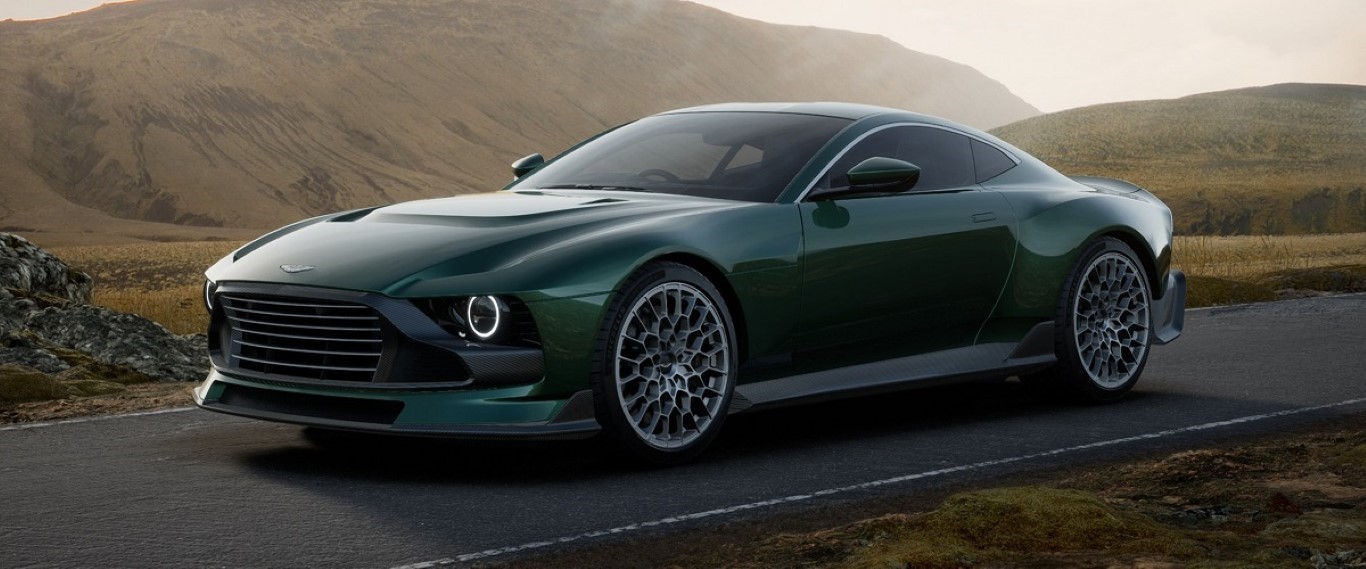
Technical specifications, versions, and history for the Aston Martin Valour.
Select a generation to see available versions
(2024-)
In the third decade of the 21st century, the global automotive industry is undergoing its most radical transformation since the replacement of horse-drawn carriages by the internal combustion engine. The transition to electrification and the digitalization of vehicle control systems has created a scenario where energy efficiency and connectivity often overshadow the visceral driving experience. It is within this context of a paradigm shift that Aston Martin, the British manufacturer based in Gaydon, conceived the Valour project.
The Aston Martin Valour should not be interpreted merely as just another high-performance automobile; it represents a manifesto of mechanical resistance and a deliberate homage to the brand's 110 years of history, celebrated in 2023. The model positions itself as an "end of an era", encapsulating the design and engineering philosophy that defined the great British Grand Tourers: large displacement front-mounted engines, rear-wheel drive, and, crucially, the direct mechanical engagement of the driver through a manual transmission.
The exclusivity of the project is guaranteed by its strictly limited production of 110 global units, a number alluding to the company's anniversary. The relevance of the Valour in the ultra-luxury market is amplified by the fact that it is, at the time of its launch, the only front-engine V12 sports car available on the market with a manual transmission, a configuration that has become extinct among major supercar manufacturers.
The primary reference for the Valour is the legendary Aston Martin V8 Vantage, launched in 1977. At that time, the V8 Vantage was hailed as "Britain's first supercar", designed to compete with the Ferrari Daytona and Lamborghini Miura in speed and acceleration.
The visual connection between the Valour and the 1977 V8 Vantage is deliberate and evident in several key areas:
Beyond the road model, the Valour seeks technical and visual inspiration from the RHAM/1 racing car, affectionately nicknamed "The Muncher". This vehicle competed in the 24 Hours of Le Mans in 1977 and 1979 and became famous for its voracity — both for fuel and brake discs — and for its extremely widened bodywork to accommodate racing tires.
The Valour pays tribute to the "Muncher" through its 21-inch forged alloy wheels with a honeycomb design, which replicate the aesthetic of the racing wheels of the era, and through its lowered, wide stance that suggests high-speed stability.
Although its roots lie in the 70s, the direct "father" of the Valour project in terms of modern execution is the Aston Martin Victor. Revealed in 2020, the Victor was a unique model ("one-off") created by the "Q by Aston Martin" customization division on the carbon fiber chassis of the One-77 supercar.
The critical success and the enthusiastic public reception to the Victor's retro-futuristic design validated Aston Martin's decision to produce a limited series with the same aesthetic philosophy. However, while the Victor was a priceless unique piece based on an exotic chassis, the Valour was designed to be produced on a larger scale (110 units), utilizing an aluminum platform derived from the V12 Vantage and the DBS, making the project viable for a select group of collectors.
| Model | Launch Year | Production Type | Powertrain | Influence on the Valour |
|---|---|---|---|---|
| V8 Vantage | 1977 | Series | Naturally Aspirated V8 | Front design, "muscle car" ethos |
| RHAM/1 "Muncher" | 1977/79 | Race Car | Twin-Turbo V8 | Wheels, wide stance, aerodynamics |
| Aston Martin Victor | 2020 | One-Off (1 unit) | Naturally Aspirated V12 (7.3L) | Retro-futuristic design language |
| Aston Martin Valour | 2023 | Limited (110 units) | Twin-Turbo V12 (5.2L) | Synthesis of all the above |
The design of the Valour is described by the brand as "forever fearless". The bodywork is constructed entirely of carbon fiber, which allowed the designers to create complex shapes that would be impossible or prohibitively expensive to stamp out of traditional metal.
The front end is dominated by a clamshell hood, a single piece of carbon fiber that extends to the wheel arches. This feature is not just aesthetic; it eliminates visible cutlines on the top of the fenders, creating a clean and continuous surface.
In the center of the hood, there is a large horse shoe vent, flanked by two NACA ducts. NACA ducts, originally developed by NASA, are designed to draw in air with minimal aerodynamic drag. On the Valour, their function is critical: feeding the twin-turbo V12 engine with the immense volume of fresh air needed for combustion and cooling, ensuring optimal thermal management even under intense use.
The side of the vehicle features air vents on the front fenders with carbon fiber "veins". The function of these elements is to extract the high-pressure turbulent air that forms inside the wheel wells when the tire spins at high speed. By relieving this pressure, the car reduces lift on the front axle, improving steering precision.
The rear adopts the "Kamm-tail" concept (truncated tail), where the bodywork is cut off abruptly in the vertical. This aerodynamic principle reduces drag by minimizing the turbulence of the air detaching from the vehicle. The rear panel includes carbon fiber "exoblades" (external blades), inspired by the 70s, which act as vortex generators to organize the airflow.
The prominent rear diffuser works in conjunction with the front splitter to create aerodynamic balance, keeping the car planted to the ground without resorting to large active rear wings, thus preserving the classic silhouette.
As a commemorative model, the Valour offered customers a vast range of personalization. A notable example is the "Aston Martin Racing Green" paint job with contrasting "Lime" accents on the edges of the diffuser and air vents, a combination that nods to the modern racing colors of the Aston Martin Formula 1 team. The carbon fiber bodywork can also be left exposed, with colored tints (red, blue, or green) that allow the weave of the material to be seen under the light.
The engineering of the Valour is focused on the purity of the driving experience. While many modern hypercars use hybrid systems to boost power, the Valour relies exclusively on internal combustion and mechanical interaction.
The Valour's powerplant is a specially calibrated version of the AE31 engine, a 5.2-liter V12 with twin-turbocharging.
The engine calibration was adjusted to offer a highly elastic power delivery. The engineering team worked to create a "virtually flat" torque curve in second gear, available from 1,800 rpm up to 7,000 rpm. In practice, this means the car has immediate response ("punch") in almost any driving situation, eliminating the need for constant downshifts for overtaking.
The core element that defines the Valour's character is its 6-speed manual transmission, developed in partnership with the Italian specialist Graziano. Mating a manual gearbox to a modern V12 engine with so much torque presents significant engineering challenges, requiring reinforced components to handle the load without compromising the ease of use of the clutch.
The transmission is rear-mounted (transaxle) to optimize the vehicle's weight distribution. It features a Mechanical Limited-Slip Differential (LSD). Unlike the electronic differentials (E-Diff) common in modern cars that use the brakes to vector torque, the Valour's mechanical LSD offers a more natural and predictable response, allowing the driver to feel exactly when the rear tires are about to lose grip.
Aston Martin emphasizes that there is no "artificial torque manipulation" or intrusive electronic systems to smooth out gear changes; the responsibility to operate the system smoothly falls entirely on the driver, reinforcing the concept of engagement.
The Valour utilizes a bonded aluminum structure, a technology that Aston Martin has refined over decades. However, to ensure the suspension works with precision, the torsional rigidity of the chassis was significantly increased.
Result: According to official documentation, the Valour boasts the stiffest body ever produced by Aston Martin up to the date of its launch, allowing for more precise control of suspension geometry under high lateral loads.
The suspension system uses adaptive dampers provided by Bilstein. The driver can select from three driving modes via buttons on the steering wheel:
Unlike the Valiant model (which we will look at later), the Valour does not use Multimatic racing dampers, as its primary focus is to be a Road Car capable of long journeys, and not just a track tool.
To contain the mass and power of the V12, the Valour is equipped as standard with Carbon Ceramic Brakes (CCB).
Weight Benefit: The use of carbon-ceramic saves 23 kg of unsprung mass compared to equivalent steel discs. This reduction improves not only braking but also ride comfort and steering agility, as the suspension has less inertia to control.
The tires are Michelin Pilot Sport S 5, marked with the code "AML", indicating they were developed specifically for Aston Martin. They feature a hybrid compound: the outer part of the tread focuses on dry grip (performance), while the inner part is optimized for wet-weather safety.
The cabin of the Valour is a study in contrasts, mixing British tradition with high-tech materials. The layout is strictly for two occupants, reinforcing the intimate character of the coupe.
The centerpiece of the interior, both visually and functionally, is the gear lever. Aston Martin opted for an exposed gear linkage design. Instead of hiding the mechanical rods under leather, the center tunnel has a cutout that allows you to see the physical operation of the transmission with every gear change.
The gear knob offers four finish options for personalization:
In a bold move against the omnipresence of leather and Alcantara in supercars, Aston Martin reintroduced traditional wool tweed in the Valour. The fabric pattern is inspired by the Aston Martin DBR1, the 1959 Le Mans winner. The use of tweed on the seats and door panels offers a warm and tactile texture, in addition to being more breathable than leather and offering better grip for the driver's body in corners.
This classic material contrasts with the "Mokume" carbon fiber or traditional carbon fiber used on the center console, dashboard, and doors. The combination creates an atmosphere that the brand describes as "timeless contemporary".
Despite its nostalgic appeal, the Valour is a modern car. The instrument panel is digital but configured to present information clearly. The infotainment system, however, is based on an older Mercedes-Benz architecture, controlled by a rotary dial and physical buttons, rather than relying exclusively on touchscreens. Critics point out that the system looks a bit dated visually, but is functionally adequate for a driver-focused car, where digital distractions should be minimized.
The ergonomics follow the standard of sports cars, with "Performance" carbon fiber seats that offer excellent lateral support, although with firm padding that can be tiring on very long trips. Storage space for personal items (like phones and wallets) is limited, a common characteristic in vehicles in this category.
Although Aston Martin prioritizes "feel" over raw numbers for the Valour, the objective performance of the car is formidable.
| Parameter | Aston Martin Valour Data |
|---|---|
| Engine | 5.2L Twin-Turbo V12 (AE31) |
| Power | 715 PS (705 hp / 526 kW) at 6,500 rpm |
| Torque | 753 Nm (555 lb-ft) between 1,800 - 7,000 rpm |
| Transmission | 6-speed Manual (Graziano) |
| Drivetrain | Rear-Wheel Drive (RWD) with Mechanical Differential (LSD) |
| 0-100 km/h | ~3.4 to 3.6 seconds (Estimated) |
| Top Speed | 322 km/h (200 mph) |
| Weight (Curb) | Approx. 1,780 kg |
| Wheels | 21" Forged Alloy Honeycomb |
| Front Tires | 275/35 R21 Michelin Pilot Sport S 5 |
| Rear Tires | 325/30 R21 Michelin Pilot Sport S 5 |
Note on acceleration: Aston Martin did not officially release an exact 0-100 km/h time at launch, focusing on the narrative of the manual experience. However, tests and estimates based on the power-to-weight ratio place the time in the 3.4 to 3.6 seconds range. The time is marginally higher than equivalent automatic cars (such as the automatic V12 Vantage which does it in 3.5s) purely due to the human time required to operate the clutch and the gear lever.
During the life cycle of the Valour, a demand arose for an even more extreme version, specifically focused on track use. This demand was catalyzed by a personal commission from the Aston Martin Aramco Formula 1 team driver, Fernando Alonso. The result was the birth of the Aston Martin Valiant, a direct evolution of the Valour.
The Valiant can be considered the "track version" of the Valour. Although they share the same DNA and chassis, the technical differences are profound and justify the distinction as separate models, albeit brothers.
| Characteristic | Aston Martin Valour | Aston Martin Valiant |
|---|---|---|
| Purpose | Road Car (Analog GT) | Track Focused (Extreme) |
| Production | 110 units | 38 units |
| Engine Power | 715 PS (705 hp) | 745 PS (735 hp) – Recalibrated |
| Dampers | Adaptive Bilstein (road/sport focus) | Racing Multimatic ASV (Adaptive Spool Valve) |
| Aerodynamics | Clean look, no moving elements | Aero discs on wheels, prominent fixed wing |
| Weight Reduction | Focus on luxury materials and carbon | 3D printed rear subframe, lithium battery, magnesium wheels |
| Interior | Comfort, Tweed, Sport Seats | Half-cage, 4-point harnesses |
| Wheels | Forged Aluminum (21") | Magnesium (21") – lighter |
The Valiant introduces innovations like a 3D-printed rear subframe, which saves 3 kg without losing stiffness, and a titanium torque tube that saves 8.6 kg. The production of the Valiant is even more restricted, limited to only 38 global units, all sold immediately.
Production of the Aston Martin Valour began at the Gaydon factory, UK, in the second half of 2023, with deliveries stretching through 2024. The quantity of 110 examples is fixed and immutable. Due to the highly desirable nature of the vehicle, all units were allocated to VIP clients and brand collectors even before the public announcement or in the weeks immediately following.
The estimated base price of the Valour was between £1 million and £1.5 million British pounds (approx. US$ 1.5 to US$ 2 million dollars). However, the final price of each unit varied drastically depending on the level of "Q by Aston Martin" customization requested by the client (special paints, exotic materials, etc.).
In the secondary market, the Valour is considered a "Blue Chip" investment asset. The combination of a V12 engine, manual gearbox, and limited production historically guarantees long-term appreciation. There were isolated reports of quick resale attempts ("flipping") shortly after launch, with some prices fluctuating, but the general trend for manual V12 Aston Martin models is solid appreciation as the electrification of the global fleet advances.
The Aston Martin Valour closes a glorious chapter in British automotive engineering. It does not try to compete with the digital lap times of an electric car, nor does it offer the autonomous driving of a modern sedan. Its value lies in the preservation of an art form: engaged driving.
By uniting the brutalist aesthetic of the 70s with the materials engineering of 2023, the Valour serves as a bridge between the past and the future of the brand. For purists, it is the definitive proof that, even in an increasingly automated world, there is still space for mechanical emotion, the noise of a V12, and the satisfaction of a perfect gear change executed by the human hand. The Valour is not just a car; it is a celebration of Aston Martin's soul.