1st Generation
(2013 - 2018)
Technical specifications, versions, and history for the Aston Martin Vanquish Volante.
Select a generation to see available versions
(2013 - 2018)
(2025-)
Select a powertrain to view full technical specifications
The Aston Martin Vanquish is one of the most iconic names in the ultra-high-performance grand tourer (GT) segment. From its inception in the late 1990s to its contemporary reinterpretations, the model embodies the combination of powerful V12 engines, aluminum and carbon fiber structure, and a sophisticated design.
For more than three decades, between 1969 and the beginning of the new millennium, Aston Martin used the established 5.3-liter V8 engine designed by Tadek Marek. With only 5,016 hand-built cars produced during that period, stricter environmental regulations forced the retirement of the V8 block. The decision to create a V12 engine to power the brand's flagship cars was made in the mid-1990s.
The V12 architecture was initially suggested in the Lagonda Vignale concept in 1993, while the extruded aluminum structure made its first practical appearance in testing on the 1996 Ford Indigo Concept, which joined two 3.0-liter Duratec V6 blocks. The evolution of these mechanics produced the functional prototype Project Vantage, designed by Ian Callum and presented in 1998. The mass-production model, nearly identical to the concept, was unveiled in October 2000 and made its public debut at the Geneva Motor Show in March 2001. Deliveries began in the summer of 2001, with hand assembly carried out at the historic Newport Pagnell factory.
The V12 Vanquish structure utilized a bonded extruded aluminum monocoque reinforced with a central carbon fiber cell, developed with technical support from Lotus. The commercial appeal of the sports car was amplified worldwide when driven by James Bond in the film 007 - Die Another Day, released in November 2002.
The first version of the model featured a naturally aspirated 5.9-liter (5,935 cc) V12 engine, built entirely of aluminum alloy. It delivered 460 bhp (466 PS) at 6,500 rpm and a torque of 535 Nm (400 lb-ft) at 5,000 rpm.
The engine was paired with a 6-speed automated manual transmission with electro-hydraulic actuation operated by paddle-shifters on the steering wheel. Performance achieved acceleration from 0 to 100 km/h in 4.5 seconds, with a top speed of 306 km/h (190 mph). The cabin was offered in a two-seater (2+0) configuration with a luggage shelf or the 2+2 option with reduced rear seats.
Presented at the Paris Motor Show in September 2004, the Vanquish S was developed to re-establish the brand's flagship position ahead of the DB9's launch.
To reach the top speed of 323 km/h (201 mph), the 5.9-liter V12 engine received deep modifications: new cylinder heads with machined intake ports and combustion chambers to optimize airflow, updated injectors, and remapping of the electronic control unit (ECU). Consequently, power increased to 520 bhp (527 PS) and torque rose to 576 Nm (425 lb-ft). The final drive ratio was shortened from 3.69:1 to 4.30:1, ensuring more agile dynamic responses.
Aerodynamically and chassis-wise, the drag coefficient dropped from 0.33 to 0.32 due to the new front splitter, widened front grille for cooling, and a redesigned trunk lid to generate more downforce. The suspensions, steering box, and Brembo brakes with floating discs adopted the standards of the optional Sports Dynamic Package (SDP). The alloy wheels of the Vanquish S received an exclusive 11-spoke design.
Starting in model year 2006, the interior underwent a major visual and technological update. The center console was leather-wrapped and incorporated the 6.5-inch color satellite navigation screen from the DB9, updated climate controls, a 900W Alpine sound system, and Bluetooth connectivity.
Faced with some owners' rejection of the single-clutch automated system of the era, the official Aston Martin Works division created an aftermarket conversion service ("Stick Shift"). The modification replaced the electro-hydraulic system with a conventional 6-speed manual lever from the V8 Vantage and a physical clutch pedal. On cars from 2006 onward, the console was reworked to create the lever gate where the ashtray used to sit. More than 90 vehicles underwent this official conversion.
To celebrate the end of the model's production and the end of more than 50 years of vehicle manufacturing at the legendary Newport Pagnell plant, the manufacturer launched the Ultimate Edition in February 2007.
Initially planned for 40 units, demand raised the volume to 50 examples (20 right-hand drive and 30 left-hand drive). The model featured the exclusive metallic color Ultimate Black (with red and blue highlights), semi-aniline leather interior upholstery with exposed stitching, dark chrome interior trim, and numbered sill plates. Chassis number 502589 was the last automobile assembled at the Newport Pagnell factory before the facility's closure in July 2007.
Following the pause during which the brand produced the DBS V12, the Vanquish name returned under project code VH310.
Launched in 2012, the new model used the fourth generation of the extruded aluminum VH (Vertical-Horizontal) platform, with the novelty of having 100% of its body panels molded in carbon fiber, guaranteeing greater torsional rigidity and weight reduction.
The initial engine was the 5.9 V12 (AM11), generating 565 PS (558 bhp) and 620 Nm of torque, paired with the 6-speed Touchtronic II automatic transmission installed on the rear axle. For model year 2015, the car received the updated AM29 engine and the 8-speed ZF Touchtronic III automatic transmission, lowering the 0-100 km/h acceleration time to 3.6 seconds and raising the top speed to 323 km/h.
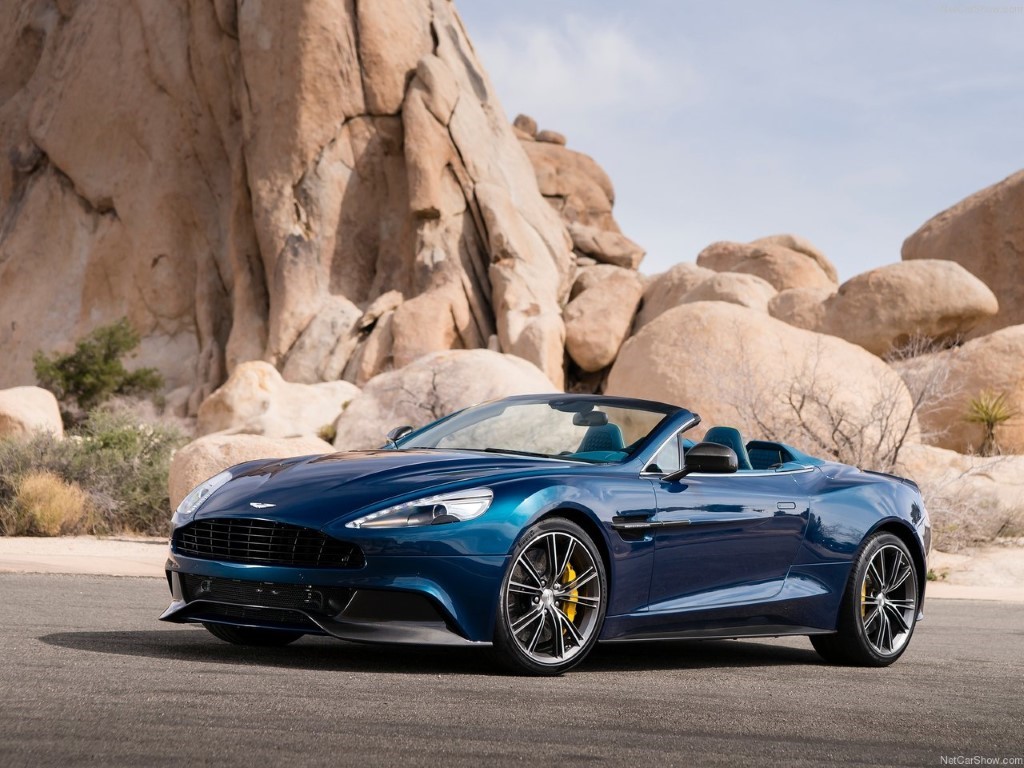
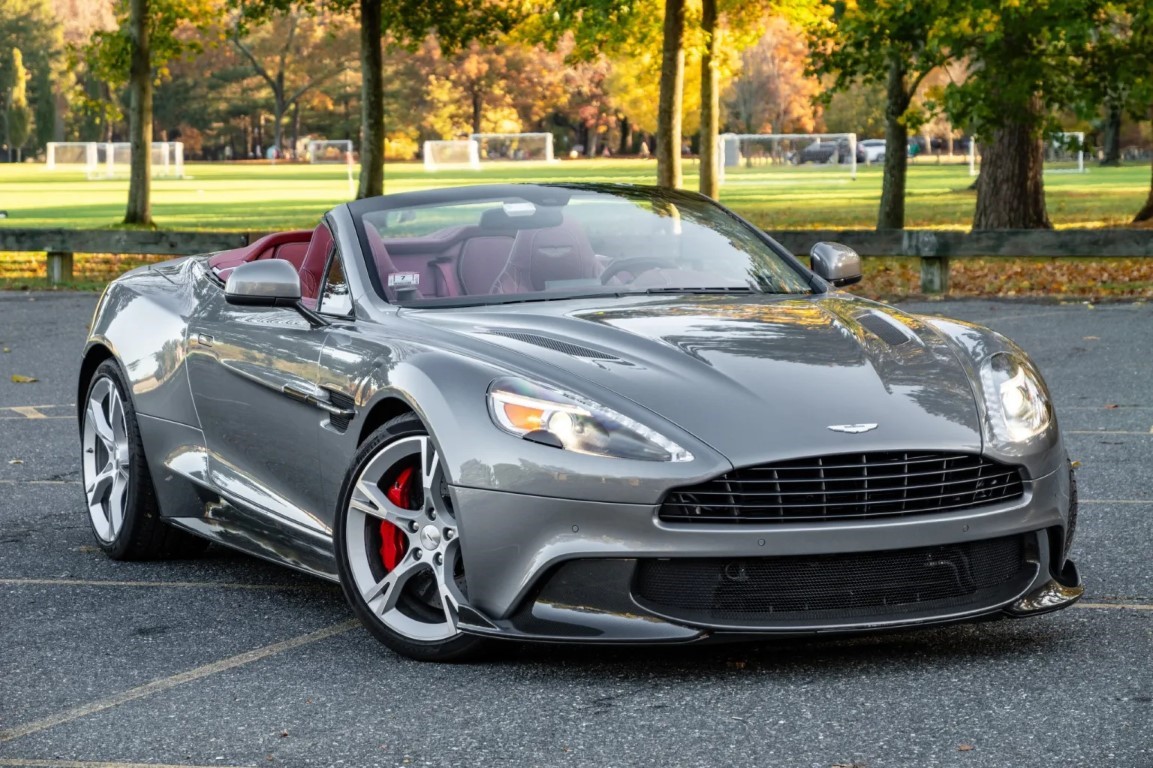
In June 2013, the brand presented the Vanquish Volante, the first convertible in the Vanquish lineup. Equipped with a triple-layer fabric soft top that retracted in 14 seconds, the model maintained the mechanical specifications of the coupe. Manufacturing of the standard Volante extended into early 2017.
In late 2016, the brand revealed the Vanquish S version of the second generation. The naturally aspirated 5.9 V12 engine (code AM27) gained an intake manifold with increased volume to optimize airflow at high revolutions.
Power rose to 595 bhp (603 PS) in the UK and Europe (and 580 bhp in markets with emission restrictions), with torque maintained at 630 Nm. The 8-speed Touchtronic III transmission had its software reconfigured for faster shifts. The chassis received stiffer springs, revised anti-roll bar bushings, and retuned adaptive dampers (ADS). Aerodynamically, the model was equipped with an exposed carbon fiber splitter and diffuser, in addition to quad exhaust outlets.
At the 2019 Geneva Motor Show, the manufacturer presented the Vanquish Vision Concept, a project aimed at transforming the model into a mid-engined supercar focused on competing with Ferrari and McLaren. The vehicle was to use an in-house developed 3.0 twin-turbo V6 hybrid engine. However, in November 2023, the brand confirmed the definitive cancellation of the project to concentrate resources on the development of traditional Grand Tourer models.
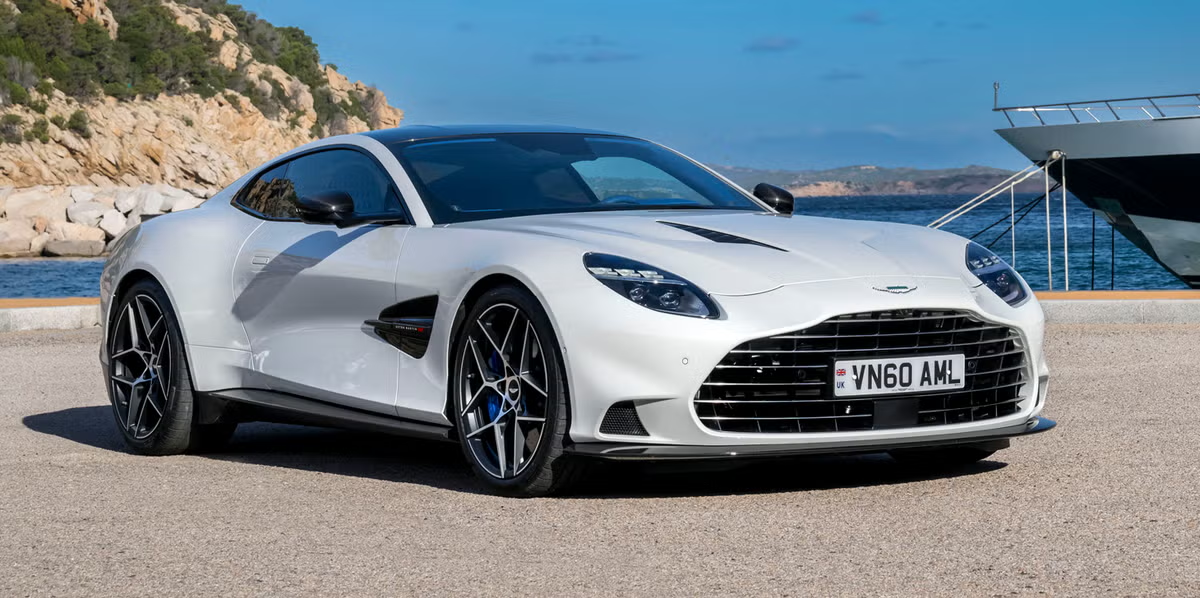
Launched in late 2024 for model year 2025, the third-generation Vanquish returned to the front-engine Grand Tourer format, positioning itself at the top of the company's vehicle lineup.
The engine is a twin-turbocharged 5.2-liter V12, delivering 835 PS (824 bhp / 614 kW) and an impressive 1,000 Nm (738 lb-ft) of torque. The 8-speed ZF automatic transmission features an integrated rear electronic differential (E-Diff).
It accelerates from 0 to 100 km/h in 3.3 seconds, reaching a top speed of 345 km/h (214 mph). The aluminum structure offers 75% higher torsional rigidity compared to the former DBS 770 Ultimate. The suspension uses Bilstein DTX dampers and the braking system features carbon-ceramic discs as standard. Global production is maintained at a strictly controlled volume of fewer than 1,000 units per year.
| Generation / Version | Period | Engine | Power | Torque | Transmission | 0–100 km/h | Top Speed |
|---|---|---|---|---|---|---|---|
| V12 Vanquish (Gen 1) | 2001–2004 | 5.9L V12 N/A | 460 bhp | 535 Nm | 6-sp. Automated | 4.5 s | 306 km/h |
| V12 Vanquish S (Gen 1) | 2004–2007 | 5.9L V12 N/A | 520 bhp | 576 Nm | 6-sp. Automated | 4.8 s | 323 km/h |
| Vanquish MkII (Gen 2) | 2012–2014 | 5.9L V12 N/A (AM11) | 565 PS (558 bhp) | 620 Nm | 6-sp. Automatic | 4.1 s | 295 km/h |
| Vanquish MkII MY15 (Gen 2) | 2014–2016 | 5.9L V12 N/A (AM29) | 568 bhp | 630 Nm | 8-sp. Automatic | 3.6 s | 323 km/h |
| Vanquish S MkII (Gen 2) | 2017–2018 | 5.9L V12 N/A (AM27) | 595 bhp | 630 Nm | 8-sp. Automatic | 3.5 s | 323 km/h |
| Vanquish (Gen 3) | 2025– | 5.2L Twin-Turbo V12 | 835 PS (824 bhp) | 1,000 Nm | 8-sp. Automatic | 3.3 s | 345 km/h |
| Generation / Specific Edition | Manufacturing Period | Units Produced |
|---|---|---|
| V12 Vanquish (Standard - Gen 1) | 2001–2004 | 1,503 units |
| V12 Vanquish S (Gen 1) | 2004–2007 | 1,086 units |
| First Generation Total (Newport Pagnell) | 2001–2007 | 2,589 units |
| -- V12 Vanquish S Ultimate Edition (included above) | 2007 | 50 units |
| Vanquish Volante (Gen 2 Standard) | 2013–2017 | ~1,001 units |
| Vanquish Centenary Edition (Gen 2) | 2013 | ~85 units |
| Vanquish S Red Arrows Edition (Gen 2) | 2017 | 10 units |
| Vanquish S Tom Brady Signature (Gen 2) | 2017–2018 | 12 units |
| Vanquish S Ultimate Edition (Gen 2) | 2017–2018 | Up to 175 units |
| Zagato Series (Coupe, Volante, Shooting Brake, Speedster) | 2016–2018 | 325 units total |
| Third Generation Vanquish | 2025– | <1,000 units/year |
The lineage of the Aston Martin Vanquish reflects the evolution of high-performance automotive engineering across three decades. From the hand-crafted construction techniques and first-generation automated gearboxes to all-carbon fiber molded structures, eight-speed transmissions, and contemporary twin-turbo engines, the Vanquish has remained true to the GT supercar concept, combining dynamism, exclusivity, and power.
Images of the Aston Martin Vanquish Volante