Origins and Development
For more than three decades, between 1969 and the beginning of the new millennium, Aston Martin used the established 5.3-liter V8 engine designed by Tadek Marek. With only 5,016 hand-built cars produced during that period, stricter environmental regulations forced the retirement of the V8 block. The decision to create a V12 engine to power the brand's flagship cars was made in the mid-1990s.
The V12 architecture was initially suggested in the Lagonda Vignale concept in 1993, while the extruded aluminum structure made its first practical appearance in testing on the 1996 Ford Indigo Concept, which joined two 3.0-liter Duratec V6 blocks. The evolution of these mechanics produced the functional prototype Project Vantage, designed by Ian Callum and presented in 1998. The mass-production model, nearly identical to the concept, was unveiled in October 2000 and made its public debut at the Geneva Motor Show in March 2001. Deliveries began in the summer of 2001, with hand assembly carried out at the historic Newport Pagnell factory.
The V12 Vanquish structure utilized a bonded extruded aluminum monocoque reinforced with a central carbon fiber cell, developed with technical support from Lotus. The commercial appeal of the sports car was amplified worldwide when driven by James Bond in the film 007 - Die Another Day, released in November 2002.
V12 Vanquish (2001–2004)
The first version of the model featured a naturally aspirated 5.9-liter (5,935 cc) V12 engine, built entirely of aluminum alloy. It delivered 460 bhp (466 PS) at 6,500 rpm and a torque of 535 Nm (400 lb-ft) at 5,000 rpm.
The engine was paired with a 6-speed automated manual transmission with electro-hydraulic actuation operated by paddle-shifters on the steering wheel. Performance achieved acceleration from 0 to 100 km/h in 4.5 seconds, with a top speed of 306 km/h (190 mph). The cabin was offered in a two-seater (2+0) configuration with a luggage shelf or the 2+2 option with reduced rear seats.
Facelift and Evolution: Vanquish S (2004–2007)
Presented at the Paris Motor Show in September 2004, the Vanquish S was developed to re-establish the brand's flagship position ahead of the DB9's launch.
To reach the top speed of 323 km/h (201 mph), the 5.9-liter V12 engine received deep modifications: new cylinder heads with machined intake ports and combustion chambers to optimize airflow, updated injectors, and remapping of the electronic control unit (ECU). Consequently, power increased to 520 bhp (527 PS) and torque rose to 576 Nm (425 lb-ft). The final drive ratio was shortened from 3.69:1 to 4.30:1, ensuring more agile dynamic responses.
Aerodynamically and chassis-wise, the drag coefficient dropped from 0.33 to 0.32 due to the new front splitter, widened front grille for cooling, and a redesigned trunk lid to generate more downforce. The suspensions, steering box, and Brembo brakes with floating discs adopted the standards of the optional Sports Dynamic Package (SDP). The alloy wheels of the Vanquish S received an exclusive 11-spoke design.
Starting in model year 2006, the interior underwent a major visual and technological update. The center console was leather-wrapped and incorporated the 6.5-inch color satellite navigation screen from the DB9, updated climate controls, a 900W Alpine sound system, and Bluetooth connectivity.
Manual Conversion by Aston Martin Works
Faced with some owners' rejection of the single-clutch automated system of the era, the official Aston Martin Works division created an aftermarket conversion service ("Stick Shift"). The modification replaced the electro-hydraulic system with a conventional 6-speed manual lever from the V8 Vantage and a physical clutch pedal. On cars from 2006 onward, the console was reworked to create the lever gate where the ashtray used to sit. More than 90 vehicles underwent this official conversion.
V12 Vanquish S Ultimate Edition (2007)
To celebrate the end of the model's production and the end of more than 50 years of vehicle manufacturing at the legendary Newport Pagnell plant, the manufacturer launched the Ultimate Edition in February 2007.
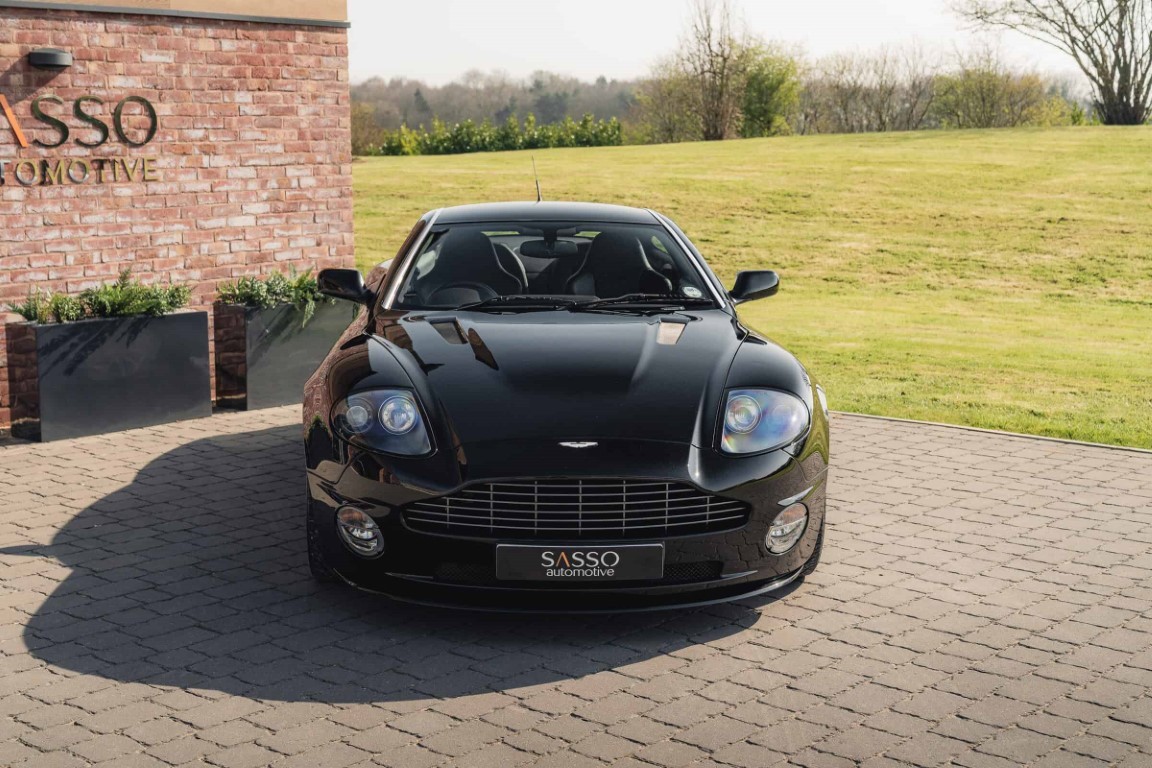
Initially planned for 40 units, demand raised the volume to 50 examples (20 right-hand drive and 30 left-hand drive). The model featured the exclusive metallic color Ultimate Black (with red and blue highlights), semi-aniline leather interior upholstery with exposed stitching, dark chrome interior trim, and numbered sill plates. Chassis number 502589 was the last automobile assembled at the Newport Pagnell factory before the facility's closure in July 2007.