1st Generation
(2009-2017)
The ultimate engine in the most agile chassis: 700 hp of British fury within a carbon sculpture.
Select a generation to see available versions
(2009-2017)
(2022-2023)
Select a powertrain to view full technical specifications
In the pantheon of modern automotive history, few vehicles capture the purist imagination with the same intensity as the Aston Martin V12 Vantage. This automobile is not just a model within a lineup; it represents a moment of philosophical and engineering defiance. The premise was deceptively simple, evoking the era of classic "Hot Rods": install the largest and most powerful engine available into the company's smallest and most agile body. However, Aston Martin's execution of this idea—a brand historically associated with refined and elegant Grand Tourers (GTs)—resulted in a machine of singular character, frequently described as "a brute in a tailored suit."
This technical and historical report aims to dissect, in exhaustive detail, the trajectory of the V12 Vantage. From its initial conception as a "skunkworks" (secret development) project in 2007 to its final turbocharged farewell in 2022, we will analyze every bolt, every strategic decision, and every production number that makes up the legend. We will examine how Aston Martin navigated the constraints of the VH (Vertical Horizontal) platform, the internal battles over manual versus automated transmissions, and how, against all logical market odds, this car became the last bastion of the analog driving experience.
The following analysis is not limited to listing specifications; it seeks to understand the "why" behind the data. Why did Aston Martin insist on a manual transmission when Ferrari was abandoning it? Why was the Roadster's production so restricted? And how did the evolution from a naturally aspirated V12 to a twin-turbo fundamentally alter the vehicle's soul? Through collected data and expert analysis, we will reconstruct the definitive narrative of the V12 Vantage.
In 2007, Aston Martin was experiencing a period of optimism and newly acquired independence, having separated from Ford. Under the leadership of Dr. Ulrich Bez, the brand sought to reaffirm its identity not merely as a maker of beautiful cars, but as a serious engineering force. The V8 Vantage, launched in 2005, was already a critical and commercial success, positioned as a direct rival to the Porsche 911. However, critics pointed out that the V8's chassis was capable of handling much more power than the original 4.3-liter engine offered.
The response to this criticism did not come from a product planning committee, but from the passion of the engineers. The idea of transplanting the V12 engine from the flagship DBS into the compact Vantage chassis seemed, on paper, a physical and dynamic impossibility. The Vantage's engine bay had been designed for a short V8; a long V12 would drastically alter weight distribution and airflow.
The world was introduced to this audacious idea on December 11, 2007. The occasion was the inauguration of Aston Martin's new Design Studio in Gaydon, Warwickshire. Before an audience of VIPs and journalists, the cover was pulled off a car painted in a vibrant blue (Mako Blue), christened the V12 Vantage RS Concept.
The "RS" in the name wasn't just marketing; it signified a direct connection to the racetrack. Unlike the production car that would follow, the RS concept was an engineering beast focused almost exclusively on circuit performance.
The reaction was immediate and overwhelming. The company received what it described as a "flood" of interest, with clients willing to write blank checks that very night. Dr. Ulrich Bez, sensing the potential, announced: "If there is sufficient demand, we will seriously consider a low-volume production run in the near future." The seed was planted, but the path to production would require compromises and brilliant engineering solutions.
Transforming the RS Concept into a sellable, durable, and road-legal car took only 12 months—an incredibly short development time by industry standards. However, some crucial changes were made compared to the initial concept.
The most significant change was the engine. The concept's dry-sump racing V12 was deemed too extreme, expensive, and difficult to maintain for a global road car. In its place, Aston Martin utilized the AM11 specification of the 5.9-liter V12 engine, the exact unit found in the contemporary DBS. While it was a traditional wet-sump system, it was robust, reliable, and already homologated for emissions.
The heart of the first-generation V12 Vantage is a masterpiece of internal combustion engineering.
The biggest technical challenge was heat. Stuffing a 6.0-liter V12 into an engine bay designed for a 4.3-liter V8 created a thermal furnace. The engineers' solution became the car's visual signature: the large louvers on the hood. Made of hand-laid carbon fiber, these vents were not decorative; they were vital for extracting hot air from the radiators and reducing front-axle lift at high speeds.
To stop the car, Aston Martin standardized the use of Carbon Ceramic Matrix (CCM) brakes.
The 2009 launch was met with near-universal acclaim. The automotive press praised the car's "analog" character. In a world rapidly moving toward dual-clutch gearboxes and electric power steering, the V12 Vantage retained heavy, communicative hydraulic steering and a manual shifter.
The definitive moment in pop culture occurred in the final episode of Top Gear's Series 13 (August 2009). Jeremy Clarkson delivered a poetic and melancholic review, suggesting that due to environmental and economic pressures, "we will never see a car like this again." The segment ended with the car parked against a desert landscape to the sound of Brian Eno's "An Ending (Ascent)," cementing the V12 Vantage's status as an instant classic before it even went out of production.
V12 Vantage Carbon Black Edition
To maintain interest in the model, Aston Martin released aesthetics-focused special editions. The most prominent was the Carbon Black Edition.
V12 Vantage Roadster (2012–2013)
The convertible arrived late in the life cycle, in 2012. Removing the roof on a car with so much torque and front-end weight required extensive structural reinforcement to prevent chassis flex ("scuttle shake").
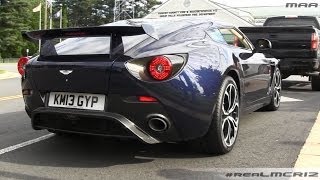
The V12 Zagato deserves a chapter of its own, as it represents the union of the V12 Vantage's raw mechanics with Italian haute couture. Created to celebrate the 50th anniversary of the Aston Martin-Zagato partnership (which began with the DB4 GT Zagato), this car was an exercise in design and craftsmanship.
Based entirely on the V12 Vantage's mechanics (VH chassis, 5.9L 510 bhp engine, manual gearbox), the Zagato differentiated itself through its bodywork.
Before selling the road car, Aston Martin built two racing prototypes, affectionately nicknamed "Zig" (green) and "Zag" (red). They competed in the 2011 Nürburgring 24 Hours, proving the mechanical durability of the package prior to customer delivery.
Aston Martin originally announced an intention to produce up to 150 units. The price, however, was astronomical: around £330,000 to £396,000 (depending on taxes), double the price of the donor car. Due to this prohibitive cost and the unstable global economy at the time, production was cut short.
In 2013, the original V12 Vantage was discontinued to make way for the V12 Vantage S. The letter "S" denoted more than just a facelift; it represented a deep technical overhaul designed to make the car faster and more track-focused.
The biggest change was under the hood. The engine evolved into the AM28 specification.
The most polarizing decision of the "S" generation was the initial elimination of the manual gearbox. Aston Martin installed the 7-speed Sportshift III transmission.
The V12 Vantage S introduced Bilstein adaptive dampers with three modes: Normal, Sport, and Track. This widened the car's operating window, making it more comfortable on long journeys (GT) and stiffer and flatter on circuits, partially resolving the criticism that the original car was "too stiff" for daily use.
Listening to the pleas of purists and observing the appreciating values of used manual models, Aston Martin made a bold move in 2016 (Model Year 2017). They reintroduced a manual option as a "no-cost" item.
The VH platform, already mature, served as the foundation for some of the most extreme machines the brand ever built.
Originally intended to be called the "Vantage GT3," the car was renamed GT12 following a legal dispute with Porsche over the use of the GT3 moniker. The GT12 was the ultimate expression of the naturally aspirated V12 for the track.
Launched to commemorate Aston Martin Racing's (AMR) victory in the GTE Pro class at Le Mans. The AMR was essentially a V12 Vantage S with the factory "Power Pack" engine (close to 600 hp) and racing-inspired paint schemes (like Stirling Green with Lime Green stripes).
Just as production of the VH Vantage seemed to have concluded, the bespoke "Q by Aston Martin" division accepted a special commission that resulted in the V600. The name paid homage to the 1990s V8 Vantage V600, the most powerful car in the world at its time.
After a hiatus of a few years, where the new generation of the Vantage (launched in 2018) operated only with AMG-supplied twin-turbo V8 engines, Aston Martin announced one final "hurrah" for the V12.
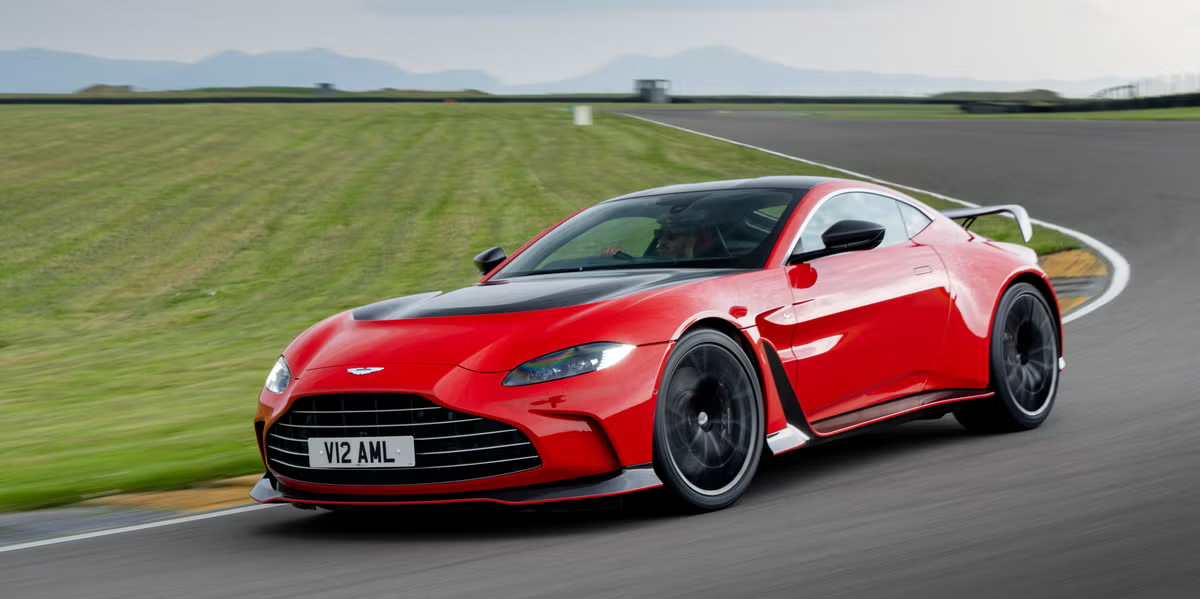
The 2022 model is a completely different animal from previous generations. Based on the new bonded aluminum architecture, it had to be widened by 40mm to accommodate the suspension and aerodynamics needed to handle the new power.
The design was dictated by the need for cooling and downforce. The front grille grew by 25% to feed the radiators. The hood sports a "Horse Shoe" vent to extract heat from the turbos. At the rear, a fixed wing generates 204 kg of downforce at top speed, keeping the car planted.
Aston Martin set strict numbers to guarantee future appreciation:
Both runs sold out prior to their public launch, offered first to loyal customers.
A crucial part of the V12 Vantage story is its rarity. Unlike the Porsche 911 Turbo, which is produced in the thousands, the V12 Vantage was always a niche product. Below, we present a consolidated analysis of production numbers, compiled from enthusiast registries and factory data.
| Generation | Model | Years | Transmission | Units (Approx.) |
|---|---|---|---|---|
| Gen 1 | V12 Vantage Coupe | 2009-2013 | Manual (6-speed) | 1,199 |
| Gen 1 | V12 Vantage Roadster | 2012-2013 | Manual (6-speed) | 101 |
| Zagato | V12 Zagato | 2011-2012 | Manual (6-speed) | 61 (65 total) |
| Gen 2 | V12 Vantage S Coupe | 2013-2017 | Sportshift III | ~1,017 |
| Gen 2 | V12 Vantage S Coupe | 2016-2017 | Manual (7-speed) | 260 |
| Gen 2 | V12 Vantage S Roadster | 2013-2017 | Sportshift III | ~272 |
| Gen 2 | V12 Vantage S Roadster | 2016-2017 | Manual (7-speed) | ~91-97 |
| Special | GT12 | 2015 | Sportshift III | 100 |
| Special | V12 AMR (Coupe) | 2017 | Manual & SSIII | ~75 (57 Man / 18 SSIII) |
| Special | V12 AMR (Roadster) | 2017 | Manual & SSIII | ~29 (23 Man / 6 SSIII) |
| Special | V600 | 2018 | Manual (7-speed) | 14 (7 Coupe / 7 Roadster) |
| Gen 3 | V12 Vantage (Biturbo) | 2022 | Automatic (8-speed) | 333 |
| Gen 3 | V12 Vantage Roadster (Biturbo) | 2022 | Automatic (8-speed) | 249 |
Note: The numbers for the manual and AMR variants are based on enthusiast registries and may vary slightly, but they represent the best available estimate.
The story of the Aston Martin V12 Vantage is the chronicle of an improbability. In an era defined by "downsizing," fuel efficiency, and platform homogenization, Aston Martin dared to do the exact opposite. They took their smallest car and gave it the biggest heart possible.
The legacy of the V12 Vantage does not lie in Nürburgring lap times or 0 to 100 km/h acceleration, areas where rivals like the Nissan GT-R or the Porsche 911 Turbo frequently outperformed it. Its legacy is emotional. It's the feel of the hydraulic steering vibrating in the driver's hands, the unfiltered, mechanical sound of a naturally aspirated V12 climbing to 7,000 rpm, and the physical demand of a heavy manual transmission that requires skill to master.
By ending production in 2022 with the 700 hp twin-turbo version, Aston Martin closed a glorious chapter of British automotive engineering. With just over 4,000 units produced across all generations and variants over 13 years, the V12 Vantage secured its place in history not just as a great Aston Martin, but as one of the last and greatest analog sports cars ever created.
Images of the Aston Martin Vantage V12 5.9 V12 Zagato