8X
(2011-2015)
2.0 Turbo
256 cv

The elite compact: Audi’s technological sophistication concentrated into an agile and character-filled format.
Select a generation to see available versions
(2011-2015)
(2016-2018)
The trajectory of the Audi A1 is not just the history of a car model; it is a case study on how a premium German brand descended the automotive pyramid to capture a new demographic, without diluting its prestige. Publicly launched in 2010, the A1 (internal code Typ 8X) represented Audi AG's official return to the "supermini" or premium compact segment, a territory the brand had left vacant since the end of the Audi 50's production in the 1970s.
The market context in the late 2000s was clear: growing urbanization and rising fuel prices were changing consumer habits. Affluent consumers wanted smaller cars to navigate congested cities, but they were not willing to sacrifice the luxury, build quality, and technology they were accustomed to in larger sedans. BMW had already proven the viability of this niche with the relaunch of the MINI brand in 2001. Audi needed a response. The A1 was that response: a condensed vehicle, under 4 meters in length, but with the unmistakable DNA of Ingolstadt.
Unlike the Audi A2 (1999-2005), which was an engineering marvel built entirely of aluminum but failed commercially due to its polarizing design and high costs, the A1 adopted a more conventional approach in terms of materials (steel), but much more aggressive in terms of styling and marketing. It was positioned not as a rational utility vehicle, but as an object of desire, focused on lifestyle, personalization, and sportiness.
The path to the production model was meticulously paved by a series of concepts that tested technologies and public reactions. Audi didn't just launch the car; it prepared the ground for three years.
The first public appearance of the project occurred at the 2007 Tokyo Motor Show, in the form of the Metroproject Quattro concept. This vehicle was fundamental for establishing the design language we would see in series production, specifically the contrasting brushed aluminum roof arch, which would become the visual signature of the first generation.
More importantly than the design, the Metroproject Quattro was an engineering laboratory. It featured an innovative hybrid propulsion system for the time: a 150 hp 1.4 TFSI engine drove the front wheels, while a 41 hp electric motor, mounted on the rear axle, powered the rear wheels. This allowed for 'Quattro' all-wheel drive without a mechanical connection (driveshaft) between the axles, saving weight and space. Although the exact hybrid system did not enter immediate production in the A1, it anticipated the electrification and electric all-wheel-drive strategy that Audi would adopt more than a decade later with the e-tron lineup.
The following year, Audi refined the idea with the A1 Project Quattro concept. This design study focused more on production viability and demonstrating infotainment technologies, such as mobile integration, which would be a sales pillar for the A1's young target audience.
Also in 2008, at the Paris Motor Show, Audi revealed the A1 Sportback Concept. While previous concepts focused on the three-door body style, this prototype confirmed that Audi had serious intentions of offering a five-door variant. The Sportback concept showed a slightly larger vehicle focused on versatility, signaling that the A1 would not just be a weekend toy, but a car capable of serving small families.
The final production model debuted at the 2010 Geneva Motor Show. Production began at Audi's plant in Brussels, Belgium (Audi Brussels S.A./N.V.), a historic facility that was completely modernized to accommodate the new compact. The choice of Brussels, rather than Germany, was strategic, allowing Audi to dedicate an entire plant exclusively to the complexity of the A1's personalization.
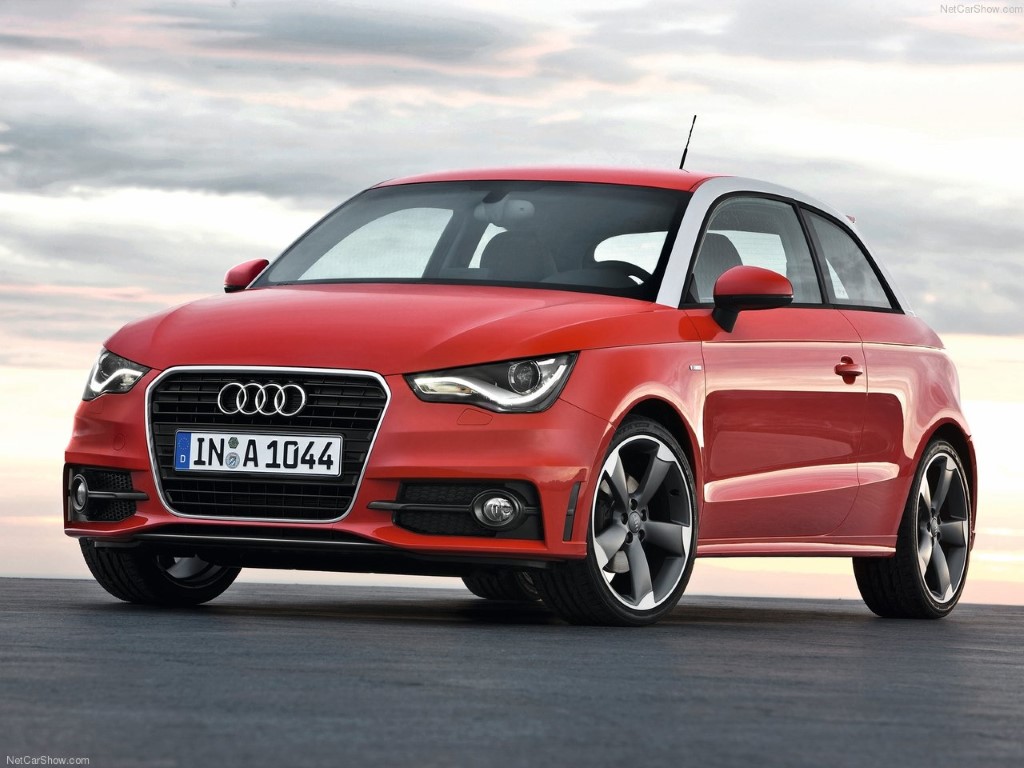
The design of the A1 (Typ 8X) was led by Stefan Sielaff's team. The front was dominated by the "Singleframe" grille with chamfered upper corners, giving it an expression of "determination". The headlights, available with "wing"-shaped LED daytime running lights, became an unmistakable nighttime signature.
The most striking feature of the three-door body was the roof arch. Audi offered this arch in four contrasting colors, giving the car a floating "coupe" appearance. The beltline, known as the "Tornado Line", encircled the entire vehicle, connecting the headlights to the taillights, which were integrated into the wraparound tailgate—a complex engineering solution that required auxiliary lights in the bumper for when the tailgate was open.
The A1 was built on the Volkswagen Group's PQ25 platform. This architecture was shared with the Volkswagen Polo Mk5 and the SEAT Ibiza Mk4. However, the claim that the A1 was just a "luxury Polo" is technically inaccurate due to the extensive modifications made by the Ingolstadt engineers.
To justify the premium price and deliver the expected Audi drivability, the brand made profound changes:
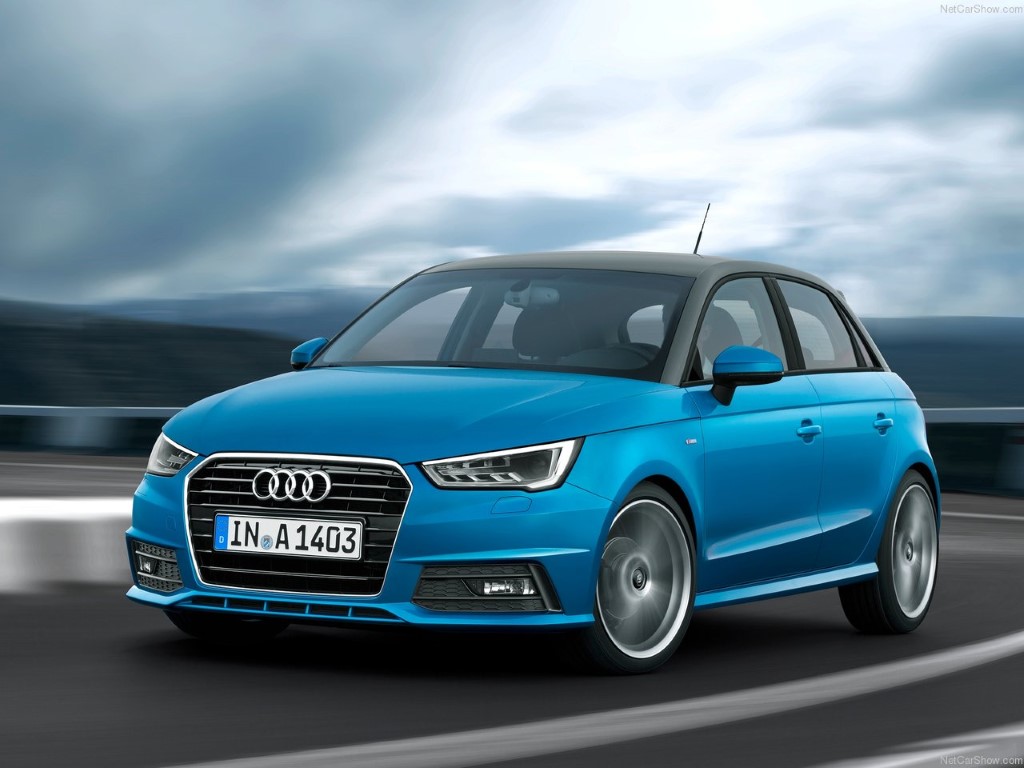
In November 2011, Audi expanded the lineup with the five-door A1 Sportback. Although the overall length (3.95 m) was identical to the three-door model, the Sportback was 6 mm wider and 6 mm taller. The roof was extended further back, providing 11 mm more headroom in the rear seat, solving one of the main criticisms of the original model: rear habitability. The Sportback quickly surpassed the three-door version in sales, becoming the mainstay of the range.
The first generation of the A1 was launched at the peak of the "downsizing" trend (reducing engine size while adding a turbocharger). The engine lineup was vast and complex, varying by year and market.
Detailed Engine Lineup Table (Generation 1 - 2010 to 2018):
| Engine Code | Configuration | Displacement | Power (hp/kW) | Torque (Nm) | Key Technology |
|---|---|---|---|---|---|
| 1.2 TFSI | Inline 4-cyl. | 1,197 cc | 86 hp (63 kW) | 160 Nm | Single turbo, 2 valves/cylinder. Focus on entry-level. |
| 1.4 TFSI (CAXA) | Inline 4-cyl. | 1,390 cc | 122 hp (90 kW) | 200 Nm | Direct injection, single turbo. The most popular engine globally. |
| 1.4 TFSI (CPTA) | Inline 4-cyl. | 1,395 cc | 140 hp (103 kW) | 250 Nm | Cylinder on Demand (CoD): Deactivates 2 cylinders under low load. |
| 1.4 TFSI Twincharged | Inline 4-cyl. | 1,390 cc | 185 hp (136 kW) | 250 Nm | Turbo + Supercharger. Mechanical supercharger for low RPMs, turbo for high. Complex and powerful. |
| 1.8 TFSI | Inline 4-cyl. | 1,798 cc | 192 hp (141 kW) | 250 Nm | Replaced the 1.4 Twincharged in the facelift. More torque and reliability. |
| 1.6 TDI | Inline 4-cyl. Diesel | 1,598 cc | 90 / 105 / 116 hp | 230-250 Nm | The European "workhorse". Extremely economical (3.8L/100km). |
| 2.0 TDI | Inline 4-cyl. Diesel | 1,968 cc | 143 hp (105 kW) | 320 Nm | Hot hatch performance with diesel consumption. |
| 2.0 TFSI (S1) | Inline 4-cyl. | 1,984 cc | 231 hp (170 kW) | 370 Nm | EA888 engine. Exclusive to the S1 model. |
The A1 offered 5- and 6-speed manual gearboxes, but it became famous for the 7-speed S tronic transmission. This was a dry dual-clutch gearbox (code DQ200). Although it offered instantaneous gear changes and improved fuel consumption, this transmission faced criticism and recalls in some markets due to mechatronics durability issues and premature clutch wear in heavy urban traffic.
In late 2014, Audi introduced the mid-cycle update of the A1. Although described by the press as "subtle", the technical changes were profound.
Audi used the first generation of the A1 as a canvas to demonstrate its extreme engineering capabilities, creating what many consider to be the best compact "hot hatches" in history.
In December 2011, Audi surprised the automotive world with the announcement of the A1 Quattro. It wasn't just a sports version; it was an engineering homologation limited to 333 units for the entire planet.
While the A1 Quattro was a limited edition, the Audi S1 was the mass-production response for those desiring performance. Launched in 2014, it was the first car in the subcompact segment to offer permanent all-wheel drive.
| Characteristic | Audi A1 Quattro (2012) | Audi S1 Sportback (2014) |
|---|---|---|
| Production | Limited (333 units) | Mass Production |
| Power | 256 hp | 231 hp |
| Torque | 350 Nm @ 2500 rpm | 370 Nm @ 1600 rpm |
| 0-100 km/h | 5.7 s | 5.9 s |
| Weight | ~1390 kg | ~1415 kg |
| Gearbox | 6-speed manual | 6-speed manual |
| Drivetrain | Quattro (Haldex Gen 4) | Quattro (Haldex Gen 5) |
To maintain interest in the model throughout its 8-year lifespan, Audi launched a dizzying amount of special editions, often exclusive to certain markets:
Audi's operation in Brazil treated the A1 as a key piece to "rejuvenate" the brand in the country.
The A1 arrived in Brazil imported from Belgium. The initial strategy focused on the high-income youth demographic. The car was positioned to compete directly with the MINI Cooper and the Fiat 500 Abarth.
With the arrival of the Sportback body style in 2012, sales in Brazil gained momentum. The 122 hp 1.4 TFSI engine was the most common, praised for its economy and good urban performance. The top-tier Ambition version featured the complex 185 hp engine (turbo+supercharger). In the Brazilian used car market, this 185 hp version requires extra attention due to the twincharged system's sensitivity to fuel quality and maintenance.
The facelifted model arrived in Brazil in 2016. The big news was the replacement of the 185 hp 1.4 engine with the 192 hp 1.8 TFSI in the Ambition version. This 1.8 engine (from the EA888 family) was much more robust and delivered superior torque, making the A1 Ambition a true "pocket rocket" on Brazilian streets.
With the Brazilian economic crisis and the devaluation of the Real, importing the A1 became prohibitive. The car's price began to encroach on the territory of the Audi A3 Sedan (which was produced locally and enjoyed tax exemptions). Audi Brazil suspended the importation of the first generation in 2018. The second generation (Typ GB) was briefly sold in Brazil starting in 2019 in extremely limited volumes and at prices exceeding R$ 120,000, focused only on the 150 hp 1.4 TFSI engine, but it was soon removed from the official catalog due to low demand compared to SUVs like the Q3.
Launched in 2018, the second generation represented a total break from the "rounded" philosophy of the first. Audi decided to masculinize the A1, drawing inspiration from icons of the past.
The most discussed design element of the new A1 is the three flat horizontal slits situated just below the hood line, above the grille. This detail is a direct homage to the 1984 Audi Sport Quattro, the rally car that defined the brand. The wide, slanted C-pillar also mimics this ancestor. The car abandoned soft curves in favor of taut lines, widened fenders, and a more planted stance.
The second generation migrated to the ubiquitous VW Group MQB A0 platform.
The second-generation A1 democratized technology from the luxury segment. Even the base model came with a fully digital instrument cluster. Optionally, it offered the full Audi Virtual Cockpit, with 3D navigation maps right on the dashboard. The MMI Touch infotainment system, tilted 13 degrees toward the driver, eliminated the rotary dial of the previous generation in favor of a purely tactile interface, supporting wireless Apple CarPlay and Android Auto.
In response to the Dieselgate scandal and the shift in public perception, Audi completely eliminated diesel engines from the A1 lineup.
Generation 2 Engine Lineup (Gasoline Only): Audi adopted its new nomenclature based on power bands (numbers 25, 30, 35, 40):
The Controversy: The 40 TFSI model is the top of the line. Unlike the previous generation, there is no S1 model with Quattro all-wheel drive in this generation. The 40 TFSI is front-wheel-drive only, which disappointed purists who expected a successor to the S1. The MQB A0 platform would technically support all-wheel drive, but the development costs were considered unfeasible for the projected sales volume.
In 2019, Audi launched the A1 Citycarver, renamed A1 Allstreet in 2022.
The analysis of production numbers reveals the magnitude of the A1's success and the economic reasons for its imminent demise.
During the first generation's life cycle, the Brussels plant produced 909,000 units of the A1.
The main markets were Germany, the United Kingdom, France, and Italy. In the UK, specifically, the A1 was a resounding success, frequently ranking among the best-selling premium cars.
Since the move to Spain, production has remained consistent, but in lower volumes due to the shrinking hatchback segment.
The Martorell plant exports more than 80% of this production, showing that domestic Spanish consumption is a small fraction of the car's final destination.
The A1 faced difficulties in markets outside Europe. In the US, it was never sold. In China, it had a limited edition, but the Chinese market prefers sedans (A3 Sedan). This limited the model's global scale potential.
Audi has officially confirmed that the A1 will not have a third generation. The model will be discontinued, alongside the Q2 compact SUV, at the end of its current life cycle, expected in 2026.
The decision is purely rational and based on three economic pillars:
The Audi A1 will leave the assembly lines in 2026 as one of the most successful brand expansion projects in recent history. It fulfilled its initial mission: to attract young customers to the Audi family. Many buyers who entered the brand with a 1.4 TFSI A1 in 2011 today drive a Q5 or an e-tron.
The model proved that luxury is not defined by size, but by engineering and finish. It will leave to history icons like the A1 Quattro and the S1, which showed that all-wheel drive and rally performance could be packaged into less than 4 meters. The end of the A1 marks the close of the era of small premium combustion cars, paving the way for the future of electric urban mobility.