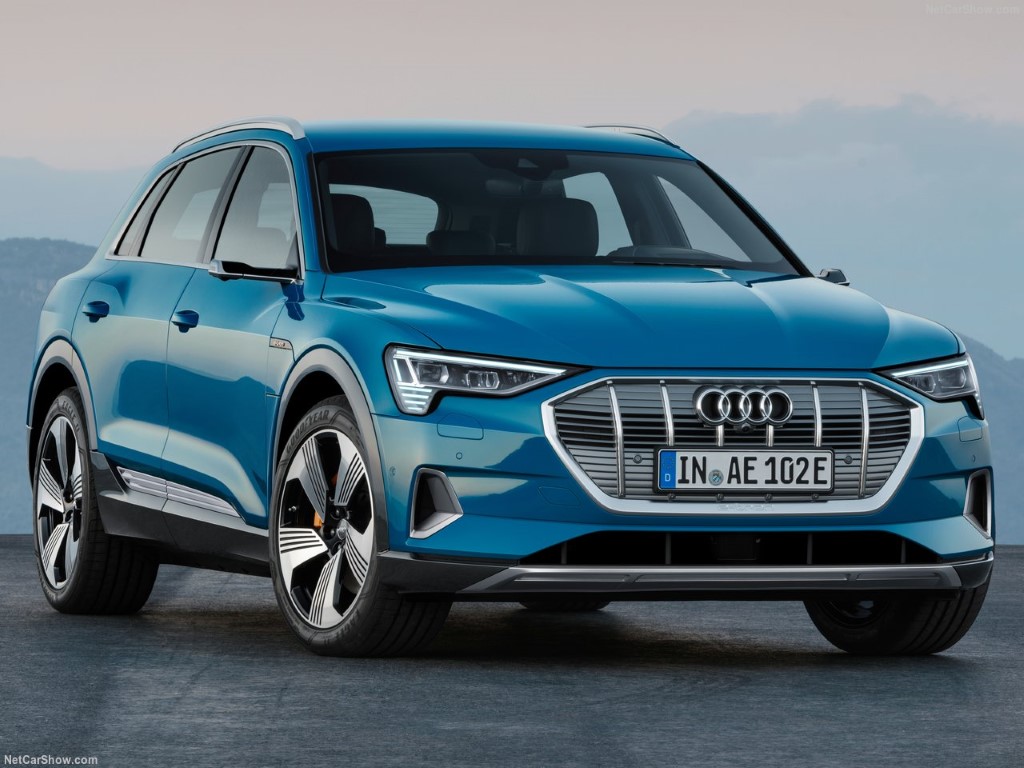
1st Generation
(2019-2023)
Electric (three motors)
503 cv

The voltage pioneer: the SUV that carried Ingolstadt’s DNA into the electric future with silence and power.
Select a generation to see available versions
(2019-2023)
The global automotive industry, throughout its centennial history, has rarely witnessed transformations as abrupt and profound as those observed in the second decade of the 21st century. For Audi AG, a premium subsidiary of the Volkswagen Group, the year 2018 marked not only the launch of a new model, but the beginning of an existential redefinition of the brand. The launch of the Audi e-tron, the manufacturer's first purely electric mass-production vehicle, represented the material and technological response to a perfect storm of regulatory pressures, shifting consumer preferences, and the urgent need to distance itself from the "Dieselgate" scandal that had shaken the conglomerate years earlier.
From the first conceptual sketches in 2015 to the melancholy, yet significant, end of its production in Brussels in February 2025, the Audi e-tron (later renamed Q8 e-tron) served as the brand's technological "icebreaker". It was designed not just to compete in sales, but to validate critical technologies — such as high-voltage battery thermal management, brake-by-wire energy recuperation systems, and camera-assisted aerodynamics — that would define Audi's engineering for decades to come.
The following analysis details not only the mechanical specifications and variations of each model year, but also explores the industrial complexities of adapting a historic factory for the carbon-neutral era, the challenges of commercialization in emerging markets like Brazil, and the relentless dynamics of technological obsolescence that led to the model's demise.
Before becoming the designation of a luxury SUV, the term "e-tron" traveled a long road within Audi's development corridors. The choice of name reflects a deliberate attempt to create a strong sub-brand, analogous to what the "quattro" suffix represented for all-wheel drive in the 1980s.
Historically, the first significant public appearance of the name occurred at the 2009 Frankfurt Motor Show, with a sports car concept based on the R8. This vehicle, which eventually saw extremely limited production as the R8 e-tron in 2015 (fewer than 100 units produced), served as a testbed for battery cells and high-performance electric motors. Simultaneously, the brand launched the A3 Sportback e-tron, a plug-in hybrid (PHEV) that began to accustom Audi's customer base to the idea of partial electrification.
The decision to name the first electric SUV simply "Audi e-tron", without numbering (like Q5 or Q7), was strategic. Audi wanted the vehicle to be synonymous with electric technology itself, positioning it as the "ur-e-tron" (the original e-tron), much in the same way the original "Audi quattro" defined four-wheel drive.
The definitive shape of the SUV began to materialize publicly in September 2015, at the Frankfurt International Motor Show (IAA). The Audi e-tron quattro concept was presented as a design and technology study that promised to solve consumers' two biggest anxieties regarding electric cars: range and charging time.
The concept's specifications were ambitious for the time:
The concept also introduced the visual language that would be adopted in production: the octagonal "Singleframe" grille, Matrix Laser headlights (which evolved into Matrix LED in production), and the absence of conventional rearview mirrors, replaced by cameras.
One of the most crucial — and controversial — engineering decisions in the history of the e-tron was the choice of its architectural base. In 2015/2016, the Volkswagen Group did not yet have a dedicated electric platform ready for the luxury segment (the MEB platform was in development for smaller cars and the PPE was still a distant project in partnership with Porsche).
Pressured by the need to launch a product quickly to compete with the Tesla Model X and get ahead of the Mercedes-Benz EQC, Audi chose to adapt the MLB Evo (Modularer Längsbaukasten Evolution) platform. This platform was originally conceived for vehicles with longitudinal combustion engines, serving as the basis for models like the Audi Q7, Q8, Bentley Bentayga, and Lamborghini Urus.
Implications of Shared Engineering:
The production model was revealed globally at a high-tech event in San Francisco in September 2018, symbolizing the direct challenge to Silicon Valley companies. Sales in Europe began in early 2019, reaching North America and other markets, such as Brazil, throughout 2019 and 2020.
The design philosophy of the e-tron was "progressive normality". Unlike competitors who adopted polarizing futuristic looks, Audi designed an SUV that looked, first and foremost, like an Audi. The proportions were athletic, sitting in size between the Q5 and Q7 (4,901 mm in length), offering the interior space of a higher-class vehicle.
| Parameter | Measurement |
|---|---|
| Length | 4,901 mm |
| Width (with conventional mirrors) | 2,189 mm |
| Width (with virtual mirrors) | 2,043 mm |
| Height | 1,629 mm |
| Wheelbase | 2,928 mm |
| Trunk Capacity (Rear) | 600 - 1,725 liters |
| "Frunk" Capacity (Front) | 60 liters (for cables) |
Aerodynamics was the engineering team's obsessive focus. The e-tron introduced innovations such as:
Virtual Mirrors The most distinctive feature of the e-tron was the option for virtual mirrors, a world premiere in mass-production cars.
Unlike many EVs that use permanent magnet synchronous motors (PSM) for their efficiency under low load, Audi opted for asynchronous motors (ASM), or induction motors, for the original e-tron.
The Logic of Asynchronous Motors: The main advantage of ASM motors is that they can be electrically deactivated without generating magnetic drag (drag torque). In cruising or low-load conditions, the e-tron operates predominantly with the rear motor. The front motor spins freely ("coasting") without consuming energy and without offering mechanical resistance. When the driver demands power or the system detects traction loss, the front motor is energized instantly. This configuration allowed Audi to replicate the feel of quattro traction with response times of 30 milliseconds — much faster than any mechanical system.
The heart of the e-tron was its complex battery system. In the 55 quattro version, the pack weighed about 700 kg and consisted of 36 modules of "pouch" type cells, supplied by LG Chem.
Audi structured the e-tron offering around power levels and battery capacity, identified by the numbers "50" and "55", as well as the sporty "S" version.
In November 2022, Audi announced an extensive facelift for the model, which hit the market in 2023. The most notable change was the name change to Audi Q8 e-tron.
The name change wasn't just marketing. With the launch of the Q4 e-tron (smaller and cheaper) and the impending Q6 e-tron, the original "Audi e-tron" nomenclature became confusing. By adopting the "Q8" badge, Audi aligned its top-of-the-line electric SUV with its combustion equivalent (the Audi Q8), clearly signaling its position as the flagship of the brand's electric SUVs.
Audi's engineering focused on solving the main criticism of the first generation: limited range compared to newer competitors like the BMW iX and the Mercedes EQS SUV. Without being able to change the physical size of the MLB Evo platform, the solution came through cell chemistry.
Specification Comparison of the Q8 e-tron Line (2023-2025)
| Model | Battery (Net) | Max Power | Torque | Range (WLTP) | 0-100 km/h | DC Charging |
|---|---|---|---|---|---|---|
| Q8 50 e-tron | 89 kWh | 250 kW (340 hp) | 664 Nm | 491 km (SUV) / 505 km (SB) | 6.0 s | 150 kW |
| Q8 55 e-tron | 106 kWh | 300 kW (408 hp) | 664 Nm | 582 km (SUV) / 600 km (SB) | 5.6 s | 170 kW |
| SQ8 e-tron | 106 kWh | 370 kW (503 hp) | 973 Nm | 494 km (SUV) / 513 km (SB) | 4.5 s | 170 kW |
Brazil, although a niche market for luxury electrics, was strategic for Audi's image in Latin America. The e-tron arrived with the mission of demystifying electrification for high-income customers.
Audi do Brasil began presales in November 2019, with the first deliveries occurring in April 2020. The timing was challenging, coinciding with the beginning of the COVID-19 pandemic, which forced the brand to adopt digital launch and home service strategies ("Audi Home Service").
To combat range anxiety in a country with incipient infrastructure, Audi do Brasil included the installation of a residential charger (Wallbox) in the vehicle's price and invested R$ 10 million in installing 150 kW fast chargers at its main dealerships, creating a "safety net" for owners.
The Brazilian market exclusively received the top-tier versions, focusing on performance and equipment.
2020 - Launch:
2023/2024 - Q8 Update:
With the switch to the Q8 e-tron, the price positioning rose considerably, reflecting improved technology and currency devaluation. Prices crossed the R$ 660,000 barrier, reaching nearly R$ 700,000 for fully equipped Sportback versions.
In Brazil, the e-tron was particularly valued for its silence on board and the shock-absorbing capacity of the air suspension on uneven roads. The range of the first generation (about 350 km real-world mixed use in Brazil) limited its use to urban commutes and short trips to the coast or nearby countryside (150 km radius), but the arrival of the Q8 e-tron with the 114 kWh battery significantly expanded this horizon, allowing for safer Rio-São Paulo trips.
The industrial history of the e-tron is inseparable from the Forest factory in Brussels (Belgium). This manufacturing plant became, simultaneously, a beacon of sustainability and an example of the pains of Volkswagen's industrial adjustment.
Audi transformed the Brussels factory, which previously produced the compact A1, into a technological showcase. In 2018, it became the first mass-production factory in the global premium segment to be certified as carbon neutral.
The factory was scaled to produce up to 120,000 cars per year, but actual demand for the e-tron, while strong initially, never saturated this capacity.
Estimated Production of the Audi e-tron/Q8 e-tron in Brussels
| Year | Approximate Production (Units) | Context |
|---|---|---|
| 2018 | Start (Ramp-up) | Start of production at the end of the year. |
| 2019 | ~43,000 | First full year of global sales. |
| 2020 | ~47,000 | Introduction of the Sportback and expansion to USA/China. |
| 2021 | 43,866 | Impact of the semiconductor crisis. |
| 2022 | 47,900 (Peak) | Best historical year for the model. |
| 2023 | 37,400 | Sharp decline post-Q8 facelift. |
| 2024 | ~23,900 (Est.) | Demand collapse; obsolescence against the Q6 e-tron. |
| 2025 | Residual | Production ended on February 28. |
In total, it is estimated that about 230,000 to 250,000 units of the e-tron/Q8 e-tron family were produced over its life cycle.
Starting in 2023, the Brussels factory faced an existential crisis.
The Audi Q8 e-tron was discontinued without a direct immediate successor on the same platform. Audi plans a future top-of-the-line SUV, likely called the Q8 e-tron again, but built on the SSP (Scalable Systems Platform) or an evolution of the PPE, expected to be manufactured in Mexico or another more efficient plant starting in 2026/2027.
Despite the abrupt end and production difficulties, the Audi e-tron fulfilled its historical mission with flying colors.
For the consumer, the e-tron (especially first-generation used models) remains an entry point into the premium EV world, offering a build quality (materials, acoustic insulation, paint) that often surpasses more modern electric models built with an aggressive focus on cost reduction.
In summary, the Audi e-tron was Audi's "space shuttle": complex, expensive, and heavy, but an engineering marvel that made the exploration of new frontiers possible and paved the way for more efficient and accessible vehicles in the future.