
Audi 90: The High-Performance Executive Sedan
The Audi 90 played a central role in the transformation of the German brand between the 1980s and 1990s. To move past its image as a builder of purely conventional family cars and compete directly against the BMW 3 Series (E30) and the Mercedes-Benz 190 (W201), the automaker needed a compact executive sedan featuring premium interior appointments, sophisticated multi-cylinder engines, and substantial technical advancements.
The historical roots of the designation trace back to the Audi Super 90 within the F103 model family, manufactured between 1966 and 1972 with a 90 hp engine and approximately 49,794 units produced. However, the modern Audi 90 lineup was established in 1984 as an independent product tier positioned between the Audi 80 and the full-size Audi 100 executive sedan. Its core premise was to combine the refined comfort of an executive sedan with Audi's proven inline five-cylinder engineering and the permanent quattro all-wheel-drive system.
First Generation: Audi 90 B2 (Typ 81 / Typ 85: 1984–1986/1987)
The commercial launch of the original Audi 90 occurred in August 1984, taking advantage of the major aesthetic and technical revision of the B2 platform. Prior to this update, five-cylinder models belonged to the upper trim levels of the Audi 80. Company leadership decided to segment the portfolio: the Audi 80 remained exclusively dedicated to four-cylinder engines for the mainstream market, while the Audi 90 consolidated the premium five-cylinder gasoline variants and the most advanced turbodiesel offering.
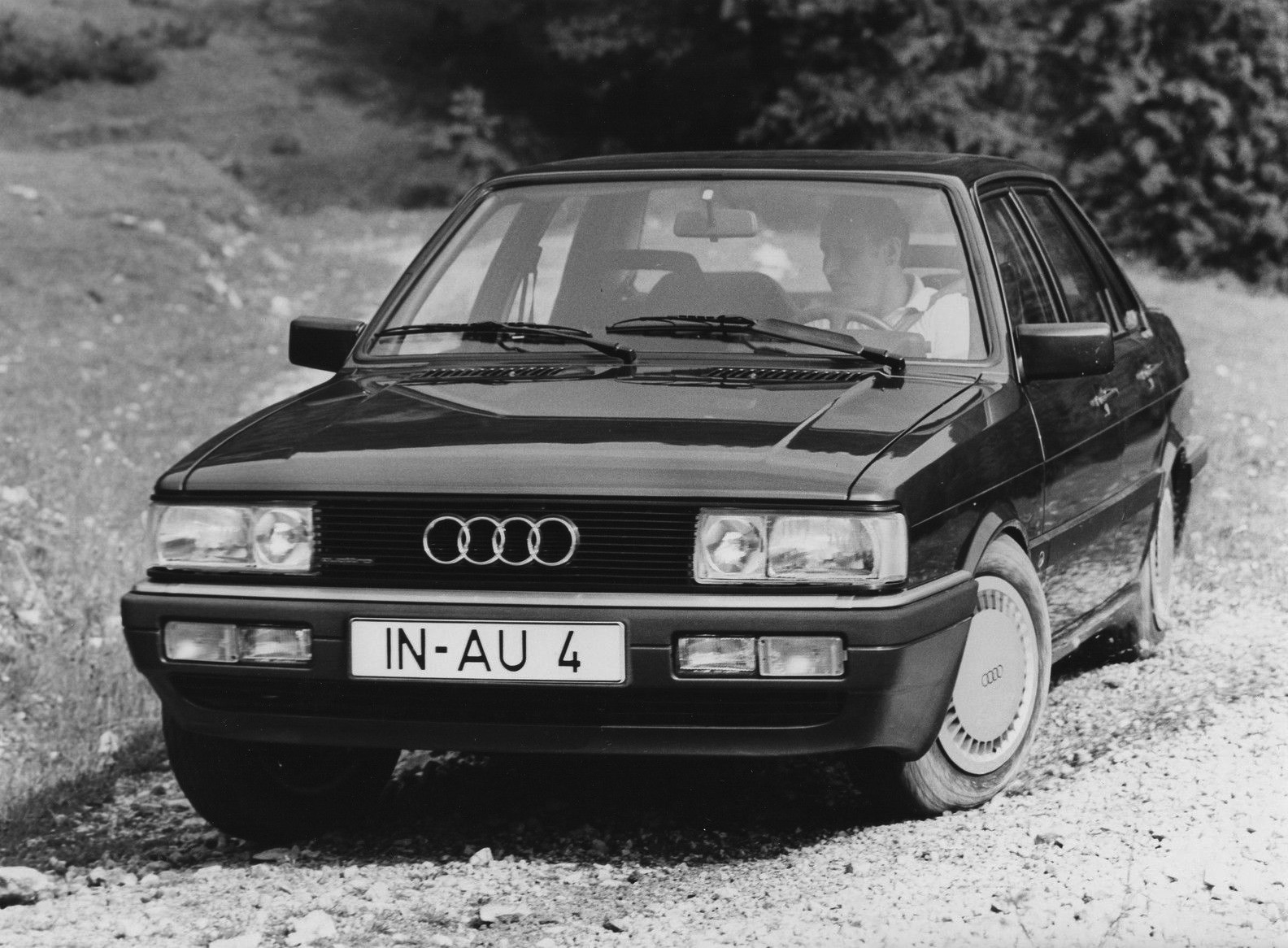
Production was divided under two distinct structural platform codes. Internal designation Typ 81 identified models configured strictly with front-wheel drive, while Typ 85 designated variants equipped with permanent quattro all-wheel drive. The latter featured a revised floorpan to accommodate the driveshaft, a dedicated independent rear suspension assembly, and a slightly shorter wheelbase (2,538 mm compared to 2,540 mm on front-wheel-drive models).
To visually differentiate the model from the Audi 80, the manufacturer designed large single-piece headlight lenses, subtle side skirts, and fully integrated bumpers painted in body color. The lower front bumper apron housed the turn signals and integrated fog lamps. The rear adopted a continuous reflective taillight panel spanning the entire trunk lid around the license plate, a styling cue clearly inspired by the upscale Audi 200 sedan. The quattro version featured satin black window moldings, a body-colored trunk spoiler, twin exhaust tips, and the "quattro" script embedded directly into the rear window heating elements.
The cabin delivered notable upgrades in material quality. The dashboard traded hard, hollow-feeling plastics for foam-padded slush-molded materials and introduced red nighttime backlighting. The seats received Kensington velour upholstery as standard alongside open-frame "doughnut" headrests across all four primary seating positions. Power steering was standard equipment on the 2.2-liter engine and optional on the 2.0-liter, while an Anti-lock Braking System (ABS) was available as a high-value option.
Powertrains and Performance (B2 Platform)
The engine lineup paired inline five-cylinder gasoline engines utilizing Bosch K-Jetronic mechanical fuel injection or KE-Jetronic electronic injection with a four-cylinder turbodiesel alternative. Tightening European anti-pollution standards prompted the introduction of non-regulated catalytic converter (U-Kat) versions and closed-loop regulated catalytic converter variants with lambda oxygen sensors (G-Kat).
| Version / Designation | Engine Code | Configuration / Displacement | Emissions Equipment | Power (hp / kW) | Torque (Nm) | Transmission / Drivetrain | 0–100 km/h | Top Speed |
|---|---|---|---|---|---|---|---|---|
| 90 2.0 | JS | Inline-5 / 1,970 cc | Non-catalyst | 115 hp / 85 kW | 165 Nm | 5-sp. Man. or 3-sp. Auto / FWD | 9.5 s | 187 km/h |
| 90 2.0 Kat | SK | Inline-5 / 1,970 cc | U-Kat catalyst | 113 hp / 84 kW | 160 Nm | 5-speed manual / FWD | 11.7 s | 181 km/h |
| 90 2.2 | KV | Inline-5 / 2,226 cc | Non-catalyst | 136 hp / 100 kW | 186 Nm | 5-sp. Man. or 3-sp. Auto / FWD | 8.6 s | 200 km/h |
| 90 2.2 Kat | KX | Inline-5 / 2,226 cc | G-Kat catalyst | 115 hp / 85 kW | 165 Nm | 5-speed manual / FWD | 9.5 s | 187 km/h |
| 90 quattro 2.2 | KV | Inline-5 / 2,226 cc | Non-catalyst | 136 hp / 100 kW | 186 Nm | 5-speed manual / Permanent quattro | 9.0 s | 200 km/h |
| 90 quattro 2.2 Kat | JT / KX | Inline-5 / 2,226 cc | G-Kat catalyst | 120 hp / 88 kW | 172 Nm | 5-speed manual / Permanent quattro | 9.6 s | 189 km/h |
| 90 Turbodiesel | CY | Inline-4 / 1,570 cc | Non-catalyst | 70 hp / 51 kW | 133 Nm | 5-speed manual / FWD | 14.4 s | 160 km/h |
B2 Generation Production Figures
Manufacturing of the first-generation Audi 90 spanned a relatively short period, concluding in Europe in July 1986. Under the official Audi 90 nameplate in the European market, exactly 66,101 units were recorded.
When factoring in the equivalent vehicles exported to North America under the Audi 4000 CS and 4000 CS quattro badges, the five-cylinder and turbodiesel B2 executive line reached 109,070 assembled vehicles through the opening months of 1987. The 2.0-liter engine (code JS/SK) represented the highest sales volume of the range, totaling 20,092 units, followed by the front-wheel-drive 2.2-liter with 15,568 cars. Permanent quattro all-wheel-drive configurations accounted for 13,662 non-catalyst units and 7,811 catalyst-equipped units. The Audi 90 Turbodiesel saw modest commercial penetration due to its high purchase price, totaling 4,067 units produced.
Second Generation: Audi 90 B3 (Typ 89 / Typ 89Q: 1987–1991)
Unveiled in May 1987, the B3 generation marked a definitive industrial leap forward for Audi. Front-wheel-drive models were designated internally as Typ 89, while quattro-equipped variants received the Typ 89Q code.
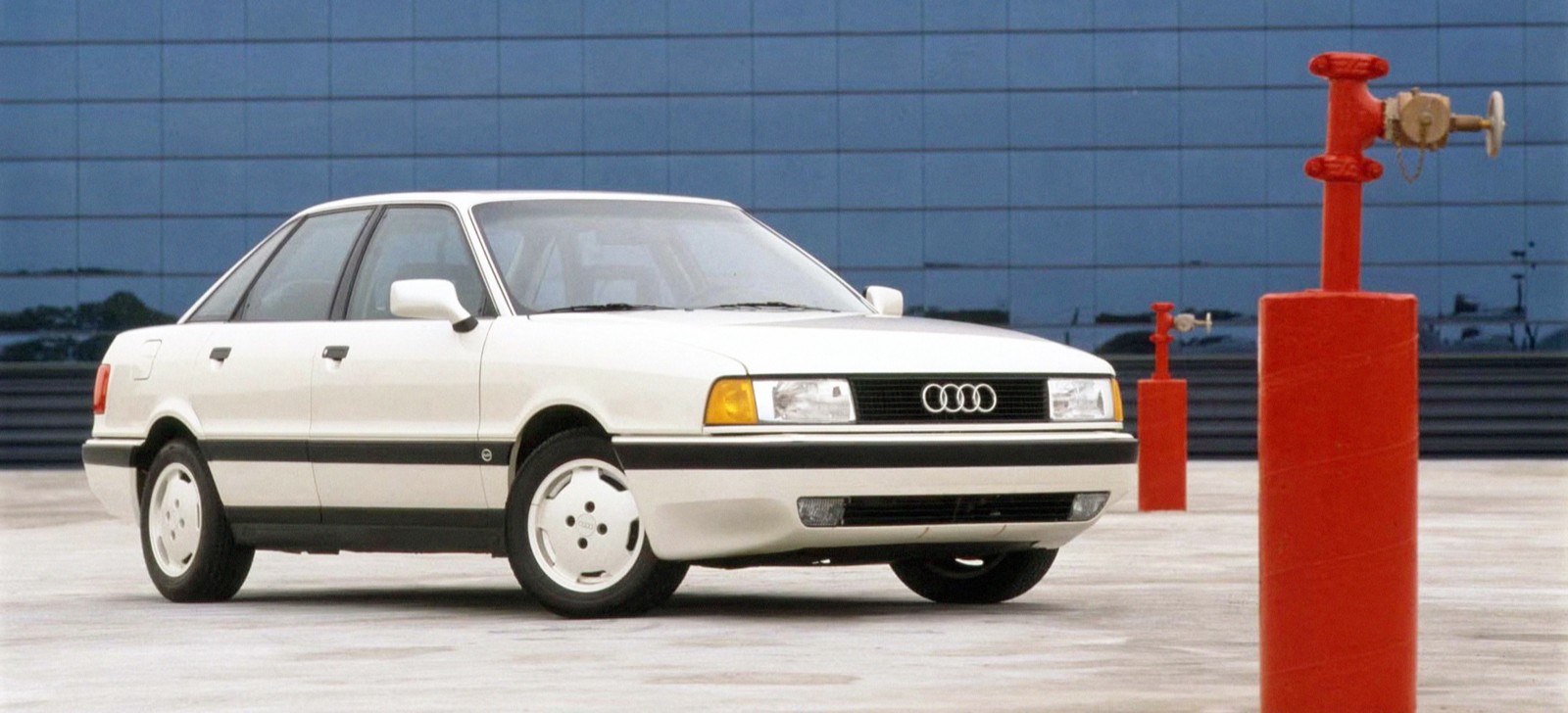
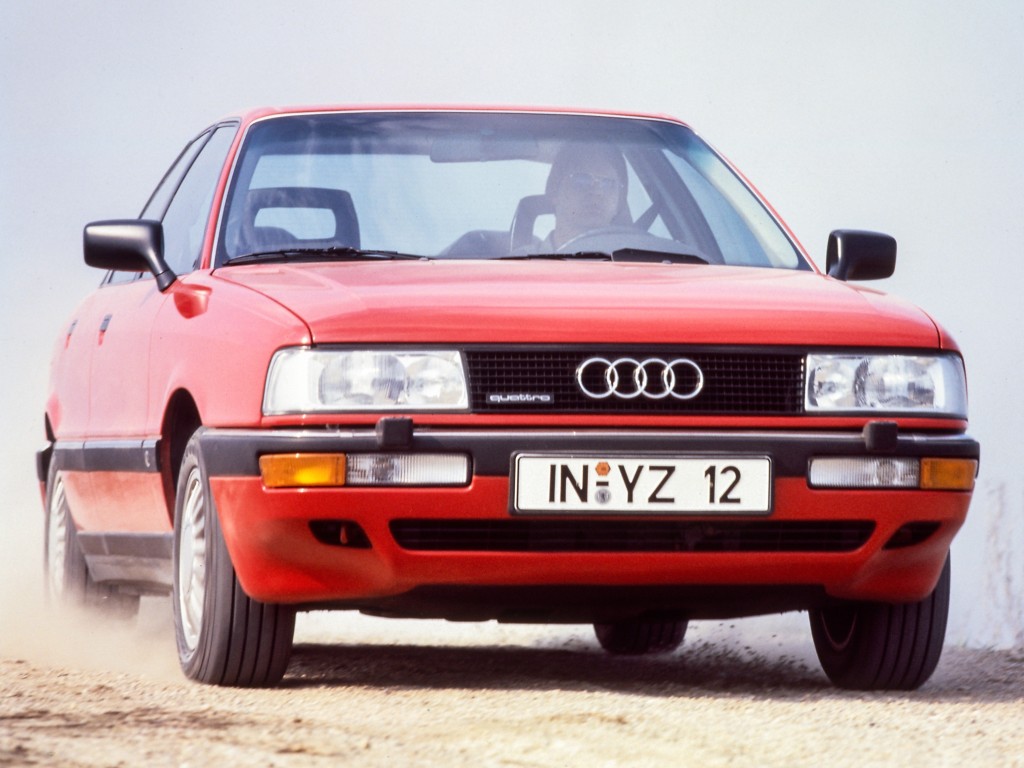
This generation stood out through the introduction of a unibody shell constructed entirely from hot-dip galvanized steel sheet metal, an innovation that resolved premature rust vulnerabilities and enabled the factory to offer a ten-year anti-perforation warranty. Furthermore, the curvilinear bodywork with flush-fitting glass set an aerodynamic benchmark, reducing wind turbulence and high-speed highway fuel consumption.
In passive safety, Audi launched the Procon-ten (Programmed Contraction/Tension) system on the 90 B3. This purely mechanical arrangement operated without electrical sensors: in a severe head-on collision, the rearward displacement of the engine block against the firewall pulled heavy steel cables anchored around the bellhousing. This mechanical pull retracted the steering column into the dashboard before the driver could strike the steering wheel, while simultaneously pretensioning the front seatbelts.
The most celebrated mechanical advance for the B3 quattro line was the implementation of a Torsen (torque-sensing) mechanical center differential. This component distributed drive torque between the front and rear axles automatically and instantaneously upon detecting slip, without requiring manual driver engagement while underway, retaining only a console-mounted push-button lock for the rear differential to assist with low-speed starts on ice or deep snow.
Visually, the Audi 90 B3 featured wraparound body-colored bumpers, wide auxiliary driving and fog lamps integrated into the lower bumper apron beside the turn signals, and elongated, higher-output composite headlights distinct from those on the Audi 80. At the rear, a continuous red acrylic lens assembly connected both taillights across the trunk lid.
Technical Milestones and Running Revisions
Rather than undergoing dramatic mid-cycle sheet metal changes, the Audi 90 B3 maintained a cohesive exterior, focusing its evolution on engine optimization and emissions controls:
In late 1988, Audi introduced the revered multi-valve 20-valve (20V) five-cylinder engines, incorporating double overhead camshafts (DOHC), crossflow cylinder heads, and four valves per cylinder, significantly raising rev limits and power output.
In early 1990, subtle mechanical revisions were carried out to comply with stricter acoustic and emissions limits. The 10-valve 2.3E engine received a revised camshaft profile, shifting rated output from 136 hp to 133 hp. Simultaneously, the cylinder head of the sporty 20-valve 2.3 traded its tubular stainless-steel exhaust header for a cast-iron manifold, adjusting power from 170 hp to 167 hp.
Heading into its final production year in 1991, the manufacturer introduced performance-oriented special editions, such as the Sport Exclusive, which added deeply bolstered sports seats, a firmer factory sport suspension, and 15-inch cross-spoke BBS alloy wheels as standard equipment.
Powertrains and Performance (B3 Platform)
The B3 engine portfolio established multi-valve five-cylinder options alongside traditional single-cam (10V) blocks and an upgraded intercooled turbodiesel.
| Version / Designation | Engine Code | Configuration / Displacement | Fuel Delivery System | Power (hp / kW) | Torque (Nm) | Transmission / Drivetrain | 0–100 km/h | Top Speed |
|---|---|---|---|---|---|---|---|---|
| 90 2.0 | PS | Inline-5 / 1,994 cc | KE-Jetronic (G-Kat) | 115 hp / 85 kW | 172 Nm | 5-speed manual / FWD | 10.2 s | 196 km/h |
| 90 2.0 20V | NM | Inline-5 / 1,994 cc | Hitachi MPI (Non-catalyst) | 160 hp / 118 kW | 181 Nm | 5-speed manual / FWD or quattro | 8.9 s | 215 km/h |
| 90 2.3E (1987-89) | NG | Inline-5 / 2,309 cc | KE-III Jetronic (G-Kat) | 136 hp / 100 kW | 190 Nm | 5-sp. Man. or 3-sp. Auto / FWD or quattro | 9.2 s | 206 km/h |
| 90 2.3E (1990-91) | NG | Inline-5 / 2,309 cc | KE-III Jetronic (G-Kat) | 133 hp / 98 kW | 186 Nm | 5-sp. Man. or 3-sp. Auto / FWD or quattro | 9.4 s | 202 km/h |
| 90 2.3 20V (1988-89) | 7A | Inline-5 / 2,309 cc | Hitachi MPI (G-Kat) | 170 hp / 125 kW | 220 Nm | 5-speed manual / FWD or quattro | 8.6 s | 220 km/h |
| 90 2.3 20V (1990-91) | 7A | Inline-5 / 2,309 cc | Hitachi MPI (G-Kat) | 167 hp / 123 kW | 215 Nm | 5-sp. Man. or 4-sp. Auto / FWD or quattro | 8.8 s | 220 km/h |
| 90 1.6 TD Intercooler | RA / SB | Inline-4 / 1,588 cc | Turbo Diesel + Intercooler | 80 hp / 59 kW | 155 Nm | 5-speed manual / FWD | 14.6 s | 174 km/h |
The 2.0-liter 20-valve variant (code NM) was developed directly to satisfy the Italian and Portuguese markets, where progressive fiscal policies levied steep value-added tax rates on passenger cars displacing over 2,000 cc. This allowed buyers in those territories to access high-revving multi-valve performance without facing prohibitive tax penalties.
B3 Generation Production Figures
Assembly of the Audi 90 B3 in Europe ran from mid-1987 until the end of summer 1991, recording a total production volume of 141,145 units.
The single-overhead-cam 2.3E five-cylinder was the commercial anchor of the lineup, celebrated for its durability and linear low-to-mid-range torque delivery. By comparison, quattro all-wheel-drive models and 20-valve variants were built in smaller batches due to higher showroom price points, making them sought-after modern collector cars. The Audi 90 1.6 Turbodiesel Intercooler had a highly selective production run, with only 1,880 units built across the entire lifespan of the B3 sedan.
Motorsport Icon: Audi 90 quattro IMSA GTO (1989)
The Audi 90 achieved international motorsport acclaim in 1989 with the development of the Audi 90 quattro IMSA GTO, engineered to contest the modified silhouette touring car division of the North American IMSA GT Championship.
While preserving the exterior roofline and styling profile of the production steel road car, the race machine was built around a bespoke high-tensile steel tube-frame spaceframe chassis clothed in carbon-composite and fiberglass panels. Positioned longitudinally under the hood sat the ultimate evolution of Audi's competition five-cylinder powertrain: a 2.2-liter (2,190 cc) aluminum-alloy block, a 20-valve cylinder head, Bosch Motronic multi-point injection, and a massive KKK turbocharger fed by an oversized nose-mounted intercooler.
This race engine developed 720 hp at 7,500 rpm and 720 Nm of torque at 6,000 rpm. A 6-speed manual racing gearbox distributed power to all four wheels through permanent quattro all-wheel drive. Weighing a homologated 1,206 kg and running on massive 360 mm wide racing slicks, the 90 IMSA GTO accelerated from 0 to 100 km/h in 3.1 seconds and achieved a top speed of 310 km/h.
Driven by factory pilots Hans-Joachim Stuck, Hurley Haywood, and Walter Röhrl, the Audi 90 secured victory in 7 of the 13 races during the 1989 calendar. Audi finished as runner-up in the Manufacturers' Championship solely because the team chose to skip the early-season endurance events at Daytona and Sebring.
Transition to the B4 Generation (Typ 8C: 1991–1995) and the North American Market
In August 1991, Audi introduced the B4 generation (Typ 8C), signaling the retirement of the 90 badge across most global markets. In Europe, the automaker unified all sedans and the new Avant estate under the Audi 80 nameplate, phasing out the 90 moniker to simplify brand communication.
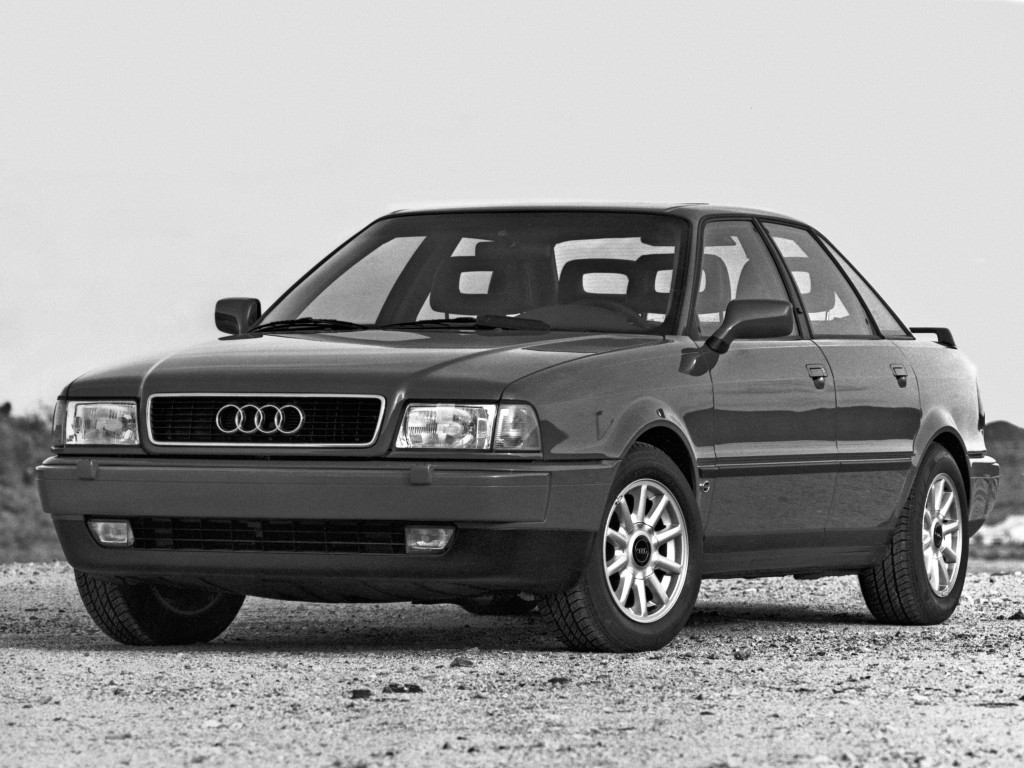
In North America, however, the brand took the opposite approach for market positioning reasons. Because American consumers associated the "80" badge with entry-level economy offerings, the local subsidiary dropped the 80 name entirely and badged all B4 sedans sold in the United States and Canada as the Audi 90 for the 1993 through 1995 model years.
The B4 platform addressed the primary functional criticisms of the B3 through an extensive structural re-engineering:
The wheelbase was lengthened to 2,611 mm, providing significantly improved rear passenger legroom. The vertical fuel tank, which sat behind the rear seatback in the B3 and compromised cargo versatility, was relocated flat beneath the luggage floor. This enabled split-folding rear seats and created a deep, flat trunk compartment. Aesthetically, the front hood was stamped in a single piece integrating the Audi grille surround.
For the North American market, the traditional five-cylinder engines were replaced in sedans by Audi's new 2.8-liter V6 gasoline engine (code AAH), featuring two valves per cylinder and multi-point electronic fuel injection.
| Model (North America - B4) | Engine | Displacement | Power | Torque | Transmission / Drivetrain | 0–60 mph (0–96 km/h) |
|---|---|---|---|---|---|---|
| Audi 90 S | AAH (V6 12V) | 2,771 cc | 172 hp (174 PS) | 245 Nm | 5-sp. Man. or 4-sp. Auto / FWD | 8.8 s |
| Audi 90 CS | AAH (V6 12V) | 2,771 cc | 172 hp (174 PS) | 245 Nm | 5-sp. Man. or 4-sp. Auto / FWD | 8.8 s |
| Audi 90 CS quattro Sport | AAH (V6 12V) | 2,771 cc | 172 hp (174 PS) | 245 Nm | 5-speed manual / Permanent quattro | 8.2 s |
Global sedan production on the B4 platform totaled 908,255 units between 1991 and 1995, with North American-specification models carrying the Audi 90 nameplate until the arrival of the next-generation A4.
Historical Production Summary Across Generations
The positioning of the Audi 90 as an upscale executive model line explains why its production figures were historically lower than the high-volume numbers of the Audi 80.
| Generation / Designation | Production Years | Body Styles | Primary Engines | Total Built Volume |
|---|---|---|---|---|
| Audi Super 90 (F103) | 1966 – 1972 | Sedan (2- and 4-door) | 1.8L 4-cyl. carburetor (90 hp) | 49,794 units |
| Audi 90 B2 (Typ 81/Typ 85) | 1984 – 1986/87 | Sedan (4-door) | 2.0L and 2.2L 5-cyl. gasoline; 1.6L 4-cyl. Turbodiesel | 66,101 units in Europe (109,070 including Audi 4000 US models) |
| Audi 90 B3 (Typ 89/Typ 89Q) | 1987 – 1991 | Sedan (4-door) | 2.0L and 2.3L 5-cyl. (10V and 20V); 1.6L 4-cyl. Turbodiesel | 141,145 units |
| Audi 90 B4 (Typ 8C - US/Canada) | 1992 – 1995 | Sedan (4-door) | 2.8L V6 12V gasoline | Integrated into global B4 sedan volume (908,255 units) |
The Technological Legacy of the Audi 90
The Audi 90 built the definitive bridge that established Audi as a respected premium automaker in the international marketplace. Rather than acting as a mere option package for the Audi 80, the 90 served as the operational testbed where German engineering perfected technical solutions that left an indelible mark on the automotive industry:
The inline five-cylinder engine gained mechanical renown for its smoothness, progressive torque delivery, and unmistakable soundtrack, forming the core of Audi's performance identity.
The mass implementation of 100% zinc-galvanized sheet metal proved the feasibility of eliminating premature corrosion across volume-production cars.
The adoption of the Torsen central differential demystified all-wheel drive on dry and wet tarmac alike, demonstrating that the quattro system provided immediate active safety without sacrificing everyday driving refinement or urban maneuverability.
Furthermore, functional safety solutions such as Procon-ten highlighted the automaker's capability to innovate in occupant protection prior to the widespread adoption of front airbags.
The lineage of the Audi 90 and Audi 80 concluded with the unveiling of the Audi A4 (B5 generation) in late 1994. The new alphanumeric naming structure inherited the rigorous mechanical build quality, advanced all-wheel-drive architecture, and structural sophistication that were systematically established throughout the lifecycle of the Audi 90.