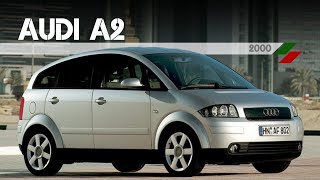
1st Generation
(2000 - 2005)
1.6 L4 16V FSI
110 cv
Technical specifications, versions, and history for the Audi A2.
Select a generation to see available versions
Select a powertrain to view full technical specifications
In the vast landscape of automotive history, few vehicles encapsulate a technical ambition as pure and uncompromising as the Audi A2. Launched at the turn of the millennium, this automobile was not just a commercial product; it was an engineering manifesto, a tangible response to the growing global concerns about fossil resource scarcity and the imperative need for emissions reduction. Designed under the aegis of the Volkswagen Group during an era of aggressive technological expansion, the A2 (internally designated as Typ 8Z) represented an audacious attempt to bring aerospace technology into the compact family car segment.
The core concept of the A2 challenged the established conventions of mass automobile manufacturing. While the industry traditionally relied on stamped steel and spot welding for unibody construction, Audi chose to transpose its revolutionary Audi Space Frame (ASF) technology, debuted in the luxurious A8, to an entry-level vehicle. The goal was to create a car that offered the interior space of a mid-size sedan, the versatility of a minivan, but with the weight of an ultralight city car and the aerodynamics of a sports car.
This report deeply analyzes the trajectory of the Audi A2, from the genesis of its initial concepts in the mid-1990s, through the production challenges at the Neckarsulm plant, to its market performance and its subsequent status as a "cult" classic. The analysis reveals that, although the A2 was a resounding technical success — achieving efficiency milestones that remain relevant decades later —, it faced significant commercial barriers, resulting in a production limited to 176,377 units between 1999 and 2005.
The 1990s were marked by growing legislative and social pressure in Europe to reduce fuel consumption. The German government and the automotive industry established a collaborative, yet extremely challenging goal: the development of a production car capable of traveling 100 kilometers on just three liters of fuel (the equivalent of about 78 mpg in the US or 33 km/l). This objective required not only incremental refinements in internal combustion engines, but a complete overhaul of automobile physics, obsessively focusing on mass reduction and aerodynamic drag.
Audi, seeking to reaffirm its slogan Vorsprung durch Technik (Advancement through Technology), took on this challenge not with a spartan microcar, but with a fully functional four-door vehicle. Development officially began in 1995, with designers in Ingolstadt and materials engineers in Neckarsulm working in unison.
The path to the production A2 was paved by a series of innovative conceptual vehicles that tested public reaction and the viability of new construction techniques.
The reception to these concepts was mixed. The engineering was universally acclaimed, but the design polarized opinions. The tall, narrow profile, dictated by the need to comfortably accommodate four passengers within a short, aerodynamic footprint, radically diverged from the low, wide hatchbacks that dominated the market.
The most distinctive element of the Audi A2 is its construction. Unlike any other car in its segment, the A2 does not have a steel unibody. It utilizes the second generation of the Audi Space Frame (ASF) technology.
The A2's ASF structure is a high-strength "cage" composed of three main types of aluminum components, each chosen for its specific load-bearing function:
The production of the A2 required the construction of a new assembly line in Neckarsulm, dedicated to aluminum. The joining techniques included over 30 meters of laser welding, as well as punch riveting and structural bonding. The result was a bare body-in-white weighing just 153 kg, roughly 40% to 43% lighter than an equivalent steel structure.
This lightness had a cascading effect throughout the vehicle: a lighter car requires less power to accelerate, smaller brakes to stop, and lighter suspension to control, creating a virtuous cycle of efficiency. The total curb weight of the base model was around 895 kg, a remarkable feat for a car with the levels of passive safety and equipment of the A2.
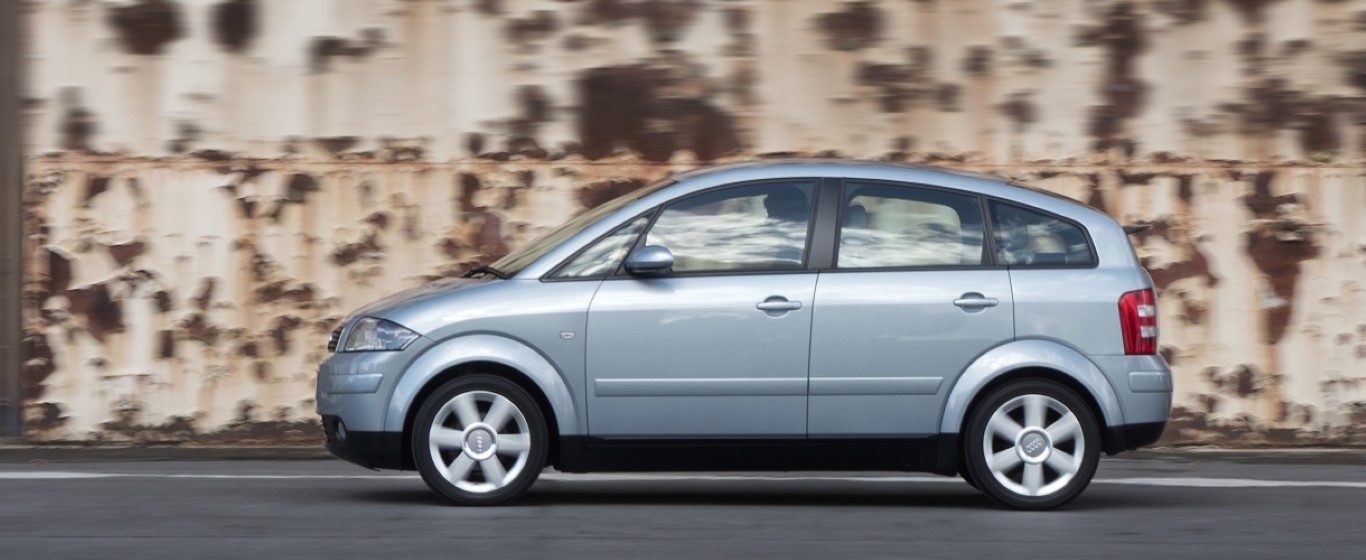
The efficiency of the A2 didn't just depend on weight; aerodynamics played a crucial role. The design, led by Luc Donckerwolke, strictly followed function. The teardrop shape, with a roof that gently slopes toward a truncated rear (Kamm tail effect), was optimized extensively in wind tunnels.
The standard A2 model already featured a drag coefficient (Cd) of 0.28, an excellent value for such a short and tall car. However, the 1.2 TDI "3L" version pushed optimization to the limit, achieving a world record of 0.25 Cd.
To reach this figure, comparable to modern sports cars and superior to many current electric vehicles, engineers implemented:
Audi equipped the A2 with an engine range focused on efficiency, consisting of compact three- and four-cylinder units. The table below summarizes the technical specifications of the produced versions.
Detailed Powertrain Table
| Model Designation | Engine Code/Type | Displacement | Maximum Power | Maximum Torque | Transmission | Acceleration 0-100 km/h | Top Speed | Combined Consumption (L/100km) | Production Period |
|---|---|---|---|---|---|---|---|---|---|
| 1.4 16V | Inline-4 Gasoline | 1390 cc | 75 hp (55 kW) | 126 Nm | 5-speed Manual | 12.0 s | 173 km/h | ~5.9 | 2000–2005 |
| 1.6 FSI | Inline-4 Gasoline (Direct Injection) | 1598 cc | 110 hp (81 kW) | 155 Nm | 5-speed Manual | 9.8 s | 202 km/h | ~5.9 | 2002–2005 |
| 1.4 TDI (75) | Inline-3 Diesel (Pumpe-Düse / Unit Injector) | 1422 cc | 75 hp (55 kW) | 195 Nm | 5-speed Manual | 12.3 s | 173 km/h | ~4.3 | 2000–2005 |
| 1.4 TDI (90) | Inline-3 Diesel (Pumpe-Düse / Unit Injector) | 1422 cc | 90 hp (66 kW) | 230 Nm | 5-speed Manual | 10.9 s | 188 km/h | ~4.3 | 2003–2005 |
| 1.2 TDI (3L) | Inline-3 Diesel (Lightweight Alloy) | 1191 cc | 61 hp (45 kW) | 140 Nm | 5-speed Automated | 14.9 s | 168 km/h | ~3.0 | 2001–2005 |
Data compiled from: 2
The most popular and simple engine. A conventional 16-valve four-cylinder, shared with the VW Polo and Golf. It was valued for its smooth and quiet operation, contrasting with the vibration of the diesels. Owner reports indicate a real-world consumption around 14 to 17 km/l (35-40 mpg US), depending on the driver's foot.
Introduced in 2002, this engine brought Fuel Stratified Injection (FSI) technology. It promised the power of a larger engine with the fuel consumption of a smaller one. However, technological complexity brought problems. The engine operated in a "stratified charge" mode at low loads to save fuel, but required high-quality gasoline (low sulfur content) and had sensitive exhaust gas treatment systems (NOx catalytic converters). Owners and mechanics report frequent problems with injectors, coils, and sensors, plus a rough operation if not fueled with premium gasoline. Despite this, it transformed the A2 into an agile car, capable of reaching 202 km/h.
These three-cylinder engines used Volkswagen's Pumpe-Düse (unit injector) technology, which generated extremely high injection pressures, resulting in excellent thermodynamic efficiency and abundant torque.
This version deserves a separate chapter. To reach the 3 liters/100km goal, Audi didn't stop at the engine. The car underwent a strict diet and exclusive aerodynamic modifications:
Despite the brilliant engineering, the 1.2 TDI was expensive and its complex gearbox proved to be temperamental and costly to fix in the long run, making it a rare but risky collector's item.
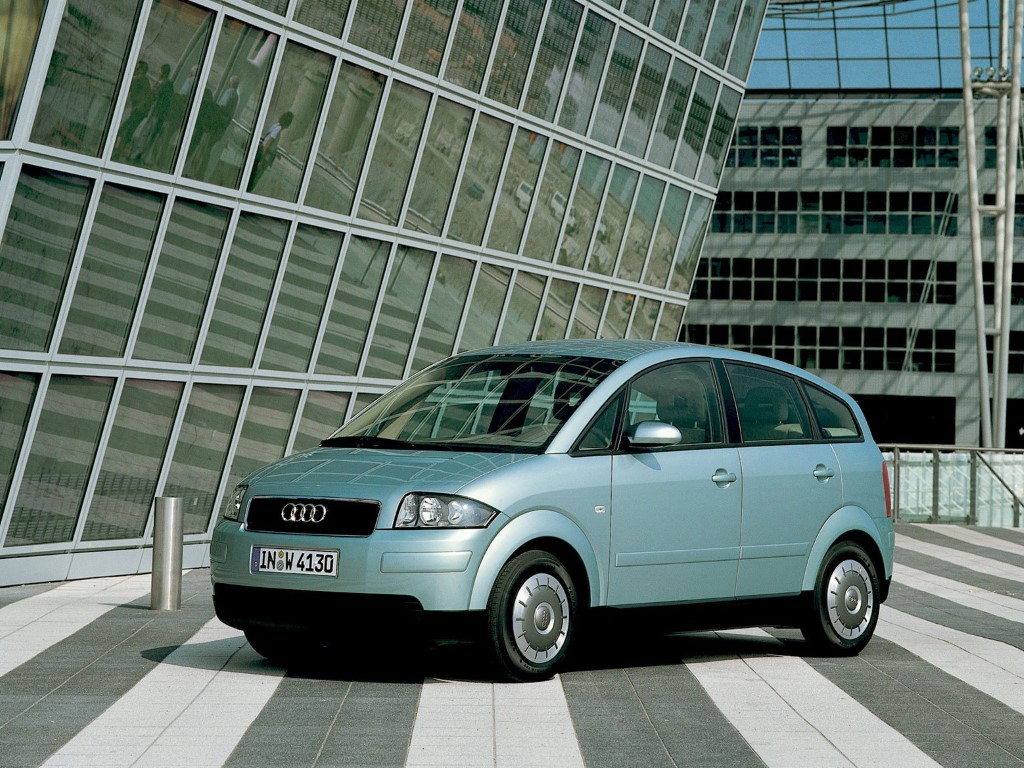
The interior of the A2 was designed to maximize usable volume. One of the central innovations was the "Space Floor Concept". The rear floorpan was lowered relative to the front seat tracks. This allowed rear passengers to have a comfortable and ergonomic leg position, even with the car being physically short. The tall roof contributed to a feeling of vertical space comparable to that of luxury sedans.
A famous idiosyncrasy of the A2 is its front grille, which is actually a "Serviceklappe" (service hatch). The engine hood was not designed to be opened by the owner; it is secured by latches and must be removed entirely if necessary. For daily maintenance, the driver simply tilts the black front grille downwards, revealing the oil dipstick and the filler necks for engine oil and windshield washer fluid. This reflected Audi's philosophy that the modern driver shouldn't need to "get their hands dirty" with the mechanics.
The rear seats were works of engineering in themselves. They could be folded or removed individually from the car (in the 4-seater versions). With the seats removed, cargo volume jumped from 390 liters to a staggering 1,085 liters, with a flat surface, transforming the hatchback into a small van capable of transporting bulky objects.
Total production of the Audi A2 was 176,377 units over five and a half years. This number fell short of Audi's expectations, which projected much larger volumes to amortize the high cost of the aluminum plant.
| Model | Units Produced | % of Total |
|---|---|---|
| 1.4 Gasoline | 81,649 | 46.3% |
| 1.4 TDI (75 hp) | 69,676 | 39.5% |
| 1.6 FSI | 11,081 | 6.3% |
| 1.4 TDI (90 hp) | 7,416 | 4.2% |
| 1.2 TDI (3L) | 6,555 | 3.7% |
| Total | 176,377 | 100% |
Data compiled from: 1
Why did such an advanced car not sell well? The analysis points to a combination of factors:
It is important to note that the Audi A2 was never officially sold in Brazil by Audi. Due to its complex technology, the need for high-quality diesel (for the TDIs) and pure gasoline (for the FSI), plus the high cost of importation, Audi do Brasil chose to focus on the A3, which was produced locally in São José dos Pinhais. However, there are reports of isolated units in the country, likely independent imports by diplomats or enthusiasts, making it an absolute rarity on Brazilian soil.
The A2 did not have "generations" in the traditional sense, but evolved through equipment packages and technical updates.
Audi offered personalization packages instead of rigid fixed trim levels:
Two decades after the end of its production, the Audi A2 is experiencing a renaissance as a "cult" classic and "Youngtimer".
The A2's biggest advantage today is its aluminum body: it does not rust. While contemporary cars like the Mercedes A-Class or VW Golf IV frequently suffer from structural corrosion, surviving A2s remain structurally sound. However, collision repairs are expensive and require aluminum welding specialists.
Common problems reported by owners include failures with the Open Sky sunroof (which can cost thousands of euros to fix), wear on interior buttons (Audi's "soft touch" coating from this era peels off), and electronic issues in comfort modules.
The idea of a "new A2" never completely disappeared. In 2011, Audi presented the A2 Concept in Frankfurt, a pure electric vehicle with 116 hp and a 200 km range. The project aimed to compete with the BMW i3, but was canceled around 2013 due to cost concerns and the lack of maturity in the electric market at the time.
Today, the original A2's lightweight architecture makes it a popular candidate for electric conversions (retrofit). Its aerodynamic efficiency and low weight mean it can achieve good range even with smaller batteries, keeping the original vision of extreme efficiency alive.
The Audi A2 was, paradoxically, a victim of its own excellence. It offered solutions to problems that the mass market did not yet consider urgent in the year 2000. It was an engineering exercise without compromise, where weight reduction and efficiency were pursued with a rigor rarely seen in mass-production cars.
If it failed commercially to meet Audi's goals, historically it triumphed as a technological milestone. The A2 proved the viability of mass aluminum production and established efficiency standards that many modern cars still struggle to match. For enthusiasts and engineers, the A2 remains not as a "weird, small car", but as a smart and durable monument to functional design — a true preview of the future that arrived too early.
Images of the Audi A2