

B6
(2001 - 2006)
3.0 V6
220 cv
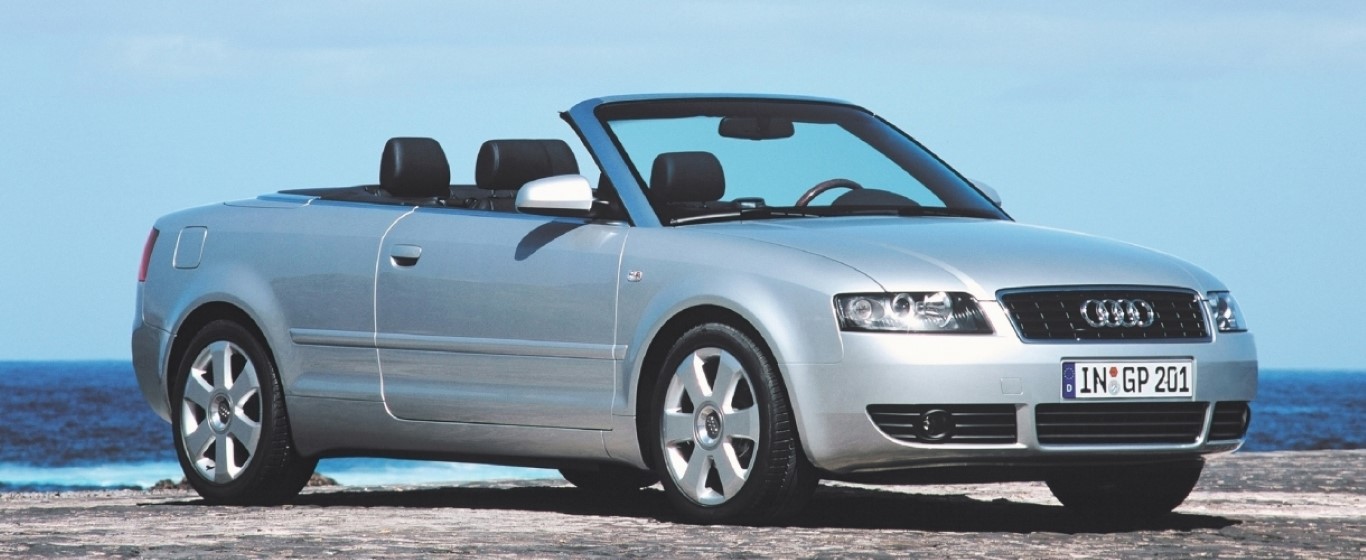
Technical specifications, versions, and history for the Audi A4 Cabriolet.
Select a generation to see available versions
(2001 - 2006)

(2005 - 2008)
Select a powertrain to view full technical specifications
The narrative of the four-seater convertible automobile is one of the most fascinating in the European automotive industry. Unlike two-seater roadsters, focused purely on performance or individualistic style, the four-seater cabriolet carries the responsibility of reconciling the freedom of an open car with the practicality of a family sedan. In this scenario, the Audi A4 Cabriolet was not just another launch; it was the definitive affirmation of Audi as a member of the "German Premium" elite, directly challenging the hegemony of BMW and Mercedes-Benz at the turn of the millennium.
To understand the magnitude of the Audi A4 Cabriolet (B6 and B7 generations), it is imperative to revisit its roots. The lineage spiritually dates back to the early days of Horch in 1901, but its direct ancestor is the Audi Cabriolet based on the Audi 80 (B3), launched in 1991. This 1991 model was a cult success, selling around 72,000 units over nearly a decade. However, when the production of the Audi 80 ceased to make way for the first generation of the A4 (B5) in 1994, Audi made a curious decision: it did not launch a convertible version of the A4 B5. Instead, it kept the old Audi 80-based Cabriolet in production until the year 2000.
This created a hiatus. Between the end of production of the original Cabriolet in 2000 and the launch of the A4 Cabriolet (B6) in 2002, Audi was left without a representative in this vital segment. This gap was not accidental; it was an incubation period. Ingolstadt's engineering team knew they couldn't just cut the roof off the A4 sedan; they needed to create a structure that set new standards for rigidity and acoustic comfort. The four-seater convertible market was exploding, jumping from approximately 21,000 units annually to over 80,000 in a decade, and Audi needed a technically flawless product to capture this growing demand, especially among the 30 to 39-year-old demographic and female buyers, who represented a significant slice of this niche.
This report meticulously dissects the trajectory of this vehicle, from Peter Schreyer's drawing board to Karmann's assembly lines in Rheine, exploring every bolt, every powertrain, and every challenge faced by owners, with a special focus on the reality of the Brazilian market.
The world premiere of the second-generation Audi A4 Cabriolet (but the first to carry the "A4" name) took place in 2002. Although it shared the "B6" designation with the sedan and the wagon (Avant), the Cabriolet was, in terms of body engineering, a distinct vehicle.
Under the design leadership of Peter Schreyer, the A4 Cabriolet adopted an aesthetic that prioritized visual cleanliness and timelessness. Unlike the sedan, which had more pronounced creases, the Cabriolet featured more fluid surfaces.
A striking feature was the continuous brushed aluminum (or chrome, depending on the version) waistline that encircled the entire cabin. This detail wasn't just aesthetic; it served to visually lower the car and emphasize the transition between the bodywork and the interior, creating a sense of unity when the top was down. The headlights, although similar to those of the sedan, had exclusive internal arrangements, and the body panels — hood, fenders, doors, and trunk lid — were exclusive to the convertible. It wasn't an adapted sedan, but a harmonized design.
The biggest challenge of any convertible derived from a unibody platform is the loss of torsional rigidity. The roof of a car acts like the top of a box; when removed, the structure tends to twist and vibrate ("cowl shake") when going over bumps.
Audi addressed this problem with aggressive materials engineering. The Volkswagen Group B6 platform (PL46) received substantial reinforcements:
The result of these efforts was a 112% increase in static torsional rigidity compared to the old Audi Cabriolet. In practice, this meant that the A4 Cabriolet offered solid handling, without the squeaks and steering imprecision common in convertibles of the era.
The "soul" of the A4 Cabriolet resided in its fabric soft top. While competitors like BMW were beginning to flirt with retractable hardtops (which would arrive in the next generation, the E93), Audi remained faithful to canvas. The justification was threefold: classic aesthetics, lower weight at the highest point of the car (center of gravity), and preservation of trunk space.
The soft top was operated by a sophisticated electro-hydraulic system. The opening or closing process took between 24 and 30 seconds. A crucial innovation for urban usability was the ability to operate the roof with the vehicle in motion, at speeds up to 30 km/h (approximately 18.6 mph). This allowed the driver to start closing the roof upon noticing the first raindrops without needing to stop traffic or park. The system featured multiple Hall sensors (magnetic position sensors) that monitored the exact location of each segment of the structure during the cycle.
Audi prided itself on the "four-season" insulation of the soft top. It consisted of three main layers:
The rear window was real glass (not plastic, which yellows over time) and had an integrated electric defroster, a vital necessity for cold and damp climates.
As a four-seater convertible, the A4 Cabriolet needed to accommodate real passengers in the back seat. The increase in wheelbase to 2,654 mm (slightly larger than the sedan) helped free up legroom. However, the soft top mechanism required the rear seat to be moved slightly forward and have a more upright backrest, which limited comfort for adults on long journeys, although it was superior to most rivals.
The trunk utilized an intelligent variable system. Inside the luggage compartment, there was a movable box to accommodate the folded top.
This required planning from the driver: if the trunk was full of hard suitcases, it would not be possible to open the roof.
The engine range for the A4 Cabriolet B6 was extensive in Europe, but in Brazil and the Americas, the selection focused on the balance between prestige and performance.
The 1.8-liter, inline 4-cylinder engine, with a turbocharger and 5 valves per cylinder (20 valves in total), was the backbone of sales.
For those seeking more refinement, Audi offered the naturally aspirated 3.0-liter V6.
The vast majority of front-wheel drive (FWD) models of the A4 Cabriolet, both 1.8T and V6, came equipped with the Multitronic transmission.
Available mainly on the V6 and S4 models, the Quattro system of this generation utilized a Torsen (Torque Sensing) center differential. It was a permanent mechanical system, normally distributing 50/50 of the torque between front and rear. In the event of traction loss, the differential instantly transferred power to the axle with more grip. This gave the A4 Cabriolet dynamic safety in the rain unmatched by rear-wheel-drive rivals (BMW and Mercedes).
Although Audi calls it "B7", this generation is technically a profound evolution of the B6. The platform remained the same (PL46), but the updates were extensive enough to justify the new nomenclature.
The most visible change was the introduction of the "Singleframe" front grille. The split double grille of the B6 was replaced by a single vertical, trapezoidal piece that descended from the hood to the base of the bumper. This design element, introduced on the A8 and A6, aligned the Cabriolet with the brand's new corporate identity. The headlights gained a more organic and wavy design at the base, and the taillights began to invade the trunk lid, visually widening the rear.
The big technical novelty of the B7 was the widespread adoption of direct fuel injection (FSI - Fuel Stratified Injection).
No history of the A4 Cabriolet would be complete without mentioning its high-performance versions, which transformed the convertible from an elegant "cruiser" into an asphalt-devouring machine.
The S4 represented the balance between sportiness and everyday use.
Launched later in the B7 lifecycle (2006-2008), the RS4 Cabriolet is today an extremely valuable collector's item.
A frequently overlooked but crucial aspect for the quality of the A4 Cabriolet is its manufacturing origin. The car was not produced on Audi's main lines in Ingolstadt. It was manufactured by Wilhelm Karmann GmbH in Rheine, Germany.
Karmann was a legendary independent coachbuilder, responsible for icons like the VW Karmann Ghia and the Beetle Convertible. The partnership with Audi dated back to the 1997 Cabriolet.
The A4 Cabriolet contract was vital for Karmann's survival in the 2000s.
In Brazil, the A4 Cabriolet landed as a symbol of supreme status, officially imported by Audi.
Launched at the peak of the brand's appreciation in the country (post-success of the domestic A3), the A4 Cabriolet competed in price with upper-middle-class apartments.
Due to Brazilian urban violence, many A4 Cabriolets (especially the 3.0 V6) were subjected to the armoring process.
For those considering acquiring or restoring an A4 Cabriolet, this guide to common faults is essential.
| System | Problem | Symptom | Solution/Prevention |
|---|---|---|---|
| Soft Top | Hall Sensor Failure | Roof stops mid-operation; warning light on the dashboard. | Diagnosis via scanner (VCDS) to identify the specific sensor. Replacement or cleaning of the sensor. |
| Soft Top | Rear Window Delamination | Glass separates from the canvas, allowing water entry. | Occurs due to heat and age. Requires specialized gluing or complete replacement of the canvas (expensive service). |
| Soft Top | Hydraulic Pump Motor | Excessive noise, slow or no operation. | The electric motor that drives the pump often fails. It can be reconditioned or replaced. Check hydraulic fluid level in the trunk. |
| Transmission | Multitronic TCU Module | Gear lights (PRND) flashing, jolts in reverse, limp mode. | Repair of the electronic module (there are specialized companies in Brazil) or replacement of the unit. Changing the transmission fluid every 40k km is vital. |
| 1.8T Engine | Oil Sludge | Low oil pressure, lifter noise. | Strict use of synthetic oil and larger filter (updated version). Cleaning the oil pickup tube in the oil pan. |
| 2.0 TFSI Engine | Cam Follower Wear | Loss of power, fault code on the high-pressure pump. | Preventive replacement of the high-pressure pump bucket (tappet) every 30,000 km. Cheap part that saves the engine. |
| Interior | Glovebox and Armrest | Hinges break easily. | The plastic dries out and the glovebox damper jams, breaking the hinge. There are metal repair kits in the aftermarket. |
| Electronics | Comfort Control Module (CCM) | Windows, lights, and locks stop working. | Occurs due to water infiltration if the battery drains (below the windshield) clog. Water floods the floorboard where the module is located. Keeping drains clean is mandatory. |
The Audi A4 Cabriolet ended its career in 2009, leaving a lasting legacy. It was not directly replaced by a "B8 A4 Cabriolet". Audi, realizing the prestige achieved by its coupes and convertibles, decided to separate them into a new product line: thus the Audi A5 was born. Therefore, the A5 Cabriolet is the direct successor to this model, inheriting its elegance but adopting a more modern platform (MLB).
Looking back, the A4 Cabriolet (B6/B7) represents a turning point. It was the car that proved Audi could make more than just efficient all-wheel-drive sedans; it could make cars desirable, exciting, and beautiful enough to make a BMW buyer think twice.
For the Brazilian enthusiast, it is a future classic. Its clean lines have aged better than many of its contemporaries, and Karmann's build quality ensures that, if well cared for, it still feels solid and luxurious decades after its manufacture. The key to happy ownership of this model lies in patience: patience to find an example with a proven maintenance history and patience to preventively maintain its complex systems. It is a piece of German automotive history that, on a sunny day with the top down, still offers one of the best driving experiences money can buy in the used market.
Images of the Audi A4 Cabriolet