4L
(2006 - 2009)
4.2 V8 FSI
350 cv

Technical specifications, versions, and history for the Audi Q7.
Select a generation to see available versions
(2006 - 2009)

(2010 - 2015)

(2016 - 2019)

(2020 - 2024)
The history of the Audi Q7 transcends the launch of a simple automotive model; it narrates the crucial moment when the Ingolstadt manufacturer decided to challenge the established hegemony in the luxury family segment, until then dominated by its historical rivals. In the early 2000s, the global automotive scene was undergoing a tectonic transformation. The sedans and station wagons (Avants), which formed the backbone of Audi, began to give way to a new category of vehicles that combined an elevated driving position, apparent robustness, and versatile interior space: Sports Utility Vehicles, or SUVs.
Mercedes-Benz had already established itself with the M-Class (launched in 1997) and BMW was reaping resounding success with the X5 (launched in 1999). Audi, known for its quattro all-wheel drive — a technology born in rallying that defined the brand —, ironically arrived late to this party. However, this delay was strategic. By observing the hits and misses of its competitors, Audi designed a product that would not only fill a gap, but redefine the standards of interior space (offering 7 real seats, something the original X5 did not do well) and finishing quality. The result of this project was the Audi Q7, a vehicle that would become the patriarch of the "Q" family and a pillar of financial sustainability for the brand.
This report dissects the trajectory of the Q7, from the first conceptual sketches to the most recent technological iterations, exploring each powertrain, every engineering advancement, and the commercial impact of this giant on the production lines and in the Brazilian market.
Before the Q7 hit the streets, it was born as a statement of intent. In January 2003, under the lights of the Detroit Auto Show (North American International Auto Show), Audi revealed the Audi Pikes Peak quattro concept. The choice of Detroit was not accidental; the United States was, and remains, the epicenter of SUV culture.
The name "Pikes Peak" carried immense historical weight for the brand. It referenced the Pikes Peak International Hill Climb, one of the most dangerous and famous hill climb races in the world, located in the Rocky Mountains, Colorado. In the 1980s, Audi used this competition to prove the superiority of its all-wheel drive, with legendary victories by the Audi Sport quattro driven by pilots like Walter Röhrl and Michèle Mouton. By naming its SUV concept after this, Audi was sending a clear message: this would not just be a large and luxury car; it would have the performance DNA and traction capability that defined the company's history.
Designed by Satoshi Wada, the Pikes Peak quattro was visually impressive and very close to what the production car would become.
Mechanically, the concept was a "monster". It housed a 4.2-liter biturbo V8 engine with FSI direct injection, capable of generating 500 horsepower (368 kW) and 630 Nm of torque from low revs (2,000 rpm). This engine allowed the giant to accelerate from 0 to 100 km/h in times worthy of sports cars of the era. The reception from the public and critics in Detroit was the green light the Audi board needed: the project, codenamed AU 716, had its design frozen and advanced to mass production.
The final production model, officially named Audi Q7 (internal code Typ 4L), was revealed to the world at the Frankfurt Motor Show in September 2004, with production starting in November 2005 at the Bratislava plant in Slovakia. The Q7 hit the market in 2006 as a 2007 model, positioning itself in the "F" segment of luxury SUVs.
To make the development of such a complex and expensive vehicle viable, the Volkswagen Group utilized a platform-sharing strategy. The Q7 was built on the PL71 platform, the same one used by the Volkswagen Touareg and the Porsche Cayenne.
However, the Q7 differed drastically from its platform siblings in terms of dimensions and purpose:
Critics at the time, as noted by The Guardian and The Observer, described the Q7 as "vast", a "whale", and "intimidating", highlighting that it "dwarfed" other SUVs on the road. The size was its biggest asset for the American market, but also its weak point in tight European cities.
The initial engine range reflected the need to move a vehicle that weighed between 2,200 kg and 2,600 kg.
Gasoline Engines:
Diesel Engines (TDI):
In a separate chapter of automotive history, Audi decided to create the ultimate diesel SUV. Leveraging the marketing from the Audi R10 TDI's victories at the 24 Hours of Le Mans, the brand launched the Q7 V12 TDI.
This vehicle remains, to this day, the only mass-produced passenger car equipped with a V12 diesel engine.
In 2009, Audi applied a mid-life facelift to keep the Q7 competitive against the new BMW X5 and Mercedes ML.
Aesthetic Changes:
After a decade of success from the first generation, Audi presented the all-new successor at the 2015 Detroit Auto Show. The Q7 Typ 4M represented a radical philosophical shift compared to its predecessor.
The main criticism of the first Q7 was its excessive weight, which hindered dynamics and fuel consumption. To solve this, Audi migrated to the modular MLB Evo (Modular Longitudinal Matrix Evolution) platform.
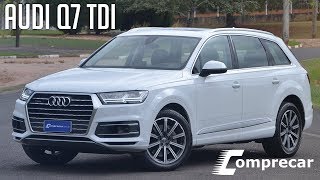
Visually, the second-generation Q7 abandoned the rounded, "whale-like" curves of the first generation in favor of taut lines, sharp creases, and a more technical and rectilinear appearance. The Singleframe grille became three-dimensional and hexagonal, connecting directly to the headlights. Although slightly shorter in external length, the interior space utilization was optimized, maintaining superior habitability for 7 passengers.
The 4M generation was a technological tour de force:
Audi introduced the Q7 e-tron quattro, a plug-in hybrid (PHEV).
The sports version of the second generation, the SQ7, deserves to be highlighted for its technical complexity and strategic change of direction.
Launched in 2016, the original SQ7 TDI was an engineering marvel. It used a 4.0 TDI V8 engine with two conventional turbochargers and a world first: the Electric Powered Compressor (EPC).
With the decline in diesel's popularity and demand from the American and Chinese markets, Audi replaced the SQ7's TDI engine in 2020 (globally).
The second generation of the Q7 has had a long life cycle, sustained by two profound updates.
The 2020 update was much more than a "facelift". Audi practically transplanted the interior of the new Q8 coupe into the Q7.
In January 2024, Audi announced a second update to extend the life of the Typ 4M model.
Brazil has always been an important destination for the Q7, serving as the top of the brand's status pyramid in the country.
The Q7 landed in Brazil in 2006, shortly after its global launch.
Currently, the Q7 is offered in Brazil mainly in the 7-seat configuration.
The Q7 is not "Made in Germany". It is a product of Bratislava, Slovakia. Volkswagen's plant in Bratislava is a center of excellence for large SUVs, producing on the same line the Q7, the Q8, the VW Touareg, and the Porsche Cayenne (bodies).
The analysis of the annual reports reveals the resilience of the model, even with the advanced age of the current project.
Table: Estimated Selected Global Production and Sales
| Year | Units (Approx.) | Context |
|---|---|---|
| 2006 | ~76,000 | First full year. Immediate success in the US. |
| 2015 | ~50,000 | Transition between generations (natural decline). |
| 2016 | ~100,000+ | Peak with the launch of the second generation and high global demand. |
| 2019 | 34,160 (US Sales) | American market remains strong pre-pandemic. |
| 2021 | 56,600 (Global) | Post-Covid-19 recovery. |
| 2022 | 52,514 (Global) | Decline due to the semiconductor crisis and war in Ukraine (affecting suppliers). |
| 2023 | 74,891 (Global) | Impressive recovery (+42%), showing that demand for luxury 7-seaters remains high. |
Cumulative Total: Since 2005, the total production of the Audi Q7 has comfortably surpassed the 1 million unit mark, consolidating itself as one of Audi's biggest financial successes in the premium segment.
The trajectory of the Audi Q7 is a masterclass in adaptation and engineering. It started as a late, yet exaggerated, response to the SUV trend, culminating in the technical extravagance of the V12 TDI engine. As times changed, the model knew how to reinvent itself in the second generation, focusing on weight reduction (the aluminum "diet") and digitalization, remaining relevant for nearly a decade through surgical updates.
Today, even with Audi heading towards an all-electric future and renaming its cars (where odd numbers will be combustion and even ones electric, suggesting that the next Q7 might keep the name while the Q6 and Q8 become electric), the current Q7 remains the brand's benchmark for luxury family transport. It combines the ability to carry seven people with the finish of an executive sedan and the technology of a sports car, proving that, in Ingolstadt, size and sophistication can indeed go hand in hand.