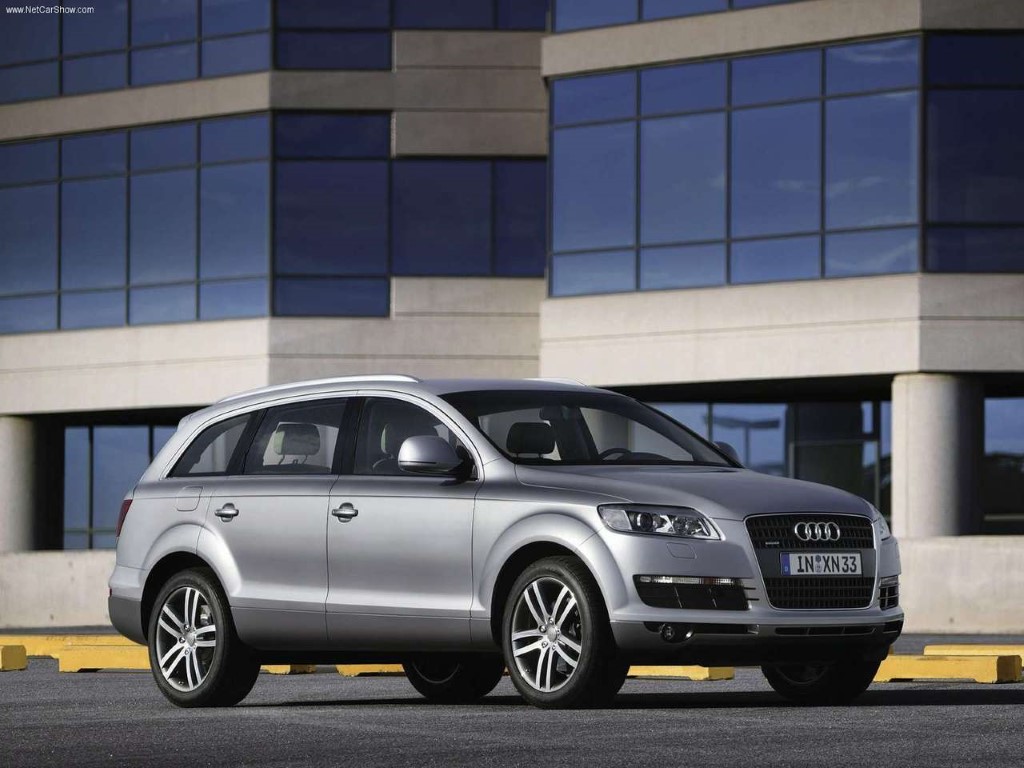
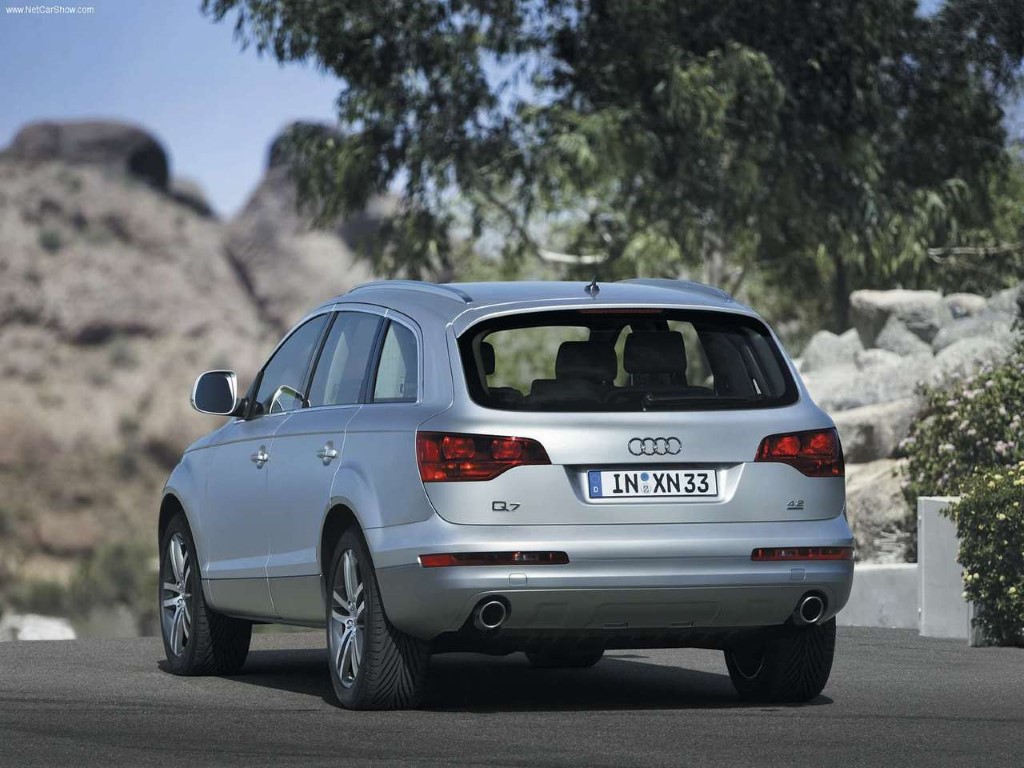
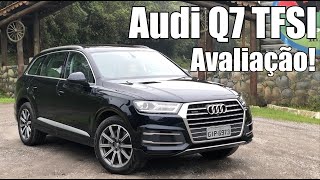
The final production model, officially named Audi Q7 (internal code Typ 4L), was
revealed to the world at the Frankfurt Motor Show in September 2004, with production starting in
November 2005 at the Bratislava plant in Slovakia. The Q7 hit the market in 2006
as a 2007 model, positioning itself in the "F" segment of luxury SUVs.
The PL71 Platform and the "Bratislava Brotherhood"
To make the development of such a complex and expensive vehicle viable, the Volkswagen Group
utilized a platform-sharing strategy. The Q7 was built on the
PL71 platform, the same one used by the Volkswagen Touareg and the Porsche Cayenne.
However, the Q7 differed drastically from its platform siblings in terms of
dimensions and purpose:
- Exaggerated Dimensions: While the Touareg and Cayenne were strict
5-seaters focusing on off-road capability (Touareg) and sportiness (Cayenne), the Q7
was stretched. With 5,085 mm in length and a massive wheelbase of 3,002 mm, it
was significantly larger, allowing for the installation of a third row of
seats.
- Focus on the Tarmac: Unlike the Touareg, which had a transfer
case with low range and mechanical differential locks for heavy
off-roading, the Q7 forwent these heavy features in favor of the quattro permanent
all-wheel-drive
system with a Torsen (torque-sensing) center differential. This made it
more suited for highway and city use, although still capable of tackling
snow and dirt roads competently.
Critics at the time, as noted by The Guardian and The Observer, described the Q7 as
"vast", a "whale", and "intimidating", highlighting that it "dwarfed" other SUVs on the road.
The size was its biggest asset for the American market, but also its weak point in
tight European cities.
First Phase Powertrains (2005–2009)
The initial engine range reflected the need to move a vehicle that weighed between
2,200 kg and 2,600 kg.
Gasoline Engines:
- 3.6 FSI VR6: The entry-level engine. The VR6 is a compact engine (a V6
with a very narrow angle, allowing for a single cylinder head), delivering 280 hp and
360 Nm
of torque. It was robust, but struggled against the car's weight, resulting in high
fuel consumption.
- 4.2 FSI V8: A classic naturally aspirated Audi V8, producing 350 hp and
440 Nm. It offered the smoothness and sound that luxury customers desired, with an
acceleration from 0 to 100 km/h in 7.4 seconds.
Diesel Engines (TDI):
- 3.0 TDI V6: The most balanced and best-selling option in Europe.
Initially with 233 hp and 500 Nm, it quickly evolved into more powerful and
cleaner versions.
- 4.2 TDI V8: A high-performance diesel, a favorite among enthusiasts.
With 326 hp and a massive 760 Nm of torque, it delivered the pulling power of a truck
with the
response of a sports car.
The Pinnacle of Engineering: Q7 V12 TDI quattro (2008–2012)
In a separate chapter of automotive history, Audi decided to create the ultimate diesel
SUV. Leveraging the marketing from the Audi R10 TDI's victories at the 24 Hours of Le
Mans, the brand launched the Q7 V12 TDI.
This vehicle remains, to this day, the only mass-produced passenger car
equipped with a V12 diesel engine.
- The Heart of the Beast: A 6.0-liter (5,934 cc) biturbo block.
- Numbers: 500 hp of power and an unbelievable 1,000 Nm of constant
torque between 1,750 and 3,250 rpm.
- Performance: 0 to 100 km/h acceleration in 5.5 seconds. Top speed
limited to 250 km/h.
- Technical Exclusivity: The torque was so brutal that Audi had to
reinforce the entire transmission and equip the model, as standard, with
carbon-fiber-reinforced
ceramic brakes, since ordinary steel brakes would suffer rapid fade
when trying to stop such mass at high speeds.
- Design: Visually, it was distinguished by widened wheel arches,
specific LED daytime running lights on the bumper (before the general facelift), and an
exclusive
interior.
2009 Facelift: Modernization and Efficiency
In 2009, Audi applied a mid-life facelift to keep the Q7
competitive against the new BMW X5 and Mercedes ML.
Aesthetic Changes:
- Light Signature: Introduction of continuous LED daytime running lights in
the
headlights (an Audi trademark at the time) and LED taillights.
- Refinement: The "Singleframe" grille gained vertical chrome
bars, and the bumpers were redesigned with lower protections in a contrasting
color to emphasize robustness.
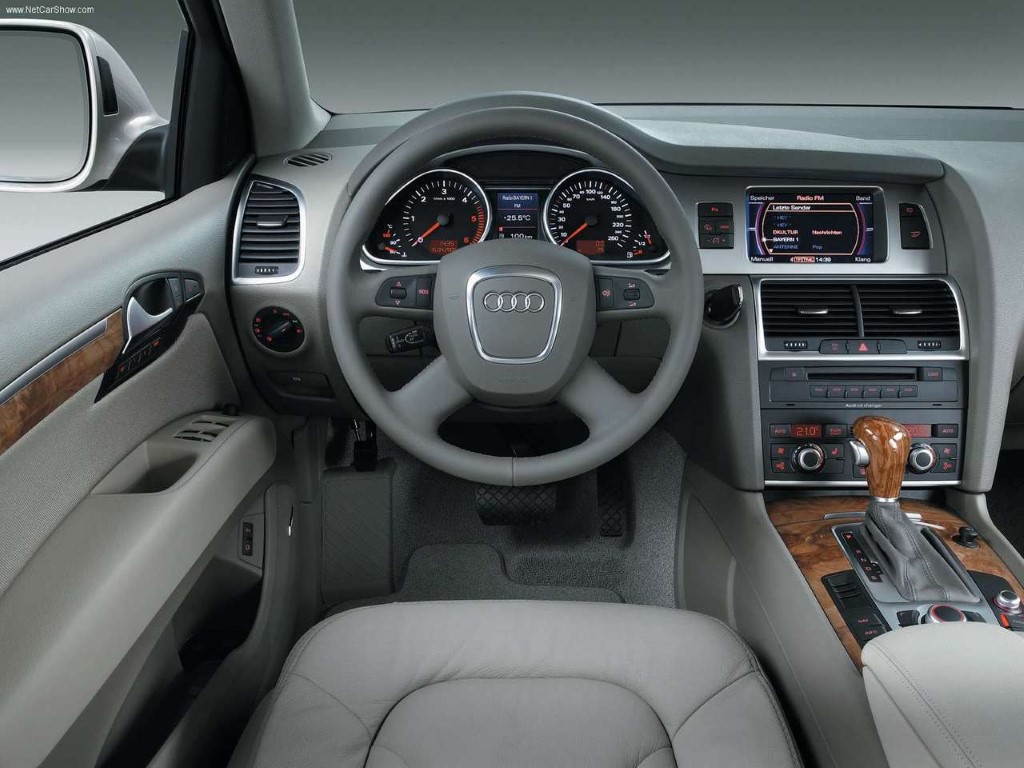
- Interior: Improvements to the MMI navigation system (third generation),
new wood trims, and ambient lighting in the doors.
- Mechanical Revolution (2010 onwards): The most important change was not
aesthetic, but rather in the transmission. The old 6-speed Tiptronic automatic
gearbox was replaced by the excellent 8-speed ZF.
- Impact: This change drastically reduced fuel
consumption and improved highway comfort, allowing the engine to run at
very low RPMs at cruising speed.
- New Engines: The 3.6 VR6 and 4.2 V8 gasoline engines were retired in
favor of the new 3.0 TFSI Supercharged V6. Despite being a V6, the use of a mechanical
supercharger allowed for immediate torque, replacing the naturally aspirated V8 with
superior efficiency.