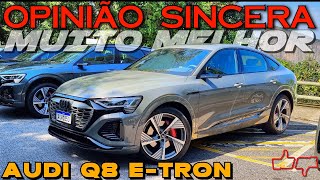
1st Generation
(2023-)
Electric (Two motors)
408 cv
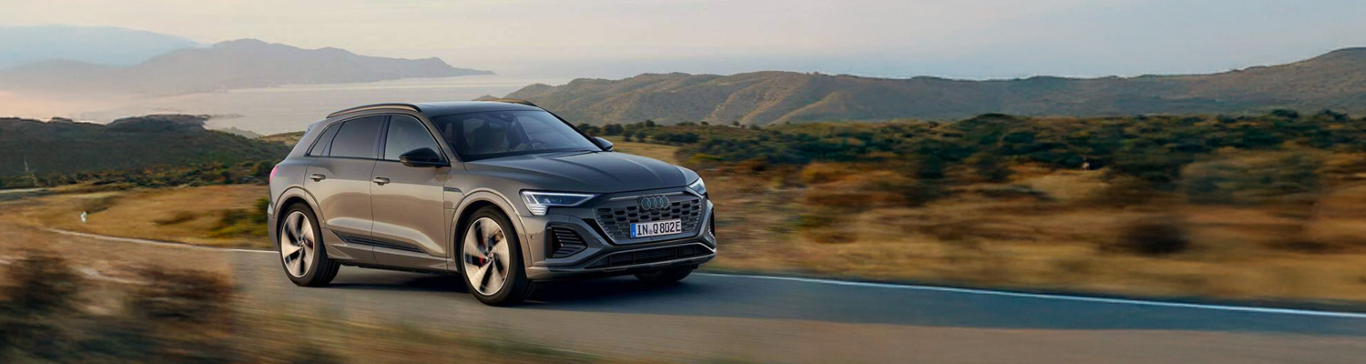
Technical specifications, versions, and history for the Audi Q8 e-Tron.
Select a generation to see available versions
(2023-)
The global automotive industry has gone through, in the last decade, an unprecedented metamorphosis, marked by the imperative transition from internal combustion engines to electric propulsion. In this scenario of technological disruption, few vehicles carry the historical and strategic weight of the model we analyze in this dossier: the Audi e-tron, later renamed and evolved into the Audi Q8 e-tron.
This report is dedicated to an exhaustive and granular analysis of this vehicle, which not only served as the Ingolstadt brand's first mass-produced fully electric automobile, but also functioned as a rolling laboratory for technologies in thermal management, aerodynamics, and battery industrialization. The document covers everything from the project's genesis in the mid-2010s, through the global launch in 2018, the nomenclature restructuring in 2022, to the complex conclusion of its production at the Brussels plant in February 2025.
Throughout the following sections, we will detail the technical specifications of each version (50, 55, and S/SQ8), the engineering behind its adapted platform, the commercial impact on the Brazilian market, and the legacy left by this pioneer in the premium electric SUV segment.
Audi's decision to enter the electric market with a large SUV was not accidental. In 2015, when the e-tron quattro concept was presented at the Frankfurt Motor Show, the brand faced the dual challenge of cleaning up its post-diesel emissions crisis image and responding to the growing threat of new competitors in the luxury segment, notably Tesla. The adopted strategy was one of "normalization": rather than creating a vehicle with an exotic design that would alienate its conservative customer base, Audi designed the e-tron to be, first and foremost, an Audi — with the build quality, silence, and familiar ergonomics, but with an electric heart.
The first life phase of the model, marketed simply as "Audi e-tron" (and its coupe variant, the "e-tron Sportback"), was defined by pragmatic engineering choices that shaped its capabilities and limitations.
Unlike more recent models built on native electric architectures (such as the MEB or PPE), the original e-tron was developed on a profound adaptation of the MLB Evo (Modularer Längsbaukasten Evolution) platform. This platform is the backbone of established internal combustion vehicles from the Volkswagen Group, such as the Audi Q7, Q8, Bentley Bentayga, and Lamborghini Urus.
The use of MLB Evo brought direct implications for design and functionality:
One of the most important technical distinctions of the e-tron was the use of asynchronous induction motors (ASM) on both axles in the 50 and 55 quattro versions. Most competitors opted for permanent magnet synchronous motors (PSM) due to their higher theoretical energy efficiency. However, Audi prioritized "freewheeling" capability.
ASM motors have a crucial advantage in all-wheel drive configurations: they can be completely de-energized without generating significant magnetic drag. This allowed the e-tron to operate predominantly with the rear motor in highway cruising situations, decoupling the front motor to save energy. The front motor kicked in within milliseconds only when the driver demanded full power or when sensors detected a loss of grip, creating an ultra-responsive electric quattro system.
Although the absolute range of the first e-tron (around 400 km WLTP for the 55 model) was not class-leading, Audi established an industry benchmark for sustained charging speed.
In an electric vehicle, air resistance is the greatest enemy of range at highway speeds. The Audi e-tron was sculpted in a wind tunnel to mitigate the disadvantages of its tall and wide SUV body.
The e-tron's initial drag coefficient (Cd) was 0.28 — an impressive figure for the segment. To achieve this number, Audi implemented several solutions:
The e-tron's most futuristic and debated feature was the introduction, a world first in production cars, of virtual rearview mirrors.
In November 2022, Audi revealed the model's mid-life update, renaming it the Audi Q8 e-tron. This change was not just marketing; it was a technical response to criticisms about range and preparation for the brand's future portfolio.
The decision to add the "Q8" prefix served to clarify the hierarchy of Audi's electric range. With the imminent arrival of the Q4 e-tron (smaller and cheaper) and the Q6 e-tron (intermediary), keeping the original name simply as "e-tron" would cause confusion. By adopting the Q8 nomenclature, Audi unequivocally positioned the model as the top of the line, the "flagship" of electric SUVs, equivalent to the combustion Q8 in prestige and finish.
The greatest limitation of the first generation — range — was addressed with a profound update in battery cell chemistry, without altering the physical size of the pack.
In addition to the battery, the efficiency of the powertrain was improved.
The e-tron range has always been divided into power levels defined by the numbers "50", "55", and the letter "S". Below, we detail the specifications for the global and Brazilian market.
This is the gateway to the lineup, focused on the balance between cost and urban usability.
The volume and most balanced version, responsible for the majority of global sales.
The sporty "S" version is a technological showcase, being one of the few production electric vehicles to use three motors: one on the front axle and two on the rear axle.
The history of the Q8 e-tron is inseparable from the Audi plant in Forest, Brussels, a facility with deep historical roots (started in 1948 assembling Studebakers) and which became a symbol of the complexities of modern industry.
For the production of the e-tron, the Brussels factory was transformed into a showcase of sustainability. It was the first high-volume factory in the premium segment to be certified as carbon neutral.
Despite its pioneering status, the Brussels plant faced insurmountable challenges. The factory's urban location prevented physical expansions necessary to reduce operational costs. Furthermore, global demand for the Q8 e-tron models fell faster than predicted in 2024, pressured by the arrival of more modern and cheaper competitors and by the saturation of the luxury electric segment.
In 2024, Audi announced restructuring plans that culminated in the confirmation of the production line's closure. The final date for the manufacture of the Q8 e-tron in Brussels was set for the end of February 2025. This event generated significant tensions with Belgian unions and protests, marking a melancholy end for a facility that produced around 160,000 units of the first-generation e-tron. Future production of the group's large electric SUVs is expected to be transferred to Mexico (San José Chiapa) or other global plants with more competitive costs.
Brazil represented a strategic image market for Audi with the e-tron line, serving to position the brand as a technological leader in the region.
With the update to the Q8 e-tron, Audi Brasil simplified the portfolio, focusing on high-value-added versions.
A feature frequently cited in marketing materials, but rarely explained in depth, is the Digital Matrix LED headlight system, available as an option or standard on the top versions of the Q8 e-tron.
This technology derives directly from high-quality video projectors. Each headlight contains a small chip with approximately 1.3 million micromirrors. Each of these mirrors measures only a few hundredths of a millimeter and can have its position changed up to 5,000 times per second via electrostatic fields.
Unlike standard LED headlights that simply turn segments on and off, the Digital Matrix LED "draws" light on the road with pixel resolution.
To consolidate the analysis of the model's evolution, we present detailed comparative tables.
| Technical Characteristic | Audi e-tron 55 (2019-2022) | Audi Q8 e-tron 55 (2023-2025) | Technical Evolution / Impact |
|---|---|---|---|
| Battery (Gross/Usable) | 95 kWh / 86 kWh | 114 kWh / 106 kWh | +19% usable capacity with new chemistry. |
| Maximum Range (WLTP) | ~440 km | ~582 km | Range leap enables real long-distance trips. |
| Charging Power (DC) | 150 kW | 170 kW | Maintenance of the characteristic flat charging curve. |
| Drag Coefficient (Cd) | 0.28 (SUV) | 0.27 (SUV) | Airflow optimization at the front and wheels. |
| Rear Motor | 12 stator windings | 14 stator windings | Greater torque with lower current consumption. |
| Steering | Standard ratio | More direct ratio | More agile response in corners and the city. |
Table elaborated based on compiled technical data.
The most recent data indicate the challenge that led to the closure of the Brussels factory.
The trajectory of the Audi Q8 e-tron concludes, in its current form produced in Belgium, as a fundamental chapter in the history of automotive electrification. The model fulfilled its primary mission with flying colors: to prove that the energy transition did not require sacrificing luxury, comfort, or brand identity.
For the consumer, the Q8 e-tron remains, especially in the used market and in the final zero-kilometer units, as a benchmark of build quality. The interior, which uses sustainable materials like recycled plastics from PET bottles and carpets made from recovered fishing nets, established a standard of "conscious luxury" that permeates the brand's new releases.
The future of Audi's electric lineage now rests on the Premium Platform Electric (PPE), debuted by the new Q6 e-tron. This new model promises greater efficiency and even faster charging (800V architecture), but it owes its existence to the hard-learned lessons — from battery thermal management to the complexity of motor production — with the pioneering Q8 e-tron. The "closing of the curtains" in Brussels in February 2025 does not erase the technical brilliance of a car that, in 2018, had the courage to be Audi's first step towards an emission-free future.