Type 42
(2007 - 2012)
5.2 V10 40V FSI
560 cv

Technical specifications, versions, and history for the Audi R8.
Select a generation to see available versions
(2007 - 2012)

(2012 - 2015)

(2016 - 2019)

(2019 - 2024)
The history of the automotive industry is marked by moments of transition where established brands decide to transcend their own identities. Until the mid-first decade of the 2000s, Audi was widely recognized for its competence in producing executive luxury sedans, high-performance station wagons — the famous "Avants" — and for the technological revolution that the quattro all-wheel-drive system brought to rallying in the 1980s. However, the Ingolstadt manufacturer lacked a crucial element to compete in the rarefied air of global automotive prestige: a dedicated mid-engine supercar, capable of facing historical rivals like the Porsche 911 and the Ferrari F430.
The Audi R8 project did not just represent the launch of a new model; it symbolized a tectonic shift in the brand's perception. Audi wanted to capitalize on its absolute dominance in endurance racing, specifically at the 24 Hours of Le Mans, where the Audi R8 LMP racing prototype had secured five victories between 2000 and 2005. The goal was to create a direct technological and emotional bridge between the racetracks and the roads, materializing the "Vorsprung durch Technik" (Advancement through Technology) philosophy in its purest and most visceral form.
Over two generations, spanning a production of nearly two decades that ended in the first quarter of 2024, the R8 cemented its position as a modern icon. With a total of 45,949 units produced at the Böllinger Höfe and Neckarsulm factories, the model proved that the rationality of German engineering could coexist with passion and emotive design, resulting in one of the most significant vehicles of the 21st century. This report meticulously details this trajectory, from the initial concepts to the final units delivered, analyzing the technical evolution, market variations, and the specific impact on the Brazilian landscape.
To understand the R8, it is necessary to go back to the 2003 Frankfurt Motor Show. Audi, then under the leadership of Martin Winterkorn and with design headed by Walter de Silva, revealed the Audi Le Mans quattro concept car. This vehicle was explicitly designed to celebrate the brand's three successive victories at Le Mans (2000, 2001, and 2002), a feat that put Audi on the global high-performance map.
The Le Mans quattro concept was not just a styling exercise; it was a statement of intent. Visually, it established almost all the characteristics that would define the production car three years later. The low and wide silhouette, the cab-forward design typical of rear mid-engine vehicles, and the trapezoidal Singleframe front grille were present. The most distinctive element, however, were the "sideblades" — vertical blades of contrasting material (often carbon fiber or aluminum) positioned behind the doors. More than an aesthetic adornment, these blades served a critical aerodynamic and cooling function, directing the airflow to the mid-engine.
Under the concept's glass hood resided a fierce technical ambition: a 5.0-liter biturbo V10 engine with Fuel Stratified Injection (FSI), capable of generating 610 horsepower (449 kW) and 750 Nm of torque. Although the initial production engine would be different, the chassis architecture and value proposition were already defined. The reception from the public and critics was so overwhelming that the Volkswagen AG board of directors gave the green light for development, tasking quattro GmbH (now Audi Sport GmbH) with the job of transforming the dream into industrial reality.
A crucial factor in the development of the R8 was the acquisition of Lamborghini by the Volkswagen Group in 1998. This allowed Audi to share development costs and cutting-edge technologies. The first-generation R8 (Type 42) was developed on the same structural basis as the Lamborghini Gallardo. However, it would be a mistake to consider the R8 merely an "Audi Gallardo". The R8 utilized a unique aluminum space frame (Audi Space Frame - ASF) and had a slightly longer wheelbase (2.65 meters), which gave it a more spacious cabin and superior directional stability at high speeds, making it more usable for daily driving than its more aggressive Italian cousin.
The official launch of the production Audi R8 took place at the Paris Motor Show in September 2006. The car remained incredibly faithful to the Le Mans quattro concept, something rare in the automotive industry. Production began at the Neckarsulm factory, where a specific assembly line was created, with a large part of the process being carried out manually by specialized artisans, ensuring a level of build quality that would become a benchmark in the segment.
Audi's initial strategy was to launch the R8 with a V8 engine, positioning it in a price bracket below Lamborghini and competing directly with the Porsche 911 Carrera 4S and the Aston Martin V8 Vantage.
Engine Engineering The heart of this first model was the 4.2-liter FSI V8 engine. Although based on the architecture of the engine used in the RS4 sports sedan (B7), the R8's powerplant received profound modifications. The most significant was the adoption of a dry sump lubrication system.
In standard passenger cars, the oil is stored in a reservoir (sump) at the bottom of the engine. In extreme sports driving, the centrifugal force in corners can cause the oil to shift to the sides, leaving the oil pump "dry" and causing catastrophic damage. The dry sump eliminates this lower reservoir, storing the oil in a separate tank and using scavenge pumps to ensure constant lubrication under any G-force. Furthermore, the absence of the deep sump allowed the engine to be mounted much lower in the chassis, drastically reducing the vehicle's center of gravity and improving driving dynamics.
V8 Specifications:
Transmission and Dynamics The R8 V8 offered two transmission options:
The R8's quattro all-wheel-drive system differed radically from the one found in Audi's sedans. Instead of a Torsen center differential (which distributes torque mechanically and evenly), the R8 used a viscous coupling on the front axle. Under normal grip conditions, the system sent about 85% to 90% of the torque to the rear wheels, preserving the driving feel of a pure rear-wheel-drive car. Only when the rear wheels lost grip would the viscous fluid heat up and solidify, transferring up to 30% of the force to the front axle, ensuring safety and traction.
In December 2008, Audi responded to the demand for more power by introducing the R8 V10. This model elevated the R8 from the sports car category to that of a genuine supercar.
The V10 Engine: Derived directly from the Lamborghini Gallardo LP560-4, this 5.2-liter FSI engine was a naturally aspirated masterpiece.
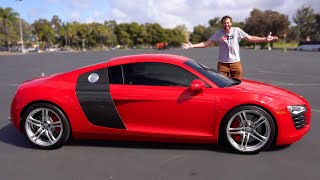
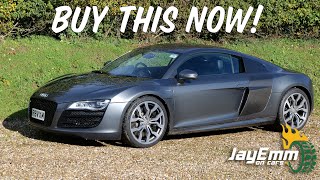
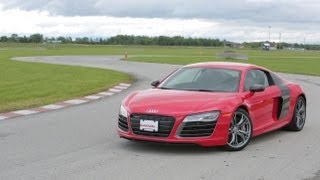
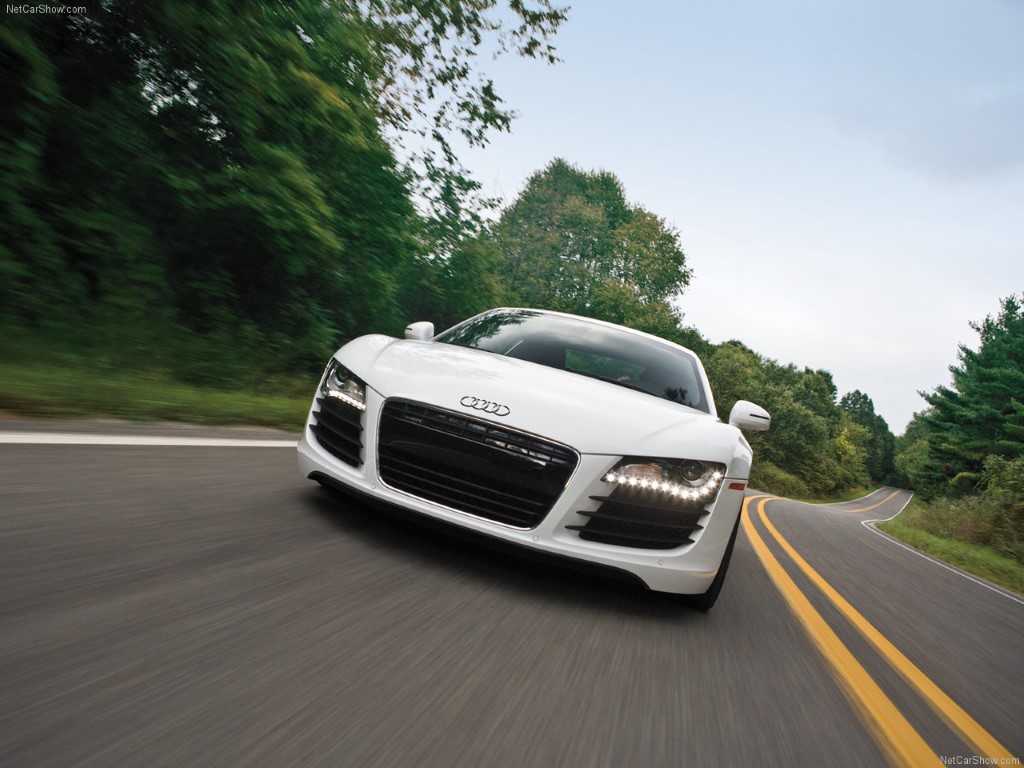
Visual Identification: The V10 distinguished itself from the V8 with oval exhaust outlets (the V8 had four circular tips), wider sideblades for increased air flow, a front grille with chrome finish and, notably, it was the first car in the world to offer fully LED headlights (Full-LED) as standard equipment, an innovation that would become an industry standard years later.
The convertible version, named Spyder, was first introduced with the V10 engine in 2010, followed by the V8 version in 2011. Audi opted for a fabric (canvas) soft top instead of a retractable hardtop. The choice was technical and aesthetic: the canvas weighed only 42 kg (30 kg for the structure plus the fabric), keeping the center of gravity low, and preserved the classic silhouette of the car.
The transformation into a convertible required structural changes. The iconic upper "sideblades" were removed, as the soft top storage structure occupied that space. The side air intakes were redesigned to be only on the lower part, giving the Spyder a more horizontal and elongated look. The glass engine cover, a beloved showcase on the coupe, was replaced by a vented cover with stylized grilles, necessary for thermal dissipation without the airflow from the coupe's roof.
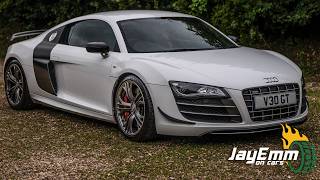
For enthusiasts who found the R8 V10 too "civilized", Audi launched the R8 GT, a limited edition focused on track performance.
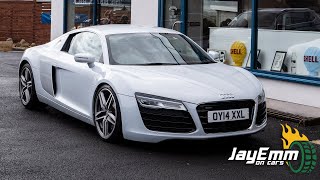
In 2012 (2013 model year), the R8 received its mid-life update. Visually, the changes were subtle: new LED headlights with restructured internal design, new taillights with dynamic turn signals (which light up sequentially in the direction of the turn), and circular exhaust outlets for all models.
The biggest change, however, was mechanical. The criticized R-tronic transmission was retired in favor of the new 7-speed S-tronic dual-clutch gearbox. This transmission transformed the car's behavior, offering virtually imperceptible gear shifts in urban use and lightning-fast shifts in sports driving, eliminating the torque interruption that occurred in the previous gearbox.
Along with the facelift, Audi introduced the R8 V10 Plus model, which brought 550 hp of power and firmer suspension, serving as the new regular top-of-the-line model, spiritually replacing the GT version.
The second generation of the R8, code Type 4S, was revealed at the 2015 Geneva Motor Show. If the first generation proved that Audi could make a supercar, the second had the mission to perfect it technologically. The car was developed in parallel with the Lamborghini Huracán, sharing the new Modular Sport System (MSS) platform.
The MSS platform represented a qualitative leap. It combined the aluminum space frame structure with structural components made of Carbon Fiber Reinforced Polymer (CFRP), specifically in the center tunnel and the rear firewall (B-pillar). This hybrid construction increased the chassis' torsional rigidity by 40% compared to the previous generation, while simultaneously reducing weight.
Visually, the design became more angular and technical. The Singleframe grille became wider, flatter, and more geometric. The characteristic "sideblades" were divided into two parts (upper and lower), which allowed for a more continuous shoulder line on the side of the car.
Inside, the revolution was total with the introduction of the Audi Virtual Cockpit. Audi eliminated the central infotainment screen from the dashboard. All information — navigation, media, car settings, and telemetry — were now displayed on a 12.3-inch TFT screen located directly behind the steering wheel. This allowed for an extremely clean and driver-focused dashboard design ("Monoposto"), with the climate controls ingeniously integrated into the air vents themselves.
With the launch of Generation 2, Audi made tough decisions. The V8 engine was discontinued, as well as the manual transmission option. Demand for manuals had dropped drastically at the end of Generation 1's life, and the pursuit of faster lap times made the S-tronic dual-clutch transmission mandatory. The R8 was now offered exclusively with the 5.2 FSI V10 engine and the 7-speed S-tronic gearbox.
Initially, the Type 4S was offered in two power configurations of the V10:
The quattro all-wheel-drive system also evolved. The passive viscous coupling of Generation 1 was replaced by an electro-hydraulic multi-plate clutch actively controlled by software. This allowed for fully variable torque distribution; the system could send up to 100% of the force to the front or rear axle in milliseconds, depending on the dynamic situation, making the car much more agile and less prone to understeer.
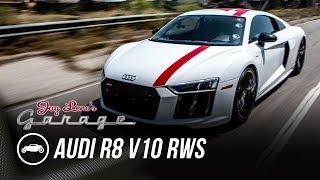
In 2017, Audi broke one of its most sacred traditions. It launched the R8 V10 RWS (Rear Wheel Series), limited to 999 units. It was the first production Audi with purely rear-wheel drive. Without the driveshaft, front differential, and multi-plate clutch, the RWS was 50 kg lighter than the quattro model. The goal was to offer a more purist and challenging driving experience, allowing for controlled drifts. It was such a success that rear-wheel drive would later cease to be a limited edition and become a regular production model.
In 2019, the R8 received an aesthetic and naming update to align with the Audi Sport division.
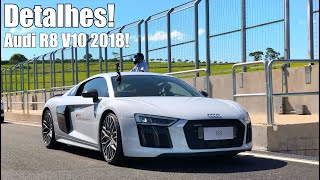
Design: The front became more aggressive, with three horizontal slits above the grille, a direct homage to the legendary Audi Sport quattro rally car of the 80s.
New Names and Power:
The rear-wheel drive version became permanent in the lineup, named R8 V10 RWD (and later R8 V10 performance RWD).
The final phase of the R8 was marked by commemorative editions celebrating its legacy.
Launched to celebrate 10 years of the V10 engine in the R8. Limited to 222 units globally (50 for the US), the car stood out with its matte Daytona Gray paint, engine intake manifolds, and 20-inch wheels with a matte bronze finish. The interior was entirely black with copper stitching.
A tribute to the success of the R8 LMS (the GT3 racing version) at the Nürburgring circuit, known as the "Green Hell", where the car had won the 24 Hours five times since 2012. Limited to 50 units, the model was painted in an exclusive dark Tioman Green, with matte black details on the hood, roof, and rear, evoking the livery of the winning race cars. Mechanically, it was based on the 620 hp R8 V10 performance quattro.
The final farewell occurred with the launch of the R8 Coupé V10 GT RWD. Limited to 333 units (just like the first-generation GT), this was the most powerful rear-wheel-drive R8 ever made.
The R8's presence in Brazil was remarkable, serving as the brand's main image builder in the country. Audi do Brasil brought the model officially throughout almost its entire lifespan.
The R8 landed in Brazil in late 2007, already as a 2008 model.
The second generation faced a more difficult economic scenario in Brazil, with the dollar on the rise.
The 5.2 FSI V10 engine is the defining element of the R8's character. In an era where competitors like Ferrari (488/F8), Porsche (911 Turbo), and McLaren migrated to turbocharged engines (smaller and more efficient, but with muffled sound), Audi maintained the purity of natural aspiration.
Sound and Response: The main technical advantage is the immediate throttle response — there is no "turbo lag". The emotional advantage is the sound. The engine revs up to 8,700 rpm, producing a sharp and linear mechanical howl that is impossible to replicate with turbos.
Dual Injection: To meet increasingly stringent emissions standards and ensure performance, the engine uses a dual injection system. At partial loads, it uses indirect injection (in the manifold) for better mixing and lower particulate emissions. At full load, it uses direct injection (in the chamber) for maximum power and cylinder cooling.
The table below summarizes the evolution of raw performance of the main models across the generations:
| Generation | Version / Year | Engine | Power | Torque | 0-100 km/h | Top Speed | Weight (approx.) |
|---|---|---|---|---|---|---|---|
| Gen 1 | V8 Coupé (2007) | 4.2 V8 | 420 hp | 430 Nm | 4.6 s | 301 km/h | 1,560 kg |
| Gen 1 | V10 Coupé (2009) | 5.2 V10 | 525 hp | 530 Nm | 3.9 s | 316 km/h | 1,620 kg |
| Gen 1 | GT Coupé (2011) | 5.2 V10 | 560 hp | 540 Nm | 3.6 s | 320 km/h | 1,525 kg |
| Gen 2 | V10 Coupé (2015) | 5.2 V10 | 540 hp | 540 Nm | 3.5 s | 320 km/h | 1,595 kg |
| Gen 2 | V10 Plus (2015) | 5.2 V10 | 610 hp | 560 Nm | 3.2 s | 330 km/h | 1,555 kg |
| Gen 2 | Performance (2019) | 5.2 V10 | 620 hp | 580 Nm | 3.1 s | 331 km/h | 1,595 kg |
| Gen 2 | GT RWD (2023) | 5.2 V10 | 620 hp | 565 Nm | 3.4 s | 320 km/h | 1,570 kg |
(Note: 0-100 km/h times may vary slightly depending on the testing source and conditions, but the data above reflects official factory figures found in Audi records and specialized press.)
Production of the Audi R8 ended in March 2024, marking the end of a golden era for Audi. The model fulfilled its mission with flying colors: it transformed the brand's image, proving that Audi belonged to the elite of supercar builders.
The R8's legacy lies in its duality. It was one of the few cars in history capable of winning 24-hour races on Sunday and being comfortably driven to the office on Monday. The combination of a charismatic naturally aspirated V10 engine, the safety of quattro all-wheel drive, and a design that aged like an instant classic guarantees the R8 a place in the automotive pantheon. For Brazil, it remains a symbol of status and automotive passion, whose remaining units will be preserved and valued as witnesses to a time when engineering sought, above all else, emotion.