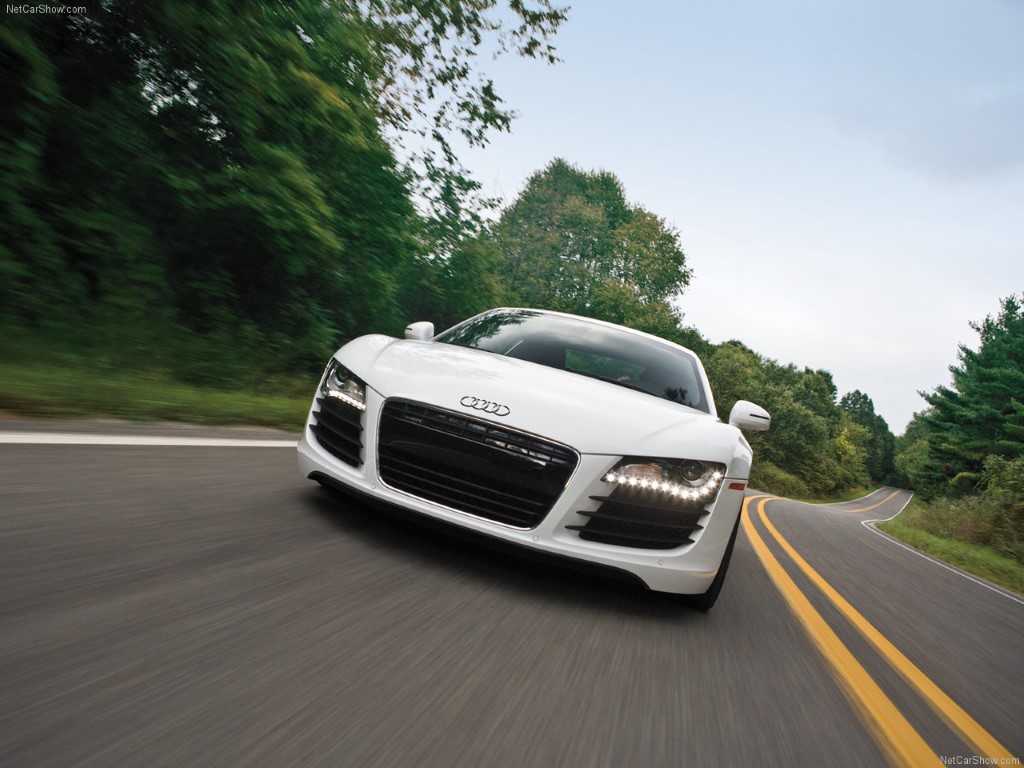
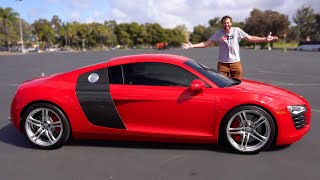
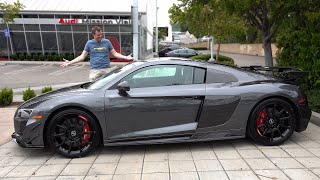
The official launch of the production Audi R8 took place at the Paris Motor Show in September
2006. The car remained incredibly faithful to the Le Mans quattro concept, something rare in
the automotive industry. Production began at the Neckarsulm factory, where a specific
assembly line was created, with a large part of the process being carried out manually
by specialized artisans, ensuring a level of build quality that would
become a benchmark in the segment.
The Audi R8 V8 4.2 FSI (2007–2012)
Audi's initial strategy was to launch the R8 with a V8 engine, positioning it in a price
bracket below Lamborghini and competing directly with the Porsche 911 Carrera 4S and the
Aston Martin V8 Vantage.
Engine Engineering
The heart of this first model was the 4.2-liter FSI V8 engine. Although based on the
architecture of the engine used in the RS4 sports sedan (B7), the R8's powerplant received
profound modifications. The most significant was the adoption of a dry sump
lubrication system.
In standard passenger cars, the oil is stored in a reservoir
(sump) at the bottom of the engine. In extreme sports driving, the centrifugal force
in corners can cause the oil to shift to the sides, leaving the oil pump
"dry" and causing catastrophic damage. The dry sump eliminates this lower
reservoir, storing the oil in a separate tank and using scavenge pumps
to ensure constant lubrication under any G-force. Furthermore, the absence of the
deep sump allowed the engine to be mounted much lower in the chassis, drastically
reducing the vehicle's center of gravity and improving driving dynamics.
V8 Specifications:
- Power: 420 horsepower (309 kW) at 7,800 rpm.
- Torque: 430 Nm between 4,500 and 6,000 rpm.
- Maximum RPM: 8,250 rpm.
- Performance: 0 to 100 km/h in 4.6 seconds; Top speed of 301
km/h.
Transmission and Dynamics
The R8 V8 offered two transmission options:
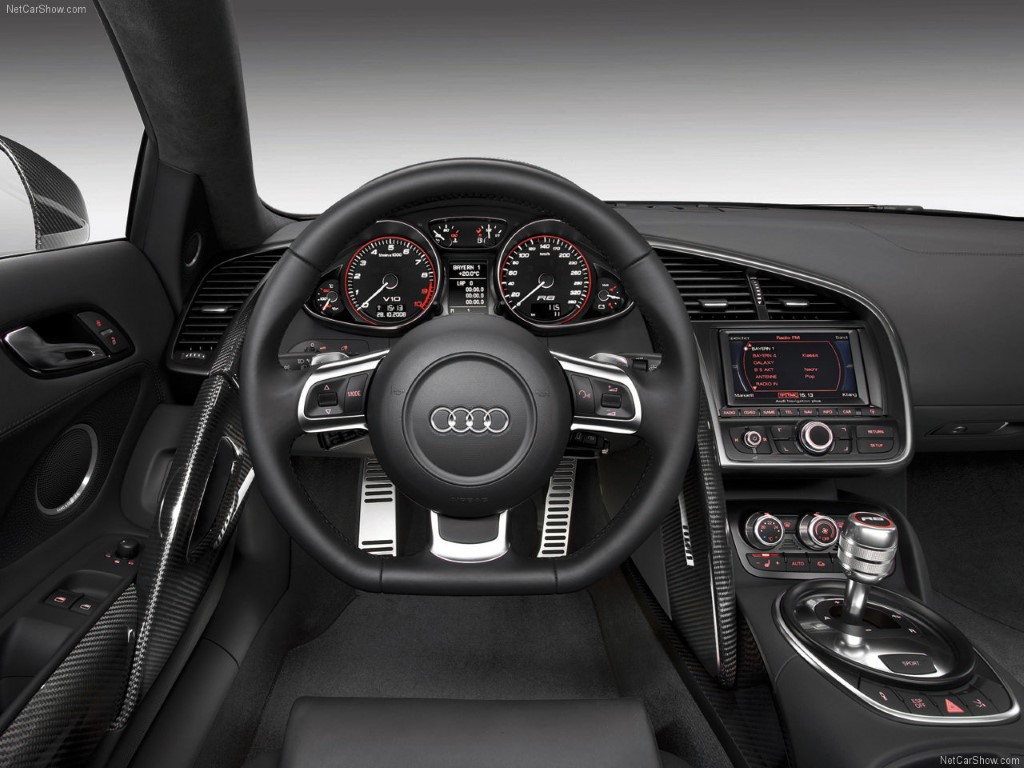
- 6-speed manual: This gearbox became legendary. It
featured an exposed metal gate (gated shifter) in which the gear lever
moved, producing a characteristic metallic sound ("clack-clack") with every shift.
Today, manual models are highly valued by collectors due to the
pure mechanical connection they offer.
- R-tronic: An automated single-clutch manual transmission.
Derived from Lamborghini's e-gear gearbox, the R-tronic was effective on track, but
frequently criticized for its behavior at low speeds. Shifts
could be jerky ("hiccups") in urban traffic, which contrasted with the R8's daily
use proposition.
The R8's quattro all-wheel-drive system differed radically from the one found in Audi's sedans.
Instead of a Torsen center differential (which distributes torque mechanically and
evenly), the R8 used a viscous coupling on the front axle. Under normal
grip conditions, the system sent about 85% to 90% of the torque to the rear
wheels, preserving the driving feel of a pure rear-wheel-drive car.
Only when the rear wheels lost grip would the viscous fluid heat up and
solidify, transferring up to 30% of the force to the front axle, ensuring safety
and traction.
The Arrival of the V10 5.2 FSI (2009–2012)
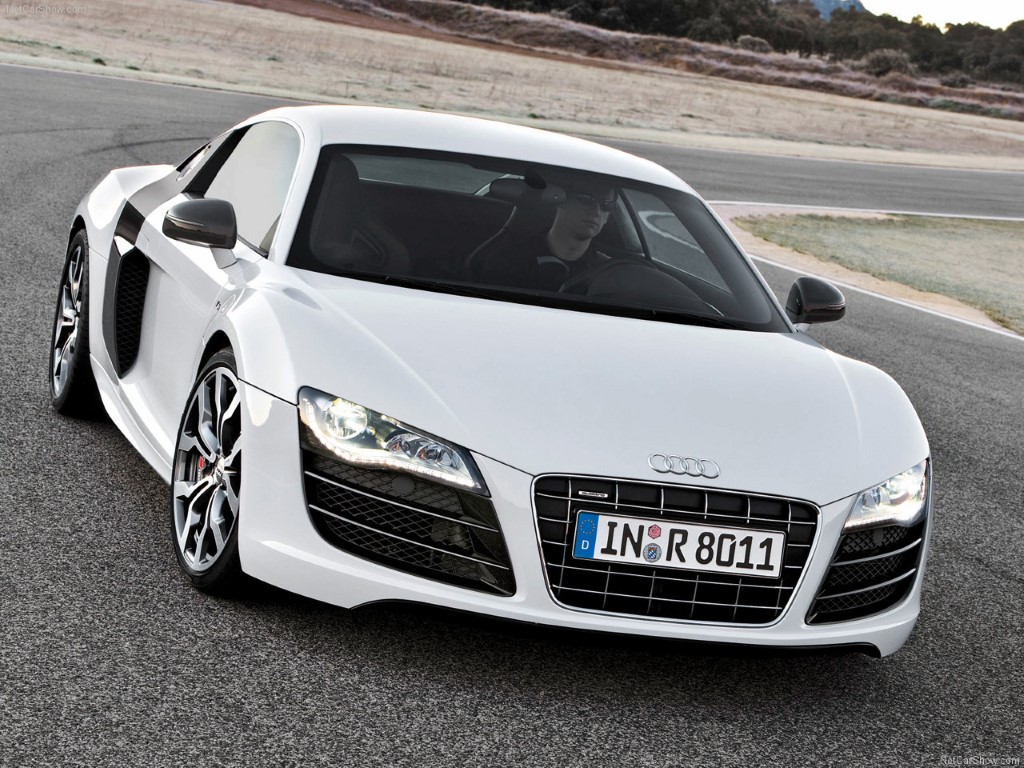
In December 2008, Audi responded to the demand for more power by introducing the R8 V10.
This model elevated the R8 from the sports car category to that of a genuine supercar.
The V10 Engine: Derived directly from the Lamborghini Gallardo LP560-4, this 5.2-liter
FSI engine was a naturally aspirated masterpiece.
- Power: 525 horsepower (386 kW) at 8,000 rpm.
- Torque: 530 Nm at 6,500 rpm.
- Performance: 0 to 100 km/h in 3.9 seconds; Top speed of 316
km/h.
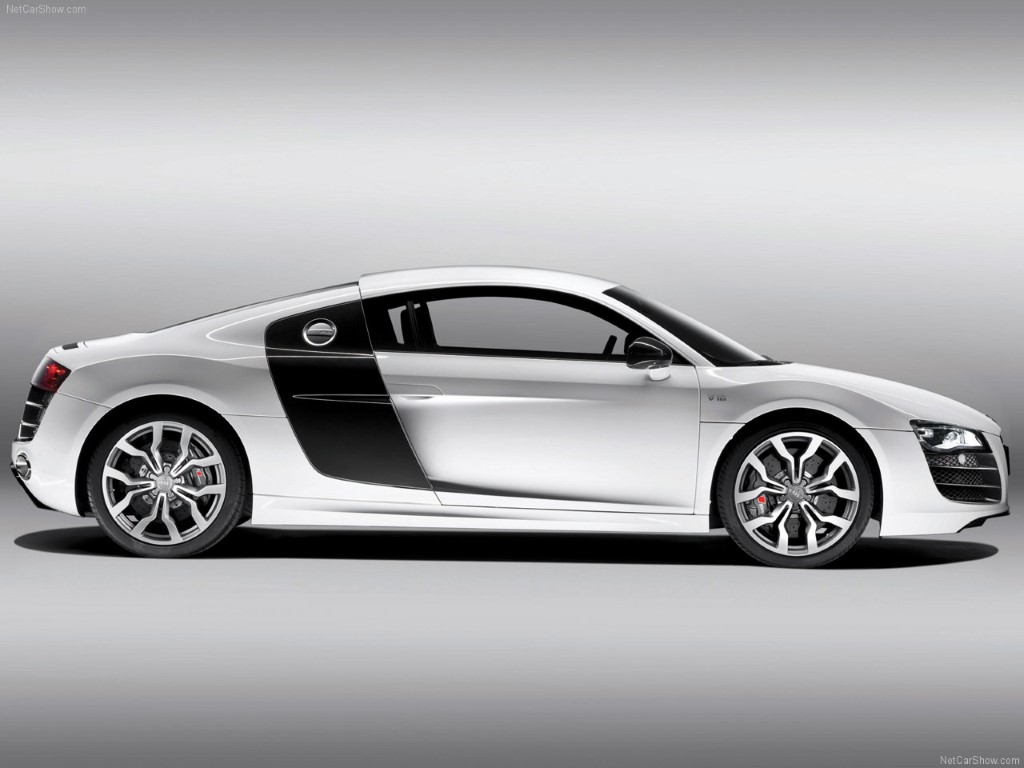
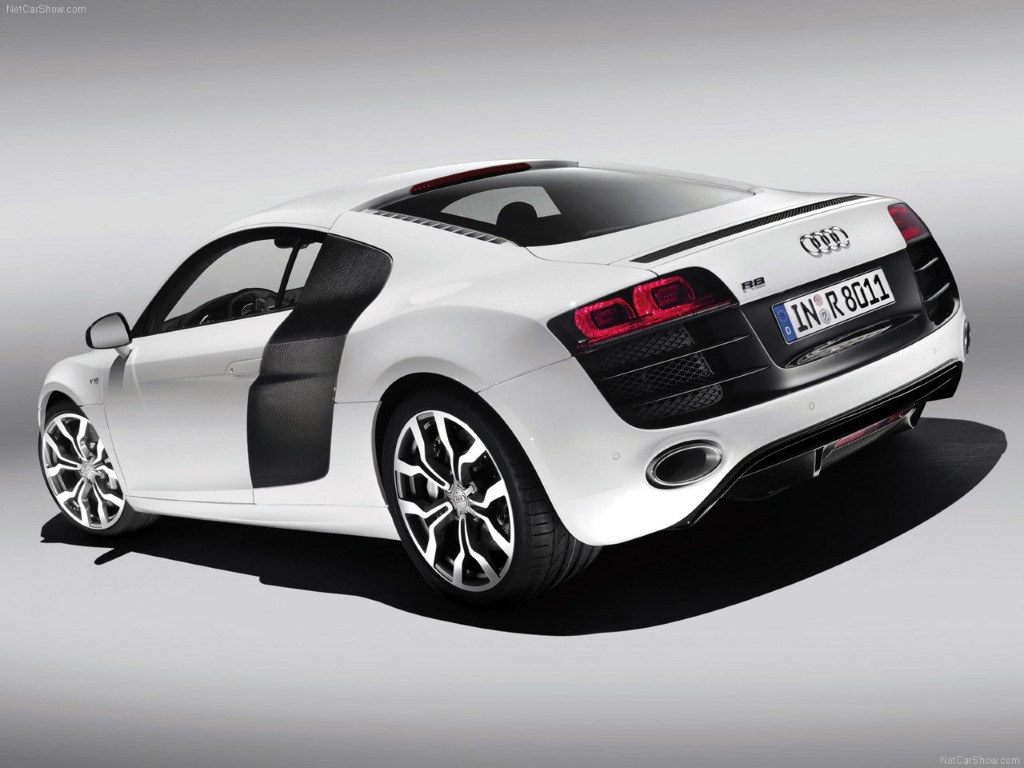
Visual Identification: The V10 distinguished itself from the V8 with oval exhaust outlets (the V8
had four circular tips), wider sideblades for increased air
flow, a front grille with chrome finish and, notably, it was the first car in the
world to offer fully LED headlights (Full-LED) as standard equipment, an
innovation that would become an industry standard years later.
Audi R8 Spyder: Opening to the Sky (2010–2015)
The convertible version, named Spyder, was first introduced with the V10 engine
in 2010, followed by the V8 version in 2011. Audi opted for a fabric (canvas) soft top instead
of a retractable hardtop. The choice was technical and aesthetic: the canvas weighed only
42 kg (30 kg for the structure plus the fabric), keeping the center of gravity low, and
preserved the classic silhouette of the car.
The transformation into a convertible required structural changes. The iconic upper "sideblades"
were removed, as the soft top storage structure occupied that
space. The side air intakes were redesigned to be only on the lower
part, giving the Spyder a more horizontal and elongated look. The glass engine
cover, a beloved showcase on the coupe, was replaced by a vented cover with stylized
grilles, necessary for thermal dissipation without the airflow from the coupe's roof.
The Pinnacle of the First Generation: R8 GT (2011–2012)
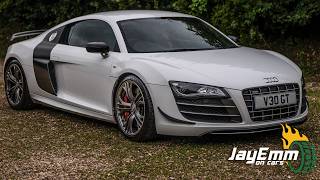
For enthusiasts who found the R8 V10 too "civilized", Audi launched the R8 GT, a
limited edition focused on track performance.
- Exclusivity: Production was strictly limited to 333 units
of the Coupé version and, later, 333 units of the Spyder version (GT Spyder). Each
car had its production number engraved on the gear lever.
- Carbon Diet: Through the "Audi ultra" philosophy, the car underwent
severe weight reduction. The windshield was made of thinner glass, the
rear window of polycarbonate, and there was extensive use of Carbon Fiber
Reinforced Polymer (CFRP) on the rear lid, bumpers, and sideblades. The result
was a 100 kg reduction compared to the standard V10.
- Increased Performance: The V10 engine was recalibrated to deliver
560 horsepower (412 kW). Acceleration from 0 to 100 km/h dropped to 3.6 seconds, with
a top speed of 320 km/h. The model also featured a fixed rear spoiler,
a more aggressive diffuser, and "canards" (flics) on the front bumper to increase
downforce.
The Facelift and the S-tronic Revolution (2013–2015)
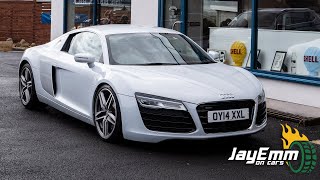
In 2012 (2013 model year), the R8 received its mid-life update. Visually, the
changes were subtle: new LED headlights with restructured internal design, new
taillights with dynamic turn signals (which light up sequentially in the direction of the
turn), and circular exhaust outlets for all models.
The biggest change, however, was mechanical. The criticized R-tronic transmission was
retired in favor of the new 7-speed S-tronic dual-clutch gearbox. This
transmission transformed the car's behavior, offering virtually imperceptible
gear shifts in urban use and lightning-fast shifts in sports driving,
eliminating the torque interruption that occurred in the previous gearbox.
Along with the facelift, Audi introduced the R8 V10 Plus model, which brought 550 hp of
power and firmer suspension, serving as the new regular top-of-the-line model, spiritually
replacing the GT version.
Conceptual Models and Special Series of Generation 1
- R8 V12 TDI Concept (2008): One of Audi's boldest experiments
was trying to put a diesel engine in a supercar, capitalizing on the
TDI technology that was winning at Le Mans. The concept used a 6.0-liter biturbo
diesel V12 engine, generating 500 hp and an impressive 1,000 Nm of torque. Although
functional, the project was canceled for series production. The excessive weight of the
diesel
engine negatively altered the weight distribution, and the colossal torque required a
transmission that would not fit in the R8's chassis without major structural
modifications.
- R8 e-tron (Prototypes): Since 2009, Audi showcased electric
concepts of the R8. An extremely limited production version (less than 100
units) was finally built at the end of Generation 1's life and beginning of
Generation 2, serving primarily as a testbed for high-performance
batteries.
- R8 LMX (2014): A final series of 99 units that marked the world debut
of laser headlight technology in a production car, offering a light beam
with a much longer range than traditional LED.