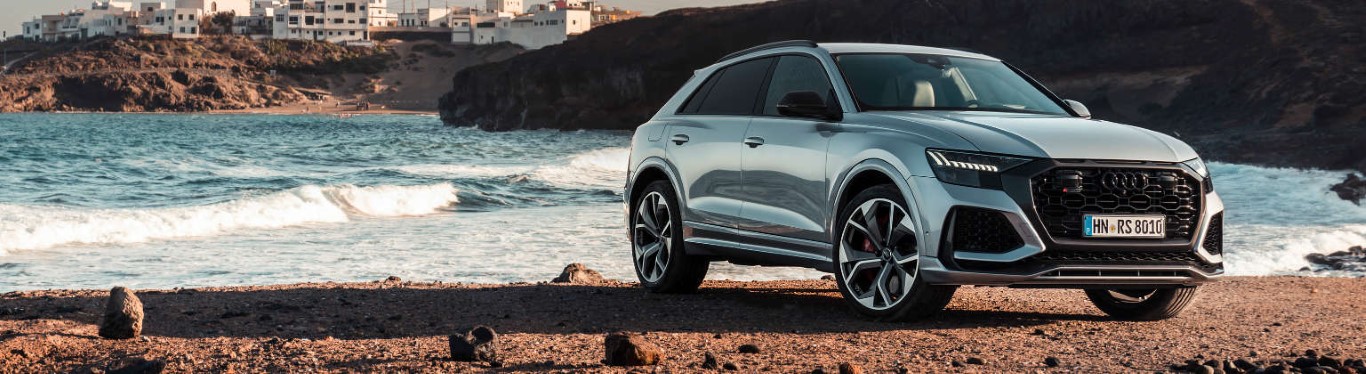
1st Generation
(2020-2024)
The track titan: the SUV that challenged the laws of physics to become Ingolstadt's fastest and most commanding utility vehicle.
Select a generation to see available versions
(2020-2024)
(2025-)
Select a powertrain to view full technical specifications
The rise of the "Super SUV" is undoubtedly the most striking phenomenon of the luxury automotive industry in the 21st century. For decades, dynamic performance and practical utility were diametrically opposed concepts; one either had a low, light, and fast car, or a tall, heavy, and capable vehicle. The Audi RS Q8 emerges as German engineering's definitive answer to this dilemma, a vehicle that not only combines these worlds but effectively rewrites the expectations of what a 2.3-ton vehicle is capable of achieving on a racetrack.
This technical and historical report aims to dissect, with exhaustive detail, the trajectory of the RS Q8. From its conception on the drawing boards of Ingolstadt and Neckarsulm (headquarters of Audi Sport GmbH), through the strategic sharing of platforms within the Volkswagen Group, up to its limited editions and the recent 2025 renewal. We will analyze not only the power figures, but the complex web of mechatronic systems — air suspension, active roll stabilization, all-wheel steering — that allow this colossus to defy physics.
The RS Q8 is not an isolated product; it is the pinnacle of Audi's "Q" line and, arguably, one of the most ambitious projects of the RS division. By sharing mechanical DNA with the Lamborghini Urus and the Porsche Cayenne Turbo GT, it occupies a strategic position: it offers the performance of a hypercar with the discretion and daily usability characteristic of the four-ring brand. Next, we will detail every bolt, every line of code, and every market decision that makes up the history of this model.
To understand the RS Q8, it is first necessary to understand the structure that supports it. The model is built on the MLB Evo (Modularer Längsbaukasten Evo) modular platform, developed by the Volkswagen Group for vehicles with longitudinal engines. This is no ordinary platform; it is an elite architecture designed to accommodate the conglomerate's most sophisticated vehicles.
The torsional rigidity of this platform is the secret that enables the RS Q8's performance. Without a rigid base, the suspension could not work with precision, and the brute force of the V8 engine would twist the chassis, impairing drivability. The MLB Evo uses an intelligent mix of materials:
This platform is the same one used by the Bentley Bentayga, Lamborghini Urus, and Porsche Cayenne. However, Audi Sport carried out specific adjustments to the suspension geometry, bushings, and subframes to ensure that the RS Q8 had its own identity — less aggressive than the Urus in daily driving, but equally capable when pushed to the limit.
The RS Q8 was designed to be the "Coupe" version of the Q7, but with a much more assertive visual personality. The design team, led by Marc Lichte, sought direct inspiration from the Audi Sport Quattro of the 1980s, the car that cemented the legend of all-wheel drive in rallies.
This homage is visible in the "blisters" (flares) over the wheel arches. The RS Q8 is significantly wider than the standard Q8:
These flares are not just aesthetic; they are functional, necessary to cover the wider tracks and the gigantic wheels (up to 23 inches) that the car uses. The octagonal "Singleframe" front grille adopts a honeycomb weave in gloss black or carbon, an exclusive signature of RS models, designed to maximize airflow to the radiators.
The powerplant that equips the RS Q8 is the EA825, a 4.0-liter V8 engine with direct injection and two turbochargers. This engine is a masterpiece of packaging and thermal efficiency.
"Hot-V" Configuration:
Unlike conventional turbo engines, where the turbos hang on the sides of the engine, in the EA825 the two twin-scroll turbochargers are mounted inside the V formed by the cylinder banks (the V angle is 90 degrees).
Production Numbers (2020-2023 Generation):
Despite being a performance monster, the RS Q8 has an ecological conscience forced by European emission standards. The Cylinder on Demand system deactivates cylinders 2, 3, 5, and 8 when the engine is under low load (for example, at highway cruising speeds).
In this mode, the car operates as a 2.0-liter V4. The deactivation and reactivation process takes only milliseconds and is managed by closing the intake and exhaust valves and cutting injection and ignition in those cylinders. The driver rarely notices the transition, except for a slight change in the instantaneous consumption indication on the dashboard.
The RS Q8 is not a traditional hybrid, but it utilizes a Mild Hybrid Electric Vehicle (MHEV) system. The central component is a Belt Alternator Starter (BAS) connected to the crankshaft, powered by a 48-volt lithium-ion battery located in the trunk.
This system has three main functions:
If the engine is the heart, the suspension is the brain that allows the RS Q8 to counter its mass. Audi Sport equipped the model with the most advanced chassis technology available.
Standard on all RS versions, this suspension uses air bags instead of conventional steel springs. The system features multiple chambers that allow varying not only the height but also the stiffness of the air spring.
This is the "magic" system that differentiates the RS Q8 from ordinary SUVs. Traditional stabilizer bars are fixed steel tubes connecting the left and right wheels to prevent the car from leaning too much in corners. The problem is that rigid bars make the car uncomfortable on bumpy roads, as the impact on one wheel is transferred to the other.
The RS Q8 solves this with the eAWS (electromechanical Active Roll Stabilization) system. The stabilizer bars are split in half, connected by a high-voltage (48V) planetary electric motor.
To mask the long wheelbase of nearly 3 meters, the RS Q8 also steers the rear wheels.
The history of the RS Q8 can be divided into two main phases: the launch generation (2020-2023) and the mid-life update, known as "Facelift" or "Product Upgrade" (2024-Present).
Launched globally in late 2019 as a 2020 model, the first RS Q8 set the parameters.
In mid-2024, Audi presented the 2025/2026 lineup with profound changes. The main novelty was the bifurcation of the line into two distinct models, following the strategy already used in the RS 6 Avant.
Maintains the mechanical configuration of the previous phase:
This version represents the apex of combustion engine development at Audi Sport. It is the most powerful SUV ever made by the brand.
Comparative Table: Generation 1 vs. Generation 2 Performance
| Characteristic | RS Q8 (2020-2023) | RS Q8 Performance (2025+) | Technical Evolution |
|---|---|---|---|
| Engine Code | EA825 | EA825 Evo | ECU mapping and turbo pressure |
| Maximum Power | 600 hp (591 hp) | 640 hp (631 hp) | +40 hp via flow optimization |
| Maximum Torque | 800 Nm | 850 Nm | +50 Nm |
| 0-100 km/h | 3.8 seconds | 3.6 seconds | Improvement in traction and power |
| Max. Speed | 250 km/h (305 opt.) | 280 km/h (305 opt.) | Raised standard limiter |
| Differential | Torsen T3 | Lightweight Self-Locking | Lower inertia, faster response |
| Lighting Technology | Matrix LED | HD Matrix LED + Laser | Doubled range with laser beam |
| Weight (DIN) | ~2,315 kg | ~2,275 kg | Reduction via forged wheels and exhaust |
The Nürburgring Nordschleife circuit in Germany is the gold standard for performance measurement. The history of the RS Q8 is inextricably linked to this 20.8 km track.
Even before reaching stores, in 2019, test driver Frank Stippler shocked the automotive world by setting a time of 7:42.253.
This time dethroned the Mercedes-AMG GLC 63 S, which held the previous record. The feat was massively used in the car's marketing, proving that it was not only fast in a straight line but capable of withstanding the brutal lateral G-forces of the "Green Hell."
Over the years, the RS Q8's record was broken by the Porsche Cayenne Turbo GT (an even more track-focused platform "sibling"). In 2024, with the launch of the RS Q8 Performance version, Audi returned to the track.
Again with Frank Stippler at the wheel, the new model clocked 7:36.698.
Analysis: A reduction of almost 6 seconds compared to the previous model. This is an eternity in motorsport. Audi attributed this improvement not only to the extra 40 hp but primarily to the new center differential and the recalibration of torque vectoring, which allowed for higher cornering speeds.
Production of the RS Q8 is not massive. It is estimated to represent less than 5% of the total volume of Q8s sold. To maintain interest, Audi and partners launched highly collectible editions.
Available in the first year of production, the "Edition 1" was a closed package with almost all options. It was characterized by exclusive black or gray paint, black emblems, and specific design 23-inch wheels.
To celebrate 40 years of Audi Sport, a highly limited series was created, focused on Middle Eastern markets (like Abu Dhabi).
ABT is Audi's "quasi-official" tuner, and its versions are often sold in selected dealerships in Europe.
Brazil has a passionate relationship with the RS line, being one of the markets where the penetration of these high-value models is surprisingly high relative to the brand's total volume.
Unlike Europe, where the car comes "bare" and the customer adds options, Audi do Brasil imports the RS Q8 in almost complete packages.
The interior of the RS Q8 is a study in "Digital Luxury". The cabin philosophy is minimalist, eliminating physical buttons in favor of touch screens.
The center console features two screens:
The system offers haptic (a small vibration on the finger) and auditory feedback when touched, simulating the feel of a physical button so the driver knows the command was accepted without taking their eyes off the road.
The 12.3-inch instrument panel is fully digital. In the RS Q8, it has exclusive layouts (RS Runway) that simulate an airplane runway or performance-focused dials:
The RS sports seats are upholstered in perforated Valcona leather with honeycomb pattern stitching. The steering wheel and gear lever are frequently wrapped in Alcantara for better grip. There is extensive use of matte "Race" aluminum or carbon fiber on the dashboard. The acoustic insulation features double-glazed glass, guaranteeing absolute silence while cruising, unless the sport exhaust is activated.
The Audi RS Q8 will be remembered as one of the final milestones of the internal combustion golden era. It represents the moment when technology allowed an SUV to do things previously restricted to race cars.
Although it shares parts with the Urus, the RS Q8 built its own identity: it is the "rational supercar." It offers 95% of its Italian cousin's performance for a fraction of the price, and with a visual discretion that allows it to be used in corporate environments without drawing unwanted attention — until the V8 engine wakes up.
With the industry moving towards full electrification, the 640 hp RS Q8 Performance, with its pure twin-turbo V8 (only mildly hybridized), is an instant collector's item. It closes a chapter of pure mechanical engineering, where the solution to making a fast car was to put more cylinders, more turbos, and more mechanical genius under the hood. For the owner, it delivers not just transportation, but a complete sensory experience, validated by records and uncompromising engineering.
Images of the Audi RS Q8