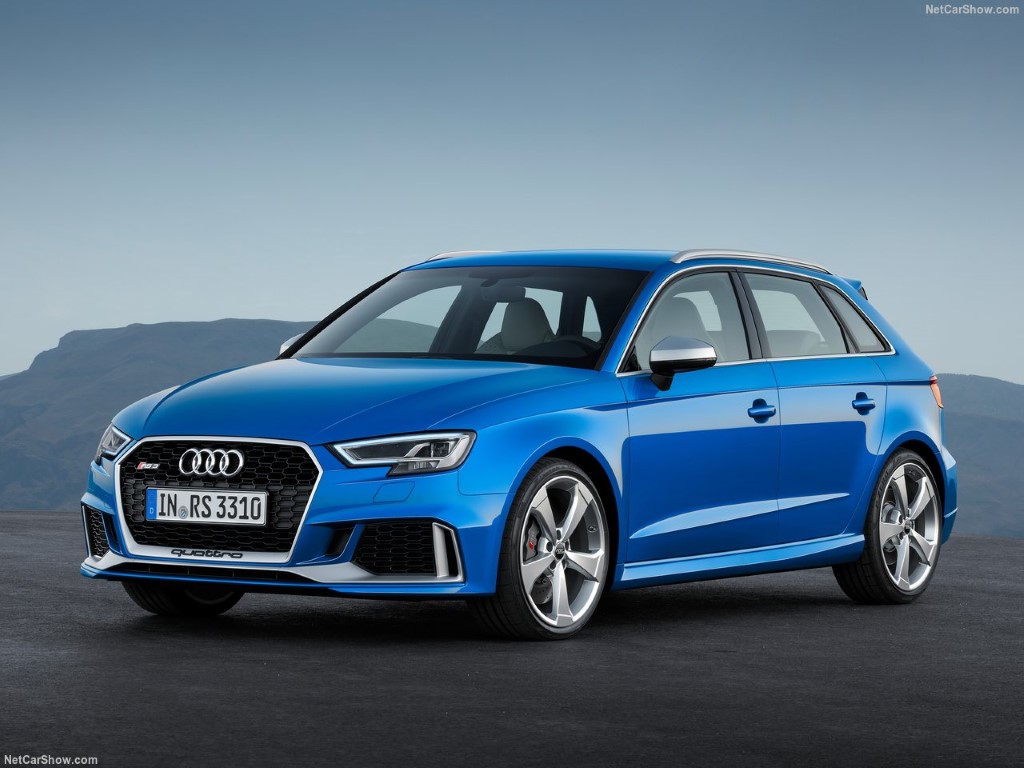
8P Facelift
(2011-2012)
The little giant: the five-cylinder hatchback that brought rally DNA to modern asphalt with raw power.
Select a generation to see available versions
(2011-2012)
(2015-2017)
(2017-2021)
(2021-2024)
The contemporary automotive industry is marked by the relentless pursuit of efficiency, often resulting in engine downsizing and the homogenization of mechanical configurations. In this scenario, the Audi RS3 stands out not only as a high-performance product, but as a manifesto of resistance for traditional mechanical engineering. This report exhaustively analyzes the model's trajectory, from its conceptual roots in the Group B Rally era to its current iteration as a dynamic benchmark in the premium compact segment.
The concept of the "Hot Hatch" — a compact car with sporty performance — was popularized in the 1970s. However, the launch of the Audi RS3 in 2011 ushered in a new category, often called the "Hyper Hatch". These vehicles transcend the traditional boundaries of the segment, offering power outputs exceeding 300 or 400 horsepower, complex all-wheel-drive systems, and acceleration comparable to supercars of previous generations.
The central element that defines the RS3's identity is its 2.5-liter TFSI inline five-cylinder engine. This configuration is not a random choice, but a direct homage to the original Audi Quattro and the Sport Quattro S1 that dominated racing in the 1980s. With a 1-2-4-5-3 firing sequence, the engine produces a syncopated and guttural sound signature, distinct from the ubiquitous four-cylinder engines found in the competition, often being compared to half of a V10 engine, like the one found in the Audi R8 or Lamborghini Huracán.
Next, we dissect the technical evolution, market nuances, and specificities of each generation (8P, 8V, and 8Y), with particular emphasis on mechanical engineering and the model's insertion into the Brazilian market.
The first generation of the RS3, internally designated as 8P, represented a significant engineering challenge. The Audi A3 8P had been in production since 2003, and the decision to create an RS variant only emerged at the end of the model's life cycle. The goal was clear: transfer the Audi TT RS powertrain to the practical A3 Sportback platform, creating the fastest hatchback in the world at the time.
The launch took place in 2011, and production was prematurely ended in 2012. This short manufacturing period, combined with logistical complexities — the car was assembled at the Audi plant in Győr, Hungary, where the engines were produced — contributed to its rarity.
The heart of the RS3 8P was the 2.5 TFSI engine, a unit that quickly gained legendary status. Unlike later generations, this engine used a Compacted Graphite Iron (CGI) block. This material, used in high-compression diesel engines, offers extreme resistance to tension and heat, allowing the engine to withstand very high cylinder pressures.
The architecture of the 8P chassis imposed severe limitations. The five-cylinder engine, with its heavy iron block, was mounted transversely ahead of the front axle. This resulted in an unfavorable weight distribution, with a high mass concentration at the nose of the car.
To combat the natural tendency to understeer (the front of the car losing grip and "sliding" outward in a corner), Audi Sport engineers implemented an unorthodox solution: wider front tires than rear ones.
This "reverse" configuration aimed to increase the contact patch and mechanical grip at the front, helping to "pull" the car into the corner. The quattro all-wheel-drive system utilized a 4th generation Haldex coupling, which operated predominantly as front-wheel drive, sending torque to the rear only when it detected slip.
The RS3 8P was produced exclusively in the Sportback body style (5-door hatchback). There was no 3-door or Sedan version in this generation.
The introduction of the Volkswagen Group's MQB (Modularer Querbau) modular platform allowed the second generation of the RS3, the 8V chassis, to take a quantum leap in terms of torsional rigidity and weight reduction. This generation is crucial in the model's history as it marks the transition from a "niche experiment" to a high-volume global product. The 8V generation is divided into two distinct phases: Pre-Facelift (8V.1) and Facelift (8V.2).
Initially launched only as a Sportback in late 2014, the 8V.1 model still carried traces of the previous generation's engineering under a new skin.
In 2017, Audi carried out a mid-cycle update that went far beyond aesthetic changes. A practically new 2.5 TFSI engine was introduced, marking the greatest technical evolution in the model's history.
The DAZA Engine Engineering
The new engine, internal code DAZA, abandoned the iron block in favor of an aluminum block.
The Arrival of the Sedan
For the first time, the RS3 was offered in a Sedan configuration. This decision was strategic to penetrate the US and Chinese markets, where hatchbacks have lower acceptance. The Sedan maintained the same mechanics as the Sportback, but with a more classic and elegant silhouette.
Visual and Technological Changes
The facelift (8V.2) brought a more angular aesthetic.
| Characteristic | 8V Pre-Facelift (2015-2016) | 8V Facelift (2017-2020) |
|---|---|---|
| Engine Code | CZGB | DAZA / DNWA (post-2019) |
| Block Material | Cast Iron | Aluminum |
| Engine Weight | +26 kg (baseline) | -26 kg (lighter) |
| Power | 367 cv | 400 cv |
| Torque | 465 Nm | 480 Nm |
| Fuel Injection | Direct Only | Dual (Direct + Indirect) |
| Body Styles | Sportback Only | Sportback and Sedan |
| Instrument Cluster | Analog (Virtual Cockpit rare option) | Virtual Cockpit (Standard in most markets) |
Brazil officially received the 8V generation, marking the consolidation of the compact RS lineup in the country.
The current generation, designated 8Y, represents the ultimate refinement of the RS3 formula. While the 8V generation focused on raw engine power, the 8Y concentrated on chassis dynamics and advanced electronics to eliminate historical criticisms about the "dull" handling of all-wheel-drive Audis.
The RS3 8Y is visually the most aggressive of all. The track widths (distance between wheels on the same axle) were widened, requiring wider fenders.
The most critical innovation of the 8Y generation is the replacement of the traditional Haldex rear differential with the RS Torque Splitter, developed in partnership with Magna.
How It Works (Difference from Haldex)
Active Torque Vectoring
In a sharp right-hand turn, the system sends more power to the left (outer) rear wheel. This creates a yaw moment that pushes the car's nose into the corner, physically combating understeer. The result is a car that points with much more agility and allows for earlier re-acceleration upon exiting a corner.
Specific Driving Modes
The Torque Splitter enabled new modes in Audi Drive Select:
The aluminum 2.5 TFSI engine was retained, now with Engine Control Unit (ECU) updates for faster response times.
After a significant hiatus since the end of the 8V generation, Audi Brasil reintroduced the RS3 to the national market, aligned with the 8Y generation's mid-life facelift (known as 8Y.5).
Unlike Europe, where the Sportback has strong appeal, the Brazilian strategy focused almost exclusively on the Sedan body style. The model arrived in two distinct configurations, positioning itself at the top of the compact sports car food chain in the country.
Version 1: Audi RS3 Sedan (Standard Configuration)
Version 2: Audi RS3 Sedan Track (Extreme Configuration)
This is a specific novelty to cater to enthusiasts who frequent track days.
With prices surpassing the R$ 700,000 barrier, the RS3 Sedan Track enters competition territory with the BMW M2 and Porsche 718 Cayman. Its differentiator lies in versatility: it is a four-door car, with a usable trunk and the capacity to carry four adults, but which can keep up with (and often surpass) dedicated two-seater coupes on a circuit, thanks to the all-wheel drive and the Torque Splitter.
Audi used limited editions to maintain interest in the RS3's life cycle and celebrate historical milestones.
Created as a farewell to the 8V generation in the US.
The fastest and most exclusive factory version to date.
These are trim levels and not necessarily limited in number, but highly desired.
A topic of intense technical debate among owners and tuners involves the durability and capacity of the 2.5 TFSI engine blocks.
Audi protects the exact production numbers of the RS line. However, based on registration records (such as in the UK), we can infer the scale.
The table below summarizes the technical evolution across generations:
| Specification | RS3 8P (2011-2012) | RS3 8V Pre-Facelift (2015-2016) | RS3 8V Facelift (2017-2020) | RS3 8Y (2021-Present) |
|---|---|---|---|---|
| Body Styles | Sportback | Sportback | Sportback and Sedan | Sportback and Sedan |
| Engine (Code) | 2.5 TFSI (CEPA/B) | 2.5 TFSI (CZGB) | 2.5 TFSI (DAZA) | 2.5 TFSI (DNWA) |
| Block Material | Cast Iron | Cast Iron | Aluminum (-26kg) | Aluminum |
| Power | 340 cv | 367 cv | 400 cv | 400/407 cv |
| Torque | 450 Nm | 465 Nm | 480 Nm | 500 Nm |
| 0-100 km/h | 4.6 s | 4.3 s | 4.1 s | 3.8 s (Official) |
| Drive | Haldex Gen 4 | Haldex Gen 5 | Haldex Gen 5 | RS Torque Splitter |
| Dashboard | Analog | Analog | Virtual Cockpit | Virtual Cockpit Plus |
| Sold in BR? | No (Officially) | Yes | Yes (Sedan/Hatch) | Yes (Sedan/Track) |
The history of the Audi RS3 is a narrative of continuous improvement. It began as an ambitious project to transplant a large engine into a small car (8P), evolved into a more balanced global platform (8V), and reached its technological zenith with the current generation (8Y), which finally solved the riddle of driving dynamics through active torque vectoring.
For the Brazilian market, the RS3 represents a unique opportunity. In an automotive world that is rapidly moving towards total electrification — Audi has announced that it will only launch electric models from 2026 onwards — the current RS3 is, very likely, the last of its lineage to carry the iconic five-cylinder engine.
This fact gives the model not only the status of a performance tool, but of an instant collector's item. The combination of the inimitable 1-2-4-5-3 engine sound, the daily usability, and the cutting-edge Torque Splitter technology guarantees the RS3 a definitive place in the pantheon of the greatest compact sports cars ever made. The "Track" version sold in Brazil, with its semi-slick tires and ceramic brakes, is the ultimate expression of this philosophy: a car born from rally tracks, civilized for the streets, but ready to break records at the touch of a button.