

C7
(2014-)
4.0 V8 32V Twin-Turbo
560 cv

Technical specifications, versions, and history for the Audi RS7.
Select a generation to see available versions
(2014-)

(2015 - 2019)
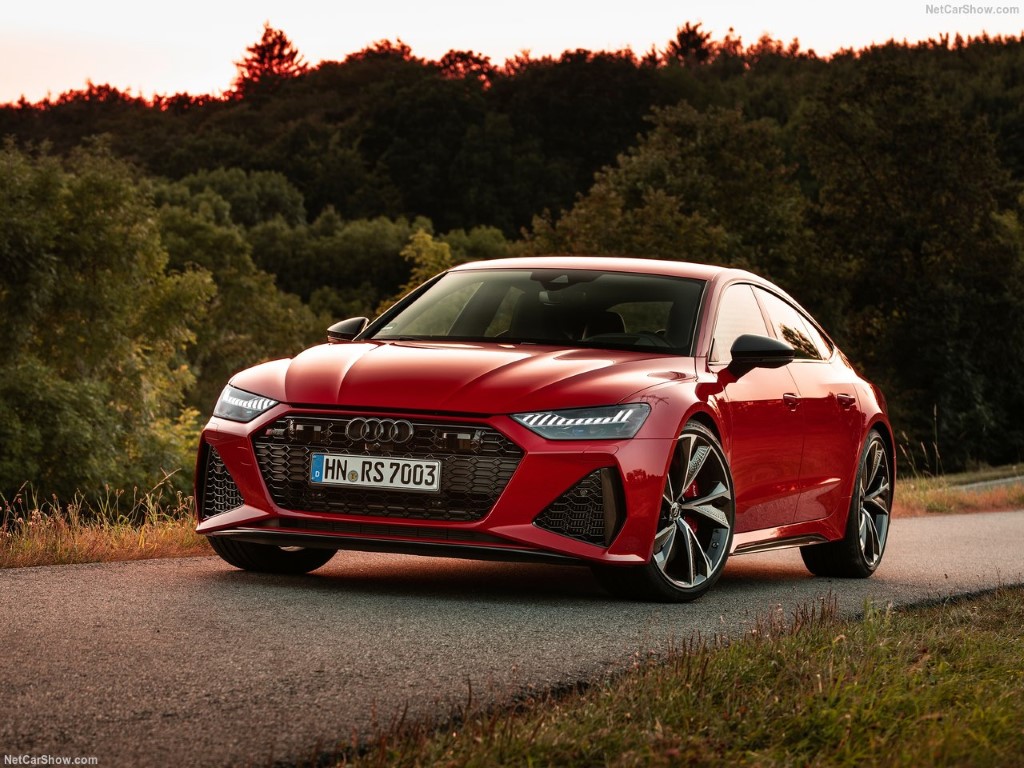
(2020-)
The luxury automotive industry underwent a radical transformation in the first decade of the 21st century. Traditionally, high-income consumers had to choose between the aesthetic elegance of a two-door coupe and the practical functionality of a three-box sedan. The rigidity of these categories began to dissolve with the introduction of vehicles that challenged conventional nomenclatures, merging the descending roofline ("fastback") of sports cars with four-door accessibility. Although Mercedes-Benz pioneered this modern niche with the CLS, Audi responded with an interpretation that focused not only on style, but on utilitarian versatility, giving rise to the "Sportback" concept.
The Audi A7 Sportback, launched in 2010, served as the architectural foundation for what would become the pinnacle of the brand's executive performance: the Audi RS7. Audi Sport GmbH's (formerly known as quattro GmbH) decision to develop an RS ("RennSport" or Racing Sport) version based on the A7 was not trivial. The C7 platform, shared with the Audi A6, offered the torsional rigidity and wheelbase necessary to accommodate high-performance mechanics, but with a more favorable center of gravity and aerodynamic drag coefficient than those found in the Avant station wagons, such as the legendary RS6.
Within Audi's portfolio, the RS7 occupies a unique position. It sits above the S7, which is designed as a fast everyday "Grand Tourer", and acts as the more aerodynamic and aesthetically aggressive sibling to the RS6 Avant. While the RS6 cultivates a fan base focused on the dichotomy between "family car" and "super sports car", the RS7 is positioned for the executive or enthusiast who prioritizes visual presence and performance on autobahns. It competes directly against heavyweight German rivals, specifically the BMW M6 Gran Coupe (and subsequently the M8 Gran Coupe) and the Mercedes-AMG CLS 63 (evolving into the AMG GT 4-Door). The engineering philosophy behind the RS7 has always been clear: to create a vehicle capable of transporting four adults in supreme comfort, but with the dynamic capability to challenge supercars in linear acceleration and top speed.
The first-generation Audi RS7 (internal code C7) made its world debut at the Detroit Auto Show in 2013, hitting the market as a 2014 model. The choice of the United States for the debut was strategic, signaling the importance of the North American market for high-performance sedans, where station wagons (like the RS6) have historically had less acceptance. Immediately, the model was acclaimed as the most powerful four-door vehicle ever produced by Audi to that date, setting a new standard for the brand in terms of power delivery and design.
The heart of the C7 RS7 marked a break from the era of naturally aspirated V10 engines that equipped the previous generation of the RS6 (C6). Audi adopted the philosophy of "downsizing" with forced induction, resulting in the development of the 4.0-liter TFSI biturbo V8 engine.
One of the most crucial technical innovations of this engine is the configuration known as the "Hot V". In traditional V8 engines, the intake manifolds are inside the "V" (between the cylinder banks) and the turbochargers are on the outside. In the RS7, Audi inverted this logic: the cylinder heads were designed so that the exhaust exits into the "V", where two twin-scroll turbochargers and the intercoolers are mounted.
This architecture offers significant thermodynamic and dynamic advantages:
This low-end torque delivery is what gives the RS7 its characteristic "inexhaustible force" in any gear, eliminating the need for constant downshifting for overtakes.
Unlike the Audi S6 and S7 of the same era, which used the 7-speed S-tronic (DL501) dual-clutch transmission, Audi Sport chose to equip the RS7 with a conventional 8-speed automatic transmission (Tiptronic), supplied by ZF.
The reason for this choice is purely technical: durability under extreme torque loads. At the time of the C7's development, Audi's dual-clutch gearboxes were at the limit of their torque capacity with the entry-level V8 engines. The torque converter of the ZF 8HP gearbox, on the other hand, could reliably handle the 700 Nm of torque and violent launches (Launch Control) without the risk of overheating or premature clutch wear. Furthermore, the lengthened eighth gear allowed for a lower engine speed at cruising speeds, contributing to fuel economy.
The Quattro permanent all-wheel drive is the soul of the RS7. Under normal conditions, the mechanical center differential distributes torque in a ratio of 40% to the front axle and 60% to the rear, conferring a rear-biased driving dynamic that appeals to enthusiasts.
However, the major technical differentiator of the RS7 is the Sport Differential on the rear axle, which was standard or optional depending on the market. While a standard differential only allows the wheels to spin at different speeds, Audi's sport differential uses superimposed gears and electro-hydraulic multi-plate clutches to actively send torque to the outside wheel during a corner.
Mechanics of Torque Vectoring:
When entering a left-hand turn, for example, the system sends more power to the right
rear wheel. This creates a yaw moment that helps pivot the car
into the corner, physically combating the natural tendency to understeer (pushing
wide) that is common in heavy front-engine cars. The result is agility
that defies the vehicle's nearly two-ton mass.
Despite being a performance monster, the C7 RS7 incorporated advanced efficiency technologies for its time. The "Cylinder on Demand" (COD) system is capable of deactivating four of the eight cylinders (cylinders 2, 3, 5, and 8) in low to medium load situations and in high gears.
The Vibration Challenge:
A V4 engine operating within an unbalanced V8 block generates unwanted vibrations and
noises. To combat this without the driver noticing, Audi installed active engine
mounts. These mounts contain electromagnetic actuators that generate
counter-vibrations (out of phase) to cancel out engine oscillations when it is
operating in 4-cylinder mode. Simultaneously, the car's sound system (Active
Noise Cancellation) emits frequencies through the speakers to cancel the low-frequency
noise generated by half-engine operation.
Around 2015, for the 2016 model year, the A7 line received a significant update, known internally and by enthusiasts as the "C7.5" or "Facelift". Although the base mechanics remained similar, visual and technological updates were crucial to maintaining the model's relevance against newer competitors.
The biggest news of the C7.5 era was the bifurcation of the RS7 line. Audi introduced the RS7 Performance variant, aimed at buyers who wanted to extract the maximum potential from the platform without resorting to the aftermarket tuning scene.
Technical Changes in the Performance Version:
Comparative Table: Generation C7 (Base) vs. C7.5 (Performance)
| Technical Specification | RS7 C7 Base (2014-2015) | RS7 C7.5 Performance (2016-2018) |
|---|---|---|
| Engine | 4.0 V8 Biturbo TFSI | 4.0 V8 Biturbo TFSI (Revised) |
| Maximum Power | 560 hp @ 5,700 rpm | 605 hp @ 6,100 rpm |
| Maximum Torque | 700 Nm @ 1,750 rpm | 700 Nm (750 Nm on Overboost) |
| Gearbox | ZF 8-Spd Tiptronic | ZF 8-Spd Tiptronic (Sport Software) |
| 0-100 km/h (Official) | 3.9 seconds | 3.7 seconds |
| Top Speed | 250 km/h (Limited) | 280 km/h or 305 km/h (Dynamic Pkg) |
| Curb Weight | ~1,995 kg | ~2,030 kg |
When the second generation (C8) was revealed in late 2019, the most striking change was visual. In the previous generation (C7), the RS7 shared the same body width as the standard A7, giving it a "wolf in sheep's clothing" appearance. For the C8 generation, Audi answered customer requests for greater visual differentiation and aggressiveness.
The C8 RS7 is significantly wider than the base A7. The fenders were widened by about 20 millimeters on each side (40mm in total), requiring exclusive body panels. In fact, the C8 RS7 shares only four body panels with the standard A7: the hood, the roof, the front doors, and the trunk lid. Everything else — bumpers, side skirts, rear doors, and rear quarter panels — is exclusive to the RS version. This is not just aesthetic; it allows the use of wider tracks, improving lateral stability in high-speed corners.
The 4.0 TFSI V8 engine was retained, but deeply modernized to meet strict Euro 6d-TEMP emissions standards and improve efficiency. The main innovation was the integration of a 48-volt Mild Hybrid Electric Vehicle (MHEV) system.
Operation of the 48V System:
The C8 generation offers two distinct driving personalities, depending on the chosen suspension:
Another technical novelty of the C8 generation is the dynamic steering of the rear axle. At low speeds, the rear wheels turn up to 5 degrees in the opposite direction to the front ones, reducing the turning circle by up to 1 meter and making the car much more maneuverable in cities and parking lots. At high speeds, they turn up to 2 degrees in the same direction as the front ones, virtually increasing the wheelbase and providing greater stability in highway lane changes.
With competition intensifying (BMW M5 Competition and Mercedes-AMG GT 63 S), Audi launched, starting in 2023/2024, the RS7 Performance version for the C8 generation, which in many markets replaced the base model.
The engineering behind the power gain involved hardware, not just software:
A common criticism of modern luxury cars is excessive isolation, which disconnects the driver from the machine. For the RS7 Performance, Audi strategically removed about 8 kg of acoustic insulation material between the engine compartment, the interior, and the rear.
This measure had a twofold effect:
The Performance version introduced a new mechanical center differential, which is lighter and more compact. It improves precision in torque distribution between the axles, reducing the tendency to understeer at the limit of grip and making the steering more precise and communicative.
Performance Comparison: C8 Base vs. C8 Performance
| Metric | RS7 C8 Base (2020-2023) | RS7 C8 Performance (2024+) |
|---|---|---|
| Power | 600 hp (591 hp) | 630 hp (621 hp) |
| Torque | 800 Nm | 850 Nm |
| 0-100 km/h Acceleration | 3.6 seconds | 3.4 seconds |
| 0-200 km/h Acceleration | ~12 seconds | ~11 seconds (Estimated) |
| Weight | ~2,150 kg (Heavy MHEV) | ~2,065 kg (Reduced insulation) |
The history of the RS7 is punctuated by extremely limited production versions, created to maintain interest in the model and offer exclusivity to collectors. The scarcity of these models is intentionally manufactured.
This is one of the rarest versions ever produced for the North American market.
Based on the Performance version, this edition was limited to 125 units (in the US).
Although ABT Sportsline is a tuning company, its relationship with Audi is so intrinsic (operating Audi's racing teams in Formula E and DTM) that its versions are often considered "semi-official" and sold at selected dealerships.
The "Nogaro Blue" color is sacred to Audi, having been the launch color of the original RS2 Avant in the 90s. Although more common on the RS6 Nogaro Edition (limited to 150 units in Europe), the RS7 can also be ordered in this color through the "Audi Exclusive" program. There are records of special orders configuring the RS7 in this color, making these examples "one-of-one" or extremely low production, highly valued in the used market.
Audi AG, in its annual financial and production reports, groups the production numbers of the A7 family (which includes A7, S7, and RS7) into a single category. This makes it difficult to obtain an exact official number of how many RS7 units were produced globally.
However, it is possible to make an educated estimate based on market data:
The production of the RS7 takes place at the Neckarsulm plant in Germany, where Audi Sport GmbH is headquartered. The complexity of the assembly (especially the engine installation and the final quality tests) often involves manual processes that are not applied to the regular line A7s, limiting production output.
Brazil received the C7 RS7 shortly after its global launch, positioning it as the brand's image car ("Halo Car"), often competing for attention with the R8 supercar.
The depreciation of luxury supercars in Brazil is steep in the first three years, but tends to stabilize when the model reaches a "cult" or collectible status.
Estimated Price Evolution Table (Brazil - FIPE Table Reference)
| Model Year | Version | Average Price Range (FIPE/Market Estimate) |
|---|---|---|
| 2014/2015 | RS7 C7 Base | R$ 350,000 - R$ 420,000 |
| 2017/2018 | RS7 C7.5 Performance | R$ 550,000 - R$ 650,000 |
| 2021/2022 | RS7 C8 Base | R$ 850,000 - R$ 980,000 |
| 2024 (Zero Km) | RS7 C8 Performance | R$ 1,250,000+ |
For an exhaustive report, it is imperative to discuss the reality of ownership beyond the performance numbers. The RS7 is a complex machine and requires rigorous maintenance.
The 4.0 TFSI engine of the C7 generation (mainly pre-facelift) has a known weak point documented in forums and technical bulletins: the oil filter screens that feed the turbochargers.
The Audi RS7 Sportback consolidated itself in just over a decade as a fundamental pillar of the Audi Sport brand. It proved that the decision to merge the silhouette of a coupe with the usability of a sedan was not just a styling exercise, but an answer to a real demand in the luxury market.
From the mechanical brutality of the C7 generation, which democratized supercar performance in a four-door package, to the technological sophistication of the C8 generation, with its hybridization, rear-wheel steering, and intelligent suspension, the model has maintained its essence. The introduction of the Performance variants demonstrates Audi's continued commitment to refining the internal combustion V8 engine to its thermodynamic limit before the inevitable transition to total electrification.
Looking to the future, industry rumors and trends suggest that the next generation of the RS7 could undergo radical changes, possibly adopting plug-in hybridization (PHEV) to compete with the Porsche Panamera Turbo S E-Hybrid and the Mercedes-AMG GT 63 S E Performance, or even a transition to fully electric platforms under the e-tron nomenclature. Until then, the current RS7, with its pure and visceral biturbo V8, remains as one of the great "Grand Tourers" of the modern era, celebrating internal combustion in its most elegant and powerful form.