Global Launch and Reception
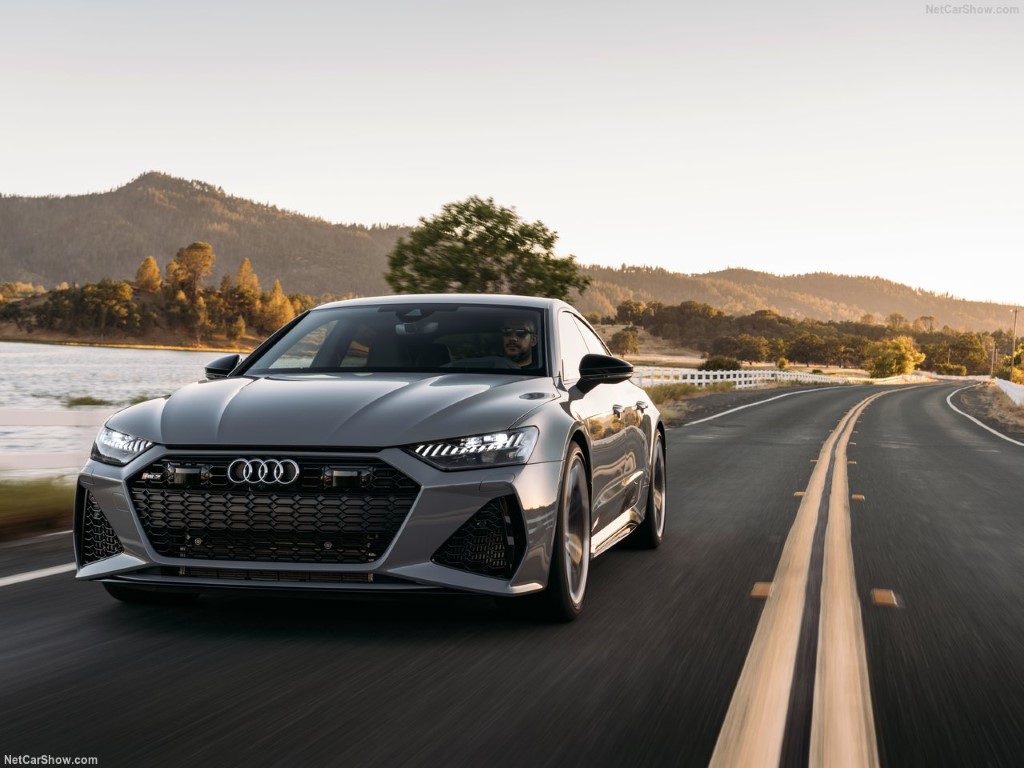
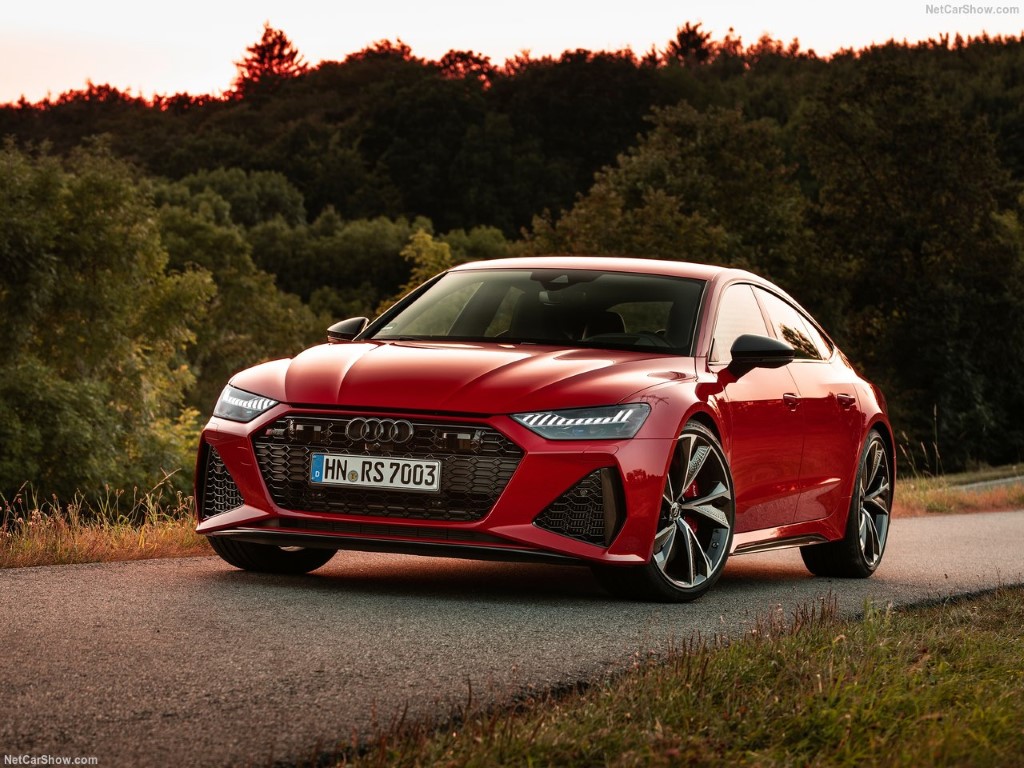
The first-generation Audi RS7 (internal code C7) made its world debut at the Detroit
Auto Show in 2013, hitting the market as a 2014 model. The choice of the
United States for the debut was strategic, signaling the importance of the North American
market for high-performance sedans, where station wagons (like the RS6) have
historically had less acceptance. Immediately, the model was acclaimed as the most powerful
four-door
vehicle ever produced by Audi to that date, setting a new
standard for the brand in terms of power delivery and design.
Powertrain Engineering: The 4.0 TFSI V8 Engine
The heart of the C7 RS7 marked a break from the era of naturally aspirated V10 engines
that equipped the previous generation of the RS6 (C6). Audi adopted the philosophy of
"downsizing"
with forced induction, resulting in the development of the 4.0-liter TFSI biturbo V8 engine.
The "Hot V" Configuration
One of the most crucial technical innovations of this engine is the configuration known as the "Hot
V". In traditional V8 engines, the intake manifolds are inside the "V" (between the
cylinder banks) and the turbochargers are on the outside. In the RS7, Audi
inverted this logic: the cylinder heads were designed so that the exhaust exits into
the "V", where two twin-scroll turbochargers and the intercoolers are mounted.
This architecture offers significant thermodynamic and dynamic advantages:
- Throttle Response: The path the exhaust gases travel
from the engine to the turbine is drastically shortened. This minimizes the loss of heat
and
kinetic energy, resulting in a substantial reduction in "turbo lag" (delay in
turbine response).
- Compactness: The engine becomes more compact, allowing for better
positioning in the chassis to optimize weight distribution.
Output Specifications (Phase 1)
- Power: 560 horsepower (hp) available between 5,700 and 6,600 rpm.
- Torque: 700 Nm (approximately 516 lb-ft), delivered on an
extremely broad plateau ranging from 1,750 to 5,500 rpm.
This low-end torque delivery is what gives the RS7 its characteristic
"inexhaustible force" in any gear, eliminating the need for constant
downshifting for overtakes.
Transmission and The Role of the Torque Converter
Unlike the Audi S6 and S7 of the same era, which used the 7-speed S-tronic
(DL501) dual-clutch transmission, Audi Sport chose to equip the RS7 with
a conventional 8-speed automatic transmission (Tiptronic), supplied by ZF.
The reason for this choice is purely technical: durability under extreme torque
loads. At the time of the C7's development, Audi's dual-clutch gearboxes were
at the limit of their torque capacity with the entry-level V8 engines. The torque
converter of the ZF 8HP gearbox, on the other hand, could reliably handle the 700 Nm of
torque and violent launches (Launch Control) without the risk of overheating or
premature clutch wear. Furthermore, the lengthened eighth gear allowed for a
lower engine speed at cruising speeds, contributing to fuel
economy.
Quattro Drivetrain and Sport Differential
The Quattro permanent all-wheel drive is the soul of the RS7. Under normal conditions, the mechanical
center differential distributes torque in a ratio of 40% to the front axle and 60% to
the rear, conferring a rear-biased driving dynamic that appeals to
enthusiasts.
However, the major technical differentiator of the RS7 is the Sport
Differential on the rear axle, which was standard or optional depending on the market.
While a standard differential only allows the wheels to spin at different
speeds, Audi's sport differential uses superimposed gears and electro-hydraulic
multi-plate clutches to actively send torque to the outside wheel during
a corner.
Mechanics of Torque Vectoring:
When entering a left-hand turn, for example, the system sends more power to the right
rear wheel. This creates a yaw moment that helps pivot the car
into the corner, physically combating the natural tendency to understeer (pushing
wide) that is common in heavy front-engine cars. The result is agility
that defies the vehicle's nearly two-ton mass.
Efficiency Technology: Cylinder on Demand (COD)
Despite being a performance monster, the C7 RS7 incorporated advanced efficiency technologies
for its time. The "Cylinder on Demand" (COD) system is capable of deactivating four
of the eight cylinders (cylinders 2, 3, 5, and 8) in low to medium load situations and in
high gears.
The Vibration Challenge:
A V4 engine operating within an unbalanced V8 block generates unwanted vibrations and
noises. To combat this without the driver noticing, Audi installed active engine
mounts. These mounts contain electromagnetic actuators that generate
counter-vibrations (out of phase) to cancel out engine oscillations when it is
operating in 4-cylinder mode. Simultaneously, the car's sound system (Active
Noise Cancellation) emits frequencies through the speakers to cancel the low-frequency
noise generated by half-engine operation.