
Audi S1: From Group B Icon to Compact Hot Hatch
The S1 moniker holds a prominent place in the history of automotive engineering and motorsport at Audi. Originally conceived at the height of the Group B rally era in the 1980s, the name was revived thirty years later to christen the most radical sports models based on the German brand's subcompact platform. The trajectory of the Audi S1 spans from homologation specials with extreme aerodynamics to mass-production models and all-electric high-performance prototypes.
Motorsport Origins: Audi Sport Quattro S1 and S1 E2
The first chapter of the S1 lineage emerged in 1984 with the launch of the Audi Sport Quattro S1, developed to meet the Group B rally homologation rules of the Fédération Internationale de l'Automobile (FIA). To overcome the lack of agility of the original long-wheelbase Audi Quattro on twisty stages, engineers shortened the vehicle's wheelbase by 320 millimeters and adopted the more steeply raked windshield from the Audi 80 to reduce dashboard reflections.
The inline five-cylinder engine with an aluminum block had its displacement reduced to 2,133 cc. This change allowed the model to fit into the up-to-3.0-liter engine class after applying the 1.4 multiplication factor required by the FIA for turbocharged engines. In the road-going version sold to the public, this engine delivered 306 hp at 6,700 rpm and 350 Nm of torque at 3,700 rpm. Only 224 units of the short-wheelbase Sport Quattro were manufactured and sold to the public at an original price of 203,850 Deutsche Marks.
In late 1985, Audi introduced the ultimate track evolution of the model: the Sport Quattro S1 E2. The engine displacement was slightly adjusted to 2,110 cc and received an air recirculation system on the KKK turbocharger to maintain high plenum pressure and eliminate turbo lag. The official declared power was 480 hp at 7,500 rpm and 480 Nm of torque at 5,500 rpm, though final factory versions used in 1986 reached up to 600 hp.
Featuring a body constructed from carbon-kevlar composite, massive front and rear aerodynamic appendages, and a reduced weight of 1,090 kg, the S1 E2 accelerated from 0 to 100 km/h in 3.1 seconds. Some units utilized an automated gearbox called "power-shift", considered the direct forerunner of modern dual-clutch technology. Following the cancellation of Group B in the World Rally Championship, the S1 E2 triumphed at the famous Pikes Peak International Hill Climb, claiming victories with Michèle Mouton in 1985, Bobby Unser in 1986, and Walter Röhrl in 1987, the latter setting a historic record of 10 minutes and 47.85 seconds.
The Transition to the Road: The Precursor Audi A1 quattro
After decades without using the emblem on subcompact road cars, Audi presented the exclusive Audi A1 quattro in late 2011, marketed between 2012 and 2013. Although it did not formally carry the "S1" name, this vehicle served as a direct engineering laboratory for the production model that would follow.
With production strictly limited to 333 numbered units worldwide, the A1 quattro required profound modifications to the original front-wheel-drive platform. The rear floor structure was adapted to accommodate the permanent all-wheel-drive system with a Haldex-type hydraulic multi-plate clutch and a new independent multilink rear suspension with four control arms per wheel, replacing the torsion beam of the conventional A1.
The engine installed under the hood was the four-cylinder 2.0 TFSI (engine code CDLH, from the EA113 engine family), sourced from the Audi TTS. This powerplant generated 256 hp at 6,000 rpm and 350 Nm of torque between 2,500 and 4,500 rpm, mated exclusively to a six-speed manual transmission. The model accelerated from 0 to 100 km/h in 5.7 seconds and reached a top speed of 245 km/h.
All 333 units were painted in Glacier White metallic with a high-gloss black roof, accompanied by 18-inch alloy wheels in a "turbine" design inspired by 1980s rally cars. The interior featured Nappa leather sports seats, red contrast stitching, and the unit's serial number engraved on the lower spoke of the sports steering wheel.
The Production Model Era: Audi S1 and S1 Sportback (8X Generation)
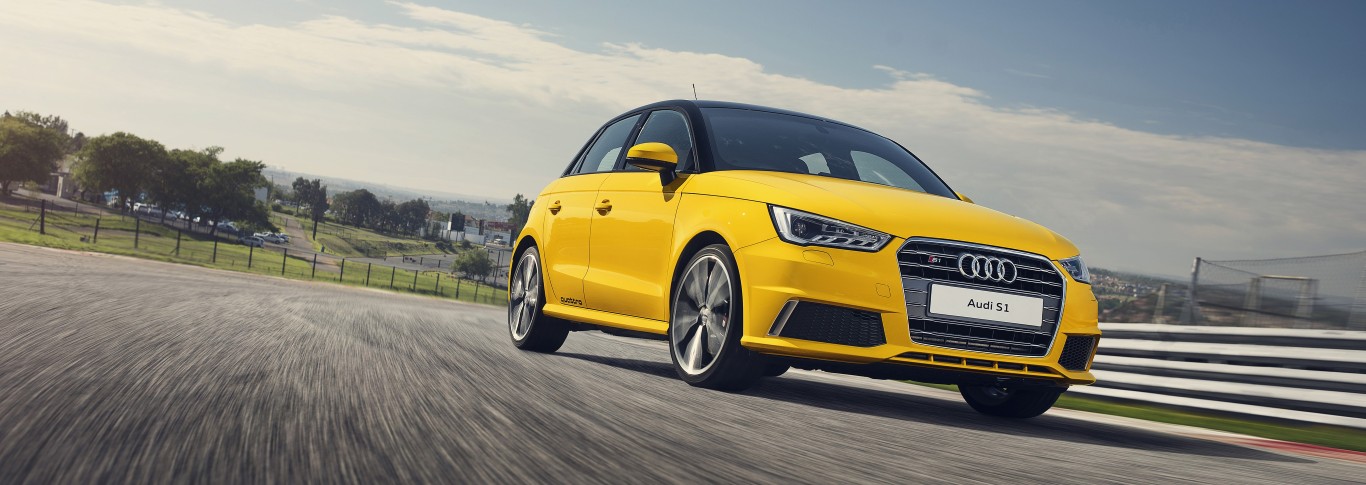
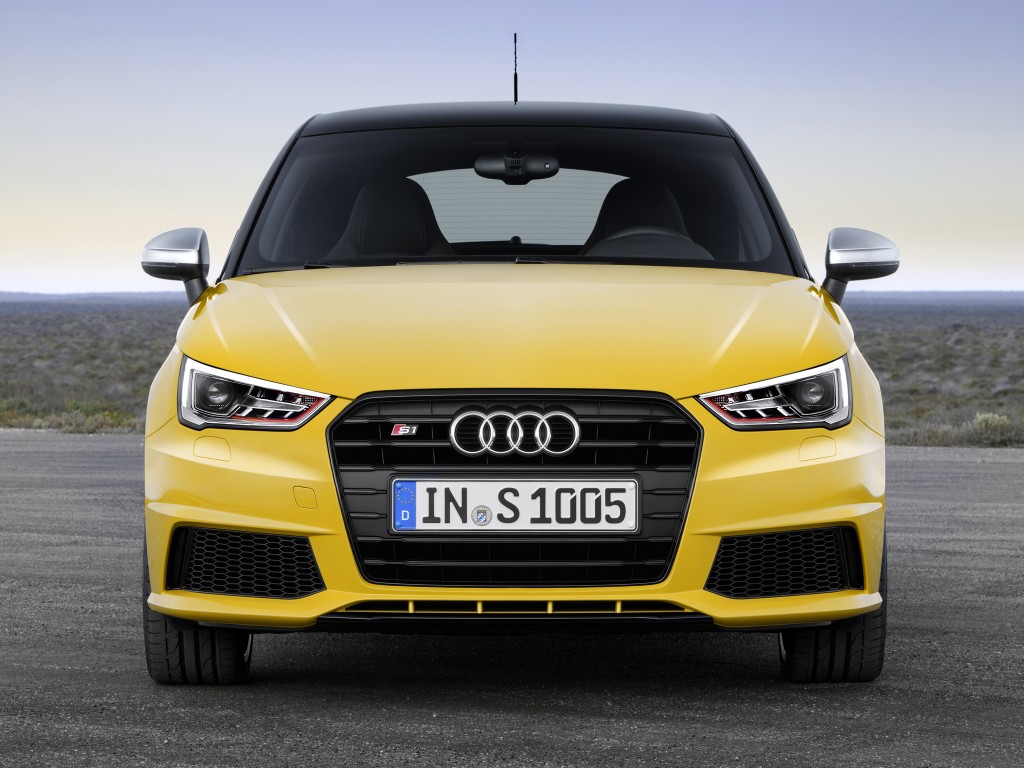
Drawing on the lessons learned from the 2012 limited edition, Audi launched the Audi S1 and Audi S1 Sportback (five-door version) in 2014 as full production models built on the 8X platform. The model became the first hot hatch in the premium subcompact segment to offer factory permanent all-wheel drive.
Powertrain and Performance
The 8X generation of the Audi S1 replaced the old EA113 block with the new 2.0 TFSI engine from the EA888 Gen 3 family (code CWZA). Although power output was tuned to 231 hp at 6,000 rpm, torque increased to 370 Nm, available across a broad rev range between 1,600 and 5,200 rpm. The transmission remained strictly a six-speed manual, delivering power to the quattro all-wheel-drive system with electronic torque distribution between the axles.
The three-door model completed the 0 to 100 km/h sprint in 5.8 seconds, while the S1 Sportback version recorded 5.9 seconds, with both variants reaching a top speed of 250 km/h.
Chassis and Dynamic Tuning
The chassis of the S1 8X received a comprehensive overhaul compared to the standard A1 range. The rear suspension adopted a four-link multilink setup coupled with adaptive dampers adjustable via the Audi drive select system. The electromechanical power steering was upgraded to a progressive type with a more direct ratio, and the front axle pivot bearings were modified to increase steering precision and turn-in response speed. The braking system was upsized, featuring larger discs and calipers painted in black or red with the S1 emblem.
Life Cycle Updates and End of Production (2015–2018)
Alongside the mid-cycle facelift applied to the A1 lineup in 2015, the Audi S1 received subtle visual updates. The Xenon Plus headlights gained new LED daytime running light signatures with more angular contours, and the taillights were reconfigured with new light guides. Inside, the model retained grey instrument dials with white needles, stainless steel pedals, and sports seats with integrated headrests.
Production of the 8X generation Audi S1 ended in 2018. With the launch of the second-generation Audi A1 (GB platform) in 2018, the brand chose not to develop an S1 successor. The high costs of adapting the quattro all-wheel-drive system to the MQB A0 platform and stringent European emission standards made continuing the combustion-powered model unviable.
The Electric Reinterpretation: Audi S1 e-tron quattro Hoonitron
In 2022, the Audi Sport division revealed a unique one-off prototype developed specifically for stunt driver Ken Block: the Audi S1 e-tron quattro Hoonitron. Designed in just nine months at the Neckarsulm design center, the model drew direct aesthetic inspiration from the styling cues and aerodynamic wings of the legendary Pikes Peak Sport Quattro S1.
The vehicle was built on a carbon fiber monocoque chassis, with a wheelbase of under 2.4 meters and a near-ideal weight distribution of 52% on the front axle and 48% on the rear. The suspension uses MacPherson strut layouts on both axles with over 200 mm of suspension travel to withstand jumps and heavy impacts.
The powertrain is entirely electric, consisting of two motor-generator units (MGU) derived from the brand's motorsport program, weighing just 55 kg each. Each motor delivers 250 kW of power and 320 Nm of torque, generating a combined output of 500 kW (approximately 680 hp) and 640 Nm of instantaneous torque. The system operates on an 800-volt architecture and is powered by four 14.4 kWh lithium-ion battery packs, totaling 57.6 kWh. Torque distribution between the front and rear wheels is fully variable, enabling wheel speeds in excess of 200 km/h during drift maneuvers.
Comparative Table of Technical Specifications and Production
The following table presents the technical data, mechanical configurations, and production figures for the various S1 variants created by Audi:
| Model / Variant | Production Period | Quantity Produced | Engine Configuration / Code | Maximum Power | Maximum Torque | Transmission / Drivetrain | Acceleration (0 to 100 km/h) | Top Speed |
|---|---|---|---|---|---|---|---|---|
| Sport Quattro S1 | 1984–1985 | 224 units | 2.1L 5-cylinder Turbo (2,133 cc) | 306 hp @ 6,700 rpm | 350 Nm @ 3,700 rpm | 5-speed manual / quattro all-wheel drive | 4.9 s | 250 km/h |
| Sport Quattro S1 E2 | 1985–1986 | ~20 units (Competition) | 2.1L 5-cylinder Turbo (2,110 cc) | 480 hp to 600 hp | 480 Nm @ 5,500 rpm | 6-speed manual or Power-shift / quattro | 3.1 s | ~220 km/h (rally gearing) |
| A1 quattro | 2012–2013 | 333 units | 2.0 TFSI I4 Turbo (EA113 / CDLH) | 256 hp @ 6,000 rpm | 350 Nm (2,500-4,500 rpm) | 6-speed manual / quattro (Haldex) | 5.7 s | 245 km/h |
| S1 / S1 Sportback (8X) | 2014–2018 | Series production (~12,000 units) | 2.0 TFSI I4 Turbo (EA888 Gen 3 / CWZA) | 231 hp @ 6,000 rpm | 370 Nm (1,600-5,200 rpm) | 6-speed manual / quattro (Haldex) | 5.8 s (3dr) / 5.9 s (5dr) | 250 km/h |
| S1 e-tron quattro Hoonitron | 2022 | 1 unit (Bespoke) | Electric with 2 MGU motors | 500 kW (~680 hp) | 640 Nm | Direct-drive (1-speed) / Electric quattro | < 2.5 s (estimated) | > 200 km/h |
Technical Evolution and Industrial Impact
The study of the Audi S1 lineage reveals profound transformations in the automotive architecture choices adopted by the industry over recent decades. In the original 1980s model, the pursuit of performance required drastic modifications to the vehicle's structure and the use of advanced composite materials to offset the weight of the all-wheel-drive system and the large five-cylinder engine hung out over the front axle.
When the moniker returned in the A1 quattro and S1 8X models, the engineering challenge shifted focus. Rather than homologating a race car, the brand needed to package four-wheel-drive components and a multilink suspension into a compact chassis originally designed for everyday city use. The resulting solution required redesigning the rear floorpan and fuel tank, enabling the placement of a high-output 2.0-liter turbocharged engine into a subcompact platform without compromising high-speed stability.
The decision to offer the S1 8X exclusively with a manual transmission reflected a commitment to driver engagement in a market already dominated by dual-clutch automatic gearboxes. Finally, the Hoonitron project demonstrated how electronic torque vectoring across electric motors can replicate and expand upon the dynamic agility pioneered by mechanical rally differentials, establishing the transition of Audi's performance lineage into the era of full electrification.
Conclusion
The history of the Audi S1 encapsulates the evolution of the pursuit of traction, power, and agility within the Ingolstadt brand. Born as an extreme competition machine in Group B rallying, the S1 redefined the use of all-wheel drive in international motorsport. Three decades later, the formula was successfully downscaled to create one of the fastest and most dynamic subcompact road cars of its time. Even with the phase-out of internal combustion engines in the subcompact segment, the S1 concept endures as a symbol of technical innovation, extending its legacy into the high-performance prototypes of the electric era.