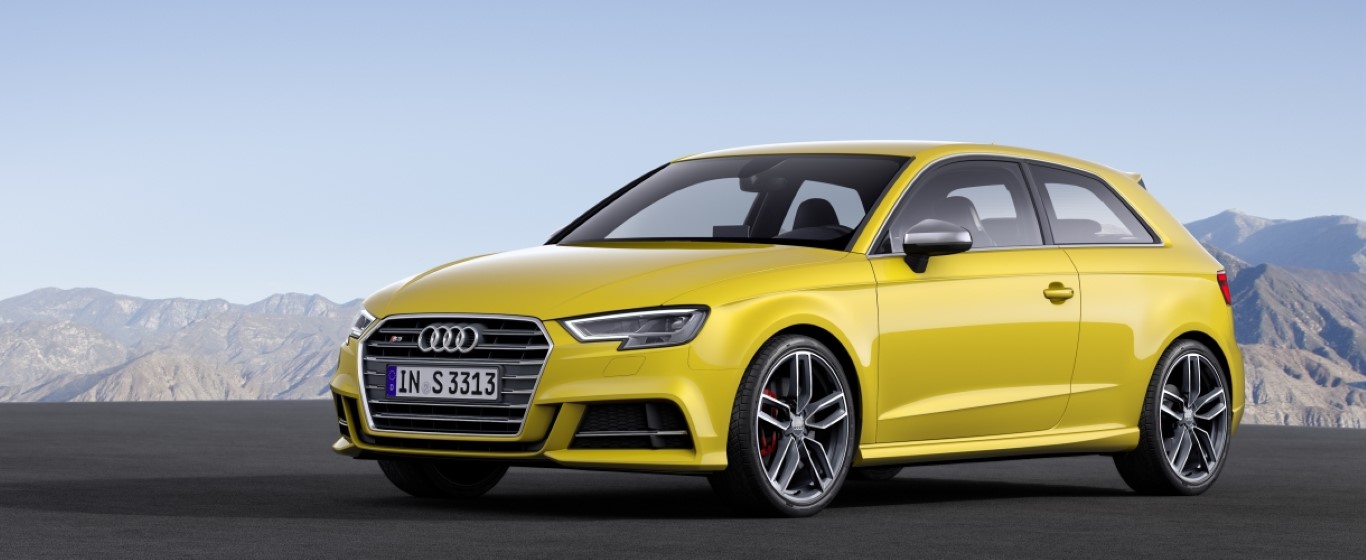
Historical Context and Design Philosophy
The first generation of the S3, internally designated as Typ 8L, hit the market in 1999, three years
after the launch of the conventional A3. Audi's goal was clear: to create a "hot hatch" that was not only
fast but also sophisticated, distancing itself from mainstream competitors like the Volkswagen Golf GTI or
the Ford Escort RS Cosworth, which focused purely on raw performance or cost-benefit.
The design of the S3 8L followed the Bauhaus school of functionality and minimalism, but with added
muscle. Unlike the A3, the S3 featured widened fenders to accommodate wider tracks, discreet yet assertive
side skirts, and redesigned bumpers to house the dual intercoolers (a technical necessity that became a
visual trait). Available exclusively as a 3-door hatchback, the model communicated a sporting purity and
structural rigidity that the 5-door version (launched later for the regular A3) could not convey at the
time.
Mechanical Engineering: The 1.8T 20V Engine
The heart of the S3 8L is a fundamental piece in the history of compact internal combustion engines. It is a
1.8-liter, inline 4-cylinder engine with a turbocharger and a cylinder head featuring the distinct
configuration of 5 valves per cylinder (3 intake and 2 exhaust), totaling 20 valves. This exotic
configuration aimed to maximize volumetric efficiency at high RPMs, allowing the engine to "breathe" better.
The evolution of this engine during the 8L's lifecycle is divided into two distinct phases, crucial
for collectors and enthusiasts:
Phase 1: Pre-Facelift (1999–2001)
The first models left the factory with engines calibrated to deliver 210 hp (154 kW) and 270 Nm of
torque.
- Engine Codes: Initial units used the APY and AMK codes. The APY engine is
often associated with robust internal components, although there are technical debates regarding the
strength parity between the connecting rods and pistons of this version and later ones. The electronic
management system was already advanced for its time, allowing precise adjustments of ignition and
injection.
- Performance: Acceleration from 0 to 100 km/h was achieved in approximately
6.8 to 6.9 seconds, respectable numbers that put the S3 ahead of many dedicated rear-wheel-drive sports
cars of the era.
Phase 2: Facelift (2001–2003)
In a mid-life update, Audi introduced significant improvements. The engine received the BAM code,
which would become legendary in the tuning community.
- Technical Improvements: Power was raised to 225 hp (165 kW) and torque
increased to 280 Nm. More than just a software remap, the BAM engine featured structural reinforcements,
including revised piston pins (although there is controversy over the 19mm vs 20mm diameter compared to
the AMK) and an improved variable valve timing (VVT) system to optimize the torque curve.
- Dynamic Results: The 0 to 100 km/h time dropped to about 6.6 seconds. Top
speed increased marginally, but the main difference felt by the driver was the engine's elasticity in
rolling acceleration.
The Quattro System and the Introduction of Haldex
Unlike Audi's larger models (A4, A6), which used longitudinal engines and the purely mechanical
Torsen center differential, the S3 8L had a transverse engine (due to the platform shared with the VW Golf).
This required an innovative solution for all-wheel drive: the 1st Generation Haldex system.
This system was based on an oil-bathed multi-plate clutch located next to the rear differential.
Under normal grip conditions, the S3 8L behaved predominantly as a front-wheel-drive car (approximately 95%
of torque to the front axle). Upon detecting a rotation difference between the axles (wheel slip), a
mechanical hydraulic pump generated pressure to close the clutch and transfer torque to the rear wheels.
While effective for traction on slippery surfaces, the system was "reactive" — it required the slip to occur
before correcting it.
The S3 8L in Brazil
The arrival of the S3 in Brazil was a milestone of status. Officially imported, the model
consolidated the brand's premium image, which was already manufacturing the domestic A3 in Paraná. Brazilian
units were typically "top of the line", equipped with electric Recaro seats, sunroof, and a Bose sound
system. The 225 hp model (BAM engine) arrived in the country in its final years of production (2002-2003)
and is extremely highly valued today by collectors due to its rarity and potential for mechanical tuning.