

8T
(2010 - 2011)
3.0 V6 Supercharged
333 cv
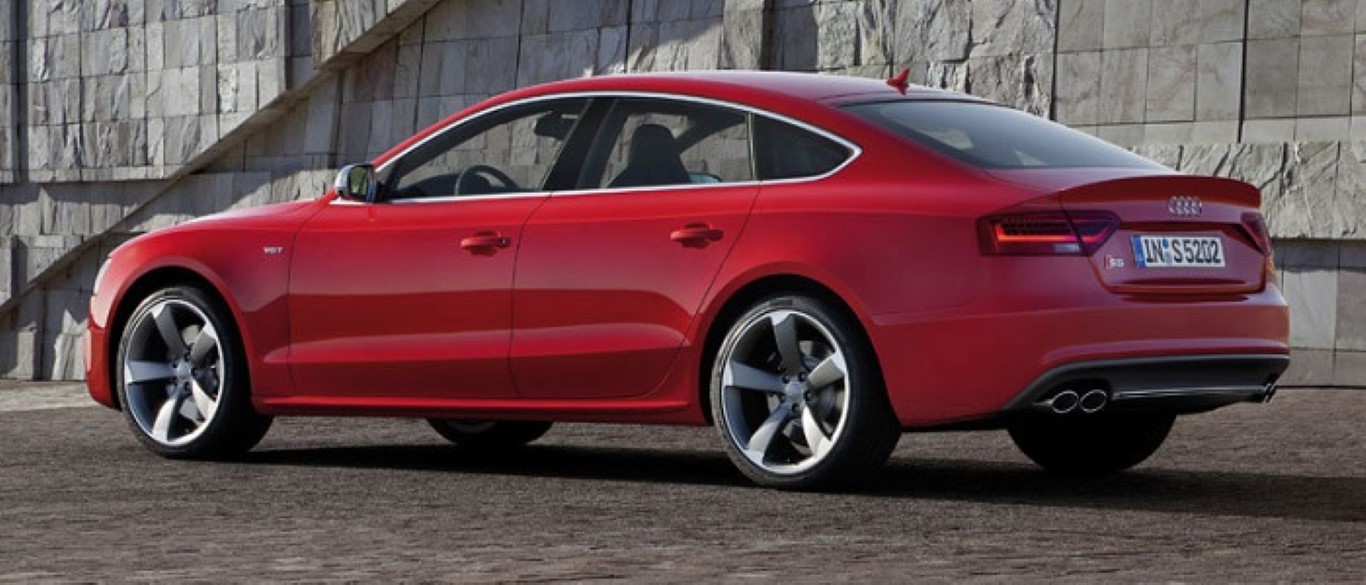
Technical specifications, versions, and history for the Audi S5 Sportback.
Select a generation to see available versions
(2010 - 2011)

(2012 - 2016)

(2017 - 2019)

(2020 - 2024)
Select a powertrain to view full technical specifications
The launch of the Audi S5 in 2007 did not merely represent the introduction of a new model into the German automaker's portfolio; it symbolized a fundamental strategic pivot in the brand's identity. During the 1990s and early 2000s, Audi focused heavily on sedans (A4, A6, A8) and station wagons (Avants), leaving a vacuum in the mid-size luxury coupe segment since the discontinuation of the Audi Coupé (based on the B3/B4 chassis) in 1996. The S5, revealed simultaneously with the A5 at the Geneva Motor Show, was Audi's answer to the dominance of the BMW 3 Series Coupe and the Mercedes-Benz CLK, positioned as a classic Grand Tourer (GT): a vehicle capable of crossing continents at high speed with supreme comfort, while maintaining the agility needed for winding roads.
The importance of the S5 transcends its powertrain; it was the debut vehicle for a new modular architecture that would define Audi's driving dynamics for nearly two decades. Designed by the renowned Walter de Silva, who described the A5/S5 as "the most beautiful car I have ever designed," the model brought classic proportions with a long hood, short overhangs, and the distinctive lateral "tornado line" that became a visual signature of the brand.
This report dissects the history of the Audi S5 through its generations (B8, B8.5, B9, B9.5, and the upcoming B10), analyzing the body variations (Coupe, Cabriolet, and Sportback), the complex powertrain choices that ranged from naturally aspirated V8s to diesel V6s, and the impact of these decisions on the global automotive market.
To understand the S5, it is imperative to understand the underlying engineering that allowed its existence. Before 2007, many Audi vehicles based on the B platform (like the A4 B6/B7) suffered dynamic criticisms due to engine placement. The engine block was mounted entirely ahead of the front axle, resulting in an excessively front-heavy weight distribution (often 60/40 or worse), which exacerbated the tendency to understeer (the front of the car "pushing" or "sliding" in corners).
With the S5 (B8 generation), Audi debuted the Modular Longitudinal Platform (MLP). The crucial innovation of this platform was the repositioning of the front differential. Engineers moved the differential ahead of the clutch (or torque converter), allowing the front axle to be shifted forward by about 154 millimeters.
Direct impacts of the MLP architecture on the S5:
All iterations of the S5 were equipped with the Quattro permanent all-wheel-drive system. In the B8 and B9 generations, the system relied predominantly on a mechanical self-locking center differential (often Torsen or crown-gear in more recent versions). Under normal conditions, the torque distribution was 40% to the front axle and 60% to the rear, reinforcing the feel of a rear-wheel-drive car, but with the safety of all-wheel drive. The system could mechanically vector torque, sending up to 85% of the power to the rear or 70% to the front depending on available grip.
The first generation of the S5 is often considered the most "emotional" by purists, primarily due to the Coupe model's exclusive powertrain. Audi adopted an unusual bifurcated strategy, where the Coupe used a different engine from the Cabriolet and Sportback versions.
The B8 S5 Coupe was launched with a naturally aspirated 4.2-liter V8 engine (code CAUA). Unlike the high-revving V8 found in the RS4 of the same era, the S5's V8 was tuned to offer abundant torque at low and mid-range RPMs, suiting the car's GT profile.
Technical Specifications (S5 Coupe B8):
The presence of this large V8 engine in a mid-size coupe put the S5 in direct competition—in terms of character, if not raw power—with icons like the BMW M3 E92 and the Mercedes C63 AMG, although the S5 was positioned a step below in price and aggressiveness.
The B8 S5 Coupe offered two transmission options, varying by market:
When Audi expanded the S5 lineup to include the convertible model (Cabriolet) in 2009 and the four-door model with a coupe profile (Sportback) in 2010, the industry was already migrating towards downsizing. Consequently, these body styles never received the V8 engine.
Instead, they debuted the 3.0 TFSI V6 engine. Despite the "T" (Turbo) nomenclature, this engine used a Roots-type mechanical compressor (Supercharger) housed between the cylinder banks.
Technical Specifications (S5 Cabriolet/Sportback B8):
These models also introduced the 7-speed S-tronic transmission (DL501), a dual-clutch gearbox that offered millisecond gear changes, surpassing the Coupe's Tiptronic in reaction speed.
Comparative Table: S5 B8 Coupe vs. V6 Variants
| Characteristic | S5 Coupe (2007-2012) | S5 Sportback / Cabrio (2009-2012) |
|---|---|---|
| Engine | 4.2L Naturally Aspirated V8 (FSI) | 3.0L Supercharged V6 (TFSI) |
| Power | 354 hp | 333 hp |
| Torque | 440 Nm | 440 Nm |
| Induction | Natural | Mechanical Compressor (Roots) |
| Main Gearbox | 6-spd Manual or 6-spd Tiptronic | 7-spd S-tronic (Dual-Clutch) |
| Character | Classic, Sonorous, Linear | Technological, Low-end Torque, Fast |
The mid-life "facelift" of the B8 platform, known as B8.5, brought subtle aesthetic changes but critical mechanical standardization.
Starting in 2013, the S5 Coupe abandoned the V8 engine. The entire S5 lineup (Coupe, Sportback, and Cabriolet) was unified under the 3.0 Supercharged V6 engine (333 hp). Audi justified the change citing fuel efficiency and CO2 emissions. Although the loss of the V8's soundtrack was lamented, the V6 engine proved to be extremely robust and responsive, earning a reputation for high reliability and ease of power modifications (tuning).
During this phase, the manual transmission was eliminated in most global markets, including Europe, where the S-tronic became standard. However, the North American (US) market retained the 6-speed manual gearbox option exclusively for the Coupe until the end of production in 2017. This makes manual B8.5 S5 Coupes rare and highly valued vehicles in today's used market, representing the final combination of a modern chassis, a Supercharged V6 engine, and analog interaction.
Launched in 2017, the B9 generation was built on the new MLB Evo platform, a lighter and stiffer evolution of the previous architecture, utilizing an intelligent mix of ultra-high-strength steel and aluminum.
The biggest mechanical change was the replacement of the mechanical compressor with a turbocharger.
In a technical decision that surprised many, Audi abandoned the dual-clutch transmission (S-tronic) in the gasoline B9 S5, adopting the 8-speed ZF 8HP torque converter automatic transmission (code AL552/0D5).
Why the change?
The interior of the B9 marked a generational leap in technology. The highlight was the Audi Virtual Cockpit, a 12.3-inch digital instrument panel capable of rendering high-definition Google Earth maps at 60 frames per second, directly in the driver's line of sight. The horizontal design of the dashboard, with air vents spanning the entire width of the cabin, increased the feeling of space.
In 2020, the S5 received an update (facelift) designated B9.5. Visually, the car gained a wider honeycomb front grille, ventilation slits above the grille (a tribute to the 1984 Audi Sport Quattro), and a new infotainment system with a 10.1-inch touchscreen.
However, the big news was the radical bifurcation of powertrains based on geography.
The S5 kept the 3.0 Turbo gasoline V6 engine (354 hp / 500 Nm), continuing the B9's trajectory with minor refinements.
In Europe, Audi replaced the gasoline engine with a Diesel engine (TDI), aiming to meet CO2 emission targets and offer massive range for long-distance trips.
European S5 TDI Specifications:
Revealed in mid-2024, the B10 generation represents the largest restructuring in the model's history, affecting everything from the name to the body style offerings.
Audi restructured its product lineup: even numbers (A4, A6) will be dedicated to electric vehicles (e-tron), while odd numbers (A5, A7) will house combustion vehicles.
Thus, the former combustion A4 Sedan/Avant ceases to exist and is absorbed by the new Audi A5/S5 family. The S5 B10, therefore, replaces both the old S4 and the S5.
In response to the global decline in demand for coupes and convertibles, Audi discontinued the S5 Coupe and S5 Cabriolet. The B10 lineup consists exclusively of:
The S5 B10 debuts the Premium Platform Combustion (PPC).
The S5 Sportback, launched in 2010, became the central sales pillar for the model. By combining the emotional aesthetics of a coupe with the practicality of four doors and a wide-opening trunk (liftgate), it cannibalized sales from both the A4 sedan and the A5 coupe. In the US and China, the Sportback vastly outperformed the sales of the two-door versions, justifying its solitary survival in the B10 generation.
Although fundamental to the brand's image, the production volumes of the Coupe and Cabriolet were always fractions of the total. The Cabriolet, in particular, required heavy structural reinforcements (adding about 200 kg to the car's weight) to compensate for the lack of a fixed roof, which impacted dynamics. The decision to eliminate them reflects the rationalization of Audi's production in a market focused on SUVs and electrification.
Although Audi does not disclose exact production numbers by trim configuration, market data indicates that manual variants of the S5 (B8/B8.5) represented less than 5-10% of sales in markets where they were offered. Special editions like the Panther Edition (B9, limited to 100 units in the US, with Panther Black crystal-effect paint) are extremely rare and collectible.
Audi utilized various editions to maintain interest in the model throughout its life cycles:
| Edition | Generation | Exclusive Details |
|---|---|---|
| Black Edition / Black Optic | All | Replacement of all chrome (grille, window trims) with gloss black. Exclusive wheels (like the famous "Rotor" wheels on the B8). |
| Competition / Competition Plus | B9 / B9.5 | Focus on dynamics. Included manually adjustable coilover suspension (in some markets), recalibrated sport differential, a louder sport exhaust, and removal of acoustic insulation for more emotion. |
| Panther Edition | B9 (2019) | Exclusive to the US. Limited to 100 units (75 Sportback, 25 Coupe). Exclusive Panther Black Crystal paint (black with purple flakes), Alcantara interior with Crescendo Red stitching. |
| Carbon Edition | B9 | Introduced real carbon fiber components on the exterior (spoilers, mirror caps) and carbon inlays in the interior. |
For potential owners or students of the model, it is crucial to understand the mechanical weak points of each era:
The Audi S5 established itself as one of the most competent Grand Tourers of the 21st century. Its history is marked by adaptability: it was born with the visceral soul of a naturally aspirated V8 to challenge BMW's hegemony, matured with the efficiency of the mechanical compressor, and evolved into the digital age with turbos and hybrid systems.
The B8 Coupe generation with the V8 engine and manual gearbox remains the "Holy Grail" for collectors seeking the pure analog experience. The S5 Sportback (B9/B9.5), on the other hand, defined the modern standard of the "one car for everything", offering sports car performance, all-weather traction, and family practicality. With the arrival of the B10 generation and the end of the two-door variants, a golden chapter of expressive design closes, but the S5 name survives, now carrying the weight of also replacing the iconic S4.
Images of the Audi S5 Sportback