C4
(1994 - 1997)
4.2 V8
326 cv

Technical specifications, versions, and history for the Audi S6.
Select a generation to see available versions
(1994 - 1997)
(1999 - 2004)

(2006 - 2008)

(2009 - 2012)

(2013 - 2014)

(2015 - 2019)

(2020 - 2024)
The Audi S6 is not just a model within the vast range of Audi AG; it represents the crystallization of a specific automotive development philosophy known in the industry as "Q-Car" or "Sleeper". Strategically positioned between the mass-market executive sedan (the Audi A6) and the limited-production practical supercar (the Audi RS6), the S6 carries the burden and the privilege of being the daily-usable performance vehicle. Over almost three decades, the S6 has served as a barometer for the engineering priorities of the Ingolstadt brand, transitioning from rally-derived five-cylinder turbo engines to high-revving naturally aspirated V8s, experimenting with exotic-sourced V10 engines, returning to efficient forced induction and, finally, bifurcating into hybrid diesel technologies and electric propulsion.
This report exhaustively analyzes the trajectory of the Audi S6 in its Sedan (Limousine) and Avant (Station Wagon) versions. The analysis focuses on technical specifications, production nuances, critical regional variations, and the mechanical evolution that defines each generation, from the C4 platform to the imminent electrification of the PPE (Premium Platform Electric) era.
The history of the S6 begins in a period of profound restructuring of Audi's identity. In 1994, the brand decided to abandon the numerical nomenclature based on power or series (such as Audi 80, 100) in favor of the "A" alphanumeric structure (A4, A6, A8). The Audi 100, a pillar of the brand, was renamed the Audi A6. Consequently, the sporty version of the Audi 100, which since 1991 had been sold as the "Audi S4" (known by purists as the "Ur-S4" or original S4), needed a new name to align with the new A6 series. Thus the first Audi S6 was born.
It is crucial to understand that the C4 S6 was not an entirely new car, but rather a technical and aesthetic evolution of the C4 S4. The visual changes were subtle, removing the black trim from the bumpers in favor of full body-color paint, altering the headlights, and introducing new badges. However, under the skin, the engineering continued to reflect the excessive robustness typical of Audi in the early 90s.
The C4 generation of the S6 is unique in the model's history for offering two distinct engine options, each with a radically different character, defining two subcultures within the enthusiast community.
The most iconic and numerous powertrain of this period was the 2.2-liter, inline 5-cylinder, 20-valve, turbocharged engine, designated by the internal code "AAN". This engine is a legend in mechanical engineering due to its direct connection with the engines of Audi's Group B rally cars.
To compete with the refinement of BMW (5 Series V8) and Mercedes-Benz (E-Class V8) rivals, Audi also offered the S6 with a 4.2-liter V8 engine (AEC code).
Quattro permanent all-wheel drive was mandatory standard equipment. In this generation, the system utilized a Type 1 or Type 2 Torsen (Torque Sensing) center differential, depending on the year of manufacture. This purely mechanical system had the ability to vary torque distribution between the front and rear axles instantaneously, based on available grip, without the latency of Haldex clutch-based electronic systems that would later equip smaller Audi models.
The 6-speed manual transmission (code 01E) is famous for its industrial robustness. The first gear was short for quick launches, while the sixth gear served as an "overdrive" for high-speed fuel economy.
At the end of the C4 platform's life cycle (1996-1997), Audi produced a final farewell version, developed not by the main assembly line, but by its high-performance subsidiary, quattro GmbH (precursor to today's Audi Sport GmbH). This model was named the S6 Plus.
The disparity between Avant and Sedan production clearly demonstrates the historical S6 buyer's preference for the versatility of the station wagon body style, a trend that would continue in future generations.
Estimated Production Table: C4 Generation
| Model | Period | Body Style | Units Produced (approx.) |
|---|---|---|---|
| S4 (C4) | 1991–1994 | Sedan | 9,286 |
| S4 (C4) | 1991–1994 | Avant | 4,654 |
| S6 (C4) | 1995–1997 | Sedan | 3,231 |
| S6 (C4) | 1995–1997 | Avant | 3,724 |
| S6 Plus | 1996–1997 | Sedan | 97 |
| S6 Plus | 1996–1997 | Avant | 855 |
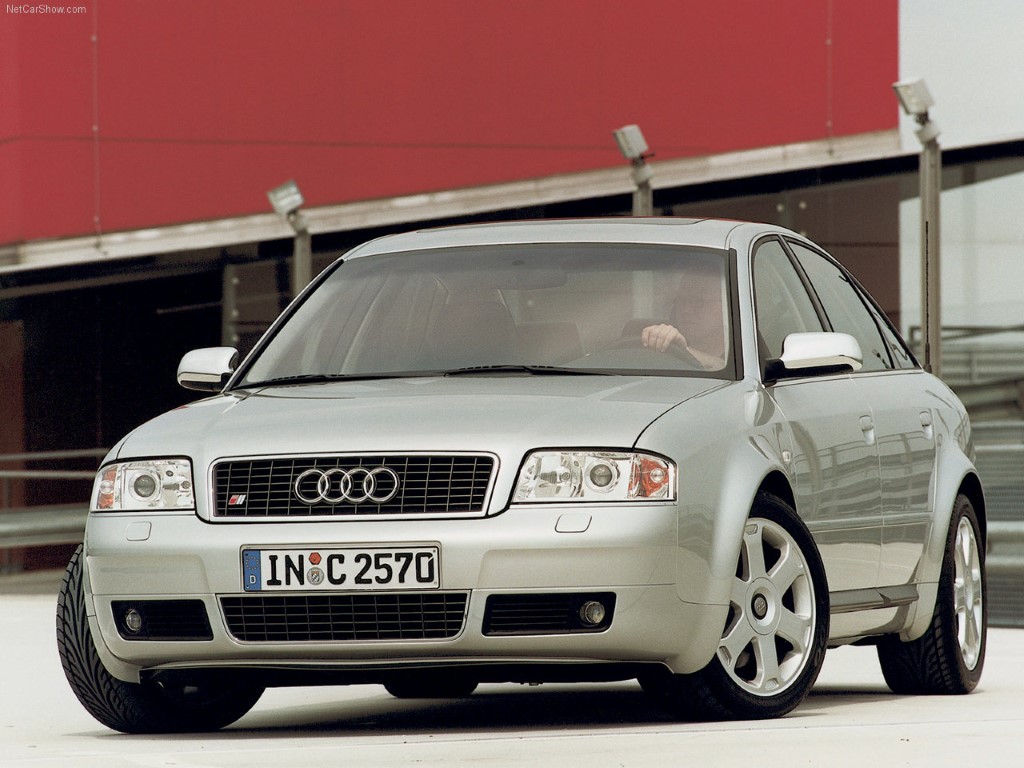
Launched in 1999, the C5 S6 represented a radical change. While the C4 was discreet, the C5 adopted a muscular stance. Audi applied a "widebody" treatment to the S6, significantly widening the wheel arches to accommodate wider axles and larger section tires (255/40 R17). This aesthetic alteration was not merely cosmetic; it allowed for more aggressive suspension geometry and greater lateral stability. The design followed the "Bauhaus" school of the C5 A6, with rounded lines and an arched roof that defined the aerodynamics of the era (Cd 0.34).
In this generation, Audi definitively abandoned the 5-cylinder engine for the S6, standardizing the naturally aspirated 4.2-liter V8. However, this was a technologically superior engine to the one in the previous S6 Plus.
Transmission was a point of significant divergence in this generation.
The C5 S6 utilized a Four-Link front suspension made entirely of aluminum to reduce unsprung mass. Although it provided precise handling and eliminated "torque steer", the aluminum control arms and their rubber bushings wore out quickly, becoming a frequent maintenance item. The rear suspension was a self-adjusting trapezoidal link setup, ensuring the rear wheels maintained optimal camber under heavy cornering loads.
It was during the C5 era that Audi's modern hierarchy was established. In 2002, Audi launched the C5 RS6, which took the S6's V8 engine and added two turbochargers to reach 450 horsepower. This repositioned the S6: it was no longer the absolute top, but rather the "rational" and naturally aspirated alternative, free from the complexity and astronomical maintenance costs of the turbos and the problematic DRC (Dynamic Ride Control) suspension of the RS6.
Although exact global numbers are difficult to isolate due to blending with A6 data, it is known that the C5 S6 was produced in considerably higher volumes than the C4 S6 Plus, but still maintained exclusivity. In the US, the C5 S6 Avant was sold only for the 2002 and 2003 model years, making it a rare sight.
In the mid-2000s, the German automotive industry entered an "arms race" of cylinders. With BMW launching the E60 M5 with a V10 engine, Audi responded by equipping the C6 S6 with a 5.2-liter V10 FSI (Fuel Stratified Injection) engine. This was the first and only time an S6 had ten cylinders.
There is a persistent myth that this engine was "lifted straight" from the Lamborghini Gallardo. The technical reality is more complex and interesting.
The C6 S6 holds a special place in the history of automotive design for introducing LED daytime running lights (DRL) integrated into the front bumper. This strip of 5 LEDs on each side not only became the S6's visual signature, but sparked a global trend of daytime lighting that all manufacturers subsequently followed.
Despite the 435 hp output, the C6 S6 weighed nearly 2,000 kg (1,970 kg for the Avant). Audi worked hard to mitigate the weight distribution (with the V10 hanging ahead of the front axle).
Production of the V10 S6 was limited, in part due to the 2008 global financial crisis that struck midway through its life cycle.
The C7 generation marked the end of giant naturally aspirated engines and the beginning of the era of turbo efficiency. The V10 was replaced by an all-new 4.0-liter Biturbo V8.
For the first time, the S6 received the 7-speed dual-clutch transmission (DL501). The instantaneous gear shifts (in the order of milliseconds) transformed acceleration performance. The C7 S6 accomplished 0-100 km/h in about 4.6 seconds (frequently tested at 4.0 seconds by magazines), destroying the times of the previous generation.
To justify a V8 in an emissions-conscious world, Audi introduced the Cylinder on Demand system. In light load situations (highway cruising), the system deactivated the valves and injection for cylinders 2, 3, 5, and 8, turning the engine into a V4.
In 2016, the line received a significant technical and visual update (C7.5).
Despite being mechanically robust, this generation's 4.0T engine has a known critical flaw. The oil filter screens that protect the turbochargers have a very fine mesh that tends to clog with oil residue over time. When this happens, the oil flow to the turbos is cut off, leading to catastrophic failure of the turbines. Audi released revisions of the part (with a wider mesh), and many owners perform this replacement preventatively.
The C7 generation was a massive commercial success. In the US, combined sales of the A6/S6 line remained above 20,000 units annually between 2013 and 2015. The versatility of the 4.0T engine, which offered V4 economy and supercar performance, attracted many buyers who had previously considered the BMW 550i or Mercedes E550.
The current generation (C8), launched in 2019, brought the most radical change in the S6's market strategy. For the first time, the powertrain depends entirely on the buyer's geographical region.
In Europe, where fuel costs are high and CO2 targets are strict, Audi equipped the S6 with a 3.0-liter TDI V6 Diesel engine.
In markets where diesel has a bad reputation or low acceptance (such as the US and China), the S6 utilizes a 2.9-liter Biturbo TFSI Gasoline V6 engine (the same engine from the RS5 and Porsche Panamera 4S).
The interior of the C8 represents total digitalization. The MMI rotary dial from the C6/C7 generations was eliminated in favor of two touchscreens with haptic (tactile) feedback. The "Virtual Cockpit" (digital instrument cluster) became standard.
Externally, the "Singleframe" grille became wider and lower, and the car adopted prominent shoulder lines that evoke the original Quattro from the 80s.
For the 2025 model year, Audi launched the "Nardo Sport Edition". This aesthetic package includes the exclusive Nardo Gray color (previously reserved for RS models), black roof, darkened headlights, carbon fiber trims, and Crimson red seat belts. Mechanically, the car maintains the specifications of the standard C8, signaling the maturity of this platform before replacement.
Audi has already officially announced the next phase of the S6 lineage: total electrification. The S6 e-tron, slated for 2025/2026, will be sold alongside the combustion models for a brief period.
The table below summarizes the evolution of key specifications across generations, allowing a direct comparison of engineering progress.
| Generation | Production Period | Main Powertrain (Gasoline) | Power | Torque | 0-100 km/h (Sedan) | Transmission | Approx. Weight |
|---|---|---|---|---|---|---|---|
| C4 S6 | 1994–1997 | 2.2L I5 Turbo (AAN) | 230 hp | 350 Nm | 6.8s | 6-Man / 4-Auto | 1,650 kg |
| C4 S6+ | 1996–1997 | 4.2L V8 (AHK) | 326 hp | 400 Nm | 5.6s | 6-Manual | 1,680 kg |
| C5 S6 | 1999–2003 | 4.2L V8 40v (ANK) | 340 hp | 420 Nm | 5.7s | 5-Tip / 6-Man* | 1,760 kg |
| C6 S6 | 2006–2011 | 5.2L V10 FSI (BXA) | 435 hp | 540 Nm | 5.2s | 6-Tiptronic | 1,910 kg |
| C7 S6 | 2012–2018 | 4.0L V8 TT (CEUC) | 420/450 hp | 550 Nm | 4.4s | 7-S Tronic | 1,895 kg |
| C8 S6 | 2019–Pres. | 2.9L V6 TT (DKMB) | 444 hp | 600 Nm | 4.4s | 8-Tiptronic | 2,035 kg |
| S6 e-tron | 2025+ | Dual Electric Motors | 543 hp** | N/A | 3.7s | 1-Speed | 2,370 kg |
*Manual available only in selected markets in Europe.
**Power with Launch Control/Boost.
For the collector or enthusiast, each generation offers a distinct value proposition:
The history of the Audi S6 is, ultimately, the story of Audi's relentless pursuit of "perfect all-weather performance". The model evolved from a rally homologation to a supercomputer on wheels, but has always kept its core promise: transporting four adults and luggage at supreme speed, total comfort, and absolute safety, without drawing unnecessary attention.