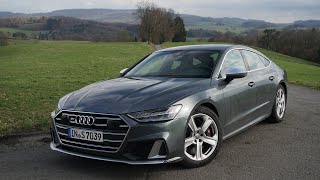
C7
(2012 - 2014)
4.0 V8 32V Twin-Turbo
420 cv

Technical specifications, versions, and history for the Audi S7.
Select a generation to see available versions
(2012 - 2014)

(2015 - 2019)

(2020-)
The contemporary automotive industry is defined by segmentation. However, few vehicles manage to navigate between distinct categories as competently as the Audi S7 Sportback. Positioned at the heart of the German brand's executive range, the S7 is not just a more powerful version of the A7 sedan; it represents the crystallization of the "Grand Tourer" (GT) concept for the 21st century. This report presents an exhaustive analysis of this model's trajectory, dissecting its origins, the engineering behind each generation, the market nuances — with a specific focus on the Brazilian scenario — and the numbers that define its exclusivity.
The "Sportback" concept, introduced by Audi, merged the aesthetic elegance of a coupe, the functionality of a station wagon (due to the trunk lid integrated with the rear window), and the comfort of a luxury sedan. The S7, launched in 2012, arrived to fill the critical gap between the rational A7 and the visceral RS7, offering a daily-usable performance proposition, capable of crossing continents at autobahn speeds with supreme comfort, while maintaining sharp dynamics when pushed on winding roads.
Across two main generations — the C7 (including the C7.5 facelift) and the C8 —, the model witnessed one of the most radical mechanical transformations in the brand's recent history, abandoning noble V8 engines in favor of complex, electrified V6 architectures, and, in certain markets, diesel-powered units. This document explores this technical and marketing metamorphosis in depth.
The first generation of the Audi S7 was built on the MLB platform (Modularer Längsbaukasten), a longitudinal modular matrix from the Volkswagen Group that allowed Audi to position the engine further back relative to the front axle, improving weight distribution compared to previous models. The model was revealed in 2011 and hit the global market as a 2012/2013 model, immediately setting a new design standard.
The design of the S7 C7 is frequently cited by critics and enthusiasts as one of the high points of automotive aesthetics in the 2010s. Differentiating itself from the conventional A7, the S7 adopted the "discreet sportiness" philosophy of the S line.
The core element of the S7 C7 experience was the 4.0 TFSI biturbo V8 engine (Engine Code: CEUC). This powerplant represented a significant technological leap for Audi, replacing the old naturally aspirated V10s from the previous S6/S8 with a smaller, supercharged, and more efficient unit.
Specifications and Technical Data (S7 C7)
"Hot-V" Architecture: A crucial innovation of this engine was the positioning of the two twin-scroll turbochargers inside the "V" formed by the cylinder banks, rather than on the outer sides. This configuration drastically shortened the path the exhaust gases needed to travel to the turbines, resulting in almost instantaneous acceleration response and the elimination of "turbo lag".
Cylinder on Demand (COD): To reconcile the performance of a V8 with fuel consumption requirements, Audi implemented the Cylinder on Demand system. In situations of light or medium load (such as highway cruising speed), the system deactivates cylinders 2, 3, 5, and 8, closing the valves and cutting off the injection. The engine then operates as a 2.0-liter V4. The transition occurs in milliseconds and is virtually imperceptible to the driver. To counteract the natural vibrations of a V4 engine, Audi installed active engine mounts (which generate counter-vibrations) and the Active Noise Cancellation system through the car's speakers.
Unlike the RS7, which used a conventional 8-speed automatic gearbox (ZF 8HP) to handle torque exceeding 700 Nm, the S7 C7 was equipped with the 7-speed S-Tronic transmission (Code DL501). It is a wet dual-clutch gearbox, known for its surgical speed in gear shifts and the feeling of a direct connection between the accelerator and the wheels.
The permanent Quattro all-wheel drive is the dynamic pillar of the model. In this generation, the system used a Crown Gear center differential, lighter and more compact than the traditional Torsen. Under normal conditions, the torque distribution was 40% to the front axle and 60% to the rear, giving a dynamic behavior closer to a rear-wheel-drive car. Optionally, the Rear Sport Differential actively distributed force between the rear wheels, accelerating the outer wheel in corners to mitigate understeer (the car's tendency to push wide).
The Audi S7 Sportback was introduced to the Brazilian market in the second half of 2013. The economic context of the time still allowed the importation of niche vehicles with some viability, although the "Super IPI" (higher industrial tax) was already in effect.
In 2014, Audi presented the mid-life update for the A7 family, dubbed the "facelift" or "C7.5" generation. Global sales began as a 2015 model, arriving in Brazil shortly after. Although the basic structure remained unchanged, the technological and mechanical improvements were substantial.
The most striking visual change occurred in the light clusters. The S7 C7.5 introduced sharper and more angular headlights, equipped with Matrix LED technology (standard in Brazil). This system uses a camera on the windshield to detect vehicles ahead or oncoming, individually turning off the LED diodes that would cause glare, while keeping the rest of the road illuminated at maximum power.
At the rear, the taillights received a new, more horizontal internal design and, most importantly, dynamic turn signals (which light up sequentially in the direction of the turn), a feature that would become a brand design signature.
Audi refined the mapping of the 4.0 TFSI V8 engine for the C7.5 phase.
The interior received crucial processing updates. The MMI (Multi Media Interface) Navigation Plus system started using an Nvidia Tegra 30 graphics processor, allowing fluid menu transitions and detailed 3D maps.
The update arrived in Brazil for the 2016 model year. However, the economic scenario had changed drastically, with a high dollar exchange rate and an economic recession.
The completely new second generation of the S7 was introduced in 2019, based on the new evolution of the MLB Evo platform. This model brought a philosophical and mechanical rupture that sparked intense debates among enthusiasts and the specialized press: the decision to equip the car with different engines depending on the continent.
The design of the S7 C8 was heavily influenced by the "Audi Prologue" concept. The Singleframe grille became wider and lower, positioned to emphasize the visual width of the car. The character lines became more muscular over the wheel arches (an homage to the original 1980s Audi Quattro).
The most distinctive element is the rear lighting: a continuous OLED light bar connects the two taillights, executing complex animations ("Coming Home/Leaving Home") when locking and unlocking the vehicle, creating an unmistakable nighttime signature.
For the first time in the model's history, Audi split the S7's powertrain globally.
In the European market, pressured by CO2 reduction targets and the popularity of diesel in long-distance vehicles, Audi launched the S7 with a 3.0 V6 TDI engine.
For markets like the US, China, the Middle East, and (potentially) Brazil, where diesel in passenger cars is prohibited or unpopular, the S7 received the 2.9 biturbo V6 TFSI engine.
In both the diesel and gasoline versions, the S7 C8 abandoned the S-Tronic (DCT) gearbox in favor of a conventional 8-speed automatic transmission (Tiptronic/ZF 8HP).
The situation of the S7 C8 in Brazil is complex. Audi do Brasil restructured its high-performance portfolio, focusing on the RS line (RS6, RS7, RS Q8) and EVs (e-tron GT).
Confusion between the S and RS versions is common, but the differences go far beyond a simple engine software tune. The table below details the structural distinctions:
| Characteristic | Audi S7 Sportback | Audi RS7 Sportback |
|---|---|---|
| Bodywork (Width) | Standard body ("Narrow Body"). Width equal to the A7 with the S-Line package. | "Widebody". Fenders widened by about 40mm on each side to accommodate wider tracks and wider tires. |
| Suspension | Adaptive Air Suspension as standard. Focus on the balance between comfort and sport. | RS Sport Suspension with steel springs and optional Dynamic Ride Control (DRC). Cross-linked hydraulic system to eliminate body roll. Much stiffer. |
| Engine (C7 Generation) | 4.0 V8 with smaller turbos and standard internal components. (420-450 hp). | 4.0 V8 with larger turbos, forged pistons and connecting rods, enlarged cooling system. (560-605 hp). |
| Transmission (C7) | 7-speed S-Tronic (Dual Clutch). Faster and crisper shifts. | 8-speed Tiptronic (ZF). Necessary to handle the massive torque of the RS7 without breaking. |
| Brakes | High-performance steel discs (6-piston calipers at the front). | Optional "Wave" steel or Carbon Ceramic discs (massive calipers, discs up to 420mm). |
| Intended Use | The perfect "Daily Driver". Long trips, executive discretion, comfortable urban use. | The "4-door supercar". Track performance, raw acceleration, aggressive visual presence. |
Audi does not publicly disclose segregated production numbers for the S7 in its annual shareholder reports, grouping it under the "A7" family. However, through registration and sales data in key markets, it is possible to draw an overview.
Sales Table (US Example - A7/S7/RS7 Family)
Note: Approximate numbers based on sales records.
| Year | Total Sales (US) | S7 Estimate (~10%) |
|---|---|---|
| 2016 | 6,558 | ~650 |
| 2017 | 4,810 | ~480 |
| 2018 | 3,833 | ~380 |
| 2019 | 4,870 | ~480 |
| 2023 | 1,430 | ~140 |
| 2024 | 1,042 | ~100 |
For the Brazilian consumer interested in acquiring a used S7 (usually C7 or C7.5), it is vital to know the technical aspects that require attention, to avoid unpleasant financial surprises. Mechanical reliability is high for a car of this size, but preventive maintenance is non-negotiable.
This is the most famous chronic problem of the 4.0 TFSI V8 engine.
The mounts supporting the engine are hydraulic and electronically controlled to cancel out vibrations from the 4-cylinder mode (COD). They have a limited lifespan (usually 40,000 to 60,000 km on bad roads). When they fail, they leak a dark fluid and the car exhibits excessive vibrations. Replacement is costly due to the complexity of the part.
As in any car with air suspension, the rubber bags dry out over time (7 to 10 years). If the car wakes up sitting low / sagged on one side, it is a sign of a leak. The suspension compressor can burn out if forced to work continuously to compensate for the leak.
The S-Tronic transmission is robust, but the mechatronic unit (the electronic/hydraulic brain of the gearbox) and the clutches can suffer wear, especially in cars with aggressive ECU tunes (remaps). Regular changes of the gearbox fluid are essential for longevity.
The Audi S7 Sportback has consolidated itself as an icon of versatility and engineering. It offers a rare synthesis: the status of an executive car, the beauty of a coupe, and the performance of a sports car, all wrapped in a cutting-edge technological package.
The C7/C7.5 Generation remains the "sweet spot" for Brazilian enthusiasts. It combines the irreplaceable charisma of the V8 engine, the telepathic response of the dual-clutch gearbox, and a design that has aged with extreme dignity. It is a future classic in the making.
The C8 Generation, although technologically superior, suffered from the loss of mechanical identity (swapping the V8 for the V6) and from shifting global market preferences. Recent news indicates that Audi plans to restructure its nomenclature: even numbers (A6, S6, A8) will become electric, and odd numbers (A5, A7) will retain combustion engines for a while longer. This suggests that the "S7" name may disappear or be reinvented in a future electric lineup, possibly merging with the successor to the A6 e-tron.
For the automotive connoisseur, the S7 is not just a means of transportation; it is a declaration of appreciation for refined mechanical engineering and timeless design, representing an era where elegance and power walked hand in hand on the Autobahns and avenues of the world.
| Characteristic | Generation C7 (2012–2014) | Generation C7.5 (2015–2018) | Generation C8 (2019–Present) |
|---|---|---|---|
| Engine | 4.0 V8 TFSI Biturbo | 4.0 V8 TFSI Biturbo | 2.9 V6 TFSI (Gas) / 3.0 V6 TDI (Diesel) |
| Power | 420 hp | 450 hp | 444 hp (Gas) / 349 hp (Diesel) |
| Torque | 56.1 kgfm | 56.1 kgfm | 61.2 kgfm (Gas) / 71.4 kgfm (Diesel) |
| Gearbox | 7-speed S-Tronic (Dual Clutch) | 7-speed S-Tronic (Dual Clutch) | 8-speed Tiptronic (Torque Conv.) |
| Headlights | Xenon Plus / LED | Matrix LED (Sharper design) | HD Matrix LED with Laser Light |
| Infotainment | MMI 3G+ (Retractable screen) | MMI MIB2 (CarPlay/Android Auto) | MMI Touch Response (Dual screens) |
| Highlight | V8 Sound, Original Design | Refinement, Connectivity | Technology, Rear-wheel steering |