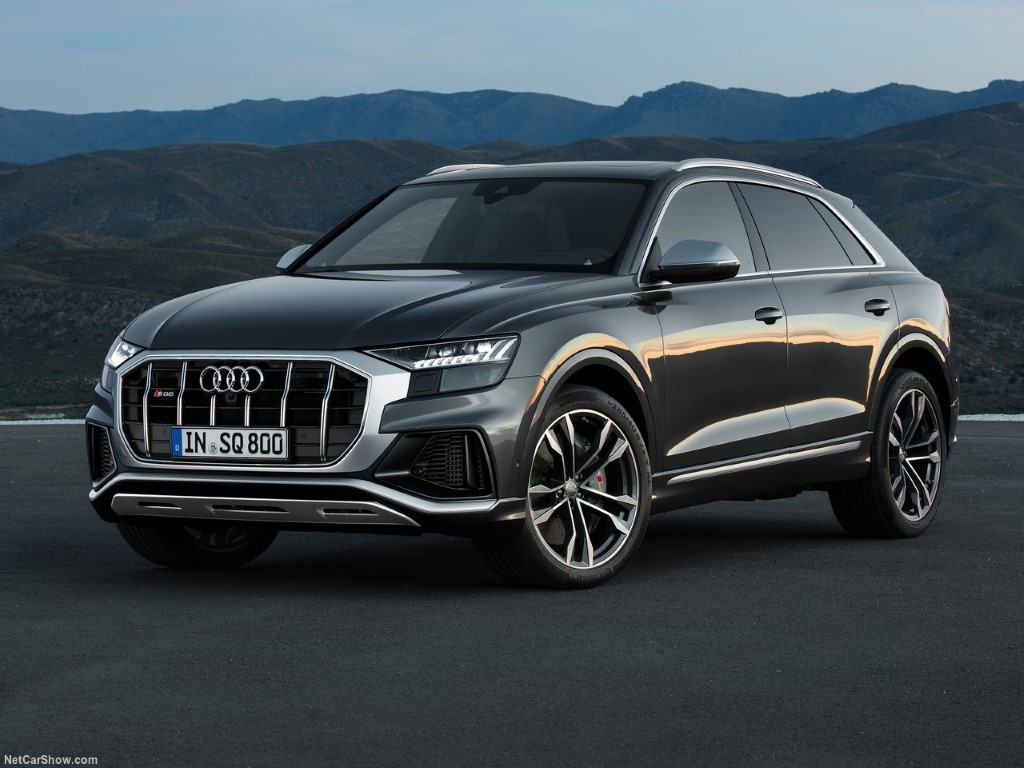
Audi SQ8

Audi SQ8

Brute force and elegance: the SUV coupe that transformed colossal size into pure dynamic agility.

Audi SQ8 Generations

Select a generation to see available versions

Audi SQ8 4M

4M

(2019-2023)

4.0 V8 twin-turbo petrol MHEV 507 cv
Audi SQ8 4M Facelift

4M Facelift

(2024-)

4.0 V8 twin-turbo petrol MHEV 507 cv

Technical Data and History: Audi SQ8

Introduction: Strategic Positioning and the "S" Philosophy

The launch of the Audi SQ8 was not merely the addition of another model to the Ingolstadt manufacturer's portfolio; it represented the culmination of a decades-long strategy to dominate the high-performance luxury SUV segment. Positioned at the critical intersection between the functional rationality of the standard Q8 and the unbridled performance of the RS Q8, the SQ8 plays the role of an elevated "Grand Tourer", designed to offer transcontinental capability with supreme comfort and engaging dynamics.

The history of the SQ8 is intricately linked to the evolution of the "SUV Coupe" concept. While competitors like the BMW X6 (2008) and the Mercedes-Benz GLE Coupe (2015) inaugurated the segment with silhouettes that often sacrificed visual harmony for the sake of novelty, Audi opted for a later, yet more refined approach. The Q8 project, and consequently the SQ8, avoided the "sedan on stilts" profile in favor of a wider, lower, and visually planted stance, directly inspired by the legendary Audi Ur-Quattro of the 1980s. The widened wheel arches (blisters) and the wide, angular C-pillar are not mere aesthetic adornments, but engineering statements that communicate the presence of Quattro all-wheel drive as the core of the vehicle's identity.

This report exhaustively analyzes the trajectory of the Audi SQ8, dissecting the complexities of its engineering on the MLB Evo platform, the tectonic transition from diesel (TDI) to gasoline (TFSI) powertrains driven by global regulations, and the recent bifurcation towards full electrification under the SQ8 e-tron designation. It will explore the production details at the Bratislava plant, the market nuances that differentiate European versions from North American and Brazilian ones, and the chassis technology that allows a 2.3-ton vehicle to defy the laws of physics.

Genesis and Development: From Concept to Reality

The Concept Car Lineage (2017)

The path to the SQ8 began publicly in January 2017, at the Detroit Auto Show, with the unveiling of the Audi Q8 Concept. This show car not only established the design language of the future top-of-the-line range but also signaled the brand's performance intentions. A few months later, at the 2017 Geneva Motor Show, Audi refined the vision with the Audi Q8 Sport Concept.

The Q8 Sport Concept was fundamental to the development of the production SQ8. It featured a 3.0 TFSI V6 engine combined with a mild hybrid system (mHEV) and an electric compressor, generating 476 hp and 700 Nm of torque. Although the final SQ8 adopted V8 architectures (both diesel and gasoline), the concept validated crucial technologies that would be implemented in the production version:

  • 48-Volt Electrical System: The backbone for the active chassis systems.
  • Electric Powered Compressor (EPC): Validated in the concept to eliminate turbo lag, a technology that would define the first generation of the SQ8 TDI.
  • Aggressive Aesthetics: The octagonal Singleframe grille with a honeycomb structure and the massive air intakes from the concept were transferred almost without alterations to the production SQ8, immediately differentiating it from the standard Q8 models.

The MLB Evo Architecture: A Noble Foundation

Understanding the SQ8 requires a deep analysis of its structure, the Modularer Längsbaukasten Evo (MLB Evo) platform. This is not just a collection of mounting points; it is an architecture shared with the elite of the Volkswagen Group, including the Lamborghini Urus, Bentley Bentayga, and Porsche Cayenne.

The SQ8's torsional rigidity is achieved through the multi-material Audi Space Frame (ASF) concept. The structure integrates:

  • Cast Aluminum: Used in the suspension towers and subframe connection points to absorb extreme suspension loads and reduce unsprung weight.
  • Ultra-High-Strength Steels: Hot-formed, they make up the passenger safety cell, the transmission tunnel, and the door sills, ensuring impact integrity and rigidity for driving dynamics.
  • Rolled Aluminum: Employed in the body panels (roof, doors, hood, tailgate) to lower the center of gravity.

This structural "nobility" is what allows the SQ8 to behave dynamically more like a sports sedan than a truck, drastically differentiating it from SUVs based on cheaper transverse platforms.

Mechanical Engineering: The Era of V8 Engines

The history of the SQ8 is a narrative of two distinct engine eras, each representing the pinnacle of technology available in its time and regulatory context.

Phase I: The Diesel Apex (SQ8 TDI, 2019–2020)

At the European launch in 2019, Audi made the bold decision to equip the SQ8 with the most sophisticated and powerful passenger diesel engine in the world, the EA898.

V8 TDI Architecture

This 4.0-liter (3,956 cc) biturbo V8 engine was designed to deliver a relentless wave of torque, ideal for moving the SUV's mass with effortless authority.

  • Power: 435 hp (320 kW).
  • Torque: 900 Nm, available from a mere 1,250 rpm.
  • Complex Forced Induction: The system utilized two sequential turbochargers. At low rpms, only one turbo operated. As load and rpm increased (above 2,200 rpm), the second turbo came into action.

The Electric Powered Compressor (EPC)

The "secret" to the TDI's performance was the third induction device: the Electric Powered Compressor (EPC). Powered by the 48-volt subsystem, the EPC was located in the intake air path, downstream of the intercooler.

  • Operation: On standing starts or roll-on acceleration at very low rpms, where exhaust gas energy is insufficient to spin conventional turbos, the EPC would accelerate its turbine to 70,000 rpm in less than 250 milliseconds. This pressurized the air instantly, eliminating turbo lag and ensuring that the 900 Nm were available at the slightest touch of the throttle.

The Decline of Diesel

Despite its technical excellence and efficiency (allowing ranges exceeding 1,000 km), the V8 TDI fell victim to increasingly stringent emissions standards and the shift in public perception post-Dieselgate. The complexity of the after-treatment systems necessary to keep the engine legal (dual AdBlue injection, massive particulate filters) made its continuation unviable, leading to its global replacement in 2020.

Phase II: Gasoline Supremacy (SQ8 TFSI, 2020–Present)

Starting in late 2020, the SQ8 was unified globally under the gasoline V8 TFSI engine, the same EA825 block developed in partnership with Porsche and used in the Panamera and Cayenne Turbo.

V8 TFSI Architecture

This 4.0-liter (3,996 cc) engine represents a different philosophy: quick response, high revs, and raw power.

  • Power: 507 hp (373 kW).
  • Torque: 770 Nm.
  • "Hot V" Configuration: The two twin-scroll turbochargers are mounted inside the engine's 90-degree "V". This drastically shortens the exhaust gas path between the cylinder head and the turbine, improving thermal and kinetic response.

Efficiency and Durability Technologies

  • Cylinder on Demand (COD): Under partial load situations, the system deactivates cylinders 2, 3, 5, and 8. The system closes the valves and cuts off injection and ignition, allowing the engine to operate as a balanced V4, reducing consumption while cruising.
  • Atmospheric Plasma Spray (APS) Coating: The cylinder liners in the aluminum block are coated with an extremely thin and hard iron layer via plasma spray. This reduces friction, wear, and improves heat dissipation, essential for a high-power-density engine.

ZF 8HP Transmission

Both powertrains use the ubiquitous and acclaimed 8-speed ZF automatic transmission (Tiptronic in Audi parlance). This torque converter gearbox is preferred over dual-clutch transmissions (S-tronic) for high-torque and towing applications, offering smoothness in low-speed maneuvers and the robustness to handle up to 1,000 Nm of torque. Audi's management software adapts gear shifts based on the selected driving mode, ranging from imperceptible (Comfort) to aggressive with artificial "kicks" (Dynamic).

Direct Performance Comparison

The table below illustrates the technical evolution between the two phases of the combustion SQ8:

Specification SQ8 TDI (2019-2020) SQ8 TFSI (2020-Present) Difference / Impact
Engine 4.0 V8 Biturbo Diesel + EPC 4.0 V8 Biturbo Gasoline Change of philosophy: Torque vs. Power.
Power 435 hp (320 kW) 507 hp (373 kW) +72 hp in favor of TFSI.
Torque 900 Nm 770 Nm -130 Nm on TFSI (less initial "punch").
0-100 km/h 4.8 s 4.1 s TFSI is 0.7s faster due to weight and power.
Weight (approx.) ~2,440 kg ~2,320 kg TFSI is lighter (aluminum vs. iron block).
Combined Consumption ~12.8 km/l (7.8 l/100km) ~8.3 km/l (12.0 l/100km) TDI was drastically more efficient.
Sound Synthesized (Soundaktor) Natural (Crossplane V8) TFSI offers authentic auditory emotion.
Chassis Dynamics and Suspension Technologies

The SQ8's true triumph is not just accelerating fast, but cornering like a vehicle with half its weight. This is achieved through the Electronic Chassis Platform (ECP), which orchestrates four main systems.

Adaptive Air Suspension Sport

Standard on the SQ8, this system uses three-chamber air springs. Depending on the driving mode and speed, the system can vary the spring stiffness (by activating or deactivating individual air chambers) and the vehicle's ride height over a 90 mm range.

  • Highway: The vehicle lowers to reduce aerodynamic drag and increase stability.
  • Off-road: Raises for maximum ground clearance (up to 254 mm).
  • Sport: The damping tuning becomes stiffer for mass control.

Electromechanical Active Roll Stabilization (eAWS)

Perhaps the most transformative technology in the SQ8. Unlike passive anti-roll bars (which are a fixed compromise between comfort and control) or older hydraulic systems (slow and complex), eAWS uses the 48-volt system.

  • Mechanism: A compact electric motor divides the anti-roll bar into two halves.
  • On Straights: The motor decouples the halves. If the left wheel hits a pothole, the impact is not transferred to the right, ensuring a silky smooth ride.
  • In Corners: The motor twists the halves in opposite directions with up to 1,200 Nm of torque. This actively counteracts the centrifugal force, keeping the body flat. The system reacts in milliseconds and can even recover energy from suspension oscillations.

All-Wheel Steering

Standard in most markets for the SQ8. The rear axle has an independent electric steering system.

  • Low Speed (<60 km/h): The rear wheels turn up to 5 degrees in the opposite direction of the front ones. This virtually shortens the wheelbase, reducing the turning circle by about 1 meter and facilitating urban maneuvers.
  • High Speed (>60 km/h): They turn in the same direction as the front ones (up to 2-3 degrees). This virtually lengthens the wheelbase, providing superior directional stability during highway lane changes.

Quattro Sport Differential

While the mechanical center differential (Torsen) distributes torque 40:60 (front/rear) under normal conditions, the optional sport differential on the rear axle is what gives the SQ8 its agility.

  • Torque Vectoring: In corners, two multi-plate clutches at the rear differential outputs can send almost all rear torque to the outside wheel. This creates a yaw moment that "pushes" the car's nose into the corner, eliminating the understeer typical of large Audis and allowing for earlier acceleration out of corners.
Design and Life on Board

Exterior: Contained Aggression

The design of the SQ8, overseen by Marc Lichte, is a study in muscular proportions. The Singleframe front grille receives specific "S" treatment, with an aluminum or gloss black finish (Black Optic package) and vertical double blades. The side air intakes are functional, feeding the intercoolers and auxiliary radiators.

At the rear, the diffuser houses four real oval exhaust tips. The continuous light element connecting the taillights emphasizes the vehicle's width.

The 2024 update introduced Matrix LED headlights with Laser technology (identified by a blue "X" in the headlight) and customizable digital OLED taillights, where the owner can choose between four brake/position light designs.

Interior: The Digital Cockpit

The interior is dominated by the MMI Touch Response concept.

  • Screens: A 10.1-inch upper screen manages infotainment and navigation, while the lower 8.6-inch screen controls climate and text input. Haptic and acoustic feedback is crucial for usability on the move.
  • Virtual Cockpit Plus: The 12.3-inch instrument cluster offers the exclusive "S-Performance" layout, with a central boomerang or bar-shaped rev counter, flanked by configurable information such as map, media, or performance data (power, torque, G-force).
  • Materials: Valcona leather sports seats with diamond stitching are standard or optional depending on the market. Matte carbon fiber trims (Carbon Twill Matte) or brushed aluminum replace the traditional woods of the Q8.
Production, Markets, and the Brazilian Reality

The Production Center: Bratislava

All Audi Q8s and SQ8s are manufactured at the Volkswagen plant in Bratislava, Slovakia. This factory is a complex logistical hub, receiving engines from Hungary (Győr) and Germany, and coordinating just-in-time production with the VW Touareg and Porsche Cayenne lines. Assembly of the SQ8 requires specific "marriage" processes (joining the body with the chassis) due to the complexity of the 48V system and active suspensions.

Sales and Market Performance

Although Audi does not disclose separate numbers for the SQ8 in all reports, the Q8 family as a whole maintains solid sales. In the US, the Q8 sold nearly 7,000 units in 2024, despite being at the end of its pre-facelift cycle. The Audi Sport GmbH division (responsible for S and RS models) reported record sales in 2023, driven by continuous demand for high-performance SUVs.

The Audi SQ8 in Brazil: A Case Study

The SQ8's presence in Brazil is peculiar and reflects the brand's fluctuating strategy in the country.

  • Combustion (V8 TFSI): Unlike the US and Europe, the combustion SQ8 was not a perennial "regular catalog" model in Brazilian dealerships. Audi Brasil historically focused on the 3.0 V6 Q8 for volume and the RS Q8 for top-tier image. The SQ8 V8 TFSI arrived in limited batches or via on-demand import, creating a price and performance gap. In the Fipe Table, the model is listed (e.g., 2024 model year), with reference values between R$ 691,762 and R$ 852,927 for pre-owned/used units. However, its rarity makes it an exclusive vehicle, often visually confused with the Q8 S-Line, but drastically superior mechanically.
  • Electrification (SQ8 e-tron): The strategy changed radically with electrification. The Audi SQ8 Sportback e-tron (formerly e-tron S) was officially launched with great fanfare, positioned as the brand's electric pinnacle. With a launch price in the range of R$ 834,990, it assumed the mantle of "S" performance in Brazilian showrooms.
The New Frontier: Audi SQ8 e-tron

To add to the complexity, Audi renamed its original e-tron line. The former "e-tron S" is now the SQ8 e-tron. It is vital not to confuse this model with the combustion SQ8 TFSI.

Fundamental Differences

The SQ8 e-tron is a Battery Electric Vehicle (BEV) built on an adapted version of the MLB Evo platform.

  • Powertrain: Uses three electric motors (one front, two rear).
  • Performance: 503 hp and a monstrous 973 Nm of instantaneous torque.
  • Electric Vectoring: The two rear motors are independent. In corners, the system can apply positive torque to the outer wheel and negative torque (regeneration) to the inner one, pivoting the car with a precision that mechanical differentials struggle to match.
  • Experience: While the SQ8 TFSI is defined by the sound and mechanical vibration of the V8, the SQ8 e-tron is defined by silence and immediate torque response, with no gear changes.
Maintenance, Reliability, and Common Problems

Owning an SQ8, whether TDI or TFSI, requires meticulous attention to maintenance.

Belt Starter Generator (BSG) - The "Achilles" of the 48V

A notorious problem affecting Audi models with the 48V MHEV system (including Q8/SQ8) is the failure of the Starter Generator (BSG/Alternator). Reports indicate electronic failures that can render the vehicle inoperable ("Christmas Tree" on the dashboard, electrical system error). Audi has extended warranties in certain markets to cover this specific component.

Oil Consumption (V8 TFSI)

High-performance V8 engines, especially those with tight tolerances and low-viscosity oils (0W-20 or 0W-30) for efficiency, may exhibit noticeable oil consumption if driven aggressively. Owners report the need to top up the level between services, which Audi considers normal within certain limits, but which requires vigilance.

Tire and Brake Wear

Due to its weight (2.3 tons) and cornering ability (masked by the eAWS), the SQ8 consumes tires and brake pads quickly. High-performance 22 or 23-inch tires are expensive replacement items.

Comparison: SQ8 vs. RS Q8

The ultimate question for the buyer: Is it worth stepping up to the RS Q8?

Characteristic SQ8 (TFSI) RS Q8 Verdict
Engine 4.0 V8 (507 hp) 4.0 V8 (600-640 hp) The base hardware is very similar; the RS has larger turbos and aggressive maps.
Suspension GT/Sport Focused Track/Stiffness Focused The SQ8 is superior for daily use on bad asphalt (common in Brazil).
Aesthetics Discreet ("Sleeper") Extroverted (Widebody) The RS Q8 draws attention; the SQ8 goes unnoticed.
Price ~R$ 700k-850k (Used) ~R$ 1.2M+ (New/Used) The SQ8 offers 90% of the experience for 60-70% of the price.
Potential Tuning (Stage 1) Tuning (Stage 1/2) An SQ8 with reprogramming (ECU tune) easily reaches the stock power of the RS Q8.

Analytical Insight: The SQ8 is the rational engineer's choice. It possesses all the sophisticated chassis hardware (4WS, eAWS, Sport Differential) that makes the RS Q8 fast, but with a more livable suspension and transmission calibration. For the Brazilian market, where road conditions are harsh, the SQ8 (when found) can be, ironically, the best performance SUV from Audi for the real world, avoiding the excessive stiffness of the RS.

Conclusion

The Audi SQ8 has consolidated itself as a milestone in contemporary automotive engineering. It represents the high point of an era that is coming to a close — the era of the large V8 combustion SUVs, complex, powerful, and mechanically fascinating. Whether in its original diesel incarnation, with its locomotive torque, or in the current gasoline version, with its sports car sound and elasticity, the SQ8 delivers a breadth of capabilities rarely seen.

The transition to electrification with the SQ8 e-tron keeps the name alive and elevates the numerical performance, but fundamentally alters the soul of the machine. For collectors and thermal mechanics enthusiasts, the SQ8 V8 TFSI will remain a future classic: the perfect balance between Audi's design elegance and the brute force of a biturbo V8 heart, wrapped in a body that defined the beauty standard for SUV Coupes.

Technical data based on: • Official manufacturer catalogs • EPA / WLTP documentation when available • Official press releases

Editorial content produced by Gabriel Carvalho. | Última revisão: Dezembro/2025.